
How to Hire NextJS Developer: Web3 Team Playbook

The Next.js hiring market stopped being quiet. In a market report tracking roles through early 2026, total Next.js job postings were said to have grown by 8.33% year over year, with openings moving from 12 in January to 9 in February and then jumping to 112 in March 2026. For a Web3 team, that kind of swing changes everything about sourcing, interview design, and budget discipline, because the same person who can ship a polished marketing site might still struggle with App Router, server rendering boundaries, and the performance pressure of a live crypto product. State of Next.js hiring in 2026
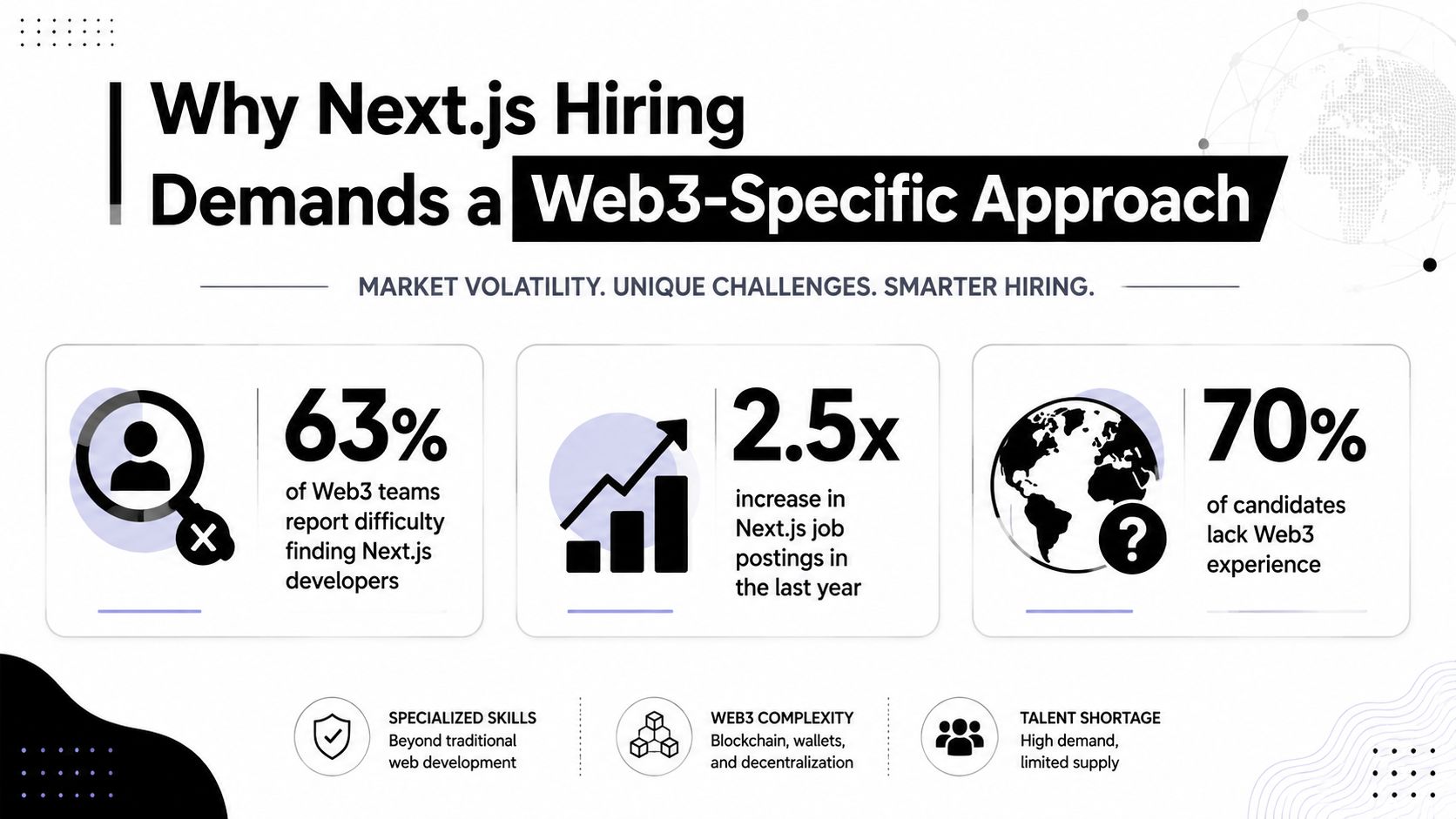
Why Next.js Hiring Demands a Web3-Specific Approach
Web3 teams cannot hire for Next.js like a SaaS company hires for generic frontend work. The framework sits directly in wallet connection flows, on-chain reads, signing states, and the edge cases that show up when a user switches accounts mid-session or opens a page with stale state. A candidate has to be comfortable with modern App Router patterns, not just React in the abstract.
Hiring pressure is part of the problem, but the bigger issue is fit. General demand for Next.js talent keeps qualified people selective, and teams that treat the role as a commodity usually spend too long talking to developers who have never shipped against production constraints. If the work involves React, server rendering, and live product behavior, the phrase hire Next.js developer should point you toward a narrow pool of people who can reason about routing, data flow, and runtime trade-offs under load. Next.js hiring market report
Why generic React screening misses the point
Legacy React screening tells you whether someone can build components. It does not tell you whether they know where Server Components end and Client Components begin, or whether they can explain streaming, Server Actions, caching, and deployment trade-offs in a way that maps to production work. Those lines matter more in Web3 because product teams have to keep a polished interface in sync with slow, external, and partially trusted systems.
Practical rule: if the candidate cannot explain how they would separate signed, user-specific actions from read-heavy server rendering, they are not ready for a serious Web3 Next.js seat.
A useful additional check is whether the candidate can speak from real current experience rather than recycled framework talk. One outside signal you can use is is Nextjs.org AI-built, which does not prove hiring fit, but does remind teams to look for evidence of actual production thinking.
A good sourcing shortcut is to compare what you hear in interviews with the kinds of profiles that show up in Web3 Next.js developer roles on Blockchain Jobs. That gives you a practical benchmark for the mix of framework depth, product judgment, and Web3 familiarity that the market rewards.
The Complete Skills Checklist for Web3 Next.js Developers
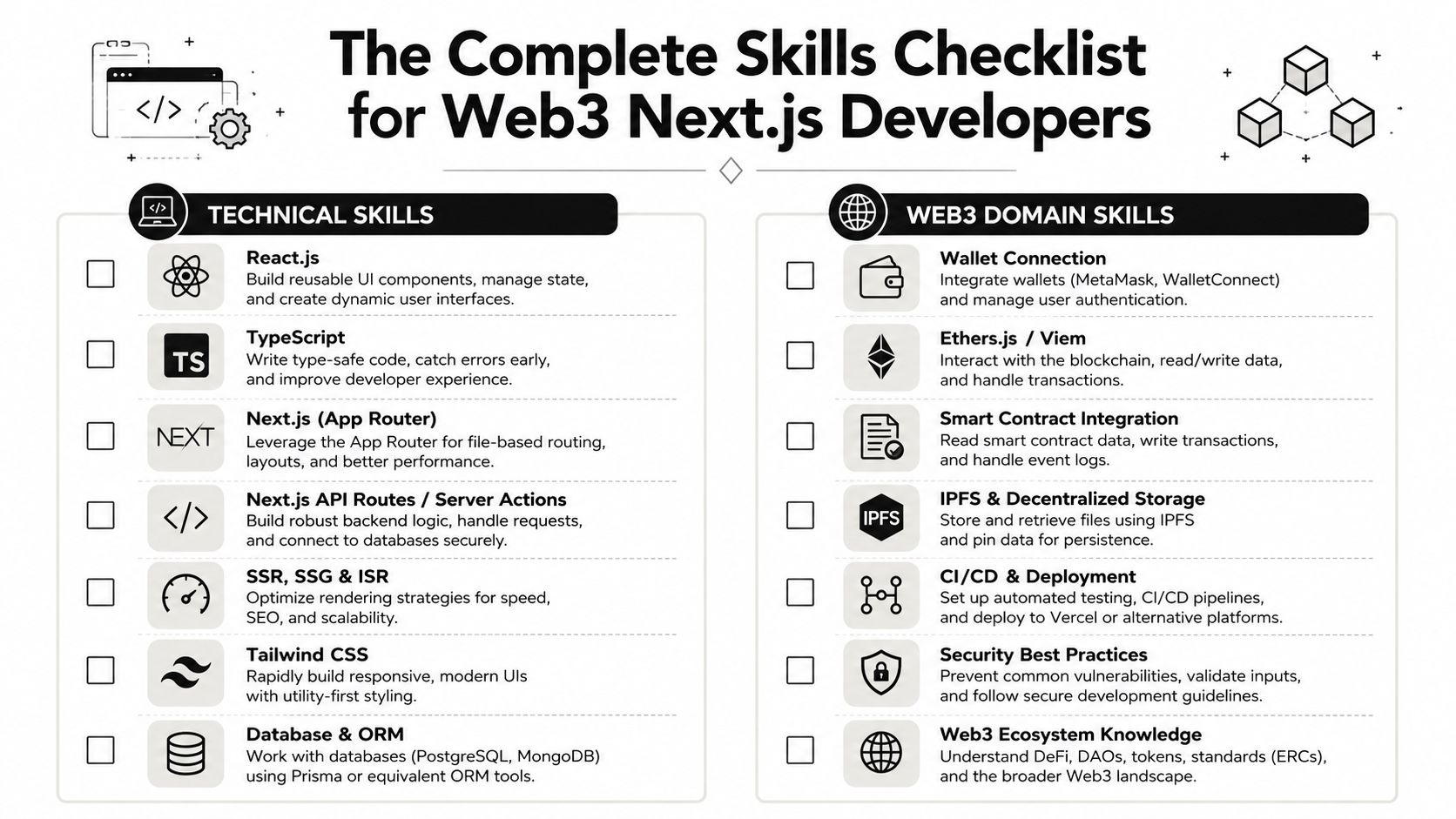
A job description gets much stronger when it separates must-haves from nice-to-haves. For this role, the must-haves should center on production Next.js skill, not broad JavaScript enthusiasm. The candidate needs to be fluent in App Router, understand Server Components vs Client Components, and be able to talk through TypeScript decisions without hand-waving.
Core technical skills to require
A solid screen starts with what the person has shipped. Look for evidence of streaming, Server Actions, caching/ISR, and deployment experience on Vercel, AWS, or a self-hosted runtime. A developer who has only worked inside the old /pages mental model will usually talk about routing and data fetching in a way that sounds current but falls apart under follow-up questions.
Performance skill is separate from framework familiarity. For a practical refresher on what that means in real React codebases, a reference like PageSpeed Plus React performance tips is useful because it pushes the conversation toward bundle discipline, render cost, and user-facing speed rather than buzzwords.
Web3-specific capabilities that change the hire
A Web3 Next.js developer also has to handle wallet-driven UX, smart contract reads, and integrations with decentralized storage. That doesn't mean the person needs to be a protocol engineer. It does mean they should understand where frontend state can become misleading, how to keep async blockchain interactions understandable to users, and how to avoid building a UI that collapses when chain data is late or inconsistent.
Use the following as a copyable rubric.
- App Router fluency: Can explain nested layouts, route groups, and where server rendering starts to matter.
- Typed code quality: Uses TypeScript carefully, avoids
any, and handles error states explicitly. - Performance literacy: Thinks about bundle size, hydration, and page rendering cost as part of the job.
- Web3 integration familiarity: Has touched wallet connection flows, contract reads, or decentralized storage in a real app.
- Deployment judgment: Knows how the app behaves in production, not just on localhost.
When you want a concrete example of the kind of role that combines these needs, the posting at https://blockchain-jobs.com/jobs/full-stack-javascript-developer-web3-nextjs-typescript-unknown-company shows how these skills can show up in a live market context, not just a checklist.
Where to Source Quality Next.js Talent for Web3 Projects
The fastest way to waste time is to cast a broad net and hope “Next.js” in a profile means the person is relevant. It usually doesn't. General job boards bring volume, but Web3 teams need signal, and the signal tends to live in specialized communities, open source work, and targeted role boards that already attract crypto-native developers.
Start with places where the candidate pool is pre-qualified
A niche board such as Blockchain Jobs remote listings makes more sense for this role than a generic posting on a large job site, because the audience is already scanning for blockchain-adjacent work. That doesn't guarantee quality, but it lowers the noise floor and speeds up the first filter.
GitHub is still one of the most useful sourcing channels for this kind of hire. Public contributions tell you more than a polished resume, especially when a developer has worked in Next.js ecosystem repos or shipped projects with visible production history. Discord communities and framework-specific forums are useful too, because strong candidates often answer difficult implementation questions long before they update their profile.
Write the posting so senior people self-select in
Don't write “React and Next.js required” and expect serious applicants to interpret that correctly. State whether the role is built on the App Router or legacy routing, name the deployment environment, and be explicit about the web stack the person will inherit. The more precise the posting, the faster the right engineers will decide whether to apply.
A good posting also signals trade-offs. Mention whether the team values frontend polish, performance work, or blockchain integration depth most heavily. Senior candidates respond better when they see the actual product challenge, not a stack of vague “must be comfortable with fast-paced environments” filler.
Candidates with real options skim for relevance in seconds. If the role description reads like it was assembled from a template, they move on.
A second useful source of candidates is direct outreach from existing production apps. If a team has a similar Web3 interface or an adjacent product pattern, the developers behind that work are often the most relevant leads. That approach takes more research, but the response quality is usually much better than cold messaging anyone with “Next.js” in their headline.
Screening and Interviewing for Production-Ready Skills
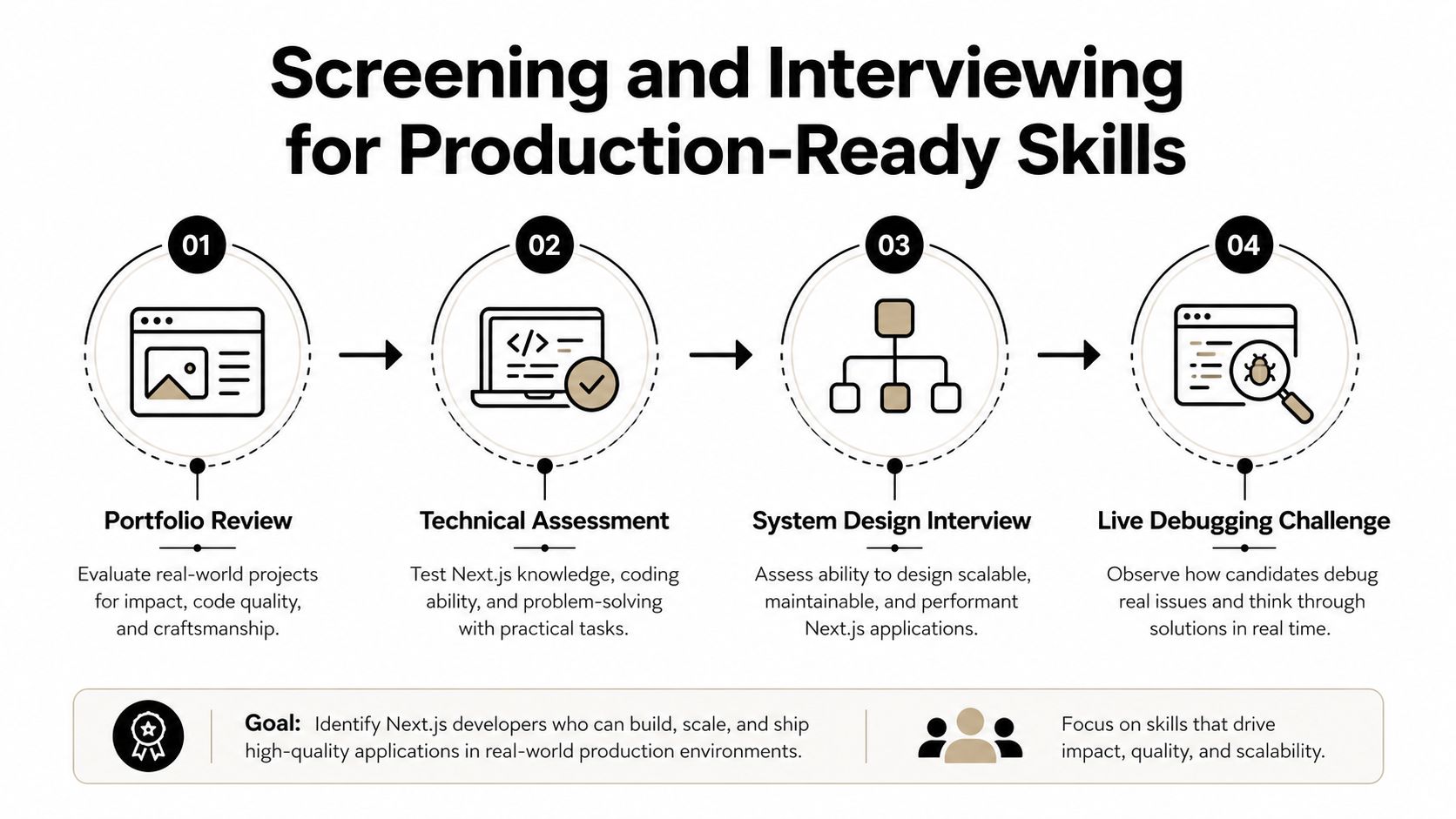
A good screening process should expose whether a person can ship a modern Next.js app under production constraints. Resume keywords don't do that. Portfolio review, short paid work, and live debugging questions are much better signals than generic algorithm tests or trivia about old React patterns.
What to inspect before the interview
Start with live apps and visible code, not self-description. Look for rendered HTML, route structure, and signs that the developer understands App Router boundaries in practice. If the project is public, check how they handle typed data, errors, and architecture choices that affect maintainability. A candidate who can talk about all three usually has real shipping experience.
A small paid task is often the cleanest test. The best version I've seen is about 3 to 4 hours plus a code walkthrough, because it surfaces judgment without asking for free labor. That lines up with hiring guidance that recommends a short task and a debrief over long take-home assignments, especially for senior candidates who are already fielding other offers. How to hire Next.js developers effectively
Questions that reveal real depth
Ask how they'd structure rendering for a page that has both fast static sections and slow personalized data. Ask what they'd do when a server component blocks render. Ask them to walk through a hydration mismatch they debugged. Those answers show whether they understand the architecture or just know the vocabulary.
A strong interviewer also listens for practical judgment. The candidate should be able to explain why a feature belongs on the server, where client state is unavoidable, and what they'd cache first in order to protect Core Web Vitals. If they only talk in framework slogans, the screen has failed.
Practical rule: the right answer sounds like a production decision, not a tutorial summary.
The video below is worth keeping in the loop for hiring managers because it reinforces a simple point, strong interviews are built around observable work, not abstract confidence.
For a separate lens on fit, a resource like culture-fit assessment guide for HR can help teams structure the softer part of the process without turning it into a vague personality screen. The useful part is not “culture fit” as a slogan, it's whether the person works cleanly in review-heavy, distributed engineering teams.
The internal role at https://blockchain-jobs.com/jobs/senior-frontend-developer-react-typescript-relayprotocol-1 is a good example of the kind of posting where production behavior matters as much as framework familiarity.
Compensation Ranges and Budget Planning for Next.js Hires
Budget errors usually start with a bad assumption, that every Next.js hire belongs in the same pay band. They do not. Cost changes with region, engagement model, and whether the person is a frontend specialist or a full-stack owner. In Web3 work, that gap matters even more because the right hire may need to handle product decisions, performance tuning, and integration work in the same week.
The clearest pricing signal comes from the spread between freelancers and agencies. The Next.js hiring cost guide places U.S.-based Next.js freelancers at $75 to $225 per hour, with a median around $110/hour, while agencies charge $150 to $300/hour because they include design, QA, strategy, and project management. The same source estimates common project costs of $8k to $25k for a marketing site, $25k to $65k for headless commerce, $40k to $90k for a SaaS MVP, and $150k+ for larger custom applications.
A separate global rate guide from Arc's developer rate report shows the same pattern at the senior level, with median Next.js rates around $45/hour worldwide versus $79/hour in the U.S. That gap is why many companies pair local technical leadership with distributed execution, especially when the roadmap is broad and the delivery window is tight.
Engagement model and budget implications
| Engagement Type | Hourly Rate Range | Typical Project Cost | Best For |
|---|---|---|---|
| U.S. Freelancer | $75 to $225/hour | $8k to $90k depending on scope | Defined builds with direct ownership |
| Agency | $150 to $300/hour | $8k to $150k+ depending on complexity | Teams that want bundled delivery support |
| Senior Global Developer | $45/hour median worldwide | Project-based depending on hours | Distributed execution with local oversight |
The right offer depends on the risk you want to carry. A freelancer can move quickly on a scoped build, but a senior hire with product continuity is more useful when the app changes every month. Agencies can reduce delivery risk, yet the rate reflects the extra layers they bundle in.
For startups, budget for the role you need, not the role you wish existed. If the hire is expected to own onboarding UX, app performance, and Web3 edge cases, compensation has to match that scope. Otherwise the search drifts, candidate quality drops, and the team ends up hiring twice.
Onboarding and Retention Strategies for Remote Web3 Teams
A strong hire can still stall if the first month is chaotic. Remote Web3 teams lose momentum when access, architecture context, and decision rights aren't ready on day one. The fix is a deliberate onboarding path that gets the developer into the codebase fast, then gives them room to own a real feature before the first quarter ends.
What the first 90 days should look like
The first two weeks should focus on setup, codebase orientation, and a single mentor relationship. By then, the developer should know where the routes live, how releases move, and what production behavior matters most for the product. The point isn't to memorize everything, it's to remove friction before the first meaningful pull request.
Between days 31 and 60, give them one production feature, use code review to teach team norms, and make sure they've been through at least one real deployment path. By days 61 to 90, shift them toward ownership, feedback loops, and a visible growth plan. That progression matters because senior Next.js developers usually stay engaged when they can shape architecture, not just close tickets.
Retention levers that actually matter
- Clear architecture influence: Let senior engineers help decide rendering strategy, component boundaries, and deployment trade-offs.
- Useful review culture: Code review should be fast, specific, and grounded in production behavior.
- Remote rhythm: Regular check-ins matter more than surveillance, especially across time zones.
- Community proximity: Support conference attendance, open source time, or participation in Web3 developer circles when possible.
Don't ignore the parts of the role that feel intangible. Senior developers often leave when they stop learning, when reviews become bureaucratic, or when product decisions are made without engineering input. They stay when the team treats them like builders, not just implementers.
Keep the first month boring in the right way. Access, permissions, repo conventions, and deployment paths should already be waiting.
Blockchain Jobs is set up for this kind of search, since it connects employers with crypto-native talent and keeps listings organized by role and category. If you're hiring for a Next.js seat inside a Web3 team, visit Blockchain Jobs and use it as a focused channel for sourcing candidates who already understand the environment you're hiring into.