Hire Solidity Developers: The 2026 Hiring Playbook
Your protocol roadmap is set. The audit window is booked. Product wants the upgrade live before the next campaign or governance vote. Then hiring stalls because the candidates who can ship secure Solidity code are either already committed, overpriced for your current budget, or much weaker than their CV suggests.
That’s the normal state of this market, not a recruiting mistake.
If you need to hire Solidity developers, the hard part isn’t finding people who can write Solidity syntax. It’s finding engineers who understand how contracts behave under adversarial conditions, who can work with product and backend teams, and who won’t create downstream audit debt that costs more than the original hire.
The High-Stakes Hunt for Web3 Talent
The market is tight for a reason. The Ethereum ecosystem is estimated at only 200,000 developers, while hundreds of job postings for Solidity developers are live at the same time, which keeps competition intense and pushes remote compensation high. Remote roles can command average salaries up to $145,000 per year, according to Bridge Teams’ Solidity hiring analysis.
That mismatch changes how teams should recruit. A generic job post and a standard engineering interview loop won’t hold up when you’re competing for people who can design upgradeable systems, reason about attack surfaces, and communicate clearly with auditors.
I’ve seen teams lose months because they hired for familiarity instead of judgment. The developer could deploy contracts. They couldn’t explain failure modes, choose safe architectural patterns, or defend design trade-offs under review. In Web3, that’s not a small miss. That’s a product risk.
A better approach starts by treating Solidity hiring as a risk management function, not just a staffing task.
Practical rule: If the role touches treasury logic, bridging, DeFi mechanics, or upgrade authority, hire for security judgment first and coding speed second.
The best candidates also evaluate you. They want to know whether your team understands contract risk, whether product scope is realistic, whether there’s an audit process, and whether they’ll be working on meaningful systems instead of vague “Web3 innovation.” A listing like this senior blockchain engineering role at 1inch signals the level of clarity strong candidates expect.
Why standard recruiting breaks down
Three things usually go wrong:
- Teams write generic briefs. They ask for “3+ years Solidity, DeFi, NFTs, React, Node, Rust, DevOps, auditing, tokenomics” and signal that they don’t know what the actual job is.
- Interviews test the wrong skills. LeetCode-style screens miss the work that matters most, such as secure state handling, access control, upgrade paths, and testing discipline.
- Offers ignore project stage. Some roles should be full-time hires. Others are better handled by a specialist contractor or a small agency during a narrow delivery window.
That’s why the rest of this playbook focuses on what generic hiring guides usually miss. Security readiness, and choosing the right engagement model for the protocol you’re building.
Crafting a Job Description That Attracts Elite Developers
Top Solidity engineers skip vague listings fast. They’ve seen too many posts written by someone who copied five competing job ads, stacked every blockchain buzzword into one document, and never explained what the developer will own.
A strong job description does the opposite. It shows that your team understands the work, the risk, and the constraints.

A modern Solidity developer isn’t just writing isolated contracts. The role often spans the full lifecycle of blockchain development, including secure smart contracts for DeFi, NFTs, and P2E, integration with existing applications, and collaboration on protocol improvements, as described in FinTech Weekly’s overview of Solidity developer responsibilities. If your job description reduces that role to “write smart contracts,” good candidates will assume your team is immature.
Write for outcomes, not laundry lists
The best job descriptions answer five questions quickly:
- What are we building
- Why does it matter
- What problems will this person solve first
- What level of ownership comes with the role
- How will quality be measured
Instead of listing every framework your stack has touched, describe the actual mandate. For example, say the hire will own an upgrade to staking contracts, harden a vault system before audit, or build a modular EVM component that integrates with an existing backend.
That gives skilled engineers something useful to assess.
A good Solidity candidate wants to know where the dangerous edges are. If your JD hides them, they’ll assume your process does too.
What to include in the brief
Use a structure like this:
Mission and protocol context
Explain the product in plain language. Is it a DeFi primitive, an NFT infrastructure layer, a gaming economy, or an enterprise blockchain integration?First 90-day scope
Name the expected work. Maybe it’s refactoring legacy contracts, adding tests in Foundry, tightening role permissions, or preparing code for audit.Architecture constraints
Mention if the system is upgradeable, multi-contract, cross-chain aware, or tightly coupled to off-chain services.Collaboration model
Clarify whether they’ll work with product managers, backend engineers, auditors, frontend teams using React or Vue, or governance contributors.Definition of success
Talk about clean deployments, test quality, audit readiness, review discipline, and maintainable code. Don’t make the role sound like a race to mainnet.
A targeted listing such as this smart contract engineer role focused on EVM work is closer to what strong candidates expect. It tells them the employer has a concrete need, not a speculative one.
What weak JDs get wrong
Weak descriptions usually over-index on inputs. They ask for years of experience, a long tool list, and “passion for blockchain.” None of that tells a serious engineer whether the role is worth pursuing.
A better post sounds like it came from the engineering lead who has to live with the codebase.
| JD element | Weak version | Strong version |
|---|---|---|
| Role summary | “Looking for a Solidity developer” | “Own secure contract development for an upgradeable EVM protocol” |
| Scope | “Build smart contracts and dApps” | “Ship and harden vault and governance modules before external audit” |
| Team fit | “Works well in teams” | “Collaborates with backend, frontend, product, and auditors in an async workflow” |
| Growth | “Fast-paced startup” | “Expands from contract implementation into architecture and review ownership” |
If you want better applicants, your JD has to prove that your team knows what great Solidity work looks like.
Sourcing Talent Where They Live Not Just Where They Apply
The strongest Solidity developers often aren’t waiting on LinkedIn for recruiter messages. They’re reviewing pull requests, talking in technical Discord channels, attending hackathons, publishing repos, and helping other builders debug edge cases in public.
That changes the sourcing strategy.

When teams say “we can’t find candidates,” what they usually mean is “we posted a job and waited.” That works poorly in Web3. Good candidates are visible through their work long before they formally apply anywhere.
Start with contribution trails
GitHub is still one of the cleanest signals. Not because every great developer lives in public repos, but because contribution history reveals how someone thinks. Look for pull requests, issue discussions, test coverage habits, code review comments, and whether they engage carefully with protocol constraints.
Useful sourcing patterns include:
- Protocol-adjacent repos
Search contributors working on libraries, tooling, or integrations near your stack. - Security-minded commit history
Review whether the developer writes tests, names edge cases, and cleans interfaces instead of only shipping features. - Discussion quality
Some candidates stand out more in review threads than in raw code volume.
Discord is also useful, but only if your team participates like builders, not tourists. If you need a map of active communities, this roundup of best crypto Discord servers is a practical starting point for identifying where technical conversations happen.
Build credibility before outreach
Cold outreach fails when it’s obvious the sender hasn’t read the candidate’s work. A message that says “We’re hiring Solidity devs. Interested?” gets ignored. A message that references a specific repo contribution, asks about a design choice, or explains why their background matches your protocol is far more likely to get a response.
Here’s the standard I use internally:
- Reference something real
Mention a contract pattern, test suite, governance module, or review comment they authored. - State the actual challenge
“We’re preparing an upgradeable system for audit” is better than “exciting Web3 startup.” - Offer a technical conversation first
Don’t force an HR screen as the first step if the candidate is clearly senior.
The broader market is easier to scan when you review specialized blockchain engineering jobs, but sourcing still works best when your team actively participates in the ecosystem.
After that, use live events as filters, not just networking moments.
Where live signal shows up
Hackathons, especially Ethereum-focused ones, reveal different strengths than resumes do. You can see who ships under time pressure, who cuts corners, who documents well, and who can explain architecture clearly to judges or peers.
A few places worth watching:
- ETHGlobal and similar hackathons
Good for spotting builders who can turn ideas into working systems fast. - Protocol Discords and dev chats
Useful for seeing who consistently helps others without hand-waving. - Audit and tooling communities
Strong candidates often spend time where testing, fuzzing, and contract review are part of the daily conversation.
Don’t source only where candidates apply. Source where they argue about patterns, ship code, and fix bugs in public.
That’s where you find people who already behave like protocol engineers.
The Security-First Technical Assessment
Most Solidity hiring processes still make the same mistake. They treat smart contract hiring like backend hiring with different syntax. That approach produces dangerous false positives.
A candidate can write compilable Solidity and still be a weak hire for a production protocol.
If the role touches user funds, governance permissions, vaults, bridges, liquidations, or upgradeable systems, your assessment should test for security mindset, audit readiness, and judgment under constraints. A structured evaluation matters here because lack of knowledge in blockchain security is the biggest red flag in Solidity interviews, and teams using a formal process with security-focused assessments followed by a trial project have reported a 98% trial-to-hire success rate in MOR Software’s hiring framework.
What to test instead of generic coding puzzles
A useful Solidity assessment usually has three parts.
First, give the candidate a contract or mini-system with realistic flaws. Ask them to identify issues, rank them by severity, and explain mitigations. The point isn’t whether they produce the same list your team would. The point is whether they notice risky assumptions and reason through impact.
Second, ask for architecture judgment. Present a product scenario and force trade-offs. Should this module be upgradeable? Where should permissions live? What belongs on-chain and off-chain? How should the team prepare for review and audit?
Third, run a debrief. Let the candidate explain what they changed, what they left unchanged, and where they’d want more context before shipping.
A good supplement here is learning how mature teams approach source code analysis. Even if your hiring managers aren’t security specialists, that kind of material helps them ask sharper follow-up questions during reviews.
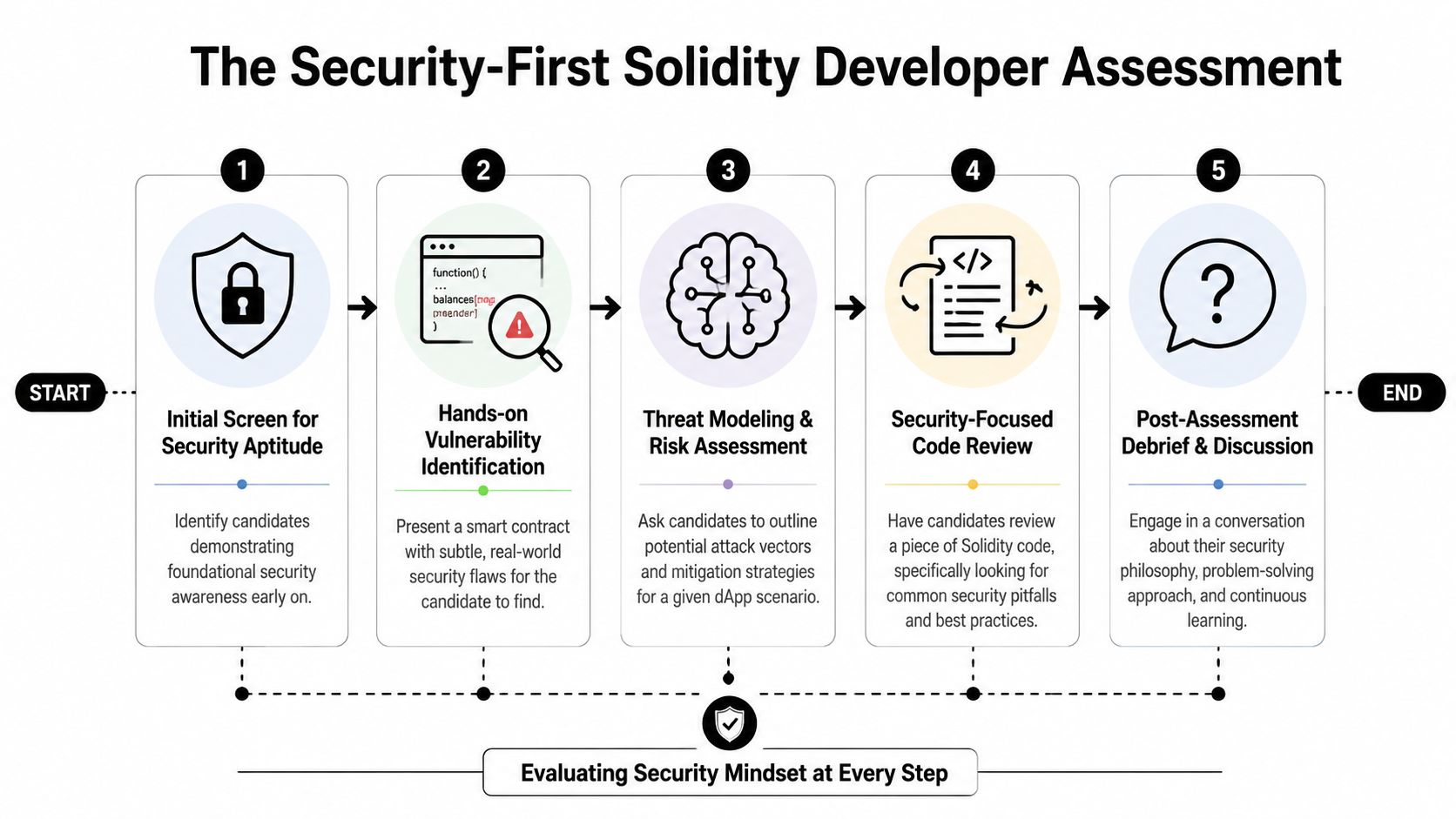
A practical assessment flow
Use a process like this:
Initial security screen
Ask short scenario questions. Example: what worries you most in an upgradeable contract with admin-controlled parameters?Vulnerability review task
Provide code with subtle flaws. Not toy examples. Include state transitions, external calls, access control, and testing gaps.Threat-model interview
Ask the candidate how they’d think about attack surfaces for your product type. DeFi, NFT marketplace, game economy, and enterprise settlement flows all create different risk shapes.Security-focused code review discussion
Walk through a contract together. This shows how the person communicates under scrutiny.Paid trial project
Keep it narrow. A small real-world task reveals reliability, clarity, and review behavior better than another interview round.
Interview questions that expose judgment
These questions work because they force reasoning, not memorization:
- How do you decide whether a contract should be upgradeable at all
- What makes a contract easier or harder to audit
- When do you prefer a modular architecture over a simpler monolith
- How would you test role management and permission boundaries
- What kinds of assumptions in DeFi systems worry you most
- If an auditor flags a medium-severity issue you disagree with, how do you respond
- What would make you block a deployment even if product wants to ship
You’re listening for how they balance simplicity, flexibility, and safety. Strong candidates don’t just list vulnerabilities. They explain design pressure, blast radius, and maintenance consequences.
Security maturity sounds calm. It doesn’t sound flashy. The best candidates usually explain what they would avoid building before they explain what they can build.
Red flags that should end the process
Some misses are coachable. Others usually aren’t.
- No threat-model thinking
They discuss syntax and gas, but not attack paths or privilege boundaries. - No audit empathy
They write code as if external reviewers don’t exist. - Overconfidence around edge cases
They insist something is “safe” without naming assumptions. - Weak testing discipline
They treat tests as proof of completion instead of proof of behavior. - Poor communication
If they can’t explain trade-offs clearly, collaboration with auditors and product teams will be painful.
You’re not hiring a compiler. You’re hiring someone who has to make irreversible systems safer.
Choosing Your Engagement Model and Structuring Offers
A lot of teams ask the wrong question. They ask whether they should hire a Solidity developer. The more useful question is what kind of Solidity relationship the project needs right now.
That answer changes with project stage, code criticality, runway, and how much long-term ownership the protocol requires.
Hourly rates vary sharply by region. North America-based Solidity developers often charge $120 to $200 per hour, while some emerging markets are closer to around $30 per hour. Using global talent pools and flexible engagement models can help organizations optimize acquisition costs by 40 to 60 percent, according to OpenPR’s analysis of Solidity hiring economics.
Match the model to the work
Here’s the simplest framing.
Full-time hires fit products with continuous protocol work, recurring upgrades, long maintenance horizons, and a need for deep system context. If the person will own architecture over time, sit in design discussions, and influence standards, full-time usually makes sense.
Freelancers or contractors fit bounded scopes. Examples include a governance upgrade, a staking migration, a refactor before audit, or a short-term burst of implementation work under an internal lead. This model works best when requirements are already clear and someone on your side can review outputs tightly.
Agencies fit teams that need speed, process, and coordinated delivery more than individual ownership. Agencies can help when you need multiple skill sets at once, such as smart contracts, QA, frontend integration, and PM support. The trade-off is that protocol knowledge may remain outside your core team unless you manage handoff carefully.
Hiring Model Comparison
| Factor | Full-Time Employee | Freelancer/Contractor | Development Agency |
|---|---|---|---|
| Best for | Ongoing protocol ownership | Narrow, defined deliverables | Multi-disciplinary delivery |
| Ramp-up | Slower upfront, stronger long-term | Fast if scope is crisp | Fastest for packaged execution |
| Context retention | High | Medium to low | Medium, depends on documentation |
| Control over decisions | Highest | High if managed directly | Shared across engagement team |
| Cost shape | Ongoing salary or fixed compensation | Variable by milestone or hourly | Higher project overhead, broader capacity |
| Security oversight need | Internal process still required | Very high, especially for solo contractors | High, plus handoff review |
| Good fit | Core contracts, maintenance, roadmap work | Audit prep, one upgrade, specialist patching | New builds with limited in-house bandwidth |
When each model works well
Use a contractor when the task has a clear beginning and end. Don’t use one to “figure out the protocol” unless you already have senior internal oversight.
Use an agency when delivery risk matters more than internal team-building. Don’t use one if your real need is a long-term technical owner who will live with architectural decisions.
Use a full-time hire when the protocol will keep evolving and the codebase needs stewardship. Don’t force a permanent hire if you only need short-term expertise around one release.
The wrong engagement model creates the same pain as the wrong person. Misaligned ownership shows up later as missed reviews, weak handoffs, and nobody wanting to maintain the contract suite.
Structuring offers without wasting budget
Good offers are clear, not bloated. The strongest candidates usually care about four things:
- Scope they can believe in
They want to know what they’re walking into. - Decision authority
Senior candidates care whether they can influence architecture and security standards. - Compensation logic
Explain base, equity or upside, milestone structure if relevant, and how reviews happen. - Operating conditions
Async norms, code review quality, audit cadence, and product discipline matter more than many teams realize.
Geographic arbitrage is real, but don’t use it blindly. A lower hourly rate is only cheaper if the developer can work independently, write reviewable code, and handle protocol-specific risk. In Solidity hiring, cheap mistakes are usually expensive mistakes.
Fractional arrangements can also work well for early-stage teams. A seasoned contract engineer or reviewer can guide architecture, shape testing standards, and support upgrades without the burden of a permanent hire. That’s often a better move than rushing into a full-time hire with unclear scope.
Onboarding for Impact and Long-Term Retention
Signing the offer isn’t the finish line. It’s the point where employers either protect the hire or waste it.
This is especially true in Solidity roles because strong developers enter chaotic environments all the time. They inherit unclear permissions, sparse test suites, undocumented deployment flows, and product teams that say “we need it live” before anyone agrees on the threat model. Good people leave those environments fast.

A disciplined onboarding plan reduces that friction. Many of the same principles from strong proven remote employee onboarding methods apply here, but Web3 teams need extra attention on security process, deployment authority, and decision boundaries.
The first 90 days
A practical onboarding cadence looks like this.
Days 1 to 14 should focus on environment setup, repository access, deployment history, architecture walkthroughs, and known risk areas. The new hire should read past audit notes if they exist, understand role permissions, and review how your team handles code review and releases.
Days 15 to 45 should shift toward contained execution. Give the engineer one meaningful but bounded task. It might be hardening tests around a critical module, refactoring a permissions layer, or implementing a narrow feature under supervision. This stage tells you whether they can work inside your process without drowning in context debt.
Days 46 to 90 should expand ownership. By then, the developer should participate in architectural decisions, challenge unsafe assumptions, and contribute to protocol planning rather than just taking tickets.
What retention actually depends on
Compensation matters, but retention usually breaks earlier in the workflow.
Solidity developers stay when the work is serious, the review culture is competent, and the team respects the cost of smart contract mistakes. They leave when everything feels rushed, undefined, or politically driven.
Focus on these areas:
- Meaningful ownership
Give senior people authority over standards, not just implementation. - Security growth
Encourage audit participation, review practice, and post-mortem learning. - Clean collaboration
Product, backend, frontend, and smart contract teams need shared language around constraints. - Visible career progression
Show how someone grows from implementer to architecture owner, reviewer, or protocol lead.
A strong Solidity developer doesn’t want nonstop fire drills. They want a team that takes irreversible code seriously.
Career progression for Solidity talent
Career progression in this field is often mishandled because companies keep the role too narrow. A strong engineer might start with implementation, but the long-term path usually expands into one or more of these lanes:
- Protocol architecture
Designing systems, upgrade paths, and module boundaries. - Security leadership
Driving review standards, audit prep, and safer development practices. - Cross-functional technical leadership
Translating protocol constraints for product, design, and backend stakeholders. - Ecosystem specialization
Owning a specific domain such as DeFi infrastructure, governance systems, or cross-chain integrations.
If you want to retain hard-to-find people, make that path visible early. Don’t wait until the developer is already interviewing elsewhere.
The teams that hire Solidity engineers well tend to do one thing consistently. They reduce ambiguity. In the interview process, in the offer, in the onboarding plan, and in the daily work. That clarity is a competitive advantage.
If you’re ready to hire Solidity developers or explore your next Web3 role, Blockchain Jobs is a focused place to find current opportunities and specialized crypto talent across engineering, security, product, design, marketing, legal, and more.