How to Become a Blockchain Developer: A Practical Career Guide
So you want to become a blockchain developer? It's a journey that's less about a formal degree and more about what you can actually build and prove to a hiring manager. The core of it comes down to building a solid foundation in programming, really getting your head around blockchain concepts like cryptography, and then proving your skills with a portfolio that gets you interviews. You'll need to learn a language like Solidity or Rust, understand the principles of decentralization, and get comfortable with development tools like Hardhat or Foundry.
Your Launchpad into a Blockchain Career
Jumping into a career as a blockchain developer puts you right on the front lines of a huge shift in both tech and finance. The demand for developers who can build, secure, and manage decentralized applications is exploding, which means there are tons of opportunities if you have the right skills. It’s a different beast compared to traditional software roles; you need a unique mix of computer science know-how, a bit of economic savvy, and a security-first mentality that hiring managers are desperate to find.
This job is about more than just slinging code—it’s about engineering trust. A typical day could involve anything from designing the logic for a smart contract that handles financial assets, to meticulously optimizing code to cut down on user gas fees, or working with a team to connect a dApp to a slick front end. Precision is everything, because one tiny bug can lead to massive financial losses and a serious hit to your professional reputation.
Why This Career Path Is in High Demand
It's no secret why so many developers are drawn to blockchain: the pay and the freedom are hard to beat. The financial upside is significant, with average global salaries for blockchain developers hitting around $150,000 per year as of January 2026. What’s more, 62% of these positions are remote, opening the door for talent anywhere to work with companies in major hubs like the US, where salaries can easily top $175,000-$200,000.
This demand isn't just a bubble; it's driven by real innovation happening everywhere:
- DeFi (Decentralized Finance): Building entirely new financial systems that cut out the middleman.
- NFTs and Gaming: Creating digital economies where players truly own their in-game items and assets.
- Supply Chain Management: Using the blockchain to create transparent, unchangeable records for tracking goods.
- Identity Verification: Crafting secure digital identity solutions that put users back in control of their data.
This visual roadmap lays out the typical path you'll follow, from learning the ropes to building a strong portfolio and finally landing that first job.
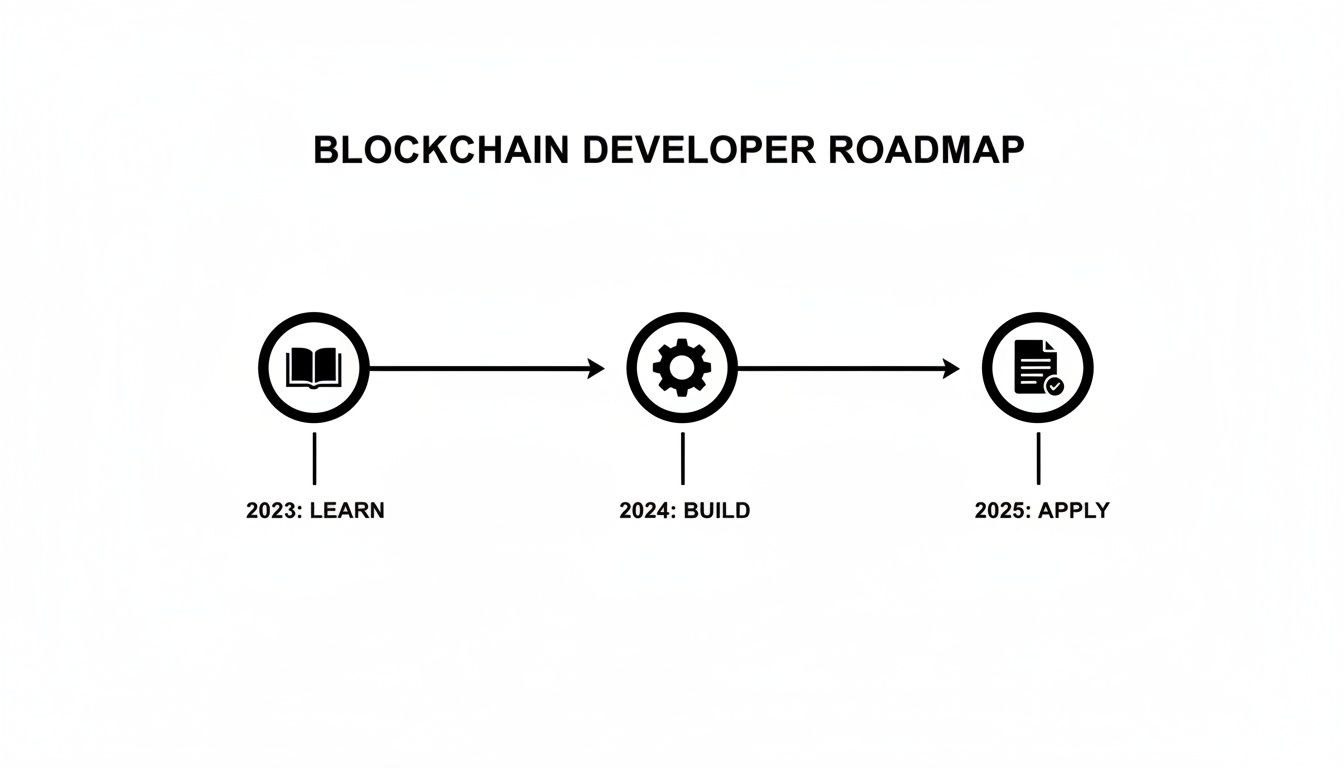
The image breaks it down nicely, showing that becoming a pro in this space is a marathon, not a sprint. It takes real dedication at every stage. If you're looking for more career tips and want to keep up with what's happening in the industry, check out the resources on our blog.
To give you a clearer picture, here’s a quick-start table outlining the journey.
Blockchain Developer Quick-Start Roadmap
This table summarizes the core components and a realistic timeline for someone dedicating serious time to learning the craft, from the basics to becoming job-ready.
| Component | Key Focus Areas | Estimated Learning Time (Dedicated Study) |
|---|---|---|
| Foundational Skills | Core programming (JavaScript/TypeScript, Python), Data Structures, Algorithms, Networking Basics | 1-3 Months |
| Blockchain Fundamentals | How blockchains work (consensus, nodes), Cryptography (public/private keys), Ethereum concepts (EVM, gas, accounts) | 2-4 Months |
| Smart Contract Dev | Solidity or Rust, Development frameworks (Hardhat, Foundry), Smart contract security patterns, Testing (unit, integration) | 3-6 Months |
| Project & Portfolio | Building 2-3 unique dApps (e.g., DeFi protocol, NFT marketplace), Contributing to open-source projects, Writing articles | 4-8 Months |
| Job Application Prep | Technical interview practice, Portfolio refinement, Networking, Resume building | 1-2 Months |
This roadmap isn't set in stone, but it gives you a solid framework. The key is consistent, hands-on learning—the more you build, the faster you'll progress toward your first interview.
Building Your Core Technical Skills
Before you can even think about building sophisticated decentralized apps, you have to get the fundamentals right. This is the bedrock of your entire career; if it's shaky, everything you build on top of it will be, too. Hiring managers aren't just looking for someone who can copy and paste a smart contract. They need an engineer who truly understands why the code works the way it does.
This becomes crystal clear during technical interviews. They’ll throw problems at you that test your core knowledge, not just your muscle memory with a specific framework. A deep understanding of computer science is what separates a junior dev from someone with real long-term potential.

Why Computer Science Fundamentals Matter
In the blockchain world, inefficient code isn't just slow—it's incredibly expensive. Every single operation in a smart contract costs users real money in gas fees. This is exactly why a solid grasp of data structures and algorithms is non-negotiable for any serious candidate.
Knowing when to use a mapping instead of an array, or how to structure a function to minimize computational steps, has a direct impact on your app's usability and cost. This is the kind of practical knowledge that gets you hired. You might be asked to optimize a snippet of Solidity code in an interview; being able to spot an inefficient loop and suggest a better data structure could be the one thing that lands you the offer.
A senior engineer at a top DeFi protocol once told me their team’s favorite screening question for junior candidates is, "Explain the gas implications of storing data in an array versus a mapping." Your answer says more about your practical engineering mindset than any certificate ever could.
Choosing Your Primary Smart Contract Language
The programming language you choose will largely determine the ecosystem you'll be working in, and by extension, the jobs you'll be applying for. While new options pop up, two giants dominate the space right now: Solidity and Rust. They aren't interchangeable—they serve different blockchains and are built on entirely different philosophies.
Solidity: This is the native language of the Ethereum Virtual Machine (EVM), which powers Ethereum and a massive ecosystem of compatible chains like Polygon, Avalanche, and Arbitrum. It's a high-level, object-oriented language that will feel familiar to JavaScript developers, making it the most common on-ramp into Web3 careers.
Rust: Known for its blistering performance and memory safety, Rust is the language of choice for blockchains like Solana, Polkadot, and Near. It gives you far more low-level control, which is essential for building high-throughput protocols. That power, however, comes with a much steeper learning curve.
So, where do you start? The smart move is to pick one and go deep.
A Practical Comparison: Solidity vs. Rust
Your decision between Solidity and Rust really boils down to your career goals and what kinds of projects you want to build. Here’s a quick breakdown to help you decide which job market to target first:
| Aspect | Solidity | Rust |
|---|---|---|
| Primary Ecosystem | Ethereum and EVM-compatible chains (DeFi, NFTs, DAOs). | Solana, Polkadot, Near (high-performance applications, gaming, infrastructure). |
| Learning Curve | Easier. Its syntax is more forgiving and feels closer to other popular languages. | Harder. The compiler enforces strict memory safety rules that can frustrate beginners. |
| Hiring Demand | Extremely high. The vast majority of current Web3 jobs are for EVM-based projects. | Rapidly growing. Demand is surging as non-EVM ecosystems gain serious traction. |
| Best For... | Beginners breaking into Web3 or developers targeting the largest DeFi and NFT markets. | Developers with systems programming experience or those aiming for high-speed blockchains. |
Don't stress too much about this choice. Plenty of seasoned developers end up learning both. But my advice is to focus on mastering one first. A deep understanding of Solidity will open the door to the widest range of opportunities available today.
Understanding Core Cryptographic Principles
You don't need a Ph.D. in cryptography, but you absolutely have to understand the core concepts that make blockchain secure. In interviews, you’ll be expected to explain how these principles apply to the code you're writing.
Here’s what you need to lock down:
- Public-Key Cryptography: This is the magic behind digital ownership. You need to be able to explain how a user's public key (their address) and private key (their password) work together to sign transactions and prove ownership of assets without ever revealing the private key.
- Hash Functions: Get comfortable with how hashing creates a unique, fixed-size fingerprint for any piece of data. This is fundamental to ensuring data integrity in blocks and creating the immutable "chain" that makes a blockchain work.
A hiring manager might ask something like, "How would you design a simple voting contract where only whitelisted addresses can vote once?" A good answer would involve using digital signatures (from public-key crypto) to authenticate the voter and possibly hashing to track votes and prevent duplicates. This is where theory meets real-world job requirements.
2. Mastering the Modern Blockchain Toolkit
Having a strong theoretical foundation is a great start, but hiring managers want to see that you can actually build. This is where the rubber meets the road. Your ability to navigate the modern blockchain toolkit—the frameworks, libraries, and environments used by professional teams—is what will separate you from other candidates. It proves you can be productive from day one.
Proficiency with industry-standard tools shows you've moved beyond tutorials. When a recruiter sees a project built with Hardhat or Foundry on your GitHub, they immediately know you understand the professional development lifecycle. It’s a massive green light.
Choosing Your Development Framework
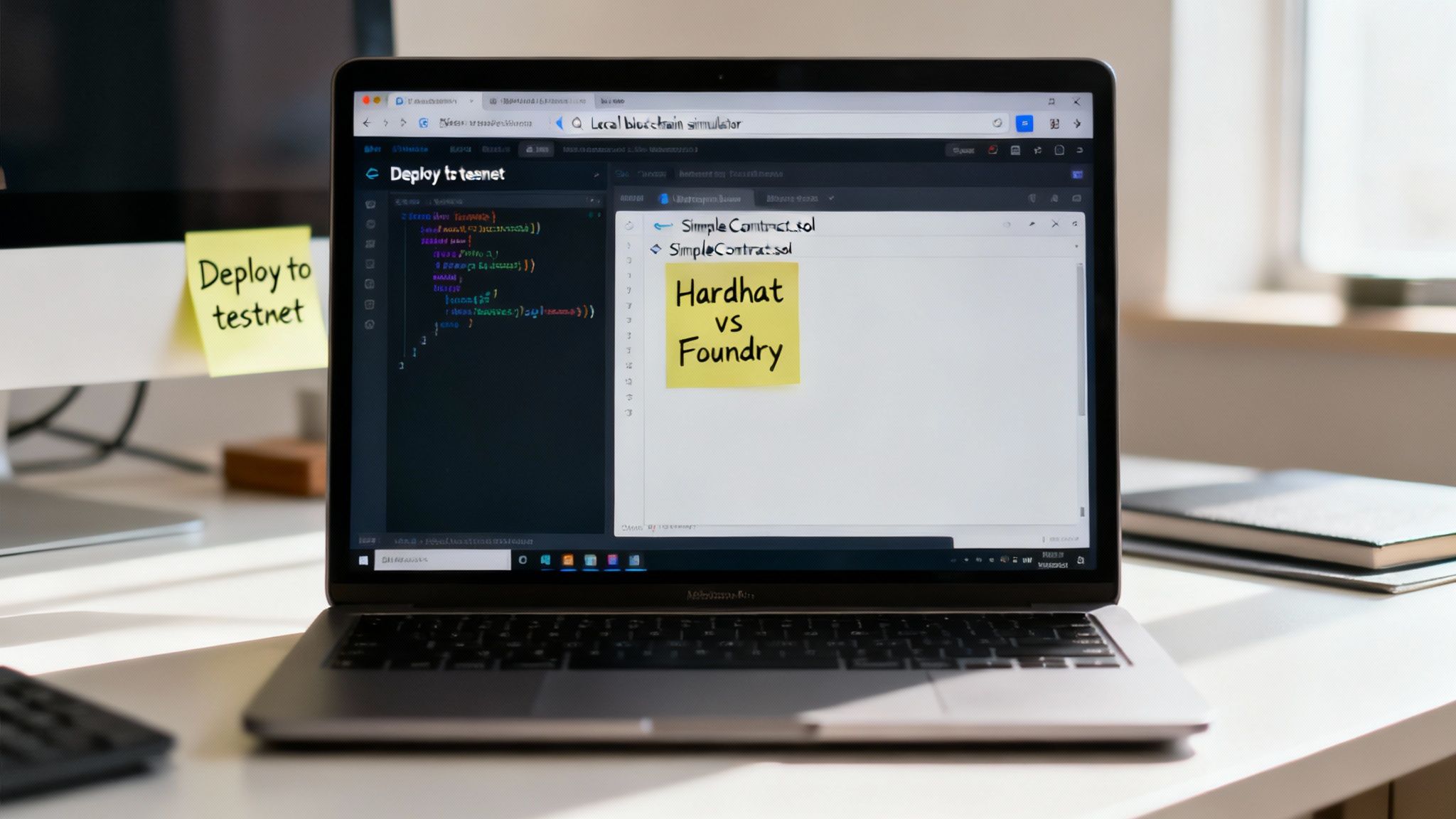
Your primary development framework is your command center. It’s where you'll write, test, and deploy your smart contracts. The two dominant players in the Ethereum ecosystem are Hardhat and Foundry, and the choice between them often comes down to your background and what feels most intuitive.
Hardhat is a JavaScript and TypeScript-based environment. If you come from a web development background, you'll feel right at home. It uses familiar tools like
console.logfor debugging and has a massive ecosystem of plugins.Foundry is a newer, Rust-based toolkit that lets you write your tests directly in Solidity. This is a game-changer for many developers because it kills the context-switching between Solidity and JavaScript, a common pain point.
So, which one should you learn? Both are excellent, but they appeal to different mindsets. Many top teams use Foundry for its raw speed and Solidity-native testing, but Hardhat's extensive documentation and plugin support make it an incredibly friendly choice for beginners.
A senior developer at a leading DeFi protocol put it this way: "We hire developers who are experts in one framework, not beginners in both. Show me you can write comprehensive, gas-aware tests in Foundry or build a complex deployment script in Hardhat, and I'm interested. Show me a shallow understanding of both, and I'm not."
Comparing Popular Ethereum Development Frameworks
Choosing the right tool can dramatically impact your learning curve and how impressive your portfolio projects are. To help you decide, here’s a direct comparison of what really matters when you're just starting out.
| Feature | Hardhat (JavaScript/TypeScript) | Foundry (Solidity) |
|---|---|---|
| Testing Language | JavaScript or TypeScript, using libraries like Chai and Mocha. | Solidity, which allows for writing tests in the same language as your smart contracts. |
| Primary Advantage | Excellent plugin ecosystem, extensive community support, and a familiar environment for traditional web developers. | Blazing-fast compilation and test execution, plus the ability to avoid JavaScript for a Solidity-only workflow. |
| Best For | Developers with a strong JavaScript background or those who need a wide range of plugins for complex integrations. | Developers who prefer a more streamlined, Solidity-centric workflow and prioritize raw performance and gas testing. |
| Hiring Signal | Signals proficiency in the most established and widely used Ethereum development environment. | Signals an interest in cutting-edge tools, performance optimization, and a deep understanding of the EVM. |
My advice? Try to build one meaningful project in each. This not only makes you more versatile but also gives you a fantastic talking point in interviews when they inevitably ask about your tool preferences.
Essential Tools For Interacting With The Blockchain
Beyond your main framework, you'll need a few other key tools to build a complete dApp. These are the pieces that let your smart contracts talk to the outside world.
Local Blockchain Simulators: Tools like Ganache or Hardhat's built-in network create a personal blockchain on your computer. This is non-negotiable for rapid development. It allows you to deploy and test instantly without spending real money on gas fees.
Frontend Libraries: Your users need a way to interact with your contracts. Libraries like Ethers.js or Web3.js are the JavaScript bridges between your web app and the blockchain. You have to master one of them. Knowing how to fetch data from a contract or trigger a transaction is a fundamental skill tested in nearly every interview. Even job descriptions for roles like a Solana Program Engineer list similar requirements for their own ecosystems, showing just how critical this skill is across the board.
Testnets: Before you ever touch the main Ethereum network, you'll deploy to a public testnet like Sepolia. Think of it as the final dress rehearsal. It lets you test your dApp in a live environment that mimics the real blockchain, using free test ETH to catch bugs. A history of successful testnet deployments on your GitHub shows you have a professional, security-conscious workflow.
Creating a Portfolio That Gets You Hired
Let's be blunt: your portfolio is everything. It’s the single most important asset you have in the job hunt, turning the skills on your resume from a list of claims into hard proof. I can tell you from experience, hiring managers often head straight to your GitHub profile before they even glance at your cover letter.
A strong portfolio does more than just show you can follow tutorials. It proves you can think like an engineer, solve real problems, and are genuinely passionate about this space. It’s what makes a recruiter stop scrolling and actually consider you for the role.
Building Projects That Impress Recruiters
Every aspiring blockchain developer has a simple NFT minting dApp or a basic ERC20 token in their portfolio. That's the baseline. To actually stand out, you need to show you can tackle something with a bit more complexity or creativity.
The real goal here is to build something a hiring manager can actually click on, interact with, and understand quickly. Instead of just cloning another project, try to find a small, real-world problem you could solve with a dApp. This immediately signals initiative and a much deeper grasp of why this technology matters.
Here are a few project ideas that go beyond the basics:
- A Decentralized Voting System: Build a dApp where users can create proposals and vote on them, but make sure each address gets only one vote. This is a great way to show you understand access control and on-chain state management.
- An On-Chain Escrow Service: Create a smart contract that holds funds between two parties and only releases them when a certain condition is met. This project is perfect for highlighting your ability to handle financial logic and think about security.
- A Gas-Optimized NFT Collection: Don't just deploy a standard NFT. Implement an ERC721A contract, then write a blog post explaining exactly how you cut down on deployment and minting costs. This demonstrates you care about efficiency, a make-or-break skill for any serious developer.
In an interview, a candidate who can walk me through the code of a live, deployed dApp they built from scratch is infinitely more compelling than someone with a perfect resume but no tangible work to show for it. We want to see how you think, not just what you've studied.
The Power of Open-Source Contributions
Want a fast track to credibility? Start contributing to established open-source projects. Think of it as a modern-day apprenticeship. Finding a bug, fixing it, and getting a pull request merged into a major library like OpenZeppelin or a framework like Hardhat is a massive hiring signal.
It proves you can navigate a large, unfamiliar codebase, collaborate with other developers, and write code that meets professional standards. You don’t have to start by rewriting the core architecture. Begin by improving documentation, fixing typos, or adding tests for uncovered code. These small contributions are incredibly valuable and give you concrete wins to talk about in an interview.
What a Strong Blockchain Portfolio Contains
A standout portfolio is more than a random collection of code—it’s a curated, professional presentation of your work. Your GitHub profile should be treated like a living, breathing resume.
Make sure your portfolio nails these key elements:
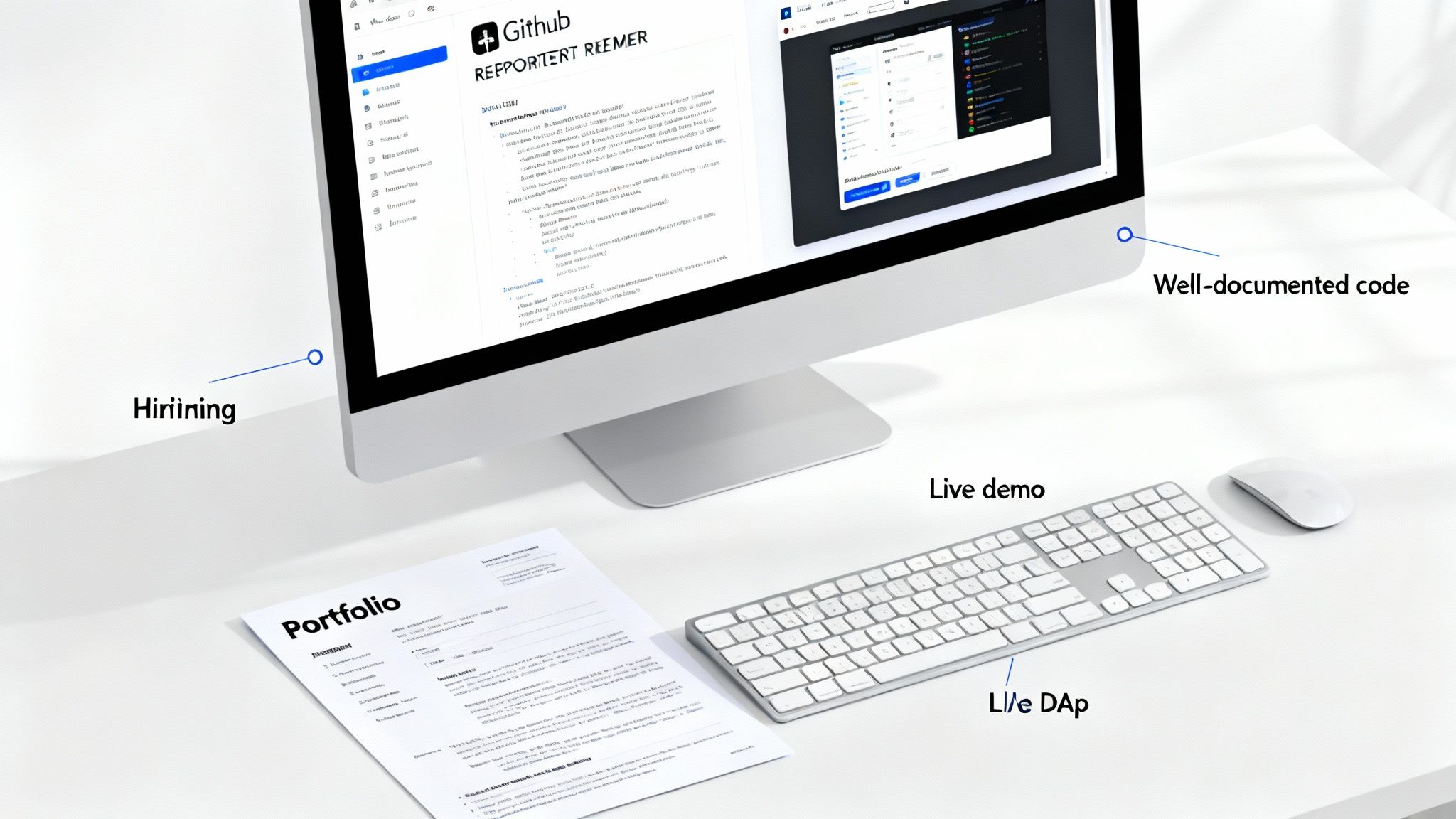
- A Detailed README for Each Project: This is your sales pitch. Clearly explain what the project does, the problem it solves, and the tech stack you used. Critically, you need to include a link to a live demo and the deployed contract on a testnet explorer like Etherscan. Make it easy for someone to see your work in action.
- Clean, Well-Documented Code: Your code needs to be readable. Use comments where the logic is complex and follow standard style guides. This shows you can work effectively on a team.
- Comprehensive Test Suites: Every single project should have a robust test suite. Aiming for test coverage of over 90% shows you have a professional, security-first mindset. Don't be shy about mentioning this number in your README.
- A Professional GitHub Profile: First impressions matter. Use a clear profile picture, write a concise bio that states your focus (e.g., "Solidity developer focused on DeFi and smart contract security"), and pin your best 2-3 projects right at the top.
When you curate your portfolio with this level of detail, you’re not just showing what you can build. You're demonstrating the professionalism, attention to detail, and thoroughness that companies are desperate to find.
Navigating the Web3 Job Market and Interviews
Okay, you've built some killer projects and your portfolio is looking sharp. Now for the final boss: landing that first blockchain developer job. The Web3 job market is a different beast. Sure, your technical chops are table stakes, but companies are also screening for a genuine passion for decentralization. They want to know you get the ethos.
This means your application materials need to speak the language of Web3. A generic tech resume and cover letter will get you nowhere fast. You have to prove you’re not just a coder for hire, but an active participant in this world.
Crafting a Job Application That Gets Noticed
Recruiters and hiring managers in this space are looking for very specific signals. Your resume needs to be polished enough to impress a human, but also structured to get past the automated Applicant Tracking Systems (ATS) that are the first gatekeepers.
Here’s how to make your application stand out:
- Load up on keywords: Make sure terms like Solidity, smart contract development, Hardhat, Foundry, EVM, and DeFi are sprinkled naturally throughout your resume. This is your ticket past the initial ATS filter.
- Show, don't just tell: Vague descriptions won't cut it. Instead of "worked on smart contracts," try something like, "Optimized smart contract gas costs, reducing average transaction fees by 15%." Numbers talk. Another great example is, "Achieved 95% test coverage on a decentralized exchange project."
- Write a Web3-native cover letter: This is where your personality shines. Name-drop a protocol the company built that you admire. Discuss a recent Ethereum Improvement Proposal (EIP) you found interesting. This shows you’re deeply engaged and not just firing off applications.
Decoding the Web3 Interview Process
Get ready for a gauntlet. The interview process for a blockchain developer role is often multi-staged and designed to test you from every possible angle. It's less about a simple coding test and more about a holistic evaluation of your engineering mind.
You can typically expect a few distinct phases:
- Recruiter Screening: The first call is about your story. Be ready to articulate why you're drawn to Web3. Your excitement for decentralization can be just as compelling as your resume.
- Technical Take-Home Assignment: You’ll likely get a small project—maybe writing a simple smart contract or hunting for a vulnerability in a snippet of code. This is a practical test of whether you can ship clean, secure, and well-documented code under a deadline.
- Live Coding Challenge: This is where the pressure is on. You'll share your screen with a couple of senior engineers and solve a problem in real time. They’re watching your thought process and communication skills just as much as your code. The goal isn't always a perfect answer, but a perfect approach.
- Systems Design and Behavioral Interview: The final round usually mixes high-level architecture questions ("How would you design a simple lending protocol?") with behavioral ones. They want to see how you think about security, scalability, and the wider impact of your work.
A common behavioral question is, "What is your favorite DeFi protocol, and what is one thing you would change about its smart contract architecture?" Your answer reveals your depth of knowledge, your critical thinking, and your genuine interest in the space far better than any coding quiz.
Be ready to dive deep into core concepts like delegatecall, reentrancy attacks, and advanced gas optimization strategies. They need to know you've wrestled with the unique, high-stakes challenges of building on-chain. If you can explain these complex topics clearly, you'll prove you have what it takes to be a valuable member of the team.
Specializing and Advancing Your Blockchain Career
Landing your first blockchain developer job is a huge milestone, but it's really just the beginning. The path to a long-term, high-impact career starts now, and specialization is the name of the game. Generalists get their foot in the door, but specialists are the ones who build a reputation, command top-tier salaries, and get to solve the most exciting problems in the space.
Think of it like choosing a major after finishing your core classes. Now that you've got the fundamentals down, it's time to decide what you want to become a true expert in. Web3 offers a few distinct and fascinating career tracks, each demanding its own set of advanced skills.
The Smart Contract Developer Path
This is often the most direct path for new developers, building on the skills you already have. You've built smart contracts for your portfolio, but specializing means going much, much deeper. It’s about becoming the go-to person for writing secure, gas-efficient, and elegant on-chain logic for DeFi protocols, NFT platforms, and DAOs.
To really excel and advance, your mindset must shift from just writing code that works to writing code that is unbreakable and incredibly cheap to run.
Your career progression will revolve around:
- Deep Gas Optimization: Squeezing every last drop of efficiency out of a contract to save users money on transaction fees. This requires a mastery of low-level concepts and a real understanding of the EVM.
- Advanced Security Patterns: Moving beyond basic checks to implement sophisticated access controls, upgradeability patterns (like proxies), and creative new security mechanisms.
- Protocol Architecture: Designing complex systems of interconnected smart contracts that can securely manage millions, or even billions, of dollars in assets.
The teams hiring for this kind of role range from DeFi giants like Aave and Uniswap to cutting-edge NFT projects. If this sounds like your path, check out postings like this Smart Contract Engineer role to see exactly what top teams are looking for.
The Core Protocol Engineer Path
Do you find yourself more fascinated by how the blockchain itself works rather than the apps built on top? If so, this is your track. Core protocol engineers work on the very foundation of a blockchain—the consensus mechanisms, the networking layer, and the client software that nodes actually run.
This is a much more challenging, systems-level career path. You won't be writing much Solidity. Instead, you'll be deep in languages like Go, Rust, or C++, working to improve the performance, security, and decentralization of the entire network.
A core protocol engineer might spend their day:
- Implementing a new Ethereum Improvement Proposal (EIP).
- Optimizing the peer-to-peer networking code to reduce latency across the globe.
- Researching and developing the next generation of consensus algorithms.
This specialty is for people who genuinely love tough computer science problems. You’ll find these roles at organizations like the Ethereum Foundation, L2 scaling solutions like Arbitrum or Optimism, and companies building entirely new layer-1 blockchains.
To advance as a blockchain developer, you must cultivate a "security-first" mindset. It's not a feature you add at the end; it's the foundation of everything you build. Your code's integrity is the product.
The DeFi Strategist and Analyst Path
Not every advanced role is purely about code. If you have a strong interest in finance and economics, you can blend your technical skills with market insights to become a DeFi strategist or a quantitative analyst. These roles are a fascinating hybrid of developer, researcher, and financial expert.
You’ll still need to read and audit smart contracts, but your main job is to analyze economic incentives, model risk, and design new financial primitives. You might spend your days using Python or SQL to query on-chain data, building models to forecast protocol revenue, or designing tokenomics that drive healthy growth.
In this career path, you’d be focused on:
- Economic Modeling: Simulating how a new lending protocol might react under extreme market conditions.
- Mechanism Design: Crafting the rules for a liquidity mining program that attracts capital without creating runaway inflation.
- On-Chain Data Analysis: Using tools to track user behavior and identify opportunities to improve a protocol.
This path is perfect for developers who are just as comfortable reading a whitepaper on game theory as they are reading Solidity. You'll find these opportunities at top DeFi protocols, crypto-focused hedge funds, and blockchain analytics firms. Each of these paths offers a clear route to becoming a senior or lead developer, where you'll not only solve technical challenges but also mentor others and shape the future of a project.
Common Questions on the Path to Becoming a Blockchain Developer
As you start piecing together your path into Web3, a few big questions are bound to come up. Let's tackle them head-on, because getting these answers straight early on will save you a ton of time, help you manage your own expectations, and keep you focused on what actually lands you a job.
Do I Need a Computer Science Degree?
Straight answer: no, you absolutely don't. The Web3 space is built on a simple principle: can you build? That’s what hiring managers care about.
Some of the best developers I know are self-taught or came out of a bootcamp. What really matters is a portfolio that shows you can create secure and efficient dApps, a solid grasp of how blockchains actually work, and real skill in languages like Solidity or Rust. Your GitHub profile is your new diploma.
Key Takeaway: Proven skills and a killer portfolio will always trump a traditional CS degree in this industry.
How Long Does It Realistically Take to Get a Job?
This is the big one, and the honest answer is... it depends. Your background and how much time you can pour into this will be the biggest factors.
Here’s a realistic breakdown based on what I’ve seen:
- For experienced software developers: If you're already a dev, you've got a massive head start. You can probably get job-ready in about 6-9 months. You're not learning to code; you're just learning a new, very specific tech stack.
- For complete beginners: If you're starting from square one, be patient with yourself. You need to build up those core programming fundamentals first. A more realistic timeline is 12-18 months of consistent, focused work.
The clock really starts ticking once you stop just watching tutorials and start building your own stuff. The moment you start creating unique projects that solve a real problem (even a small one!), you're on the fast track to getting hired.
What Are the Biggest Mistakes to Avoid When Starting Out?
I’ve seen a lot of aspiring devs get tripped up by the same few things. If you can steer clear of these, you'll be miles ahead of the competition.
The absolute biggest trap is what people call "tutorial hell." This is where you just follow along with guided projects, one after another, without ever trying to build something completely on your own. To truly learn—and to actually impress an employer—you have to get your hands dirty and create original work. It’s the only way to prove you can solve problems without a safety net.
Another massive pitfall is glossing over security. In Web3, a single vulnerability in a smart contract can mean millions of dollars lost in an instant. You must make security and rigorous testing part of your process from day one. Seriously, if you can walk into an interview and intelligently discuss reentrancy attacks or gas optimization strategies, you're immediately a much stronger candidate.
Finally, don't just be a coder. Understand the why behind decentralization. Get familiar with the economic models and philosophical ideas that drive this space. This context is what separates a good developer from a great one, and it's crucial for acing those interview questions that dig into your genuine passion for Web3.
Ready to stop wondering and start applying? Blockchain Jobs is the go-to job board for finding your place in the decentralized world. Check out thousands of curated roles in engineering, security, and more at https://blockchain-jobs.com.