Is Technology a Good Career Path: 2026 Outlook & Growth

Yes. Technology is still a good career path because U.S. computer and information technology occupations are projected to produce about 317,700 openings each year on average from 2024 to 2034, and the median annual wage is $105,990, far above the $49,500 median for all occupations. That's not hype. That's a labor market with real depth, real pay, and room for very different kinds of workers.
If you're asking because you're deciding where to put the next few years of your life, my advice is simple. Tech is worth it, but only if you pick the right lane. Too many people treat “tech” like one job. It isn't. Software engineering, cybersecurity, product, IT, data, DevOps, compliance, and Web3 all reward different strengths, and hiring managers can spot a mismatch fast.
That's the part most career content skips. Salary screenshots and growth headlines are easy. The harder question is whether your skills, temperament, and interview story match the role you're chasing. That's what decides who gets hired, who stalls out, and who builds a durable career.
The Tech Job Market in 2026 Why It Is Still Booming
The strongest argument for tech is straightforward. The U.S. Bureau of Labor Statistics projects that computer and information technology occupations will grow much faster than the average for all occupations from 2024 to 2034, with about 317,700 openings projected each year on average. The same BLS page lists a $105,990 median annual wage for the category in May 2024, compared with $49,500 for all occupations overall, according to the BLS outlook for computer and information technology occupations.
That combination matters more than people realize. Openings don't come only from new job creation. They also come from replacement needs. In recruiting terms, that means this isn't a market where you need perfect timing to get in. Companies keep hiring because teams expand, people move, and core systems still need to be built, maintained, secured, and improved.
Why hiring is still active
A lot of candidates look at layoffs, AI tools, and tighter interview loops and conclude that tech is dying. That's the wrong read. What's happening is a reset in standards. Employers are less willing to overhire, but they still need people who can solve expensive problems.
Here's what that means in practice:
- Core infrastructure still needs owners. Companies need engineers, analysts, and operators who can keep products stable, secure, and compliant.
- Digital work has spread into every industry. You don't need to work at a flashy startup to work in tech. Healthcare, finance, logistics, government, and retail all hire technical talent.
- Compensation stays attractive. Even before you specialize, the category-wide median wage creates a strong floor compared with many other career paths.
Practical rule: Don't ask whether tech is crowded. Ask whether you can become clearly useful in a function companies can't ignore.
What this means for job seekers
If you're entering now, the market rewards precision. “I want to work in tech” is too vague. “I build internal tools in Python,” “I handle cloud infrastructure,” or “I can turn user problems into product requirements” is the kind of framing that gets recruiter attention.
Job search strategy matters too. Broad job boards are fine, but niche boards often surface more relevant openings and clearer role definitions. If you're exploring where to look, this guide to technology job boards for focused job searches is a useful starting point.
The short version is this. It's not too late. But broad optimism won't get you hired. Market demand creates opportunity. Candidate clarity converts it.
Finding Your Fit with Common Tech Roles and Salaries
The biggest mistake I see is candidates picking roles based on salary headlines instead of fit. That leads to weak resumes, clumsy interviews, and fast burnout. Start with the work itself. What problems do you want to solve all day, and what evidence can you show that you can solve them?
Coursera cites BLS data showing a $105,990 median annual salary for IT and computer professionals. It also notes that product managers are estimated around $148,000, while the top 10 percent of computer and information research scientists earn over $232,120, as outlined in this tech career salary overview from Coursera. Those numbers are attractive, but they shouldn't drive your choice by themselves.
Comparison of key technology career paths in 2026
| Role | Median Salary (USD) | Core Skills | Best Entry Route |
|---|---|---|---|
| Software Developer | Included among major BLS-tracked tech roles | Programming, debugging, system design, collaboration | Degree, bootcamp, or strong portfolio |
| Data Analyst | Not specified in verified data | SQL, spreadsheets, dashboards, business thinking, communication | Self-taught projects, certificate path, degree |
| Product Manager | $148,000 | Prioritization, user research, stakeholder management, written communication | Internal transfer, operations background, MBA, or product-adjacent role |
| Computer and Information Research Scientist | Top 10 percent over $232,120 | Advanced technical depth, research, experimentation, problem solving | Degree-heavy path, often advanced study |
| Network Engineer | Around $123,000 | Networking, systems thinking, troubleshooting, documentation | Certifications, IT background, degree |
| Blockchain Engineer | Not specified in verified data | Smart contracts, distributed systems, security mindset, GitHub proof of work | Solidity or protocol portfolio, open-source contributions |
| Cybersecurity or Compliance Roles | Not specified in verified data | Risk thinking, controls, incident response, policy, communication | Certifications, IT support, audit, legal, or ops background |
How to choose the right role
Use this filter before you apply anywhere:
- Coding-heavy roles fit people who enjoy building, debugging, and spending long stretches in technical detail.
- Client-facing or cross-functional roles fit candidates who like tradeoffs, communication, and decision-making under ambiguity.
- Research-heavy roles reward depth. If you want frontier work, be honest about the education and rigor required.
- Web3 roles are often less forgiving. You need stronger proof of work because teams are small and hiring managers care about signal fast.
Good candidates don't just say what role they want. They explain why their background matches the problems in that role.
If product management interests you, compensation can be strong, but PM hiring is competitive and interview-heavy. This guide on how to negotiate your first PM offer is worth reading because salary is only one part of the package. Scope, reporting line, and product maturity matter just as much.
For candidates comparing adjacent paths, salary context also helps. If you're weighing engineering against more product-focused front-end work, this breakdown of front-end developer salaries gives useful market framing.
The right role is the one where your strengths show up clearly in interviews. That's the one to chase.
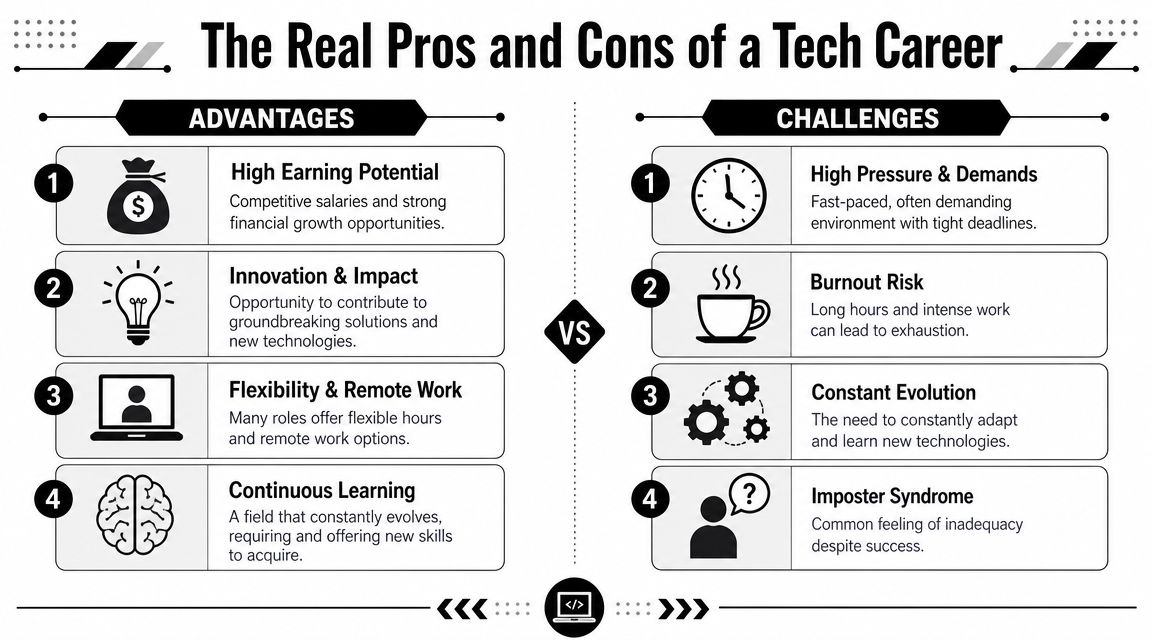
The Real Pros and Cons of a Tech Career
Most “is technology a good career path” articles are too cheerful. They talk about opportunity and stop there. That's incomplete. Tech is a strong career path, but it punishes vague positioning and rewards continuous adaptation.
The upside is real
You can build a career with strong pay, transferable skills, and role mobility. You can move from support into cloud, from analyst work into product, or from traditional software into blockchain infrastructure if you build the right portfolio and interview story.
Flexibility is another genuine advantage. Tech roles commonly offer remote and flexible work arrangements, and that changes the quality of your career, not just your calendar.
The risk side is where people get blindsided
The job market is splitting. Recent analysis points to a bifurcation where experienced specialists remain in demand while junior roles compress due to AI. The same analysis says more resilient functions include infrastructure, security, compliance, and applied AI, while routine coding and support tasks face more automation pressure, as discussed in this analysis of AI pressure on tech careers.
That doesn't mean beginners are locked out. It means beginners need a better strategy. If your value looks interchangeable, AI tools and global competition both work against you. If your value is tied to ownership, judgment, security, or business context, you're in a stronger position.
Here's the video I'd show to anyone entering the field with unrealistic expectations:
The real pros and cons in hiring terms
- Pro. Fast skill signaling. In tech, a GitHub repo, shipped feature, audit write-up, or product case study can prove competence quickly.
- Con. Interview pressure. Technical screens, take-homes, and system interviews can be exhausting if you prepare casually.
- Pro. Mobility. Skills often transfer across industries and sometimes across functions.
- Con. Mismatch is expensive. A strong communicator may hate isolated coding work. A deep builder may hate stakeholder-heavy product roles.
If you're choosing between “high-paying” and “fits how I actually work,” choose fit. People who fit the work usually end up making more anyway because they stay in the game long enough to compound.
The winners in this market aren't the people with the loudest enthusiasm for tech. They're the people who understand where they'll stay useful as tools and hiring patterns change.
Your Entry Strategy and Pathways into Tech
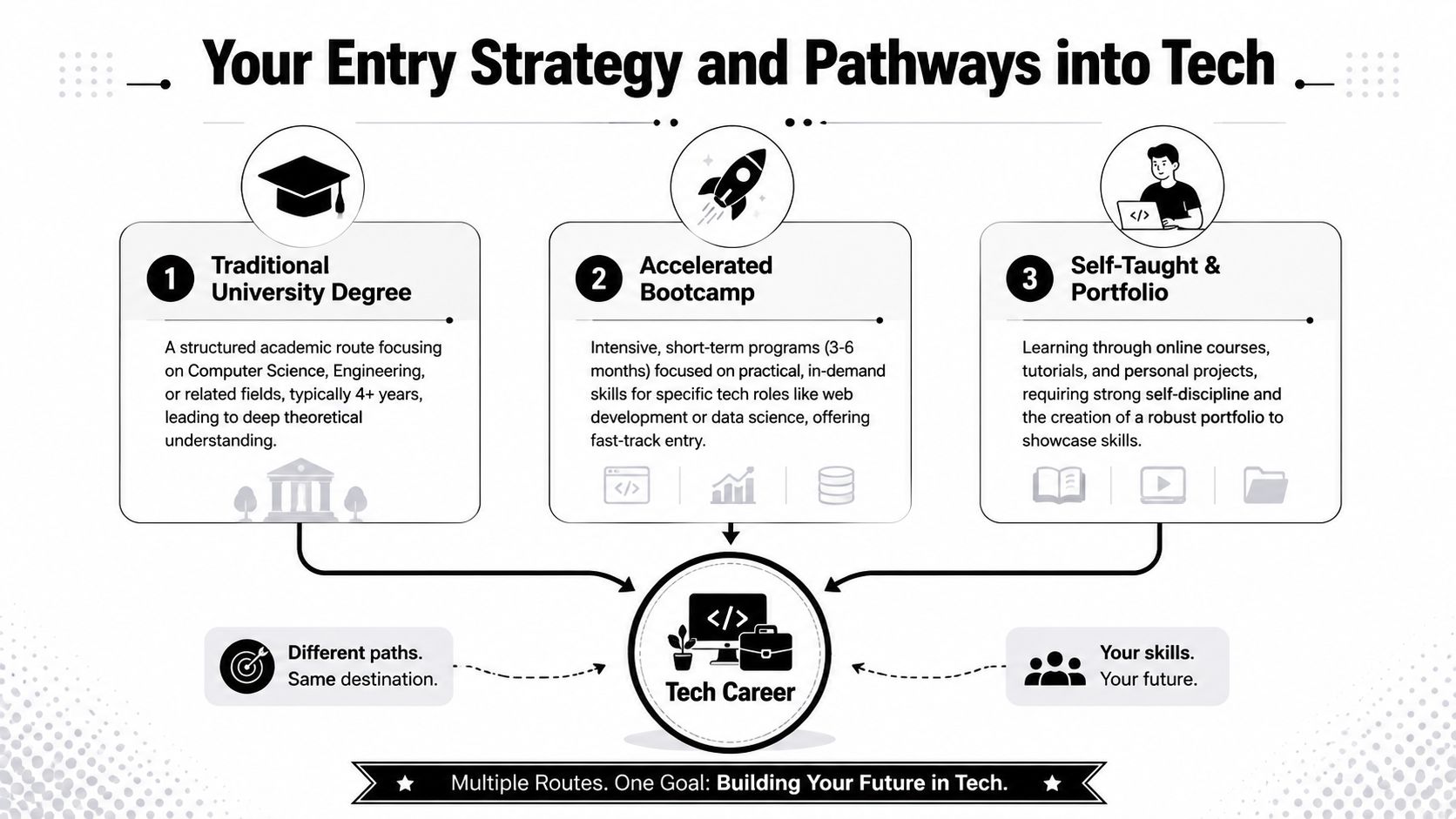
There are three credible ways into tech. Degree, bootcamp, and self-taught. All three can work. None of them work on autopilot.
The degree path
A computer science or engineering degree is still the cleanest signal for many employers, especially for deeper engineering, research, and systems roles. It gives you structure, theory, recruiting pipelines, and internship access.
But don't hide behind the degree. Hiring managers still want evidence that you can build. If your resume shows coursework but no real projects, you're behind a candidate with a smaller credential and stronger proof.
The bootcamp path
Bootcamps can work when they're paired with urgency, discipline, and a realistic target role. They're strongest for practical, applied paths such as web development and certain product-adjacent transitions. They're weaker when students expect the certificate itself to do the selling.
Your job after graduation is to remove doubt. Build projects. Contribute to something real. Get sharp at explaining tradeoffs. If you want a useful example of how to think through a transition into engineering, this structured path for backend engineers offers a grounded way to plan the move.
The self-taught path
This path works best for self-directed people who can create momentum without external pressure. In recruiting, the self-taught label is fine if the portfolio is strong. It's weak if your learning history is vague and your projects are half-finished clones.
Use this checklist:
- Pick one target role. Not five.
- Build three proof assets. Think deployed app, automation project, dashboard, smart contract repo, or technical writing sample.
- Practice interview narration. Employers don't just assess what you built. They assess how clearly you explain decisions.
- Apply with focus. Resumes customized for the job beat mass applications.
Your entry path matters less than your evidence. Recruiters hire proof, not intentions.
If you're changing careers, don't erase your previous experience. Translate it. Ops people can move into product or implementation. Finance people can move into analytics or blockchain compliance. Support people often become excellent customer success, solutions, or QA hires because they already know how systems fail in practice.
The Next Frontier How Web3 and Blockchain Fit In
Web3 is not a separate universe. It's part of the broader tech labor market, with a sharper edge. Teams are smaller, hiring is more global, and the signal-to-noise test is harder. That's exactly why strong candidates can stand out quickly.

Traditional tech skills transfer surprisingly well
If you already work in software, product, security, design, legal, or operations, you probably don't need to “start over” to move into blockchain. You need to learn a new context.
Examples:
- Backend engineers can move toward protocol tooling, smart contract integration, indexing, and infrastructure.
- Security professionals can move into smart contract review, wallet security, and operational risk.
- Product managers can work on wallets, developer platforms, exchanges, stablecoin products, and governance tooling.
- Compliance and legal professionals are increasingly relevant because decentralized products still operate inside real regulatory environments.
- Community and marketing operators matter because many Web3 products grow through ecosystems, not only paid acquisition.
What Web3 hiring managers actually want
They want proof that you understand the environment. That means some combination of on-chain familiarity, open-source participation, technical writing, governance awareness, or real product intuition around crypto users.
A generic resume line like “interested in blockchain” does nothing. A GitHub contribution, contract experiment, protocol analysis, token operations workflow, or ecosystem case study does.
If you're exploring where those roles live, this guide to blockchain technology jobs across Web3 functions gives a practical view of how broad the category really is.
In Web3 hiring, curiosity isn't enough. Teams want signs that you've already entered the arena.
This field also suits candidates who like ambiguity and speed. If you need heavy structure, long planning cycles, and narrow job definitions, traditional enterprise tech may suit you better. If you like frontier products, remote teams, and steep learning curves, blockchain can be a smart specialization.
Beyond the Entry Level How to Build a Lasting Career
Getting hired is step one. Staying valuable is the actual job.
Tech careers are often less structured than other sectors and require a blend of technical depth and strong communication skills for advancement. Purdue also notes that leadership roles may require specialized knowledge or advanced degrees, which is a reminder that career growth doesn't happen by default, as explained in Purdue's discussion of how tech careers demand both specialized and communication skills.
Build T-shaped value
You need one area where people trust you, plus enough range to work across functions. A backend engineer should understand product constraints. A PM should understand technical tradeoffs. A compliance lead in Web3 should understand how products move user funds and data.
That's what gets people promoted. Not just hard skills. Judgment.
Treat interviews like part of the job
Strong candidates prepare examples for five things:
- Execution. What did you ship or improve?
- Problem solving. Where did you unblock something difficult?
- Communication. How did you align people who disagreed?
- Ownership. What did you handle without being told?
- Learning speed. How did you ramp into a new domain?
Interview performance often determines your salary band, title, and team quality before you've written a line of code or joined a standup. Take it seriously.
Manage your career before you need to
Don't wait for layoffs, frustration, or a bad manager to start networking. Keep your portfolio updated. Write down wins as they happen. Stay in touch with former colleagues. If you work in Web3, keep a clean public footprint because hiring teams will look at it.
The people with durable careers don't drift. They make deliberate moves into stronger problems, better teams, and higher-impact skills.
Frequently Asked Questions About Tech Careers
Is technology a good career path for career changers
Yes, if you target a role that matches your prior experience instead of pretending you're starting from zero. People from operations, finance, sales, support, design, and legal often transition well because tech companies still need those skills. The key is reframing your experience in language hiring managers understand.
Is entry-level tech oversaturated
Some entry-level segments are crowded. That's true. But “entry-level” is too broad to be useful. Candidates struggle most when they apply to generic roles with no proof of work. Narrower positioning, stronger portfolios, and better interviewing still create openings.
Do you need to be great at math
Usually, no. Most tech roles reward logic, communication, troubleshooting, and attention to detail more than advanced math. Some specialized paths are more quantitative, but many solid careers in product, support, QA, UX, compliance, and even software don't require you to be a math specialist.
What matters more, credentials or portfolio
Portfolio wins more often in practical hiring. A degree can open doors. A portfolio proves you can do the job. The strongest candidates usually combine both signal types, but if you have to choose where to spend energy this month, build something and learn to explain it well.
Is Web3 a smart move or too risky
It depends on your appetite for volatility and ambiguity. Web3 can be a smart move if you bring useful skills, enjoy fast-moving environments, and build visible proof of interest. It's a bad move if you're chasing hype without understanding the work.
How important is communication in tech careers
It's essential. Weak communication blocks promotions, hurts interviews, and limits trust. The best technical people I've recruited can explain complex decisions in plain English. That's not a soft extra. That's part of seniority.
If you're serious about making a move into blockchain, don't stay stuck in research mode. Use Blockchain Jobs to see active roles across engineering, product, marketing, compliance, operations, security, and more, then compare those openings against your actual skills and build your application strategy from there.