Land Top JavaScript Developer Jobs in 2026
Even with all the chatter about tech market ups and downs, the demand for skilled JavaScript developer jobs isn't just high—it's incredibly stable. The language is simply too fundamental to how we build for the web, connect to AI, and manage cloud services. For anyone with solid JavaScript skills, this remains one of the most reliable and fulfilling career paths out there.
The JavaScript Job Market in 2026
Trying to read the job market can feel overwhelming, but for JavaScript developers, the outlook for 2026 is strong. Don't let the headlines about industry shifts fool you. The core need for engineers who can build and maintain the digital world has never been greater. At the end of the day, JavaScript is what makes the web come alive, which means countless companies depend on it.
The data backs this up. The U.S. Bureau of Labor Statistics anticipates the software development field will grow by a massive 17% between 2023 and 2033. That translates to almost 327,900 new jobs. This isn't just a small bump; it's a clear signal that software development is a long-term, durable career choice.
Why Demand Stays So Strong
From a hiring perspective, the consistent demand for JavaScript talent is driven by its unmatched versatility and central role in almost every modern tech stack.
- The Never-Ending Digital Push: Almost every company is still working to get its services online or improve its digital presence. JavaScript is the language of choice for building the user-facing apps that make it all happen.
- Connecting to New Tech: As businesses bring in AI and shift more operations to the cloud, they need developers to build the front-end interfaces and underlying plumbing that make these systems usable.
- The Rise of Web3: The growth of blockchain has opened up a whole new world for developers. JavaScript frameworks are critical for building decentralized applications (dApps), creating a fresh wave of high-value roles you can see on specialized boards for engineering jobs.
How to Position Yourself for Success
To capitalize on these opportunities and get hired, you need to understand what companies are looking for right now. It's a question every developer has: are software engineers in demand? The answer is a definite yes, but with a catch—companies aren't just looking for someone who can write code.
The developers who get hired and promoted are the ones who can think beyond the code. They understand the business problem they're trying to solve. In this market, that means seeing how your JavaScript skills help the company achieve its goals, whether that's making an app easier to use or building a secure decentralized platform.
Ultimately, being a great JavaScript developer isn't just about technical skill. It's about taking ownership of the user's experience. If you can demonstrate this business-oriented mindset in your interviews and portfolio, you can build a secure and rewarding career, no matter if you're just starting out or aiming for a senior position.
Cracking the Code on JavaScript Job Titles and Career Paths
Dipping your toes into the JavaScript job market can feel like you're trying to read a foreign language. You see titles like "Frontend," "Backend," and "Full-Stack" thrown around everywhere, but what do those labels actually mean for your day-to-day work and career trajectory? Getting a solid grasp on these roles is the first real step toward building a successful career.
Let's break it down with an analogy. Think of building a high-performance car.
The Frontend Developer is obsessed with the driver's experience. They’re designing the sleek dashboard, the comfortable leather seats, and choosing that perfect shade of cherry red paint. Using JavaScript, HTML, and CSS, they build everything you see and interact with, making sure the user interface is beautiful, intuitive, and works flawlessly on any device. It's all about what the user feels and touches.
The Backend Developer, in contrast, is the master mechanic under the hood. They're the ones engineering the V8 engine, the transmission, and the entire chassis—the core components that actually make the car go. They work with server-side tools, very often using JavaScript through Node.js, to handle databases, manage user accounts, and power all the business logic. Their work is completely invisible to the driver, but without it, you just have a pretty shell.
The Full-Stack Developer: The Ultimate Hybrid
So, what about a Full-Stack Developer? They're the chief engineer who not only understands the engine's mechanics but also has a keen eye for the car's design and user experience. They can jump between building the server-side guts of an application and crafting the user-facing interface. This kind of versatility makes them a massive asset for hiring managers, especially in nimble startups where everyone needs to wear multiple hats.
It's no surprise that demand for these do-it-all developers is exploding. We're seeing job postings for full-stack positions grow by around 30% every single year. The U.S. Bureau of Labor Statistics backs this up, projecting an impressive 13% job growth for developers through 2030. It’s clear the market has a huge appetite for pros who can connect the dots between the frontend and backend, as outlined in a recent report on what employers are really looking for.
This infographic really puts the overall growth for software developers—which is packed with JavaScript roles—into perspective.
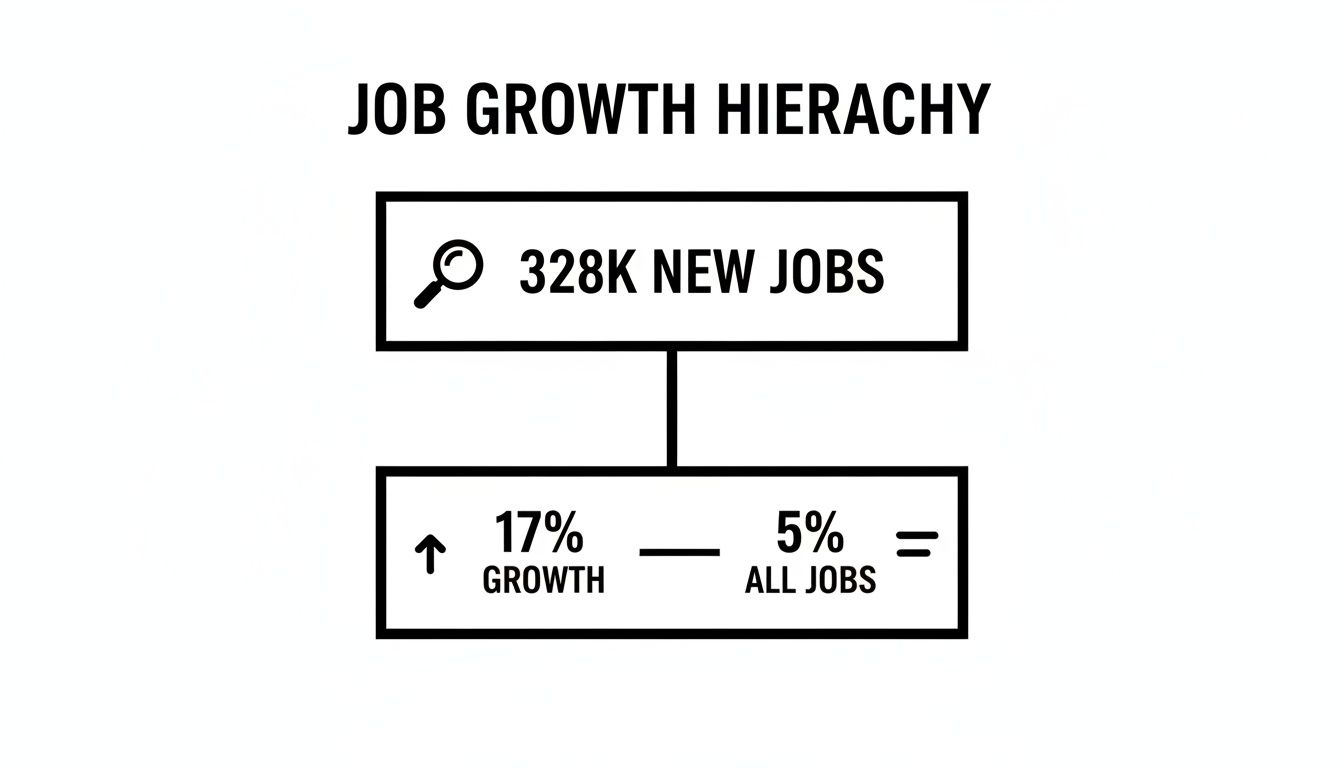
With nearly 328,000 new jobs on the horizon and a growth rate that’s flying past the average for other professions, it's a fantastic time to be in this field.
Charting Your Course: From Junior to Senior
Your career isn’t just about picking a specialty; it’s a journey through different levels of seniority. Each promotion comes with a major shift in what's expected of you, directly impacting how you interview and what hiring managers look for.
- Junior Developer: Your main mission here is to learn and execute. You'll get clearly defined tasks, work under the guidance of a mentor, and spend your days writing code to fix specific, targeted problems. In interviews, they want to see your coding fundamentals and a strong desire to learn.
- Mid-Level Developer: You’re becoming more independent. You can take on complex features by yourself, provide meaningful feedback in code reviews, and you're starting to see the bigger picture of the system's architecture. Interviewers will expect you to discuss trade-offs and own a feature from start to finish.
- Senior & Lead Developer: At this level, your job is less about just writing code and more about architecting solutions and amplifying your team's output. Seniors mentor junior developers, make high-stakes architectural decisions, and take ownership of the product's quality and ability to scale. Interviews will focus on system design, leadership, and business impact, as seen in descriptions like this Senior Fullstack Software Engineer position.
A junior developer’s job is to write code. A senior developer’s job is to ensure the right code gets written, whether they are the one writing it or not. This means mentoring, planning, and owning outcomes.
Knowing how this progression works is crucial. It helps you see where you stand today and pinpoints exactly what skills you need to build to climb to that next rung on the ladder in your JavaScript career.
Essential Skills and Frameworks for Top Jobs

If you want to land one of the top JavaScript roles, simply knowing the basics won't cut it anymore. Hiring managers are on the hunt for developers who build code that is efficient, scalable, and maintainable. This means you've got to move past the fundamentals and into specialized, high-demand skills that you can prove in an interview.
Think of it like this: anyone can follow a recipe, but a great chef truly understands the chemistry of their ingredients. For a developer, that means mastering modern JavaScript features (ESNext), guaranteeing code quality with TypeScript, and knowing exactly how to hunt down and squash performance bugs. These are the skills that make a candidate stand out and justify a higher salary.
The Modern JavaScript Toolkit
The 2026 job market for software engineers shows a definite trend: companies are hiring for seniority. In fact, over half of all open roles are now looking for developers beyond the senior level. While React is still the king, employers really want people who bring more to the table, like expertise in Next.js or a deep understanding of TypeScript. According to an analysis of what the software engineer job market looks like in 2025, having these complementary skills is your ticket to the best jobs.
A hiring manager will be digging through your portfolio and technical interviews for proof of these skills. They aren't just looking to see if you can build a simple app; they need to know you can architect a complex, reliable system from the ground up.
So, where do you focus your energy? Deciding on a framework is often the biggest choice a developer makes. The "big three"—React, Vue, and Angular—still dominate, but they each serve different needs in the market.
To help you decide, here’s a look at how the top frameworks stack up in the current job market.
Top JavaScript Frameworks Market Demand Comparison (2026)
| Framework | Market Share & Demand | Primary Use Case | Web3 Relevance |
|---|---|---|---|
| React | Highest. The undeniable market leader with the most job postings by a significant margin. | Building dynamic, component-based user interfaces for single-page applications (SPAs). | Very High. The dominant choice for building dApp frontends, with strong library support. |
| Vue | Growing. Strong in small to mid-sized projects and making inroads in enterprise settings. | Known for its gentle learning curve and flexibility, perfect for rapid development. | Medium. Growing ecosystem, but less established than React for dApp development. |
| Angular | Steady. A go-to for large, complex enterprise applications needing a structured framework. | A complete solution for building scalable, consistent applications. | Low. Not commonly used in the Web3 space; better suited for traditional corporate apps. |
As you can see, your choice of framework can either open doors to the massive Web3 market or keep you focused on more traditional enterprise development.
Expanding into Web3 Development
Speaking of Web3, this is where some of the most exciting and lucrative opportunities are right now. The great news is that your existing JavaScript skills are the perfect foundation for a career in blockchain. You just need to add a few specialized libraries to your toolbelt that let your frontend talk to a blockchain.
Here are the key technologies to learn to become a highly sought-after candidate:
- Ethers.js & Web3.js: These are your absolute must-haves for interacting with the Ethereum blockchain. Think of them as the translators between your web app and the smart contracts running on the network.
- Smart Contract Basics: You don't need to become a Solidity expert overnight, but you absolutely need to understand how smart contracts function to build a decentralized application (dApp). This knowledge is critical for collaborating with backend and smart contract engineers.
Adding these skills makes you a prime candidate for cutting-edge roles that often come with a significant pay bump. Companies are actively searching for developers who have this powerful mix of Web2 and Web3 knowledge, like in this Senior Backend Developer role at Bitfinex.
To a hiring manager, a candidate who not only knows React but also understands how to connect it to a blockchain using Ethers.js is incredibly valuable. It shows you’re a forward-thinking developer ready for the next generation of the web.
Building Your Application to Beat the System

Having the right technical skills is only half the battle. Before your application ever lands in front of a hiring manager, it has to get past the first line of defense: the Applicant Tracking System (ATS). These automated systems are notorious for filtering out perfectly good candidates simply because their resumes aren't formatted correctly.
Your first job, then, is to build a resume that can beat the bots. This doesn't mean you should cram it with every buzzword you can think of. It's about thinking strategically. Use clean, simple formatting and mirror the language from the job description. If they're asking for "React," "Node.js," or "TypeScript," make sure those exact terms are on your resume.
But just getting past the ATS isn't the goal. The real prize is impressing the human who reads it next. This is where you need to shift from listing what you know to proving what you can do.
Crafting a Recruiter-Ready Resume
The difference between a resume that gets a nod and one that gets a call is the story it tells. A simple list of frameworks you've used is forgettable. What a hiring manager truly wants to see is the impact you've made.
For example, don't just say:
- "Worked on a React-based e-commerce site."
Instead, frame it as a tangible achievement that solved a business problem:
- "Redesigned the React-based checkout flow, resulting in a 15% decrease in cart abandonment and boosting Q3 revenue."
That one change reframes you from someone who just writes code to a problem-solver who delivers real business value. That’s who companies are desperate to hire.
Building a Portfolio That Proves Your Skills
If your resume makes the claim, your portfolio provides the proof. This is your chance to back up every bullet point with tangible, high-quality work. Forget the small projects you built following a tutorial; companies want to see that you can handle complex, real-world challenges.
Your portfolio isn’t just a gallery of your work; it's your main sales pitch. Each project should be a case study that walks a hiring manager through a problem, your solution, and the skills you used to get there.
Try to include projects that demonstrate a diverse skillset and anticipate interview questions. Here are a few ideas:
- A Full-Stack dApp: Build a decentralized application from the ground up with something like React and Ethers.js. This immediately shows you're engaged with the future of the web and ready for the lucrative Web3 space.
- A Performance-Optimized Web App: Find a sluggish, poorly-coded application and refactor it for speed. Use tools like Lighthouse to document the performance improvements, proving you care about user experience and efficiency.
- An API-Driven Dashboard: Create an application that pulls in and visualizes data from a public API. This is a fantastic way to show you can work with external services and manage asynchronous data effectively.
For every project, add a detailed write-up. Explain the initial problem, the technical choices you made (and your reasoning behind them), and the final result. That narrative is what makes a portfolio stick in a recruiter's mind and ultimately lands you the interview.
Mastering the JavaScript Developer Interview
Your portfolio got you in the door—congratulations. Now it’s time to show them you have the technical chops and personality to back it up. The interview process for a JavaScript role can feel like a multi-stage marathon, but each step is designed to test a specific aspect of your professional ability. Understanding what they're really looking for is your key to crossing the finish line.
The journey almost always begins with a recruiter screen. This is a casual, non-technical chat to make sure you’re a real person who fits the general vibe of the company. Expect to talk about your recent projects, what you're looking for in your next role, and, of course, your salary expectations.
Acing Technical and Behavioral Rounds
Once you pass that initial check, you’ll head into the technical screening. This is usually a live coding challenge where an engineer watches you work. Here’s a pro tip: they aren’t just looking for the right answer. They're evaluating how you solve problems.
Can you talk through your thought process? It’s absolutely critical to think out loud. Explain why you’re reaching for a specific data structure, how you're handling potential edge cases, and what trade-offs you're making. Silence is your enemy here.
But it's not just about code. You'll also face a behavioral interview, which is designed to see if you're someone people will actually want to work with. The best framework for answering these questions is the STAR method:
- Situation: Set the scene. What was the project or challenge?
- Task: What was your specific job or goal in that situation?
- Action: Walk them through the exact steps you took.
- Result: Explain what happened because of your actions. Use hard numbers and metrics if you can.
When an interviewer asks, "Tell me about a time you disagreed with a teammate," they're testing your conflict resolution and communication skills. They want to see that you can handle professional disagreements constructively, not just prove that you were right.
Showing you’ve done your homework goes a long way. Being ready to answer essential remote job interview questions demonstrates that you're serious about the role and understand the dynamics of distributed teams.
Conquering the System Design Interview
For mid-level and senior roles, the final boss is often the system design interview. This isn't about writing code. It’s a high-level architectural challenge, like "Design a URL shortener from scratch."
The goal here is to see how you think about the big picture—scalability, reliability, and trade-offs. There's no single correct answer. What they want to see is your process. You should be asking clarifying questions, sketching out components on a whiteboard (virtual or real), and defending your technical choices. This is where you prove you have the architectural mindset to take on senior-level responsibilities.
Finding and Filtering for the Best Job Opportunities
Once your resume and portfolio are polished, it’s time to actually find the jobs. But this is where many developers get stuck, spending endless hours scrolling through generic job sites. The trick is to stop casting a wide, messy net and start fishing in the right spots.
Think of it this way: massive job boards like LinkedIn and Indeed are like the open ocean. Sure, there are millions of fish, but you’ll waste most of your time sifting through junk to find one decent catch. A smarter approach is to find the well-stocked lakes.
Why Niche Job Boards Win
Niche job boards are those well-stocked lakes. They’re built for specific industries or skill sets, which means the signal-to-noise ratio is so much better. If you're targeting the booming Web3 space, for example, a specialized board is a game-changer.
Take a platform like Blockchain Jobs. It's dedicated entirely to the Web3 ecosystem.
Right away, you see roles in engineering, product, and marketing from companies that are building the decentralized future. A focused search here means every single listing is already aligned with your interest in this specific corner of the tech world. No more scrolling past insurance adjuster or marketing manager roles.
Mastering Advanced Search Filters
No matter where you're looking, getting good with filters is what separates a frustrating job hunt from an efficient one. Don't just type "JavaScript developer" into the search bar and hope for the best. You need to get specific.
Drill down with the tools the site gives you:
- Location: Use keywords like “Remote” or “Hybrid”. Get even more specific with “Remote (US)” or “Remote (EU)” to find openings that fit your life and time zone.
- Seniority: Always filter for your level, whether it’s “Junior,” “Mid-Level,” or “Senior.” This simple step saves you from the disappointment of finding a perfect role that requires ten more years of experience than you have.
- Keywords: This is where you can really zero in. Combine your main skill (“React”) with others from your toolkit (“TypeScript,” “Ethers.js,” “Next.js”) to find jobs that match your exact technical profile.
The most effective job seekers aren't just searching—they're building a system. They save their filtered searches, set up daily alerts, and make a habit of checking their go-to niche boards. It’s about making sure you’re one of the first to see the best opportunities, not the last.
Frequently Asked Questions
Even after mapping out the JavaScript landscape, you probably still have a few questions. That’s completely normal. Let’s tackle some of the most common ones that come up for developers thinking about their salary, qualifications, and next career move.
What Is the Average Salary for a JavaScript Developer in 2026?
Money talk is always important. In 2026, what you can expect to earn as a JavaScript developer really depends on your experience, where you're located (or if you're remote), and your specific skillset. These figures are crucial for salary negotiation.
Here’s a general breakdown:
- Entry-Level Roles: Newcomers to the field can typically expect to make between $75,000 and $100,000.
- Mid-Level Developers: With a few years of solid experience under your belt, salaries jump to the $105,000 to $145,000 range.
- Senior Developers: Seasoned pros, especially those with specialized knowledge in hot areas like Web3 or AI, often command salaries well over $160,000.
It's also worth noting that competitive remote jobs tend to follow these national pay scales, so your salary isn't necessarily tied to the cost of living in a specific city.
Do I Need a Computer Science Degree for a JavaScript Job?
Honestly, no—a formal CS degree isn't the gatekeeper it once was. The tech world cares much more about what you can do than what’s on a diploma. A killer portfolio and proven skills will almost always trump a traditional degree in a hiring manager's eyes.
Many of the best developers out there are either self-taught or came out of intensive coding bootcamps.
The key to landing a great job without a degree is proving your value. Build compelling, real-world projects, contribute to open-source code, and be ready to showcase your technical expertise and problem-solving abilities during the interview process. Your portfolio is your new diploma.
How Do I Transition from Web2 to Web3 as a JavaScript Developer?
Moving into Web3 is a pretty natural career progression for a JavaScript developer. You already have the foundational skills hiring managers want. The first step is to really wrap your head around how blockchains work—the core concepts of decentralization, blocks, and transactions.
From there, you’ll want to get your hands dirty with a Web3 library like Ethers.js or Web3.js. Think of these as the bridge that lets your app talk to the blockchain.
While you don't need to be a Solidity wizard overnight, getting a basic grasp of a smart contract language like it is crucial for effective collaboration. The final piece of the puzzle is to build a simple decentralized application (dApp). This project will be the star of your portfolio when you start applying to roles on specialized job boards, demonstrating your initiative and new skills.
Ready to find your next role in the decentralized world? Blockchain Jobs is the top job board connecting talented developers with leading companies in the Web3 ecosystem. Explore curated opportunities in DeFi, NFTs, and more at https://blockchain-jobs.com.