
Your Guide to Landing a Job in Crypto (2026)

66,494 new roles entered the crypto industry in 2025, a 47% year-over-year increase, pushing Web3 employment past 460,000 professionals according to crypto industry employment statistics. That headline sounds bullish, but it hides the actual hiring dynamic. There are more legitimate paths into a job in crypto than there were a few years ago, and hiring teams are also far less forgiving of vague resumes, shallow enthusiasm, and candidates who only understand the market from X threads.
I've seen strong candidates miss because they chased titles instead of fit, accepted token packages they didn't understand, or tried to look “Web3 native” without proof of work. The people who get hired usually do three things well. They map their existing skills to the right role, they show evidence instead of ambition alone, and they think beyond the first offer toward career durability.
The State of the Crypto Job Market in 2026
More than half of crypto job postings in 2025 were still technical. That number matters, but it does not describe the whole hiring market.
What changed in 2026 is the quality of demand. Teams still need engineers, security specialists, and protocol builders. They also need product operators who can ship under legal and security constraints, recruiters who understand token incentives, finance hires who can model treasury risk, and marketers who can explain complex systems without sounding like speculators. The field is broader, and hiring is less forgiving.
That shift changes how candidates should read the market. A job in crypto is no longer just a bet on getting into a hot sector early. It is also a compensation decision and a career positioning decision. If you join the wrong team, a flashy token package can end up worth less than a lower headline offer with cleaner vesting, better cash flow, and stronger mentorship. If you choose the right niche, two years of focused work in security, infra, compliance, or developer relations can compound into real career durability.
What changed in practical hiring terms
Hiring managers now screen for judgment as much as enthusiasm.
They look for people who understand how crypto companies operate. That includes security reviews, legal coordination, governance communication, exchange listings, treasury management, incident response, and remote execution across time zones. Early-stage teams still hire for range, but even small companies want candidates who can work inside constraints instead of treating Web3 like a free-form experiment.
I also see a sharper divide between candidates who know the market and candidates who know one corner of it well enough to be useful. General interest helps you get curious. Specialization gets you hired. If you are targeting engineering paths, study how employers define blockchain roles in actual hiring documents, not just social posts. This Blockchain developer job description template is a good example of the level of clarity serious teams expect, and this guide to blockchain technology jobs across the Web3 stack shows how wide the role map has become.
Why candidates still misread the market
A lot of applicants still make three avoidable mistakes.
They treat crypto as a single category. In practice, hiring differs a lot between an exchange, a custody provider, an L2 team, a DeFi protocol, and an analytics company. The interview loop, risk tolerance, compensation structure, and pace of work can be completely different.
They overvalue upside and undervalue structure. Token compensation can be meaningful, but only if you understand vesting, lockups, exercise windows, tax treatment, dilution risk, and whether the token has real utility or only recruiting value. Candidates who ignore those details often accept weak offers for the sake of a bigger headline number.
They optimize for entry, not trajectory. Getting the first role matters, but the stronger move is choosing a role that builds a hard-to-replace specialty. Security, compliance, protocol engineering, institutional BD, developer education, and onchain data work tend to age better than broad “Web3 generalist” experience.
The market is still volatile. The hiring logic is more disciplined now. Candidates who win in 2026 usually show two things. They can solve a specific business problem today, and they are building a specialization that will still matter in the next cycle.
Decoding Web3 Roles and Finding Your Fit
A common starting point is the wrong question. They ask, “What crypto jobs are out there?” The better question is, “Which part of the Web3 stack matches how I create value?”
The market is broad enough now that role fit matters more than hype. Sector data from 2025 showed exchanges holding 34% of the workforce, public chains and infrastructure at 28%, DeFi protocols at 21%, and emerging categories like RWA and AI plus crypto at 17%. That spread points to a simple reality. A job in crypto could mean building wallets, writing governance content, shipping compliance processes, designing trading UX, or securing bridge contracts. It doesn't only mean joining a protocol as an engineer.
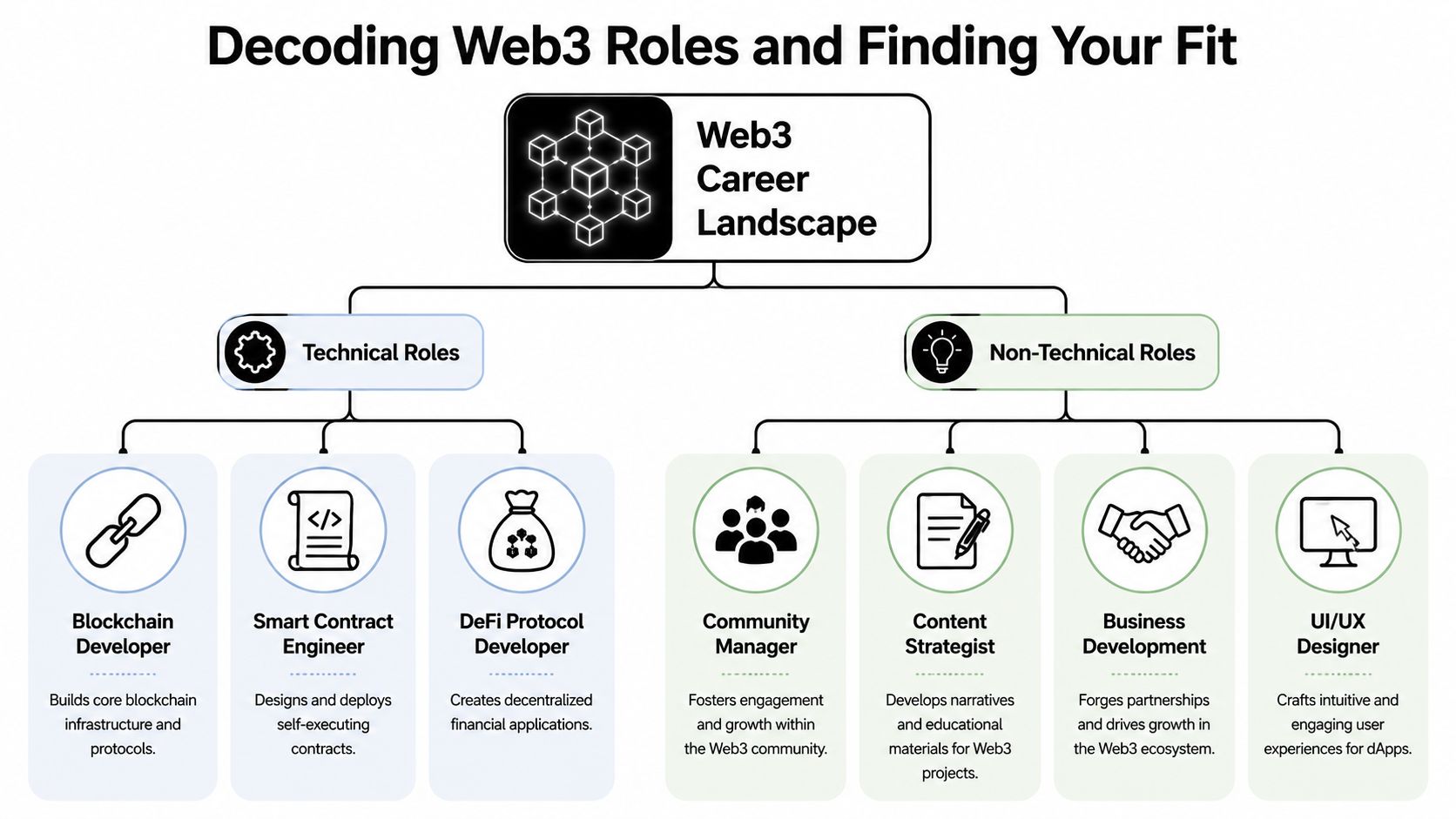
Technical roles
Technical hiring usually separates into infrastructure, application, and risk.
A blockchain developer often works closest to the stack itself. That can include node infrastructure, chain integrations, RPC performance, indexing, or backend services around wallets and data flows. If you want a concrete way to study how employers define that role, this Blockchain developer job description template is useful because it shows the mix of architecture, coding, and systems thinking teams often expect.
A smart contract engineer lives closer to application logic. These candidates write and test contracts, think about gas, upgrade patterns, permissions, and exploit surfaces, and usually work with Solidity, Foundry, Hardhat, or chain-specific tooling.
A security auditor or security engineer goes one layer deeper into adversarial thinking. They review assumptions, attack paths, access control, and integration risk. These candidates often stand out because they can explain not just what code does, but how it fails.
Non-technical roles
Non-technical doesn't mean low impact. In good teams, these functions directly affect adoption, risk, and execution.
A product manager in Web3 needs stronger systems literacy than many Web2 PM roles. You don't need to write production contracts, but you do need to understand wallets, signatures, transactions, token flows, and where user friction comes from.
A community or content lead isn't just posting updates. The best people in these roles translate protocol complexity into trust. They handle governance messaging, ecosystem education, launch communications, and often crisis communication.
Legal, compliance, and finance professionals have become more valuable as companies grow up. If you can work through cross-border issues, token-related workflows, or operational controls without killing product velocity, you're highly useful.
Crypto job roles at a glance
| Role Title | Category | Core Skills | Typical Salary Range (USD) |
|---|---|---|---|
| Blockchain Developer | Technical | Rust or Go, distributed systems, APIs, node infrastructure | Varies by company and market |
| Smart Contract Engineer | Technical | Solidity, Foundry, Hardhat, testing, gas optimization | Varies by company and market |
| Security Auditor | Technical | Threat modeling, code review, exploit analysis, formal rigor | Varies by company and market |
| Product Manager | Non-Technical | User research, token flow literacy, roadmap judgment, stakeholder alignment | Varies by company and market |
| Community Manager | Non-Technical | Communication, governance support, moderation, ecosystem engagement | Varies by company and market |
| Compliance Counsel or Manager | Non-Technical | Regulatory analysis, policy design, documentation, cross-functional advising | Varies by company and market |
| UI UX Designer | Non-Technical | Wallet UX, onboarding flows, transaction clarity, prototyping | Varies by company and market |
| Business Development | Non-Technical | Partnerships, protocol positioning, deal execution, ecosystem mapping | Varies by company and market |
How to choose your lane
Don't pick based on what sounds prestigious. Pick based on your evidence and your working style.
- Choose engineering if you like shipping under technical constraints and can point to code, tests, or architecture decisions.
- Choose product if you naturally connect users, systems, and trade-offs, and you can write crisp specs around wallet behavior or transaction flows.
- Choose growth or community if you're good at turning complexity into trust and can show writing, campaigns, moderation, or governance work.
- Choose compliance or legal if you can operate in ambiguity without becoming a blocker.
If you're still unsure, spend time reviewing role breakdowns and market categories in this guide to blockchain technology jobs. It helps translate abstract titles into actual work.
The best-fit role usually sits at the intersection of what you're already good at and what crypto companies struggle to hire for.
Crafting a Crypto-Native Resume and Portfolio
Generic resumes die fast in this market. Data cited by Binance Square shows 65% of crypto job applicants are rejected due to generic resumes lacking quantifiable benchmarks, and profiles with crypto-specific keywords and measurable impact see a 35% higher application-to-interview conversion rate in this Binance Square hiring analysis.
That lines up with how hiring works. Recruiters and hiring managers are scanning for proof that you understand the environment you're applying to. “Passionate about blockchain” doesn't help. A GitHub repo, governance write-up, product teardown, or dashboard does.

What a crypto-native resume looks like
A strong resume for a job in crypto reads like a record of shipped work, not a list of interests. It should show relevance quickly.
For developers, that means linking to GitHub, audits, test suites, protocol integrations, hackathon repos, or technical write-ups. For product, design, marketing, or community candidates, it means publishing artifacts. That could be a user flow teardown, governance forum post, ecosystem campaign, token incentive analysis, or Dune dashboard.
Use the language teams search for. If your background includes L2 work, wallet UX, MEV mitigation, token operations, cross-chain messaging, or smart contract testing, say so plainly. The same goes for metrics. “Optimized EVM gas costs by 40%” is stronger than “improved efficiency” because it shows that you understand what crypto teams care about.
Build evidence in layers
Don't wait for a company to give you permission to become legible.
- Public code or artifacts: Push clean repos, Figma files, dashboards, or long-form analyses.
- Context-rich bullets: Explain the problem, your action, and the outcome. Avoid vague verbs like “supported” or “helped.”
- Live links: Portfolio links matter more than attachment-heavy applications in a market that values visible proof.
A developer bullet might mention contract architecture, testing depth, and a measurable improvement. A product candidate might describe reducing wallet connection friction or redesigning a signature flow after user interviews. A community candidate might show how they handled governance updates during a controversial proposal.
What to remove before you apply
Crypto hiring teams do look beyond your PDF. They check your posts, repos, comments, and public presence. Clean that up before you start applying. If your online footprint is messy or contradictory, this guide on how to clean up social media for job search is worth using as a checklist.
Also remove what weakens signal:
- Old generic summaries: Delete broad mission statements that could fit any tech role.
- Unfinished side projects: Two polished artifacts beat ten abandoned experiments.
- Buzzword stuffing: If you say “DeFi,” “AI,” or “tokenomics,” be ready to discuss actual work.
If a claim on your resume can't survive a follow-up question, cut it.
Portfolio examples that actually help
The strongest portfolios usually prove judgment, not just activity.
For engineers, that might be a small but well-tested protocol, a security review of an existing contract, or a contribution to open-source tooling. For PMs, a crisp memo on how a protocol should redesign onboarding can be enough if it shows product thinking and chain literacy. Designers can stand out with transaction-state UX, wallet connection improvements, or signing flow redesigns. Content and community candidates should show they can simplify without flattening nuance.
Your portfolio doesn't need to be huge. It needs to make it obvious why someone should interview you.
Finding and Winning Your Dream Crypto Job
Where you apply affects your odds more than most candidates think. General job boards are full of noise. You end up digging through irrelevant listings, stale roles, and companies that use “blockchain” as a branding layer rather than a real hiring need.
Specialized platforms are usually better because role tags, team categories, and crypto-native employers create better filtering. That matters when you're trying to find the right job in crypto instead of just any listing that mentions Web3.
Where signal is better than noise
General boards can still work for large exchanges, fintech firms, or companies with hybrid crypto teams. But they tend to flatten role detail. A “backend engineer” listing might require smart contract literacy, wallet integrations, and on-chain data handling, and none of that is clear until late in the process.
Specialized crypto hiring channels usually make the context visible earlier. You can see whether a company is infra-heavy, compliance-heavy, protocol-focused, or ecosystem-led. That lets you tailor your application with actual relevance instead of spraying the same resume everywhere.
What gets interviews
Strong applications feel specific. Weak ones feel transferable.
Hiring managers want to know three things fast:
- Do you understand what this company does
- Can you do the work without hand-holding
- Will you make the team sharper, calmer, or faster
That means every application should reference the product category, technical stack, user base, or operating constraints that define the role. If you're applying to an exchange, think in terms of liquidity, operations, risk, and reliability. If it's a DeFi protocol, think contracts, incentives, governance, and security. If it's infrastructure, think latency, throughput, abstractions, and developer experience.
Most interview invites go to candidates who make the hiring manager feel understood.
How to prepare for crypto interviews
Crypto interviews expose shallow preparation quickly. Candidates often prepare for generic behavioral questions and ignore the project's actual mechanics.
Use this framework before every interview:
- Read the docs: Understand the product flow, token role, architecture, and user journey.
- Trace real usage: Connect a wallet, use the app, inspect transaction prompts, and note friction points.
- Review public artifacts: Read governance forums, blog posts, audit summaries, or release notes.
- Prepare a point of view: Bring one informed suggestion, one risk you noticed, and one question that shows depth.
For technical roles, expect discussion around code quality, testing strategy, failure cases, and trade-offs. For product and design roles, expect questions on trust, onboarding, and chain constraints. For marketing, community, and ops roles, expect to discuss judgment under ambiguity.
How to evaluate the offer before you say yes
Candidates spend too much effort getting the offer and too little reading it. Title inflation, vague bonus language, unclear token references, and loosely defined probation terms still show up in crypto hiring. Before signing, review the details carefully. This breakdown of understanding offer letter risks is a practical way to spot terms that need clarification.
Ask direct questions about reporting lines, performance expectations, vesting mechanics, IP language, termination clauses, and whether token compensation is discretionary or contractual. If a company gets evasive during offer review, take that seriously.
A good crypto offer should feel ambitious and understandable at the same time.
Navigating Crypto Compensation and Token Packages
Most candidates know how to compare salaries. Far fewer know how to compare a salary plus token package, or partial fiat versus partial crypto payroll. That's where people make expensive mistakes.
Compensation in Web3 often differs structurally from traditional tech. The base salary might only tell part of the story. You may also be weighing token grants, vesting schedules, cliffs, lockups, exercise windows, payout currency, and tax timing. Many career guides skip that complexity, but for a serious job in crypto, it's central.

What to ask when a token package appears
Start with structure, not upside. Ask whether the token allocation is granted, promised, or discretionary. Ask what vests, when it vests, and what happens if you leave before a cliff. Clarify whether the token is liquid, locked, thinly traded, or subject to internal transfer restrictions.
Then look at concentration risk. A package can look generous while exposing you to too much of one asset tied to one employer. That's why partial crypto payroll needs discipline, not just enthusiasm.
According to research on crypto payroll demand and supply, 43% of employees are interested in being paid partly in crypto, but only 7% of employers offer it. The same research suggests a practical benchmark of targeting about 27% of pay in stablecoins and capping total crypto exposure at 30%, a strategy that showed 75% opt-in success in pilot programs.
A negotiation stance that protects you
The candidate mistake is obvious. They negotiate for more tokens before they understand downside.
A better approach:
- Anchor your base clearly: Treat fiat or stable salary as the foundation for living costs, taxes, and downside protection.
- Ask for stablecoin optionality: If the employer supports partial crypto payroll, stablecoins are usually easier to budget around than volatile assets.
- Model token value conservatively: Evaluate the package as if upside may take time, liquidity may be limited, and vesting may outlast your ideal tenure.
This is one reason compensation transparency matters more in crypto than in many other sectors. The same headline package can mean radically different real outcomes depending on cliff length, vesting cadence, lock conditions, and how much of your total pay sits in volatile assets.
What good candidates negotiate besides salary
Most negotiation conversations should also include operational details.
Ask about:
- Vesting schedule: Monthly, quarterly, and annual schedules create very different risk.
- Cliff terms: A long cliff can wipe out the value of a short tenure.
- Payment rails: Understand whether payroll runs in fiat first, then converts, or whether crypto is the direct payment method.
- Documentation: Make sure token compensation terms are written into the offer or a binding addendum.
If you're comparing offers across levels, this roundup of Web3 jobs that make 150K a year in 2026 is useful for seeing how seniority and function can change the compensation conversation.
Don't negotiate crypto compensation like a trader. Negotiate it like an employee who wants upside without avoidable fragility.
Building a Long-Term and Resilient Web3 Career
Teams shrink fast in downturns. The candidates who keep getting hired are usually the ones with a clear specialty, a track record that survives one failed project, and compensation choices that did not force them into a rushed move six months later.
Getting the first crypto role matters. Building a career that can survive two market cycles matters more.
A lot of candidates approach Web3 like a series of trades. Join a hot team. Collect tokens. Switch when another offer looks bigger. I have seen that strategy work in bull markets and fail hard when liquidity dries up, token vesting slips, or a project loses distribution. Durable careers are built differently. They start with a hard skill, a reputation for judgment, and enough financial discipline to stay selective.

Specialization creates staying power
The strongest candidates are rarely "general Web3 talent." They are known for something specific that teams struggle to hire for.
That center of gravity can be technical, operational, or commercial. Smart contract security, protocol data analytics, exchange integrations, growth for developer products, governance communications, treasury operations, cross-border compliance, and wallet UX are all examples. Each gives you a clearer hiring narrative than broad crypto enthusiasm ever will.
Breadth still matters. Strong careers usually become T-shaped over time. Deep expertise in one domain. Working fluency across adjacent functions so you can ship with legal, product, engineering, finance, and community teams without slowing everyone down.
Career paths that age well
Some paths hold value better than others because the underlying problems keep showing up across cycles:
- Engineer to security, infrastructure, or architecture: These candidates get harder to replace as systems become more complex and risk rises.
- Community or support to product operations: The best operators hear friction first and can turn recurring user pain into product decisions.
- Designer to trust and transaction UX: Signing flows, wallet recovery, permissioning, and onchain confirmation states are specialized problems with real downside if handled poorly.
- Legal, finance, or compliance to strategic operations: Teams need people who can turn policy constraints into workable processes without freezing execution.
Early-career candidates should test a few environments before committing. Mid-career candidates should narrow faster. At that stage, vague adaptability often reads like weak positioning.
If you are still choosing a first path, this list of jobs for beginners in blockchain is useful because it points toward roles that build transferable judgment, not just short-term title inflation.
Plan your next two moves, not just your next title
A good career decision opens the next market for you. A bad one traps you in a niche that only existed for one cycle.
Use three filters before taking a role:
| Question | Strong answer |
|---|---|
| What hard problem will this role train me to solve repeatedly? | A visible problem that matters in any market, such as security, compliance, core product flows, or revenue operations |
| What proof will I have in 12 to 18 months? | Shipped work, measurable outcomes, respected references, and artifacts you can show future employers |
| What options does this create after this company? | Access to stronger teams, better scope, and a more credible specialist profile |
Candidates often overlook the compensation angle. A package with heavy token upside can look career-accelerating, but if the company has weak product traction or your vesting starts with a long cliff, the role may reduce your options instead of expanding them. Long-term career planning in crypto is not separate from compensation planning. They are tied together. If your runway depends on a token event or secondary liquidity that may never come, you lose negotiating power later.
Build a reputation people can verify
Reputation in Web3 travels through backchannels fast. So does weak execution.
The people who keep getting referred have a pattern: they ship, communicate clearly, and leave behind evidence. For engineers, that can mean merged code, audits, technical writing, or public issue discussions. For product and ops, it can mean launch docs, postmortems, process design, analytics frameworks, or partner workflows. For go-to-market roles, it can mean case studies, growth experiments, ecosystem relationships, and clean ownership of a launch.
Anonymous clout is less useful than many candidates think. Hiring managers still ask the same questions. What did you own? What changed because of your work? Would a former founder or functional lead hire you again?
Strong crypto careers are built on specific judgment under pressure, not trend-chasing.
Your goal is straightforward. Become the person teams call when a high-stakes problem appears, and choose roles and compensation structures that let you keep building that advantage over time.