
Secure Your Job React Native: The 2026 Web3 Guide
You've probably felt this already. You can build React Native apps, you've shipped a few side projects, and recruiters still seem to sort you into the same pile as everyone who copied a clone tutorial and pushed it to GitHub. The gap between “I can code” and “I can get hired” is wider than most developers expect.
That gap gets even stranger in Web3. Startups want mobile engineers who can move fast, understand product trade-offs, and handle enough blockchain context to avoid shipping something dangerous. They don't need a protocol researcher. They need someone who can build a stable app, connect it to wallets and smart contracts, and keep the user experience sane.
Your Roadmap From Developer to Hired Engineer
The opportunity is real, but it's not automatic. A Coursera overview of React Native careers reported over 4,000 open React Native developer positions on LinkedIn, cited Glassdoor's $113,000 median US pay estimate, and noted that the US Bureau of Labor Statistics projected 16% growth for software developers from 2024 to 2034, compared with the 3% median for all occupations. That matters if you're targeting a job React Native role because it confirms you're not chasing a tiny corner of the market.
What trips people up is the assumption that demand alone should make the process easy. It won't. Hiring managers don't reward broad familiarity. They reward evidence. Can you ship? Can you debug? Can you explain trade-offs? Can you work with product, design, and backend teams without turning every feature into a rewrite?
For Web3 startups, the bar gets more specific:
- Core mobile competence first: If your state flow is messy, blockchain knowledge won't save you.
- Security awareness second: Wallets, signatures, and transaction prompts raise the cost of sloppy engineering.
- Clear product judgment: Crypto apps often fail on usability before they fail on code.
- Proof of work: Shipped apps, code samples, and thoughtful portfolio projects matter more than a list of buzzwords.
A strong roadmap looks like this:
- Tighten your fundamentals. JavaScript, React, React Native internals, performance, and platform-specific behavior.
- Add a Web3 specialization. Wallet integration, smart contract reads and writes, chain data handling, and secure UX patterns.
- Build portfolio projects that reflect the jobs you want. Not generic clones. Mobile dApps, wallet flows, transaction-heavy interfaces.
- Package your experience for hiring systems. Resume, GitHub, LinkedIn, and a portfolio that a recruiter can scan quickly.
- Prepare for interviews like an engineer, not an exam taker. Most React Native interviews are trying to detect how you think under constraints.
- Target the right openings. Generic app jobs and Web3 mobile roles have overlap, but they don't screen for the same signals.
The market rewards candidates who look easy to trust. Your whole job search should reduce doubt.
Mastering the Core React Native Skillset
React Native hiring gets misread all the time. Candidates think interviewers want framework trivia. Good interviewers don't. They want proof that you can build, maintain, and debug a production app without creating chaos for everyone else.
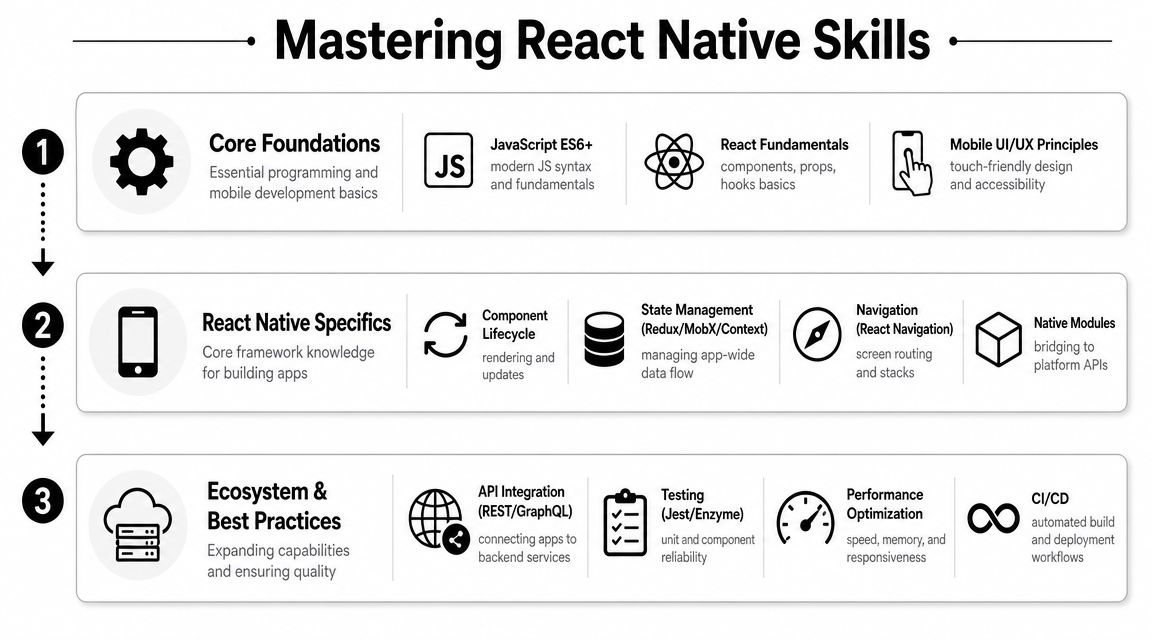
Core foundations
Start with the basics that separate weak candidates from strong ones.
- JavaScript and TypeScript fluency: You need to be comfortable with closures, async behavior, object and array transformations, error handling, and typed API contracts. If you still reach for trial-and-error every time a promise chain breaks, fix that first.
- React fundamentals: Components, hooks, rendering behavior, memoization, controlled inputs, and state ownership. A lot of React Native bugs are still just React bugs wearing mobile clothes.
- Mobile UI judgment: Spacing, safe areas, touch targets, loading states, keyboard handling, and platform conventions. Web habits don't transfer cleanly to mobile.
A surprising number of candidates can build a screen but can't explain where state should live or why a component keeps re-rendering. That's a hiring problem.
Hiring manager lens: If you can't describe data flow clearly, I assume debugging you later will be expensive.
React Native specifics that actually matter
Once the base is solid, focus on the framework details that show you've worked on real apps.
Here's the hierarchy I use when I interview:
- Navigation and screen lifecycle: React Navigation patterns, deep linking, nested navigators, and handling state when screens mount, blur, and unmount.
- State management choices: Context for small scope, Zustand or Redux when the app needs shared structure, server-state tools for remote data. The wrong tool isn't always fatal. Not knowing why you picked it is.
- Native boundaries: Native modules, permissions, device APIs, and what happens when JavaScript has to coordinate with platform code.
- Performance: Long lists, image-heavy screens, unnecessary re-renders, animation jank, and startup bottlenecks on real Android devices.
If you need a clean overview of how teams develop cross-platform mobile apps, that resource is useful because it frames React Native in practical delivery terms rather than theory.
What moves you from junior to mid-level
The jump usually comes from judgment, not syntax.
| Level | What they can do | What they often miss |
|---|---|---|
| Junior | Build features with guidance | State boundaries, cleanup, performance side effects |
| Mid-level | Own screens and flows end to end | Cross-team communication under shifting requirements |
| Senior | Design app structure and reduce risk | Sometimes over-engineers simple features |
A candidate starts to look mid-level when they can discuss trade-offs like these:
- Choosing Expo versus bare React Native based on product constraints
- Splitting UI state from server state
- Explaining why a list screen lags on lower-end devices
- Knowing when a native dependency is justified and when it adds future upgrade pain
React Native rewards engineers who keep the dependency surface small and the architecture boring.
That last point matters in startups. Fancy folder structures don't impress anyone when a simple bug takes half a day to trace.
Gaining the Web3 Edge in a Crowded Market
Generic React Native skills get you into the conversation. Web3 mobile skills change what roles you can realistically win.
Most crypto products are now judged through the app experience, not the protocol docs. Users open a wallet, approve a signature, review balances, sign a transaction, and expect the app to explain what's happening without leaking technical debt into the interface. That makes mobile engineers unusually valuable in Web3 because they sit between infrastructure complexity and user trust.
Why Web3 specialization pays off in interviews
A standard mobile candidate can build authenticated flows, API-driven dashboards, and polished UI. A Web3-ready candidate can also handle these realities:
- Wallet interaction: Connecting external wallets or embedding wallet features inside the app.
- Contract communication: Reading on-chain data, submitting transactions, and handling failures without confusing users.
- Chain-aware UX: Network switching, pending states, gas prompts, and irreversible actions.
- Security-sensitive product choices: Key handling, session persistence, biometric gates, and transaction confirmation design.
That combination is hard to fake. It shows up fast in an interview.
If you want a concrete example of how these roles are framed in the market, review a live mobile engineer opening at Fireblocks. Don't copy the wording. Study the overlap between mobile engineering, product responsibility, and crypto-specific context.
What a mobile dApp actually needs
A lot of developers overcomplicate their first Web3 app. You don't need to build a full wallet on day one. You do need to understand the moving parts.
A practical mobile dApp usually includes:
Wallet connection layer
This may involve WalletConnect-style flows, embedded wallets, or app-managed account experiences depending on the product.Blockchain read operations
Fetch balances, token metadata, NFT holdings, transaction history, or protocol positions.Write operations
Sign messages, approve token interactions, submit transactions, and reflect pending or failed states in the UI.Off-chain support systems
Indexers, backend APIs, notifications, analytics, and cached data. Very few usable crypto apps are purely on-chain from the client's perspective.
Mobile Web3 work is mostly product engineering under high trust requirements. The blockchain part is only one layer.
Choosing your first library stack
For most React Native developers entering Web3, the question isn't “Which library is best forever?” It's “Which stack helps me ship a credible first product without getting buried in abstractions?”
React Native Web3 Library Comparison
| Library | Best For | Key Feature | Learning Curve |
|---|---|---|---|
| ethers.js | Most app developers building contract interactions | Clean contract interface and signer model | Moderate |
| web3.js | Teams working in ecosystems where it's already established | Broad historical adoption across Web3 tooling | Moderate to high |
| viem | Developers who want a typed modern approach | Strong developer experience around typed interactions | Moderate |
| WalletConnect tooling | Apps that need external wallet connectivity | Standardized wallet session flows | Moderate |
My opinion is simple. Start with ethers.js unless your team has a strong reason not to. It has a cleaner mental model for most frontend and mobile engineers. Use web3.js when compatibility with an existing codebase matters more than elegance. Reach for viem if type safety and modern ergonomics are priorities and your team is comfortable adopting newer patterns.
What hiring managers want to hear
When I ask a candidate about Web3 mobile work, I'm not looking for chain maximalism. I'm listening for practical judgment:
- How would you show transaction status inside the app?
- What happens if chain data is slow or inconsistent?
- Where should signing happen?
- How do you prevent users from making an irreversible mistake?
- Which data comes from the chain, and which should come from an indexed service or backend?
Candidates who answer in terms of user trust usually stand out. Candidates who answer only in terms of libraries usually don't.
Building Portfolio Projects That Get You Hired
Most React Native portfolios fail for one simple reason. They look like practice, not proof.
A to-do app tells me you can follow a tutorial. A weather app tells me you can call an API. Neither tells me I should trust you with a wallet flow, complex state, or a production mobile app that handles money.
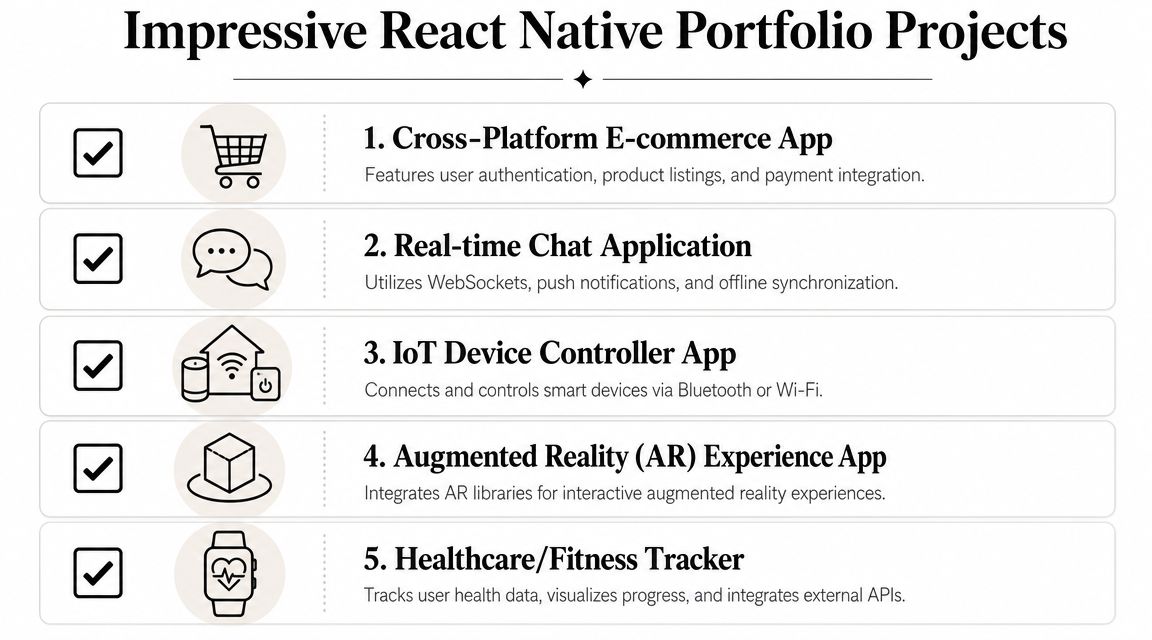
Build projects that mirror the jobs
If you want a job React Native employers take seriously, build projects that resemble the work those teams ship.
Project idea one
NFT gallery with wallet-based identity
This is the simplest useful Web3 mobile project. The app connects a wallet, fetches owned NFTs, renders collection data cleanly, and handles empty states well.
What I'd inspect:
- Contract read patterns
- Loading and refresh behavior
- Image caching and list performance
- Error handling when metadata is incomplete or slow
- Separation between UI components and chain logic
Project idea two
DeFi portfolio dashboard
This project has much higher signal because it mixes market-style interfaces with messy data. You pull token balances, protocol positions, and transaction history into a mobile dashboard that feels coherent.
What it proves:
- You can manage complex async state
- You understand derived values and formatting
- You can design around stale or delayed data
- You can avoid turning every screen into a giant effect soup
For teams evaluating React Native options for startups, boilerplates can help with setup speed, but they won't rescue weak architecture. If you use one, keep the project opinionated and trim anything you don't need.
The project that gets the most attention
Transaction signing wallet prototype
This is not where I'd tell a beginner to start, but it gets attention because it forces you to deal with trust-heavy UX. Even a limited prototype that signs messages, displays assets, and walks through transaction review can say a lot about your engineering maturity.
A strong version includes:
- Biometric gate before sensitive actions
- Clear transaction summary screens
- Distinction between message signing and transaction signing
- Defensive handling of failures and retries
- Sensible local persistence strategy without reckless shortcuts
If you want to see how employers frame this type of experience, study a live senior React Native engineer role in climate and blockchain. The useful part isn't the title. It's how the role blends product ownership, mobile quality, and domain understanding.
Portfolio projects should answer one question fast. Would I let this person own a feature with real users?
Make your repository easy to scan
Recruiters and interviewers don't have time to reverse-engineer your intentions. Your repo should communicate competence in a few minutes.
Use this structure:
- Clear README: What the app does, how to run it, screenshots or screen recording, architecture notes, known trade-offs.
- Feature-based folders: auth, wallet, portfolio, transactions, settings. Not giant buckets like components and utils with no boundaries.
- Small, named commits: Messy commit history suggests messy working habits.
- Environment notes: Explain required keys and mocked data paths cleanly.
- Tests where they matter: Not test theater. Cover parsing, hooks, state transitions, or critical business rules.
What doesn't help
Skip these if your goal is hiring advantage:
- Basic clones with no technical depth
- UI-only Dribbble recreations with no data flow
- Massive unfinished apps with no polished core flow
- Repositories full of copied boilerplate and no explanation
One polished mobile dApp beats five scattered side projects every time.
Crafting a Resume That Beats the Bots and Impresses Humans
A good resume doesn't list everything you've touched. It makes a hiring manager believe you can solve a specific kind of problem.
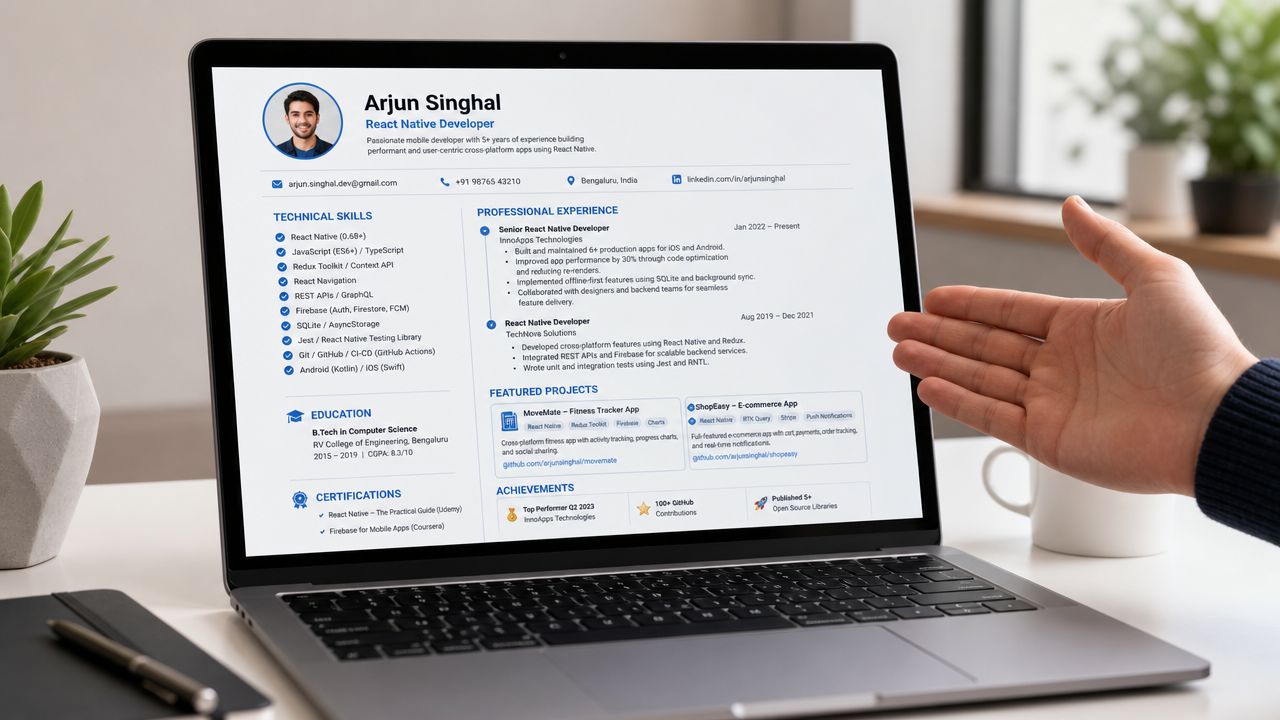
Write for filtering first
ATS systems and recruiters both scan for relevance before they scan for nuance. That means your resume needs plain language around the work you actually want.
If you're targeting React Native and Web3 roles, include the terms that accurately describe your experience:
- React Native
- TypeScript
- iOS and Android
- State management tools you've used
- Wallet integration
- Smart contract interaction
- API integration
- Mobile performance optimization
- CI/CD or release workflows
Don't keyword-stuff. If a term doesn't match your real work, leave it out. Good interviewers will spot inflated resumes quickly.
Turn tasks into evidence
Weak bullet point:
- Used Redux for state management in a React Native app
Better bullet point:
- Architected shared client state for a React Native app using Redux, separated async server data from UI state, and reduced screen-level logic by moving business rules into testable selectors and hooks
The second version works because it shows judgment. It explains what changed structurally and why it matters.
Use a simple STAR pattern in compressed form:
- Situation: What kind of app or feature?
- Task: What problem needed solving?
- Action: What did you build or change?
- Result: What concrete outcome can you describe qualitatively if you don't have verified numbers?
A lot of candidates stop at tools. Recruiters need outcomes, and engineers need decision-making.
Your resume should read like an ownership record, not a package.json file.
Tailor for Web3 without sounding performative
You don't need to pretend you're a cryptography expert. Most hiring teams would rather see honest product engineering experience than shallow blockchain buzzwords.
Good phrasing looks like this:
- Built mobile wallet connection flows and handled signature requests with clear user confirmation states
- Integrated smart contract reads into React Native screens and designed fallback handling for delayed or inconsistent chain data
- Worked with backend and product teams to present blockchain activity in a way non-technical users could understand
That sounds far stronger than:
- Passionate about DeFi, NFTs, DAOs, and the decentralized future
Your LinkedIn and GitHub need alignment
A hiring flow breaks when these three assets tell different stories:
- Resume says mobile engineer
- LinkedIn says full-stack developer
- GitHub shows unfinished experiments
Fix the mismatch. Your headline, summary, pinned repositories, and recent activity should support the same narrative. If you want a React Native Web3 role, make that visible everywhere.
Also, remove dead links, stale portfolios, and vague summaries. Clean presentation doesn't make you more technical, but it does make you easier to shortlist.
Navigating the React Native Interview Process
Most React Native interviews aren't trying to prove you're brilliant. They're trying to reduce risk. Can this person build mobile features without supervision becoming a full-time job? Can they reason through bugs? Can they collaborate under startup pressure?
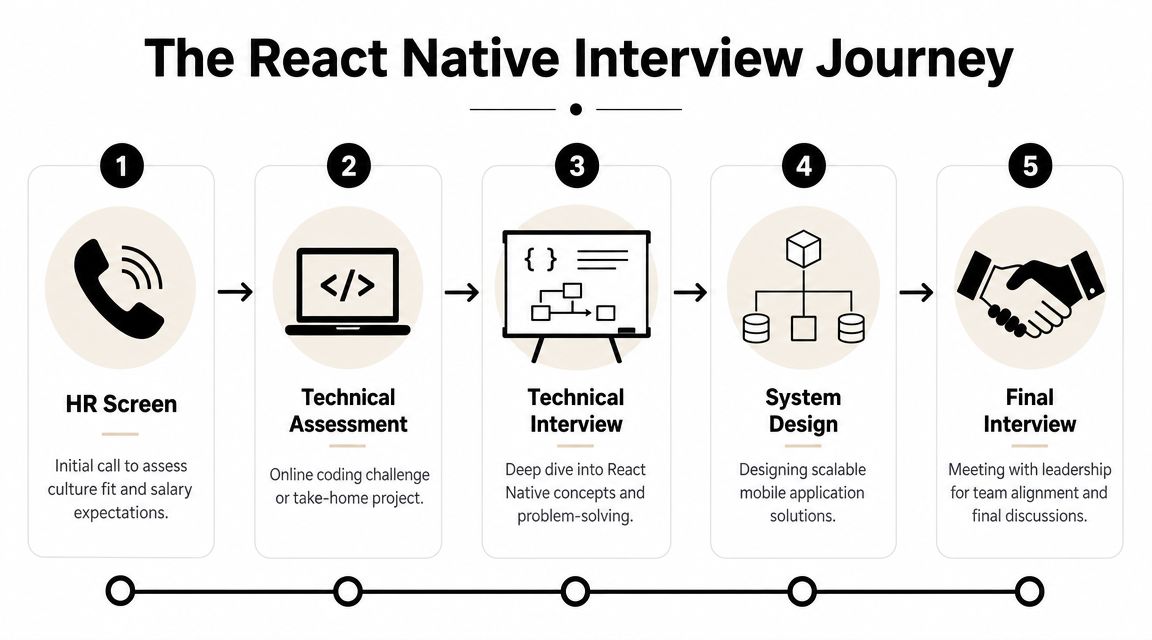
A useful framing from DevsData's React Native hiring guidance is this sequence: define the app scope, review shipped apps or code samples, then test how candidates would structure state, integrate a backend, and coordinate with designers or backend engineers. That screening sequence matches what strong companies do in practice because resumes alone don't tell them how you think.
Stage one with recruiters and hiring leads
The first call is rarely technical, but it matters. During this call, teams check communication, motivation, compensation fit, and whether your experience maps to the product.
Typical questions:
- Why React Native instead of native iOS or Android?
- What kind of app have you worked on?
- Why Web3?
- What size team do you work best in?
- What kind of role are you looking for next?
Bad answers are abstract and generic. Good answers are specific and grounded in shipped work.
For example, if asked why React Native, don't say “cross-platform is efficient.” Say that shared product logic, faster iteration, and a single mobile team are useful until a feature justifies native complexity, and then explain how you've handled that trade-off.
Technical screen and take-home
Here, weak candidates usually leak confidence. They either overcomplicate the assignment or rush into coding without clarifying constraints.
Use a simple approach:
- Restate the problem: Confirm assumptions before writing code.
- Choose boring patterns: Interview code should be readable before it's clever.
- Explain state ownership: Say where local, shared, and remote data should live.
- Handle failure paths: Loading, empty, and error states count.
- Call out trade-offs: Especially if the challenge is too small to justify heavy architecture.
Here's a practical walkthrough if you want a second voice before interview prep:
A take-home project is usually testing restraint. Teams want to see whether you can ship a maintainable solution inside limits.
Deep technical and system design rounds
In a stronger interview loop, you'll get questions that move past syntax.
Common technical prompts:
- How would you debug a React Native screen with noticeable lag?
- When would you use Context versus Redux or Zustand?
- How do you organize code for a feature that depends on both backend data and wallet state?
- What can go wrong when integrating native modules?
- How would you structure offline handling for a mobile crypto dashboard?
For system design, interviewers don't expect giant whiteboard theatrics. They want a mobile-minded architecture with sane boundaries.
A solid answer often includes:
| Interview area | What they want to hear |
|---|---|
| State design | Clear separation of local UI state, remote data, and persisted session data |
| Performance | Awareness of list rendering, memoization, image handling, and low-end Android behavior |
| Collaboration | How mobile, backend, design, and product coordinate on contracts and edge cases |
| Web3 thinking | Transaction states, wallet flows, trust-sensitive UX, and failure recovery |
Behavioral questions matter more than candidates think
Good startups ask things like:
- Tell me about a feature that changed midway through implementation
- Tell me about a disagreement with design or backend
- Tell me about a bug that took too long to fix
- Tell me about a shortcut you refused to take
The best answers sound calm and accountable. You don't need hero stories. You need evidence that you can work through ambiguity without becoming defensive.
If you're interviewing for a job React Native teams care about, prepare stories about debugging, trade-offs, collaboration, and product judgment. Those stories often decide the offer when technical skills are close.
Finding Openings and Negotiating Your Offer
A lot of developers search poorly. They apply broadly, track nothing, and wonder why the process feels random. It feels random because the strategy is random.
Generic platforms versus specialized Web3 boards
LinkedIn is useful for reach, recruiter traffic, and mainstream mobile roles. It's less useful when you want crypto-native teams that care about wallet flows, on-chain product thinking, and remote-first engineering setups.
Specialized Web3 platforms narrow the signal. A live example is this React Native wallet team role at Tether Operations Limited. Listings like that usually make the domain expectations visible much faster than general boards do.
Use both types of channels differently:
- LinkedIn for discovery: Follow companies, track recruiters, and watch who's hiring repeatedly.
- Specialized boards for fit: Focus on roles where your mobile and Web3 skills align directly.
- Direct applications for conviction: If a team's product matches your background, write a focused application instead of mass-applying.
If LinkedIn has felt noisy, these RedactAI LinkedIn job tips are a practical refresher on searching and positioning without turning your profile into keyword sludge.
What networking works
The best networking for engineers usually doesn't look like networking.
Do this instead:
- Contribute to relevant open-source tooling: Wallet SDKs, UI kits, chain data clients, or React Native packages.
- Join product-centric Discord communities: Not to shill yourself, but to understand what teams are building and where pain points are.
- Share technical writeups: Short posts about a wallet integration bug, transaction UX decisions, or React Native performance lessons can get attention from the right people.
- Reconnect with prior teammates: Startups hire through trust whenever they can.
The strongest applications usually arrive warm. Someone has seen your work, your code, or how you think.
Negotiation starts before the offer
Your advantage comes from clarity, not aggression. Know what kind of company you're speaking with, what role scope they expect, and which parts of the package matter to you.
For market context, a 2026 UK hiring snapshot for React Native reported that in the six months leading up to 8 May 2026, React Native ranked 480th among permanent UK IT jobs, up from 497th in 2025, with median annual salary rising to £70,750. Use that as one benchmark, not a script.
Negotiate around the full package:
- Base salary: Important, but not the whole story
- Equity or tokens: Ask how vesting works and what the liquidity reality is
- Remote expectations: Time zones, travel, on-call load
- Tooling and support: Learning budget, device budget, conference support
- Role scope: Title inflation with vague responsibilities is a warning sign
When you respond to an offer, keep it direct. Thank them, state your enthusiasm, identify the gap, and ask whether they can improve the package. Confident candidates sound collaborative, not theatrical.
If you're serious about landing a React Native role in Web3, use Blockchain Jobs to find openings that match your skill set. It's one of the few places where mobile engineering, wallet products, DeFi apps, and crypto-native teams show up in the same hiring stream, which makes it easier to target the right role instead of sorting through generic listings.