A Career Guide to Programming for Blockchain
Programming for blockchain isn't just another coding niche; it's a direct path to building the infrastructure for a new, decentralized internet. For developers, this translates into a high-impact career with enormous demand and serious earning potential. This world demands a unique mindset—one hyper-focused on security, decentralization, and specialized languages like Solidity or Rust, skills that hiring managers are actively seeking.
Your Roadmap to a High-Value Tech Career

Forget abstract theory. This guide is your practical roadmap to landing a top-tier tech job. We're going to get straight to the point: why programming for blockchain has become one of the most valuable skill sets you can acquire and what hiring managers are desperately searching for. This is about understanding the market forces creating these jobs so you can position yourself as the ideal candidate.
The core idea is simple: follow the money and the growth. Where you see massive investment and adoption, you'll find career-defining opportunities. Big players in finance, logistics, and gaming are all turning to blockchain to build more transparent and efficient systems. This wave of adoption creates a direct, surging demand for developers who can actually build, secure, and maintain them.
The Opportunity in Numbers
The numbers tell a compelling story for your career prospects. The global blockchain market is projected to skyrocket from USD 20.1 billion to an incredible USD 248.9 billion, riding a compound annual growth rate of 65.5%.
This isn't just future-gazing; it’s a present-day reality creating jobs right now. For example, the healthcare blockchain market exploded from USD 831.5 million to USD 7.04 billion in a single year. These aren't just statistics; they're direct indicators of why your skills in this area are becoming more valuable by the day.
This guide frames every concept, tool, and language through one lens: what gets you hired. We'll cover everything from acing the technical interview to building a portfolio that makes a hiring manager stop scrolling and schedule a call.
What This Guide Delivers
We're going to connect every technical skill to a real-world career outcome. You won't just learn what a smart contract is; you'll learn how to write one that stands up to the scrutiny of a technical interview. Instead of just listing programming languages, you'll understand which ecosystems offer the best job security and long-term growth potential.
This approach ensures you're not just learning to code—you're strategically preparing to land a high-paying role in the Web3 world. If you want a preview of the roles you could be applying for, take a look at the current blockchain engineering jobs and see what skills companies are looking for right now.
Core Concepts That Win Technical Interviews
To ace a blockchain developer interview, you need to prove you understand the why behind the technology, not just the what. Hiring managers aren't just looking for a coder; they're testing your ability to think critically about system design, security, and the real-world trade-offs involved in decentralized systems.
Think of a blockchain as a shared, tamper-proof digital notebook. Everyone on the network gets a copy, and every new entry has to be agreed upon before being cryptographically chained to the last one. That's a solid starting point, but to really impress a hiring manager, you've got to go deeper.
Decentralized Ledgers: The Single Source of Truth
At its core, programming for blockchain means building on top of a decentralized ledger. This isn't like a typical database owned by a single company. Instead, it's a shared record book maintained by a network of computers, meaning no single entity can secretly change the history.
In an interview, a common question is to compare a blockchain to a traditional database. Frame your answer to highlight the practical implications, showing you're thinking like a senior engineer:
- Trustless Operations: Explain that users don't need to trust a central middleman; the code is the law. This is the core innovation behind DeFi, enabling people to lend and borrow directly. Mentioning this shows you grasp the business value.
- Censorship Resistance: Since there's no central owner, nobody can unilaterally block a transaction. Interviewers want to know you understand that for many applications, this is a non-negotiable feature, not a bug.
- Transparency: Emphasize that on public blockchains, anyone can audit the transaction history. As a developer, this is a powerful tool for building apps where data integrity is verifiable by anyone.
When you talk about these points, be sure to mention the trade-offs—like slower speeds or higher transaction costs. This proves you’re not just a hype-driven candidate; you’re a pragmatic engineer ready to make real architectural decisions.
Consensus Mechanisms: How the Network Agrees
If nobody is in charge, how does the network agree on what’s true? That's the role of a consensus mechanism. Nailing this question is a surefire way to stand out. The two you must know are Proof-of-Work (PoW) and Proof-of-Stake (PoS).
Interview Pro-Tip: Don't just give dictionary definitions of PoW and PoS. Explain the engineering trade-offs. A hiring manager wants to see if you understand why their company might have chosen one over the other for their specific product.
For instance, explain that PoW, used by Bitcoin, relies on "miners" solving a complex puzzle. This makes it incredibly secure but energy-intensive and slow.
Then, contrast it with PoS, which powers Ethereum and most modern chains. Here, "validators" stake their own crypto as collateral. This is far more energy-efficient and allows for higher transaction speeds—a crucial factor for building scalable applications that can support millions of users. Articulating this shows you're thinking about product scalability, a key concern for any growing company.
Cryptography: The Foundation of Security
Cryptography is the bedrock of blockchain security. You don't need to be a PhD-level cryptographer, but you must demonstrate a practical, developer-centric understanding of its core principles.
Interviewers will almost certainly probe your knowledge on these concepts:
- Public/Private Keys: Use a clear analogy. Your public key is like your bank account number—safe to share. Your private key is the password that authorizes transactions; it must be kept secret. A crisp, confident explanation here is a non-negotiable prerequisite for getting hired.
- Hashing: Explain this as a way of creating a unique, fixed-size fingerprint for any piece of data. Emphasize that changing even a single character in the input creates a completely different hash. This is what chains the blocks together and makes the system tamper-evident.
A great way to impress an interviewer is to walk them through how a user signs a transaction. Explain how their private key creates a digital signature that proves they authorized the transaction without ever revealing the key itself. This practical application is exactly what hiring managers are listening for. It shows you’re ready to build secure systems and launch your career.
2. Choosing Your Tech Stack for Career Success
Deciding on your first blockchain tech stack is the single biggest career decision you'll make when starting out. This isn't just about picking a language; you're committing to an entire ecosystem of tools, communities, and most importantly, job opportunities. The path you choose now will directly shape the interviews you land and the salary you can command.
Let's look at this from a hiring manager's perspective. The major ecosystems—EVM, Solana, and Move—each represent a distinct career path with different demands and rewards.
At a fundamental level, these systems all share the same DNA: a ledger secured by cryptography and kept in sync through a consensus mechanism.
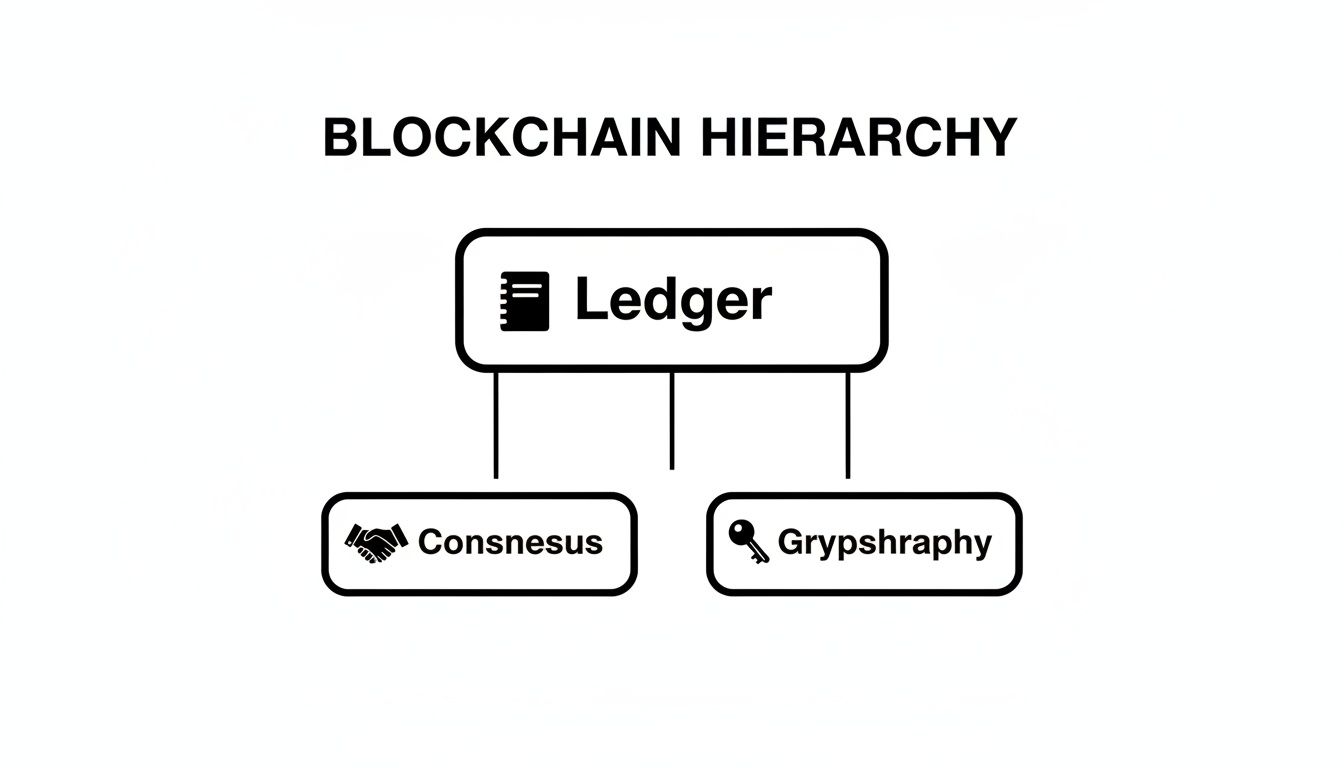
Understanding this hierarchy is table stakes. No matter which stack you choose, you'll be expected to grasp these first principles in any serious developer interview.
The EVM and Solidity: The Established Market Leader
The Ethereum Virtual Machine (EVM) is the undisputed heavyweight champion of smart contract platforms. It's the battle-tested engine powering not just Ethereum but a massive network of compatible chains like Polygon, Avalanche, and BNB Chain. The language here is Solidity.
Career Impact: Learning Solidity is the most direct route to getting hired in this space. The EVM ecosystem has an enormous network effect, hosting the overwhelming majority of valuable protocols. This translates directly into the largest number of open roles, from startups to enterprise-level companies. If your goal is to land a job quickly in the most mature segment of the market, mastering Solidity and the EVM is your best bet.
Solana and Rust: The High-Performance Challenger
The EVM's limitations around speed and cost created a huge opportunity for high-performance blockchains like Solana. On Solana, smart contracts (called "programs") are written primarily in Rust.
Career Impact: Learning Rust for Solana development opens up a different set of high-paying doors. Companies building on Solana are all about speed and scale—think high-frequency trading, Web3 gaming, and decentralized social media. These are applications where the EVM would struggle.
Choosing Rust is a strategic career move toward performance and scalability. Interviewers for Solana roles will grill you on memory management, concurrency, and optimization. These are high-value skills that often command a premium salary.
This path has a steeper learning curve, but the payoff is a powerful career differentiator. It proves to employers you can handle low-level programming and build hyper-efficient systems. As the industry demands more complex on-chain applications, Rust experts are becoming a hot commodity. You can see what this looks like in practice by checking out roles like this Senior Rust Engineer position.
The Move Ecosystem: A Laser Focus on Asset Security
A newer player gaining serious traction is the ecosystem built around the Move programming language, which powers blockchains like Sui and Aptos. Move was designed with one overriding principle: making digital assets a native, first-class citizen of the language itself.
Career Impact: Specializing in Move brands you as an expert in asset security and formal correctness. The language has built-in safeguards against common, catastrophic bugs that have caused billion-dollar exploits on other platforms. Companies building on Sui or Aptos are typically focused on bulletproof financial applications and high-value asset platforms. Proving you can write secure Move code demonstrates a deep commitment to smart contract safety, a skill every top-tier firm values. While the job market is smaller, it's growing fast and gives you a chance to become an early expert in a technology built for the future of digital ownership.
To help you decide which path aligns with your career goals, here's a breakdown of how these ecosystems compare from a job-seeker's perspective.
A Career-Focused Comparison of Blockchain Programming Ecosystems
| Ecosystem | Primary Language | Best For Roles In | Key Advantage for Developers | Learning Curve |
|---|---|---|---|---|
| EVM-Compatible | Solidity | DeFi, NFTs, DAOs, Enterprise | Largest job market and most extensive developer resources | Moderate |
| Solana | Rust | High-Throughput DeFi, Gaming, Web3 Social, Infrastructure | High-demand, high-salary skills focused on performance | Steep |
| Move-Based | Move | Secure Asset Management, FinTech, Next-Gen Collectibles | Specialization in security and a growing niche market | Moderate |
Ultimately, there's no single "best" choice—only the best choice for your career trajectory. The EVM offers the widest entry point, Rust provides a high-skill ceiling with premium rewards, and Move represents an opportunity to specialize in the emerging field of asset-centric development.
Building a Portfolio That Gets You Hired
When you're breaking into blockchain development, your GitHub profile is your resume. It's your proof-of-work. A killer portfolio is the single most effective way to show a hiring manager you can do the job before you even speak to them.
It’s time to move past generic tutorials. To get noticed, you need projects that tackle real blockchain problems. Recruiters aren't just looking for code that works; they're hunting for code that’s secure, efficient, and clearly demonstrates your problem-solving process.
This is the modern developer's workbench, where ideas become deployable smart contracts that get you interviews.

It’s in a setup just like this where you'll build the projects that land you your next role.
Projects That Prove You're Job-Ready
Think of your portfolio as a series of case studies demonstrating your skills. Every project should be a strategic choice meant to spotlight a specific, in-demand ability.
Here are three project ideas that go beyond the basics and scream "hire me" to employers.
- Decentralized Voting DApp: This is a fantastic starter project because it hits all the fundamentals an interviewer looks for: state management, access control, and preventing common exploits like double-voting. It’s the perfect way to prove you have a solid grasp of core smart contract logic.
- NFT Minting Contract and Gallery: Anyone serious about a career in this space needs to understand NFTs. Build an ERC-721 contract and a simple web gallery. This project demonstrates you can work with established token standards, handle ownership data, and integrate with off-chain storage like IPFS—all common tasks in a real job.
- Simple Yield Aggregator: If you're aiming for a high-paying role in DeFi, this one is non-negotiable. Write a smart contract that takes a token (like USDC) and deposits it into a major lending protocol like Aave or Compound. It shows you can securely interact with other protocols and manage user funds, proving you're ready for the complexities of DeFi development.
A strong portfolio answers the question, "Can you build?" before the interviewer even asks. Make sure every project has clean, well-commented code and a detailed
README.mdfile that explains what it does, why you built it, and how to run it.
Polishing Your Portfolio for the Interview
Once you have a few solid projects, frame them to wow hiring managers. This is where you connect your code directly to business value and engineering best practices.
- Lead with Security: Don't just write secure code—document it. Add comments in your smart contracts explaining why you used OpenZeppelin's ReentrancyGuard or the Checks-Effects-Interactions pattern. This shows you’re not just coding; you’re thinking defensively, a crucial trait for any blockchain engineer.
- Write Real Tests: A project without tests is a hobby. A project with a comprehensive test suite is professional-grade work. Use a framework like Hardhat or Foundry to write thorough tests covering edge cases and potential failures. High test coverage is a massive green flag for any technical recruiter.
- Ship a Live Demo: This is a small step with a huge impact. Deploy your DApps to a testnet like Sepolia and put the live link at the top of your GitHub
README. This lets a busy engineering manager see your work in action instantly, making their job easier and making you a more attractive candidate.
By building projects that matter and presenting them professionally, your portfolio will tell a compelling story about your skills and potential. When employers are looking for a blockchain developer, it's this kind of practical, hands-on experience they value above all else.
Mastering the Modern Blockchain Development Workflow
To get hired, you need to work like a professional developer, not a hobbyist. Great ideas are a start, but executing them with an industry-standard toolkit proves you’re ready to contribute to a team from day one. Your ability to efficiently write, test, and deploy secure code is the core skill hiring managers are evaluating.
This means embracing a structured, professional workflow. When you demonstrate fluency with the modern blockchain development lifecycle, you show respect for the field's complexity—especially regarding security. It's a clear signal that you can be trusted to build high-stakes applications.
Essential Frameworks for Smart Contract Development
At the heart of any professional setup is a development framework. These are integrated environments for compiling, testing, and deploying your smart contracts in an automated way. Showing you're skilled with a major framework is a non-negotiable line item on your resume.
In the EVM world, the two heavyweights are Hardhat and Foundry.
- Hardhat: This JavaScript-based environment is the incumbent and incredibly popular. It’s versatile, with a flexible local testing network and a massive ecosystem of plugins. Most established teams use Hardhat, making it a critical skill to land a job.
- Foundry: A newer, Rust-based toolkit, Foundry champions writing tests directly in Solidity. This approach is often much faster and can make you stand out to more forward-thinking or security-obsessed teams.
Hardhat’s value really shines when you see what it offers out of the box.
This isn't just a text editor; it's an entire local Ethereum development environment. You can compile, deploy, test, and debug your Solidity code in a controlled, fast, and free setting—an absolutely essential workflow for any professional developer.
Ensuring Code Quality and Security
In programming for blockchain, a single bug can cost millions. Security isn't an afterthought; it's the most critical piece of the entire process. Hiring managers will always prioritize candidates who demonstrate a security-first mindset.
A portfolio project with a slick UI but zero security analysis is a major red flag. It tells employers you haven’t yet grasped the high-stakes nature of this work.
This is where static analysis tools become your best friend. They automatically scan your code for known vulnerabilities and bad patterns before it ever touches a mainnet.
Slither is the undisputed industry standard. It's a static analysis framework that can sniff out a huge range of common security flaws. Integrating Slither into your workflow and mentioning it in your project's README is a powerful signal to employers that you take security seriously.
Interacting with the Blockchain
Once your contracts are on-chain, you need a way for applications to use them. This is handled by client libraries that bridge your code and the blockchain itself.
For the EVM, Ethers.js and Web3.js are your main options, with Ethers.js generally being the more modern choice. Knowing how to use it to read data, send transactions, and listen for events is a non-negotiable, fundamental skill that will be tested in interviews.
Finally, you must become an expert at debugging on a live network using block explorers like Etherscan. You must know how to:
- Verify your contract’s source code.
- Read contract state directly from the UI.
- Trace failed transactions to pinpoint exactly why they reverted.
Don't be surprised if an interviewer gives you a failed transaction hash and asks you to diagnose the problem. Your ability to quickly navigate Etherscan and explain what went wrong is a direct demonstration of your practical, job-ready skills. Mastering this full toolkit is what separates an aspiring developer from a hirable one.
Navigating the Web3 Job Market and Interview Process
You've learned the fundamentals of programming for blockchain. Now, how do you turn that knowledge into a great job? The key is to think like a hiring manager and craft a standout application.
On your resume, don't just list skills. Show what you did with them. Frame your experience around your portfolio projects and the problems you solved.
Instead of: "Skills: Solidity, Hardhat" Try: "Developed and tested an ERC-721 smart contract for an NFT project using Hardhat, resulting in a 15% reduction in average gas costs for minters."
See the difference? One is a word; the other is a story of your impact. Your GitHub profile should be the most prominent link on your resume—it's your live-action proof of skill.
Crafting a Standout Presence
The best opportunities often come from within the community, not just from job boards.
- Contribute to Open Source: This is the single best way to get on a team's radar. Making real contributions to an established Web3 project proves you can code, collaborate, and are genuinely invested in the ecosystem. It's a working interview.
- Get Active on Socials: Follow the builders you admire on platforms like X (formerly Twitter) and Farcaster. Share what you're building, offer thoughtful comments, and become part of the conversation. Recruiters are always watching.
- Show Up: Participate in hackathons and conferences. These events are goldmines for referrals and inside tracks on open roles, and they show you're passionate about the space beyond a 9-to-5 job.
Decoding the Technical Interview
The Web3 technical interview is less about textbook algorithms and more about practical problem-solving. Expect a mix of smart contract design questions, security challenges, and hands-on coding.
The industry is maturing fast. Big financial firms are actively hiring blockchain developers to build systems that cut costs and improve transparency. The World Economic Forum has some great insights on this digital economy shift. This means companies desperately need engineers who can think about scalability, security, and compliance from day one.
Be prepared for live coding. An interviewer might ask you to write a simple smart contract, find the vulnerability in a code snippet, or whiteboard the architecture for a basic DApp.
The secret is to talk through your thought process out loud. They aren't just looking for the perfect final answer; they're evaluating how you think. Explain your trade-offs and assumptions. This is how you prove you have the critical thinking and communication skills to succeed as a professional blockchain developer.
Your Career Questions Answered
Stepping into the Web3 world naturally brings up a lot of questions about career progression. Let's tackle the most common ones.
Do I Need a Computer Science Degree?
No. In this industry, a formal degree is far less important than your demonstrated ability to build.
Your GitHub profile is your new diploma. A portfolio packed with well-documented projects, a solid grasp of core blockchain concepts, and fluency in a language like Solidity or Rust will open far more doors. Hiring managers care about what you can do, not where you studied.
What Is the Most In-Demand Specialization?
While DeFi remains a massive source of jobs, the most critical and highly-compensated specialization is smart contract security auditing.
Auditors are the guardians of the ecosystem, tasked with finding vulnerabilities before they lead to catastrophic losses. It's a high-stakes, high-reward career path. Beyond security, developers who can build Layer 2 scaling solutions or solve cross-chain interoperability are in constant demand. They’re tackling the fundamental problems that will enable blockchain to achieve mass adoption.
A career in blockchain security isn't just a defensive role; it's about building the very foundation of trust for the entire Web3 space. Auditors who prevent catastrophic hacks are the unsung heroes, and their paychecks reflect that importance.
How Important Is Understanding AI for a Blockchain Career?
It's rapidly becoming a key differentiator. The venture capital funding tells the story: investment in US crypto firms is up 44%, with $7.9 billion deployed.
Here's the kicker for your career: for every dollar invested, 40 cents went to companies working at the intersection of crypto and AI. That's a massive signal from the market. The ability to build AI-powered DApps or integrate on-chain machine learning is no longer a niche skill—it's a competitive advantage that can set you apart in the job market. For a deeper dive, check out the 2024 crypto outlook.
Ready to find your place in the future of tech? At Blockchain Jobs, we connect top talent with leading companies in the Web3 ecosystem. Explore thousands of curated opportunities in engineering, security, product, and more at https://blockchain-jobs.com.