Quality Assurance Internship: A 2026 Guide to Landing Your First Role

A quality assurance internship isn't just another line on your resume; it's a strategic backdoor into the tech industry. It’s your chance to see how software really gets made, influencing everything from the user experience to the final product's success. This is way more than just hunting for bugs—it’s about positioning yourself as a key player on the team that ships great software, a move that hiring managers notice.
Why a QA Internship Is Your Secret Weapon for Breaking Into Tech

Let's bust an old myth right now: QA is not some simple, last-minute check. In today's tech world, a quality assurance internship is one of the smartest entry points for career progression. It’s like getting an all-access pass to see how a product goes from a raw idea to a polished release, giving you a holistic understanding of the business that is rare for junior roles.
This role puts you right in the middle of the action. You're not a bystander; you're a critical partner working alongside developers, product managers, and designers. The work you do has a direct line to user happiness and helps safeguard the company's reputation—a responsibility that looks great in an interview and on a performance review.
The Career Edge You Won't Get Anywhere Else
As a QA intern, you develop a viewpoint that is incredibly rare and valuable for long-term career growth. You learn to put on different hats—thinking like a frustrated user one moment, a developer the next, and then a business owner. This well-rounded perspective is a massive advantage for any career path you choose later, whether it’s becoming a senior QA engineer, a product manager, or even a software developer yourself.
- You See the Whole Picture: Instead of focusing on a single feature, you learn how the entire product fits together. This big-picture thinking is exactly what hiring managers crave when they're looking for future leaders.
- You Master the Art of Communication: Clearly explaining a bug takes a surprising amount of skill. You learn to describe complex technical problems with precision and diplomacy, a core competency for any senior role.
- You Become a Professional Problem-Solver: At its core, QA is detective work. You’ll sharpen your analytical mind by figuring out why things break and tracing issues back to their source, a skill directly applicable to technical interviews.
A great QA intern doesn't just point out what's broken. They understand the impact a bug has on the user and the business. That shift from just finding problems to understanding their consequences is what turns a good intern into an indispensable full-time hire.
A Fast-Track to Web3 and Blockchain
If your career goals include the future of the internet, a QA internship is a perfect entry point into the world of Web3. The need for obsessive, detailed testing is amplified when you're working with things like smart contracts, which can’t be changed once they're on the blockchain.
Web3 companies are constantly searching for people who can guarantee their protocols are secure and reliable. Starting in QA gives you the fundamental skills to build a specialized, high-demand career in this exploding field.
Curious about what hiring managers are looking for? Take a look at the different quality assurance jobs available on Blockchain Jobs to get a feel for what these companies are hiring for right now.
Building the Skillset Hiring Managers Actually Want

If you want to land a quality assurance internship, you must show hiring managers you can do more than just follow a script. They're on the hunt for candidates who bring a specific blend of technical skills and professional polish that signals long-term potential. Let's dig into what skills will make your application jump to the top of the pile and set you up for a full-time offer.
Think of these skills as your ticket in. They're not just for acing the interview; they’re the foundation you'll build your entire tech career on.
The Technical Toolkit Every QA Intern Needs
Hiring managers don't expect you to be a seasoned expert, but they do expect a baseline level of technical competence you can build on. You have to prove you’re willing and able to learn the core tools of the trade. Without these, it's tough to add real value and impress your manager.
Here are the absolute non-negotiables to focus on for your resume and interviews:
- Test Case Authoring: You have to be able to write clear, concise, and repeatable test cases. This isn't just a list of steps. It’s about meticulously documenting the expected outcome versus the actual outcome in a way a developer can understand in seconds. This is a day-one skill.
- Basic Scripting (Python or JavaScript): Knowing a bit of scripting shows you're ready to tackle test automation down the line. Even simple scripts that automate repetitive tasks signal to employers that you have huge growth potential, a key factor in converting interns to full-time hires.
- Bug Tracking with Jira: Jira (or a similar tool like Asana) is the central nervous system for most engineering teams. You need to know your way around the software, how to write a detailed bug report, and how to track its journey from "Open" to "Closed."
Data from top tech firms reveals that while 82% of QA interns begin with some basic scripting experience, a full 65% graduate their programs with proficiency in more advanced tools like JUnit and TestNG.
This rapid skill development is no accident. It's the direct result of immersive 10-12 week internships and leads to a 22% faster hiring timeline for full-time QA roles. You can see what big players like Amazon expect by checking out their QA Engineer Internship qualifications.
The best interns don't just report a bug; they provide all the context a developer needs to fix it quickly. This includes screenshots, console logs, and exact steps to reproduce it. Saving a developer's time is one of the fastest ways to earn respect and a positive review from your team.
Professional Skills That Get You the Offer
Your technical skills might get your foot in the door, but it’s the professional skills that convince a team you’re a long-term fit worth investing in. These are the abilities that show you can think critically and collaborate effectively, key indicators for future leadership.
- An Analytical Mindset: This is about digging deeper. When a feature breaks, don't just report it. Ask why. Is this a one-off fluke, or does it signal a much bigger, systemic problem? This is the kind of critical thinking that impresses in interviews.
- Diplomatic Communication: You will be the bearer of "bad news" for developers, and you'll be doing it often. Learning to frame bug reports as a collaborative effort to improve the product—not as personal criticism—is crucial for building strong working relationships that lead to glowing references.
If you're curious about where these skills can take you, it's a great idea to look at job descriptions for more advanced positions. A posting for a Senior QA Engineer can offer valuable insights into what your career path looks like and what to focus on now.
As you build experience, your goal should shift from just finding bugs to actively preventing them. That proactive mindset is what separates a good QA intern from a future QA lead.
Essential QA Skills: Web2 vs. Web3
As you consider different internships, it's important to recognize how the required skills can differ, especially between traditional tech and the emerging Web3 space. While the core principles of QA remain, the technology stack and the risks involved are fundamentally different. Knowing this helps you tailor your resume and interview answers effectively.
The table below breaks down these differences to help you target your learning for maximum hiring impact.
| Skill Area | Traditional Web2 Focus | Emerging Web3 Focus |
|---|---|---|
| Core Testing | Testing user interfaces, APIs, and databases for functionality, performance, and usability. Focus on centralized systems. | Testing smart contracts, dApps, and wallet integrations. Focus on decentralized logic and network interactions. |
| Automation | Using tools like Selenium or Cypress for web UI automation. Scripting API tests with Postman or similar tools. | Scripting interactions with blockchain testnets (e.g., Sepolia). Using frameworks like Hardhat or Truffle for smart contract testing. |
| Security | Focusing on common web vulnerabilities like XSS, CSRF, and SQL injection. Securing centralized user data. | Auditing smart contracts for vulnerabilities like reentrancy attacks, integer overflows, and front-running. |
| Environment | Staging servers, databases, and centralized backends. The environment is controlled and predictable. | Public/private testnets, local blockchain nodes (e.g., Ganache), and decentralized storage (IPFS). The environment can be unpredictable. |
| Tools | Jira for bug tracking, Jenkins for CI/CD, Selenium for UI testing, JMeter for performance testing. | Ethers.js/Web3.js for blockchain interaction, Remix IDE for contract debugging, Foundry for testing, and specialized security tools. |
Understanding these distinctions is key. Showing a hiring manager you not only grasp traditional QA but are also familiar with the unique challenges of Web3 will make you an incredibly strong candidate for roles in the blockchain industry. It proves you're not just following a trend—you're preparing for the future of tech and a more advanced career track.
Crafting an Application That Demands an Interview
Your application is your first test. A hiring manager might only spend a few seconds glancing at your resume, so it has to make an immediate impact. This isn't just about listing what you’ve done; it's about framing your experience to solve their problems.
Forget generic bullet points. Every single line should answer the silent question in the recruiter's mind: "Will this person make our product better and be a good long-term investment?"
Frame Every Experience Through a QA Lens
You probably have more relevant experience than you realize. The trick is to translate your past activities—even a university group project or a part-time job—into achievements that scream "QA potential."
Instead of saying you "Worked on a team project," reframe it with metrics and impact. Show the hiring manager you already think like a tester.
For example: "As the designated tester for a university project, I created and executed a 25-point test plan, identifying 5 critical bugs that were fixed before our final presentation. This process ensured a smooth, error-free demo."
This one line demonstrates analysis, documentation, and a focus on quality. It proves you don’t just participate; you observe, analyze, and optimize. That’s the core of a QA professional.
Remember, a quality assurance internship is often a direct pipeline to a full-time job. Data shows a high conversion rate, with 35-45% of interns at top firms receiving full-time offers. Companies like Henkel often state that successful interns may be invited back for more opportunities, which is a key part of their talent strategy. You can learn more about how leading companies structure their internship-to-hire programs.
Write a Cover Letter That Tells a Story
Your cover letter should never just rehash your resume. It’s your chance to connect your skills directly to the company's real-world challenges and demonstrate your ambition. Do your homework. Did they just launch a new product? Are users complaining about a specific feature on Twitter or Reddit?
Address these points head-on. A cover letter that gets noticed might say something like:
- "I noticed in your App Store reviews that some users are having trouble with the new photo upload feature. In my personal projects, I’ve focused on testing image processing workflows and became proficient at spotting edge cases related to file types and network conditions. I'm confident I could help strengthen that feature."
This approach does three things: it shows initiative, proves you've done your research, and positions you as an immediate solution to a genuine problem. You’re no longer just an applicant; you're a proactive problem-solver, the exact type of candidate they want to hire.
Build a Portfolio That Shows, Not Just Tells
A portfolio is the ultimate proof of your skills, especially if you lack formal work experience. It gives a hiring manager tangible evidence of what you can do, and you don't need a professional job to build a strong one.
Here are a few powerful portfolio projects you can start on today:
- Write a Test Plan for Your Favorite App: Pick an app you use daily and write a detailed test plan for one of its main features. Document user flows, create positive and negative test cases, and clearly define expected outcomes. Host it on your personal site or GitHub.
- Contribute to an Open-Source Project: Find a project on GitHub and help with their testing. Submitting a single, well-documented bug report is a real-world demonstration of your skills you can link to directly on your resume.
- Analyze a dApp on a Testnet (for Web3 roles): To stand out for a Web3 QA internship, get your hands dirty. Interact with a decentralized application on a testnet like Sepolia. Document the user journey, identify potential security flaws, or analyze transaction confirmation times. This shows you're not just interested in blockchain, you're actively engaged.
These projects prove you have the initiative and practical skills to start contributing from day one, reducing your ramp-up time and making you a more attractive hire. If you're looking for more ideas and a place to connect, you might be interested in joining an internship community for aspiring tech professionals.
How to Nail Your QA Internship Interview
This is it. The interview is your chance to show you’ve got the QA mindset. It's not about reciting textbook definitions; it's about proving you can think logically, ask smart questions, and communicate clearly. Think of it as your first real test—an opportunity to show you’re already thinking like a full-time team member.
From that first call with HR to the final technical deep-dive, you need to weave a consistent narrative: you're a proactive, analytical problem-solver who is eager to contribute to building great products.
Answering Behavioral Questions with Impact
Hiring managers lean on behavioral questions for a simple reason: past performance is the best predictor of future performance. So when they ask, "Describe a time you found a flaw in something," they want to see your analytical process.
The absolute best way to frame your answer is the STAR method. It's a classic for a reason.
- Situation: Quickly set the stage. What was the project? What was the context?
- Task: What was your specific goal or responsibility?
- Action: This is the heart of your story. Detail the exact steps you took.
- Result: What was the outcome? Quantify it whenever possible.
Let's say they ask about finding a flaw. A weak answer is just "I found a bug." A strong, hireable answer shows impact.
"During a university group project (Situation), I was responsible for testing the user registration flow (Task). I discovered the password field accepted just a single character. Realizing this was a major security risk, I took screenshots, wrote a clear bug report in our project tracker explaining the vulnerability, and walked our team lead through it (Action). As a result, the team immediately prioritized the fix, and we implemented an eight-character minimum. This drastically improved our feature's security before the final presentation (Result)."
This answer proves you can spot risks, document them professionally, and grasp the bigger business picture—all critical skills for a quality assurance internship and a future full-time role.
Tackling Technical QA Problems
When a hiring manager says, "How would you test a login page?" don't just rattle off a list of test types. It's a logic puzzle, not a memory test. They want to see you think systematically and demonstrate your problem-solving approach.
The first thing you should do is ask clarifying questions. This shows you don't jump to conclusions and value precision.
- "What are the specific password requirements?"
- "Is there a 'Forgot Password' link? What's its expected behavior?"
- "Are there social login options, like with a Google account?"
- "What happens after three failed login attempts? Is the account locked?"
Asking these questions immediately proves you're thinking about requirements, edge cases, and the user experience. Once you have that context, you can then outline your approach, breaking it down into functional, UI, security, and even performance testing, giving specific examples for each. This structured thinking is exactly what interviewers look for.
Asking Questions That Show Your Value
At the end of the interview, when they ask, "Do you have any questions for us?", your time has come to shine. This is your opportunity to interview them and demonstrate your career focus. Skip the generic stuff about "company culture."
Instead, ask questions that prove you're already picturing yourself contributing to the team and thinking about your growth path.
- "What does the bug lifecycle look like here, from discovery all the way to deployment?" This shows you're thinking about process and workflow.
- "How does the team measure success in QA? What are the key metrics you track for an intern's performance?" This signals that you're focused on delivering results and meeting expectations.
- "What opportunities are there for interns to get involved in test automation?" This shows ambition and a desire to develop high-value skills.
- "Could you walk me through a recent, challenging bug the team handled and how you all solved it?" This highlights your curiosity and your drive to learn from real-world situations.
Questions like these position you not just as a student looking for an internship, but as a future professional ready to make a real impact and grow with the company.
Your First 90 Days: A Roadmap From Intern to Full-Time Offer
Congratulations, you landed the QA internship! Now the real journey begins. The next three months are your chance to prove you’re not just a temporary hire, but a future full-time asset. This is your game plan for turning that internship experience into a job offer.
The First 30 Days: Become a Sponge
Your first month is all about absorbing information. Think of yourself as a sponge. Your primary objective is to listen, learn, and deeply understand the product, team, and processes.
Get to know the product inside and out. Pay close attention to team dynamics and study the existing testing processes like they're your favorite subject. Don't hesitate to ask questions, but make an effort to find the answers yourself first by digging into the documentation. This simple act shows initiative and that you respect your teammates' time, a key professional trait.
Days 31-60: Shift from Learning to Doing
By month two, you should be ready to transition from a passive learner to an active contributor. You've done the prep work, and now it's time to apply it and demonstrate your value.
You should feel comfortable writing clear, concise bug reports—the kind that developers actually appreciate receiving. Start taking full ownership of testing smaller features. When you're in team meetings, don't just be a face in a box. Speak up. Offer your insights, even if it feels a little daunting. Your fresh perspective is valuable.
You've already cleared the hurdles of the interview process to get here.
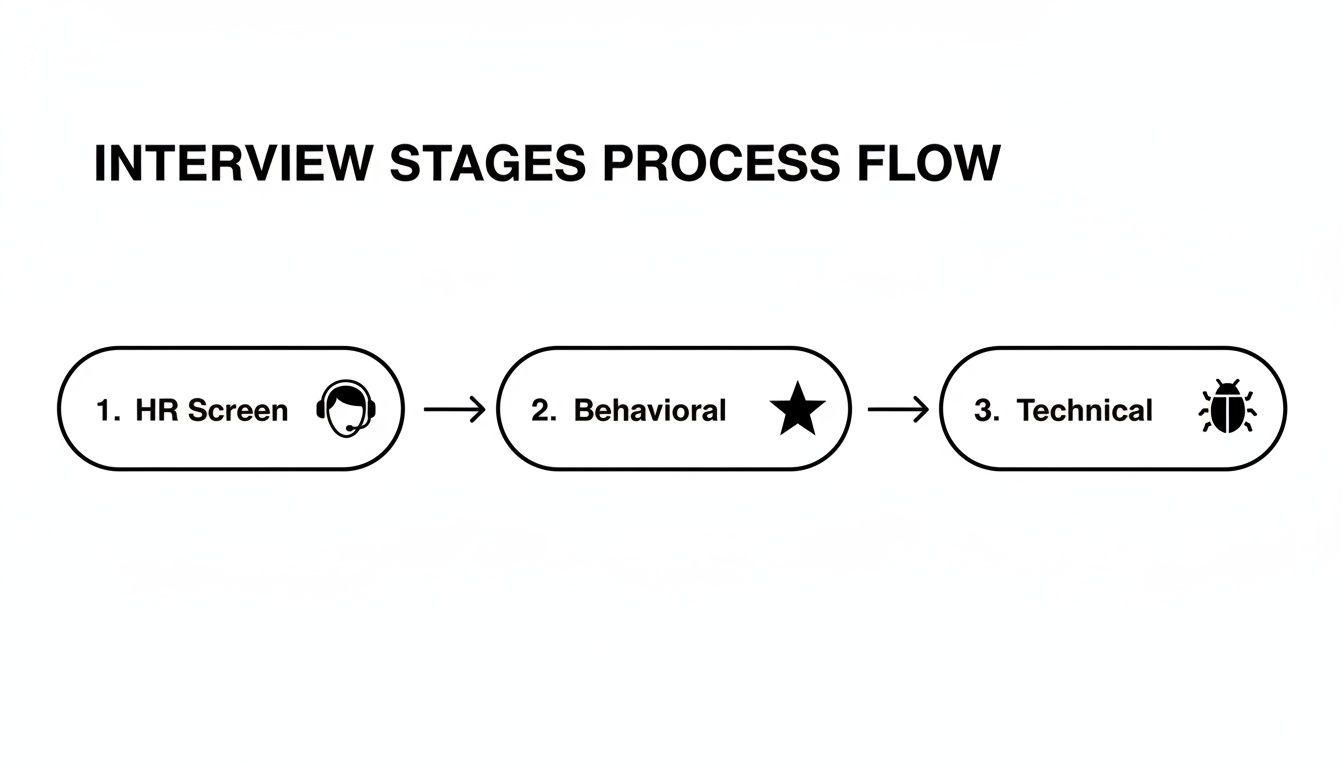
Each of those interview stages was designed to gauge your potential. Now, you get to show them they made the right bet by actively contributing.
Days 61-90: Evolve from Contributor to Leader
The final 30 days are where you seal the deal. This is your chance to showcase leadership potential, which is what truly separates the memorable interns from the forgotten ones. You're no longer just ticking boxes; you're actively looking for ways to make a tangible impact that justifies a full-time offer.
A great intern completes their work. An intern who gets a full-time offer completes their work and then asks, "What else can I do to help?" This proactive mindset is what hiring managers remember.
Here’s how to put that into practice:
- Find the Gaps: Are there areas in the test coverage that look a little thin? Proactively identify them and bring them up with your manager, maybe with a suggestion on how to approach them. This shows strategic thinking.
- Suggest Improvements: Notice an inefficiency in the bug reporting template or a clunky part of the test case management workflow? Document a simple fix and present your idea. Small process improvements show you're thinking about team efficiency.
- Mentor a Peer: If a new intern joins, offer to help them get acquainted. This is a classic leadership move that demonstrates your commitment to the team's collective success.
Document Your Wins and Make Your Case
From day one, keep a "brag document" of your accomplishments. Every significant bug you uncovered, every feature you took the lead on testing, and every process improvement you suggested—write it down. When your final review comes around, you won’t be scrambling to remember your contributions; you’ll have a concrete, powerful list to make the case for a full-time role.
This documentation, paired with the strong relationships you've built and a consistent record of adding value, makes for an undeniable case. QA internships are more competitive than ever, with listings on job boards like Indeed showing a 25% year-over-year jump. You can explore some of the latest QA summer intern roles on Indeed.com.
For those in Web3, these skills are critical. Strong QA foundations are what ensure smart contract integrity, and some crypto projects have seen internship programs help reduce deployment bugs by as much as 30%. By following this 90-day plan, you’re not just proving you can do the job—you’re proving you're someone they can't afford to lose.
Answering Your Top QA Internship Questions
As you start seriously thinking about applying for a QA internship, you're bound to have some questions. Let's tackle the big ones head-on, giving you the kind of straightforward, career-focused advice that will actually help you land a role and set yourself up for success.
Do I Need a Computer Science Degree?
Honestly, not always. While a Computer Science degree is beneficial, what most hiring managers really want is a sharp, analytical mind and proof you can actually do the work. If your background is in engineering, IT, math, or any field that taught you structured, logical thinking, you're already in a great position to be hired.
The real key is to prove your abilities. You can’t just say you’re a good tester; you have to show it.
- Build a small portfolio with test plans you've created for popular apps and link it on your resume.
- Contribute to open-source testing on platforms like GitHub. This is direct, verifiable experience.
- Earn a recognized certification in software testing fundamentals (like ISTQB) to show you're serious about the career path.
Especially for a Web3 QA internship, a genuine passion for and deep understanding of blockchain can be a huge differentiator. It shows you're not just looking for any job—you're invested in the space, and that often counts for more than a specific degree in an interview.
What Is a Realistic Salary for a QA Internship?
This is a big question, and the answer is: it varies—a lot. Your pay will depend on the company, its location, and the industry you're in. For 2026, a good ballpark is anywhere from $18 to over $40 per hour. The top-tier internships at major tech companies or in high-cost-of-living areas can even offer compensation that works out to a six-figure annual salary.
But remember, the hourly rate isn't the whole story. A paid internship at a pioneering Web3 startup could give you career-defining experience and direct mentorship that's far more valuable for your long-term career progression than a few extra dollars per hour at a legacy company. Always look at the entire opportunity, including the skills you'll build and the potential for a full-time offer.
How Can I Find QA Roles in Web3 and Blockchain?
Finding a QA internship in Web3 requires a different strategy than just scrolling through mainstream job sites. To get a competitive edge, you have to go where the builders and innovators are.
- Niche Job Boards: Look beyond the usual suspects and focus on job boards dedicated specifically to crypto and blockchain careers.
- Go Direct to the Source: Follow your favorite blockchain projects—the protocols, wallets, and dApps you admire—directly on their career pages and social media. They often post new roles there before anywhere else.
- Join the Community: Some of the best opportunities are found by word-of-mouth. Get active in the Discord servers and Telegram groups for projects that interest you. Be helpful, ask smart questions, and build a reputation. This is modern networking.
When you're searching, get specific with your keywords. Try terms like "protocol testing intern," "dApp QA," or "smart contract audit intern" to uncover roles that others might overlook. Don't underestimate the power of networking at virtual hackathons and online meetups, either—it's a great way to get on the radar of hiring managers.
Are you ready to find your place in the future of the internet? At Blockchain Jobs, we specialize in connecting talented people like you with exciting opportunities in the Web3 ecosystem. Explore the latest quality assurance openings and more.