
Your Guide to Becoming a Remote DevOps Engineer
A remote DevOps engineer bridges the gap between software development and IT operations, enabling distributed teams to build, test, and release software smoothly. To land a job and advance your career in this field, you must demonstrate mastery over cloud platforms, containerization, and Infrastructure as Code (IaC)—the core toolkit for managing complex systems from anywhere.
This career path offers high demand, excellent compensation, and significant growth opportunities, particularly for those ready to tackle the unique challenges of Web3 infrastructure. This guide provides actionable insights to navigate the hiring process, ace interviews, and accelerate your career progression.
Building Your Foundation for a Remote DevOps Career

Breaking into a remote DevOps role requires more than theoretical knowledge; it demands practical, demonstrable experience. A hiring manager won't be impressed by hearing you've read about Kubernetes; they need to see that you can confidently orchestrate containerized applications, manage stateful sets, and troubleshoot a failing pod from a different time zone.
Think of your skills as your career's foundation. Without a rock-solid grasp of core DevOps principles, any attempt to build sophisticated CI/CD pipelines or secure Web3 infrastructure will fall short in a technical interview and on the job.
Mastering the Non-Negotiable Technical Skills
Before you apply for a role, you must master the technical skills that get your resume past automated filters and prove you can contribute from day one. Your goal is not just to learn these tools but to internalize them, ready to solve real-world problems during a technical screen.
Here are the essentials to focus on for career progression:
- Cloud Platform Proficiency (AWS, GCP, Azure): You must be proficient in at least one major cloud provider. From a hiring manager's perspective, this means you can independently provision resources, implement secure IAM policies, and manage cloud costs. AWS remains the market leader, making it a strategic choice, but deep expertise in GCP or Azure is equally valuable.
- Containerization with Docker and Kubernetes: Knowing Docker is the baseline; mastering Kubernetes (K8s) is what makes you a top-tier candidate. You must be able to write efficient Dockerfiles, manage images in a registry, and orchestrate services with K8s. Prepare for interview questions on deployments, services, state management, and ingress controllers.
- Infrastructure as Code (IaC) with Terraform: Manually configuring infrastructure is a major red flag for remote teams. Proficiency with Terraform demonstrates you can build, version, and manage infrastructure safely and repeatably. Be prepared to discuss Terraform state management, modular architecture, and strategies for handling secrets.
- CI/CD Pipeline Automation: Your primary role is to empower developers to ship code faster and more reliably. This requires expertise in building and maintaining automated pipelines using tools like Jenkins, GitLab CI, or GitHub Actions. A deep understanding of CI/CD is a common requirement in high-paying Web3 roles, as seen in our DevOps & Infrastructure job listings.
Interview Pro-Tip: A classic interview question is, "Walk me through how you'd design a CI/CD pipeline from scratch for a microservices application." This tests your understanding of build stages, automated testing, artifact management, and modern deployment strategies like blue-green or canary releases. Structure your answer clearly to showcase your architectural thinking.
The Unique Demands of Web3 DevOps
While core DevOps skills are transferable, applying them in Web3 adds a layer of complexity that top recruiters actively seek. Traditional DevOps focuses on centralized applications; Web3 DevOps is about supporting and securing decentralized networks.
Demonstrating this understanding is crucial for career advancement. If you can articulate the key differences, you signal to employers that you are prepared for the unique challenges of blockchain infrastructure.
Key Web3 DevOps Differentiators to Highlight in Interviews
- Node Management and Orchestration: This is not about managing simple web servers. In Web3, you are responsible for deploying, monitoring, and maintaining critical infrastructure like validator nodes, RPC nodes, or full nodes. This requires a strong grasp of network peering, data synchronization, and the resource requirements of protocols like Ethereum or Solana.
- Decentralized Security: The security focus shifts from protecting a central database to securing a distributed network and managing private keys. Showcase your familiarity with tools like HashiCorp Vault for secrets management and best practices for securing RPC endpoints to impress hiring managers.
- Automating Smart Contract Deployments: The Web3 CI/CD pipeline includes unique stages. You will automate the compilation, testing, and deployment of smart contracts to various networks. This requires hands-on experience with development frameworks like Hardhat or Truffle and scripting interactions with the blockchain.
Crafting a Portfolio That Lands Interviews

For a remote job search, your GitHub profile is your most critical career asset. It provides tangible proof of your skills, differentiating you from candidates who only list technologies on a resume. A well-crafted portfolio demonstrates your ability to work autonomously and deliver high-quality results—two essential traits for any remote DevOps engineer.
Frame your portfolio as a career narrative. Each project should clearly define a problem, explain your choice of tools, and showcase the outcome. This storytelling approach is far more compelling to a hiring manager than a simple list of skills.
From Code Repository to Career Narrative
Treat your GitHub profile as the practical extension of your resume. Pin your most relevant and impressive projects to the top, ensuring each has a detailed README.md file. A strong README acts as your project's cover letter, explaining the "what," "why," and "how" concisely.
Avoid vague, one-line descriptions. Structure your documentation to guide a recruiter or hiring manager through your thought process. Outline the architecture, justify your technology choices, and provide clear instructions so they can replicate your work. This level of detail shows professionalism and strong communication skills.
High-Impact Projects for Web3 Recruiters
To capture the attention of Web3 hiring managers, your portfolio projects must address the specific challenges of decentralized infrastructure. Deploying another generic web application is not enough. You need to prove you understand the operational demands of blockchain technology.
Here are project ideas that will make your profile stand out:
- Deploy a Validator Node with IaC: Use Terraform or Ansible to fully automate the deployment of a validator node on a public testnet like Ethereum's Holesky. This project directly demonstrates your ability to manage critical, stateful blockchain infrastructure as code.
- Architect a CI/CD Pipeline for a dApp: Create a complete CI/CD pipeline using GitHub Actions for a sample decentralized application. The pipeline should automate smart contract compilation, execute tests using a framework like Hardhat, and deploy to a test network.
- Build a Network Monitoring Dashboard: Implement a monitoring stack with Prometheus and Grafana to track the health of a blockchain node. Create a public dashboard visualizing key metrics such as peer count, block height, and transaction pool size.
A portfolio project that quantifies its impact—like reducing cloud costs by 20% or cutting deployment time in half—speaks volumes. Add these metrics to your project READMEs. It shows you think about the business impact, not just the tech.
Proving Your Remote Readiness
Your portfolio must signal more than technical skill; it must prove you are a reliable remote collaborator. The most effective way to do this is through pristine documentation and a clean, professional Git history.
Hiring managers review commit histories to assess communication habits. Clear, concise, and descriptive commit messages demonstrate that you are a thoughtful collaborator who communicates effectively in an asynchronous environment. It proves you consider the other engineers who will interact with your work.
The DevOps job market is exploding, with projections showing it will grow from $10.4 billion in 2023 to a massive $25.5 billion by 2028. This rapid expansion has created a serious talent shortage, making DevOps the fifth-most in-demand tech profession. In fact, 29% of IT teams have recently hired DevOps engineers, signaling a massive opportunity for anyone who can prove their skills with a solid portfolio. You can learn more about the growing DevOps job market to see just how high the demand is.
Ultimately, your portfolio is your chance to control your own career narrative. It lets you move past just claiming you have skills and provide concrete proof, making it the most powerful tool you have for landing your next remote DevOps role.
Landing Your Next Remote DevOps Role
Knowing where to look is half the battle when you're on the hunt for a remote DevOps position. Sure, you can scroll through the massive general job boards, but they're often a sea of noise. The real gems are on specialized platforms where innovative Web3 companies are actively searching for talent like yours.
A successful job search relies on a focused strategy, not a shotgun approach. Tailor your resume, networking, and interview preparation to the specific demands of the blockchain industry to maximize your chances of success.
Your Application Needs to Speak Web3
Your resume and cover letter are your first impression. They must do more than list "AWS" and "Kubernetes." They need to immediately signal to a hiring manager that you understand the unique infrastructure challenges of a decentralized environment.
Put yourself in their shoes. They are looking for an engineer who grasps the complexities of managing node infrastructure, securing decentralized networks, and automating smart contract deployments.
Here's how to make your application stand out:
- Weave in the right keywords. Your resume should be packed with terms like 'node RPC,' 'validator setup,' 'decentralized storage (IPFS/Arweave),' 'smart contract CI/CD,' and 'blockchain monitoring.' This shows you're already part of the conversation.
- Show your impact with numbers. Don't just list responsibilities; quantify your achievements. Instead of "Managed CI/CD pipeline," use "Overhauled the smart contract deployment pipeline, cutting deployment times by 40% and reducing failures by 60%."
- Write a cover letter that matters. Ditch the generic template. Your cover letter should address the company's project and the role's specific challenges. Reference their tech stack and draw a direct line between your experience—for example, with validator orchestration—and the problems they need to solve.
The entire DevOps field is leaning heavily into remote work, which is great news for you. Recent data shows that a full 33% of DevOps engineers work entirely remotely, and another 58% have a hybrid setup. This just goes to show how well the DevOps culture and toolset fit a distributed team. If you want to dive deeper, you can read the full research on DevOps statistics for more on industry trends.
Network Where the Builders Are
In Web3, your network can be as valuable as your technical skills. The best opportunities often circulate within communities before ever being posted publicly. Engaging in the right circles puts you on the radar of founders and hiring managers.
Discord and Telegram are the primary communication hubs for most blockchain projects. Join the servers and channels of projects you admire and start contributing.
Don't be a lurker. Jump in and answer questions, help out newcomers, or add your two cents to a technical discussion. This is a simple, high-impact way to demonstrate your expertise and passion. You’ll quickly become a known, trusted face in the community.
By being an active participant, you transition from being just another applicant to a valued member of the ecosystem—a powerful shift that makes companies want you on their team.
Use Job Platforms That Get It
When you're ready to actively apply, focus your energy on platforms built for the blockchain space. Niche job boards cut through the clutter and connect you directly with serious Web3 companies looking for specialized talent.
Instead of wading through thousands of irrelevant listings on a mega-site, you get a curated list of roles that actually match your skills. You can, for instance, jump straight into browsing our listings to find your next remote DevOps role on Blockchain Jobs. These are the places where forward-thinking companies post their most important infrastructure positions.
Nailing the Remote DevOps Interview Process
Landing a remote DevOps engineer role is a multi-stage process designed to test your technical skills, problem-solving abilities, and communication clarity in a remote setting. With every interaction happening via a screen, how you articulate your thought process is as critical as the final answer.
Success requires a strategic approach to finding roles, optimizing your application materials, and building connections in the industry.
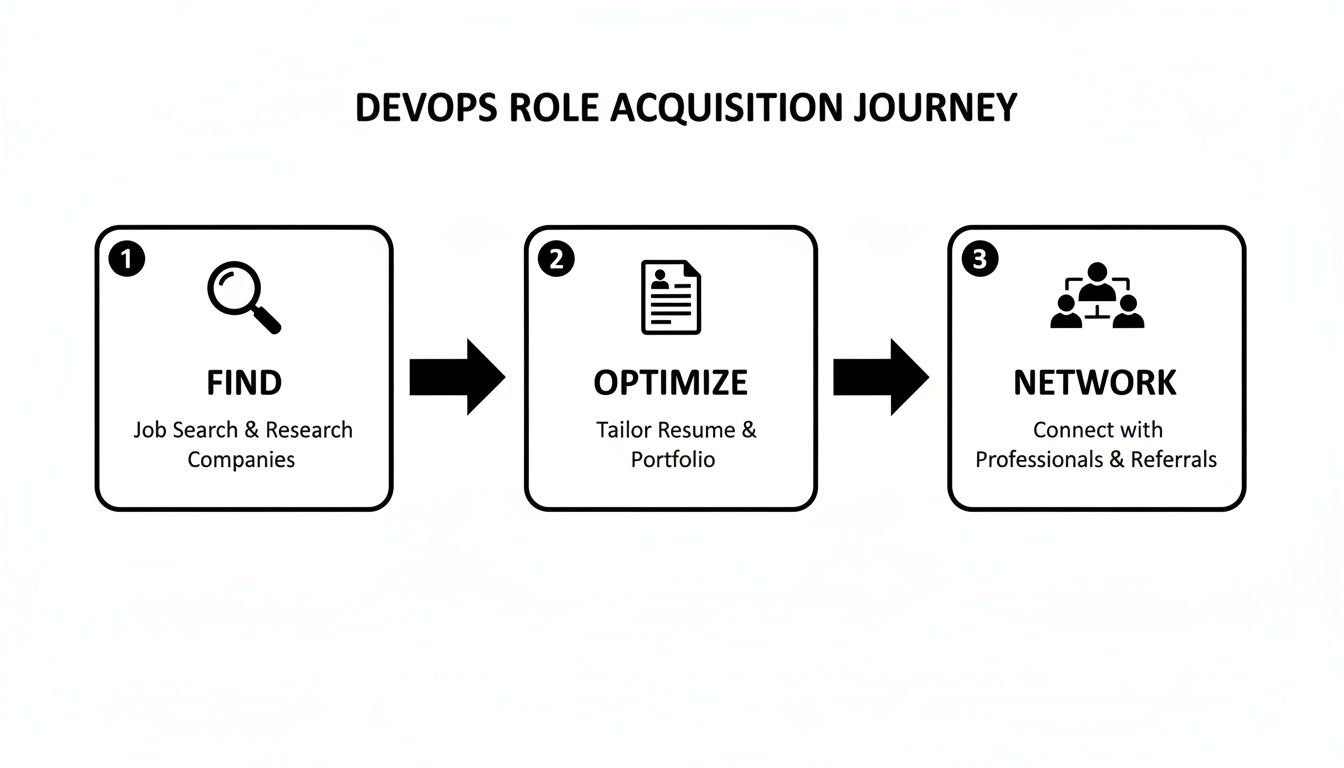
Think of the job hunt as a continuous cycle: find opportunities, optimize your approach based on interview feedback, and network to uncover even better roles. This iterative process will bring you closer to landing the right position.
Breaking Down the Interview Stages
Most remote DevOps interviews follow a predictable pattern. Understanding what to expect at each stage allows you to prepare effectively and perform your best.
Here's what you can typically expect:
- The Recruiter Screen: A brief, non-technical conversation to assess your background, career goals, and interest in the company. For Web3 roles, be prepared to articulate your passion for the blockchain space. Your goal is to show genuine interest and alignment with their mission.
- The Hiring Manager Call: This is your first significant technical evaluation. The manager will ask high-level questions about your experience with their tech stack (e.g., Kubernetes, Terraform), your DevOps philosophy, and how you've handled common infrastructure challenges. They are assessing your practical knowledge and communication skills.
- The Technical Deep Dive: This is a hands-on challenge, often involving live coding or a take-home assignment. You might be asked to debug a CI/CD pipeline, write an IaC module, or fix a broken Kubernetes manifest. The key to success is to think out loud. Explain your actions and reasoning at every step.
- The System Design Round: This stage assesses your architectural thinking. You will be given a broad prompt like, "Design a scalable monitoring system for our blockchain nodes." This is not about writing code but about demonstrating how you handle ambiguity, evaluate trade-offs, and design resilient, cost-effective systems. This is your chance to prove you think like a senior engineer.
Common Web3 DevOps Interview Questions by Category
In a Web3-focused interview, expect questions that probe your understanding of decentralized infrastructure's unique challenges. Generic DevOps answers are insufficient. You must be prepared for questions that validate your expertise in running nodes, managing keys, and ensuring uptime in a high-stakes environment.
Hiring Manager Insight: "When I ask a candidate how they would manage secrets for a validator node, I'm not just looking for a tool name like HashiCorp Vault. I want to hear them discuss the entire lifecycle: secret generation, rotation policies, access control, and the unique risks of exposing private keys in a decentralized environment."
The table below breaks down the kinds of questions you can expect, from the technical to the behavioral.
| Category | Sample Question | What Interviewers Are Assessing |
|---|---|---|
| Blockchain Infrastructure | Describe your strategy for monitoring the health and performance of a cluster of Ethereum RPC nodes. What specific metrics would you track? | Your understanding of blockchain-specific monitoring needs (e.g., block height, peer count, transaction pool size) beyond standard CPU/memory metrics. |
| CI/CD & Automation | How would you design a CI/CD pipeline to automate the deployment of a smart contract to multiple networks (e.g., testnet, mainnet)? | Your ability to automate sensitive workflows, manage environment-specific configurations, and implement security gates for contract deployments. |
| Incident Response | Walk me through your process for responding to an incident where a validator node goes offline. How would you minimize downtime and slashing risk? | Your crisis management skills, technical troubleshooting process under pressure, and knowledge of validator economics and penalties. |
| Situational Judgment | You've noticed a significant increase in infrastructure costs this month. How do you investigate the cause and what steps would you propose? | Your problem-solving approach, cost-consciousness, and ability to communicate technical findings to non-technical stakeholders. |
| Remote Collaboration | Tell me about a time you had to resolve a technical disagreement with a colleague in a different time zone. How did you handle it? | Your communication skills, your approach to asynchronous collaboration, and your ability to work effectively in a distributed team. |
These are the types of nuanced questions that separate a good candidate from a great one. You'll find that many forward-thinking teams are looking for this specific expertise, as seen in postings like this DevOps Engineer for Avalanche.
Proving You're Built for Remote Work
Remember, every interview interaction is an audition for your effectiveness as a remote employee. Interviewers are constantly evaluating your ability to communicate clearly, manage your time, and collaborate with a distributed team.
Small details make a big difference. Test your camera and microphone beforehand. Ensure your internet connection is stable. Choose a quiet, well-lit space for the call. These actions demonstrate professionalism and a serious approach to remote work.
Finally, when it's your turn, ask insightful questions. Inquire about their communication tools, on-call rotation policies across time zones, and documentation culture. This shows you are not just looking for any job—you are looking for a remote environment where you can be productive and successful.
Negotiating Your Salary and Remote Work Benefits
You've received an offer—congratulations! Now begins the crucial conversation about your compensation. Do not accept the first offer without discussion. Negotiation is a standard and expected part of the hiring process.
Understanding Remote Salary Benchmarks
Remote DevOps roles often command premium salaries because the talent is scarce and companies are competing in a global market.
Data shows that remote DevOps positions typically fall within the $125K-$174K range, with a median salary around $150K. These figures often rival salaries in major tech hubs like New York or San Francisco, regardless of your physical location. For more detailed insights, consult CareerCheck.io's salary guide.
Key Insight: Don't be surprised to see New York City-level salaries offered for remote DevOps roles. Companies know they need to pay top dollar to attract the best talent, no matter their location.
This salary resilience is driven by several factors: companies save on office overhead, global competition for skilled engineers increases base pay, and for highly specialized roles, geography is irrelevant.
Preparing Your Talking Points
Entering a negotiation unprepared is like deploying to production without testing. You must frame your value in terms of metrics and impact that the business understands.
Instead of simply stating your skills, demonstrate their value. Quantify your achievements from past roles or portfolio projects.
Here is a proven structure for your negotiation:
- Begin by expressing gratitude for the offer and reiterating your excitement.
- State your target salary range, supported by market data and your specific qualifications.
- Justify your request with concrete examples of your impact (e.g., "In my previous role, I reduced cloud costs by 20% by optimizing our IaC modules.").
Negotiation Tip: I always recommend leading with your most impressive achievement. It immediately sets a strong, positive tone and anchors the conversation around your value.
Since you're aiming for a Web3 role, make sure your examples resonate with a blockchain team. Think about things like:
- Automating smart contract deployment pipelines to testnets.
- Building out scalable node monitoring dashboards with Prometheus and Grafana.
- Creating Infrastructure-as-Code modules that can spin up new validator nodes in minutes.
I once coached an engineer who secured a 20% salary bump simply by showing how their automation work led to a 70% drop in deployment-related errors. That’s the kind of language that gets a hiring manager’s attention.
Evaluating Equity and Token Packages
In the Web3 world, your compensation isn't just about cash. Token packages can be a huge part of the deal, but they can also be incredibly confusing.
You need to ask pointed questions. Get absolute clarity on vesting schedules, performance milestones, and how the token vesting aligns with the project's roadmap. Don't get star-struck by a big number; break it down into something tangible:
- What’s the exact percentage of ownership?
- Is there a cliff, and what's the full vesting period?
- What’s the valuation cap for any future token sales?
Do your homework on the project’s tokenomics. Understanding their issuance model and any lock-up periods is crucial before you can properly value the offer.
Spotting Contract Red Flags
Not every shiny offer is gold. Sometimes, a great salary can hide some serious red flags in the contract that will make your life miserable down the road.
Be on the lookout for these warning signs:
- Vague, open-ended on-call expectations without extra compensation.
- Fuzzy terms around equity or undefined token unlocking events.
- Overly aggressive IP clauses that try to claim ownership of your personal projects.
And for remote work, you have to verify the benefits are real. Ask about:
- Stipends for your home office setup or new equipment.
- A clear budget for communication tools.
- Defined core work hours so you aren't expected to be online 24/7.
Key Takeaway: A contract is more than just a salary number. Make absolutely sure the terms support a healthy, sustainable remote work life before you even think about signing.
Negotiating Remote Work Benefits
Salary is just one piece of the puzzle. The right benefits can dramatically improve your work-life balance and long-term career growth, sometimes even more than a slightly higher salary.
Here are some remote-specific perks you should definitely consider negotiating for:
- Home Office Stipend: To cover a proper ergonomic chair, desk, and monitors.
- Internet Reimbursement: Because your job depends on a rock-solid connection.
- Flexible Work Hours: The ability to work when you're most productive.
- Coworking Space Allowance: For those days when you just need to get out of the house.
- Wellness Budget: For a gym membership, mental health apps, or anything that keeps you healthy.
- Training and Conference Support: To ensure your skills stay sharp.
| Benefit | Impact |
|---|---|
| Home Office Stipend | Improves comfort and reduces your out-of-pocket expenses. |
| Internet Reimbursement | Ensures you have reliable connectivity for critical work. |
| Flexible Work Hours | Lets you structure your day around when you're most focused. |
| Coworking Space Allow. | Provides a professional change of scenery and networking. |
| Training Budget | Keeps your technical skills current with workshops or certs. |
Think about what matters most to you. A comprehensive package that supports your growth and well-being can easily be worth more than a few extra thousand dollars in base pay.
Closing Your Negotiation
Once you have the full offer, don't feel pressured to give an immediate answer. It's completely standard to ask for 48–72 hours to review everything. This time gives you leverage and space to think clearly.
If you're lucky enough to have multiple offers, you're in an even stronger position.
- Start the conversation by anchoring on your target salary range.
- After you state your number, be quiet. Let them be the next one to speak.
- If you have other offers, you can reference them subtly to show your market value.
Always end the conversation with a clear next step, whether that's a follow-up call or a confirmation email. A well-managed negotiation not only gets you fair compensation but also sets a professional tone for your new role.
Setting Your BATNA
What's a BATNA? It's your Best Alternative to a Negotiated Agreement. In simpler terms, it's your walk-away plan.
Before you even start negotiating, you should know what you'll do if they can't meet your needs. Is it another job offer? Freelance work? Taking some time off to build a personal project?
Knowing your BATNA gives you incredible confidence. It empowers you to walk away from a bad deal, knowing you have other solid options waiting for you.
Frequently Asked Questions
Got questions? You're not alone. Breaking into a remote DevOps role, especially in the Web3 space, comes with a unique set of challenges. I've pulled together some of the most common questions I hear and answered them with practical, no-fluff advice to help you get hired.
What Certifications Actually Matter for Remote DevOps?
Look, certs aren't everything, but they do get your foot in the door and signal to hiring managers that you've put in the work. For a remote DevOps role, they want to see proof that you can handle cloud, containers, and infrastructure as code without someone looking over your shoulder.
A few certifications carry real weight in the industry:
- Certified Kubernetes Administrator (CKA): This is the gold standard for container orchestration. It proves you can manage and troubleshoot a Kubernetes cluster, a core skill for almost any modern DevOps role.
- AWS Certified DevOps Engineer – Professional: If you're targeting an AWS shop, this one is a beast. It’s tough, but it shows you have a deep, practical understanding of building and maintaining infrastructure on the world's biggest cloud platform.
- HashiCorp Certified Terraform Associate: Terraform is the lingua franca of Infrastructure as Code. This cert is relatively quick to get and instantly proves you know how to manage infrastructure programmatically.
- Azure DevOps Engineer Expert or Google Professional Cloud DevOps Engineer: Don't sleep on these if you're aiming for roles in Microsoft or Google Cloud ecosystems. They're just as valuable as their AWS counterpart in the right context.
These certs tell a story: you're self-sufficient and can manage complex, distributed systems from anywhere.
| Certification | Cost | My Estimated Prep Time |
|---|---|---|
| Certified Kubernetes Administrator | $395 | 3–6 months |
| AWS Certified DevOps Engineer Pro | $300 | 2–4 months |
| HashiCorp Certified Terraform Associate | $70.95 | 1–2 months |
Once you have the basics covered, consider a specialty cert like the Certified Kubernetes Security Specialist (CKS) to really stand out.
How Do I Get Web3 DevOps Experience Without a Job?
This is the classic chicken-and-egg problem, right? You can't get a job without experience, but you can't get experience without a job. The key is to create your own experience. In Web3, this is surprisingly accessible.
Forget waiting for permission. Get your hands dirty:
- Find a public testnet for a blockchain like Ethereum Sepolia or a Layer 2 like Arbitrum Goerli.
- Spin up your own validator or RPC node. Don't just follow a guide—understand it.
- Now, tear it down and rebuild it using Terraform or Ansible. Automate everything.
- Document the entire process in a GitHub repo. Your
README.mdshould be so clear a total beginner could follow it. - Write a short blog post about a problem you hit and how you solved it. This shows your thought process.
This isn't just "practice"—it's a portfolio. You're building tangible proof of your skills while demonstrating the exact kind of initiative and remote work habits companies are desperate for.
From the Field: "I learned more from setting up my own Chainlink node and automating it with Ansible than from any online course. Hiring managers were way more interested in my GitHub repo showing that project than they were in my resume."
What's the Biggest Hurdle for New Remote DevOps Engineers?
It’s not the tech. It’s the communication.
When you’re not in the same room, you can't just lean over and ask a question. The "quick sync" is gone. This is where many new remote engineers stumble.
The most common pitfalls I see are:
- Silent Struggles: Working on a problem for hours without telling anyone you're stuck.
- Vague Updates: Dropping a "still working on it" message with no context.
- Ignoring Time Zones: Kicking off a major deployment at 5 PM on a Friday without realizing half the team in another geo is already offline.
The solution is to over-communicate, but do it smartly. Write concise daily stand-ups in Slack. When you ask for help, provide logs, screenshots, and a clear summary of what you've already tried. Proactive, clear, written communication is the single most important skill for a successful remote DevOps engineer.
Key Takeaway: In a remote role, your keyboard is your most important tool. Master asynchronous communication, and you'll thrive.
How Do I Keep Up When Everything Changes So Fast?
The pace in this field is relentless, and you can't afford to fall behind. You have to build a system for continuous learning. It's not about reading everything; it's about curating your information flow.
Follow the release notes for the core tools you use, like Kubernetes and Terraform. Join a few high-signal newsletters or subreddits. Find a couple of good podcasts you can listen to while running errands.
Most importantly, dedicate time for hands-on learning. Set aside a few hours every couple of weeks to spin up a new tool or try a new feature. This "tinkering time" is what separates the good engineers from the great ones.
Ready to find a role where you can put all this into practice? Start exploring remote Web3 infrastructure positions on Blockchain Jobs.