Remote Jobs for Junior Developers: A Strategic Guide to Getting Hired

Finding your first remote job as a junior developer can feel like a long shot, but in the Web3 world, it’s a strategic career move. The blockchain space often values demonstrable skills—what you can build—over formal credentials. This opens doors for bootcamp grads and career-changers, but you need a plan.
Let's cut through the noise and build a job search strategy that gets you from application to offer letter.
Understanding the New Web3 Remote Job Market
The tech industry's shift to remote work has changed the hiring game. For junior developers, this presents a huge opportunity and a new challenge. While companies now hire from anywhere, you're also competing with a global talent pool. Your ability to showcase practical, hands-on skills is the single most important factor in your job search.
This is especially true in Web3. The entire field is built on decentralization and meritocracy, and this philosophy extends to hiring. A hiring manager for a DeFi protocol is more interested in your GitHub activity and understanding of smart contracts than your university. This levels the playing field, allowing your skills to take center stage.
Who Is Getting Hired?
The profile of a junior developer isn't what you might think. It’s not just for 22-year-olds fresh out of college. The demographics reveal a much broader picture.
In the early 2010s, there were over 173,161 junior software developers in the US. Today, while men still dominate at 80.5%, women represent a growing 19.5%. What's most relevant to your career path is the average age: 39 years old. This proves that many successful developers are pivoting into tech later in their careers, bringing valuable real-world experience that hiring managers appreciate.
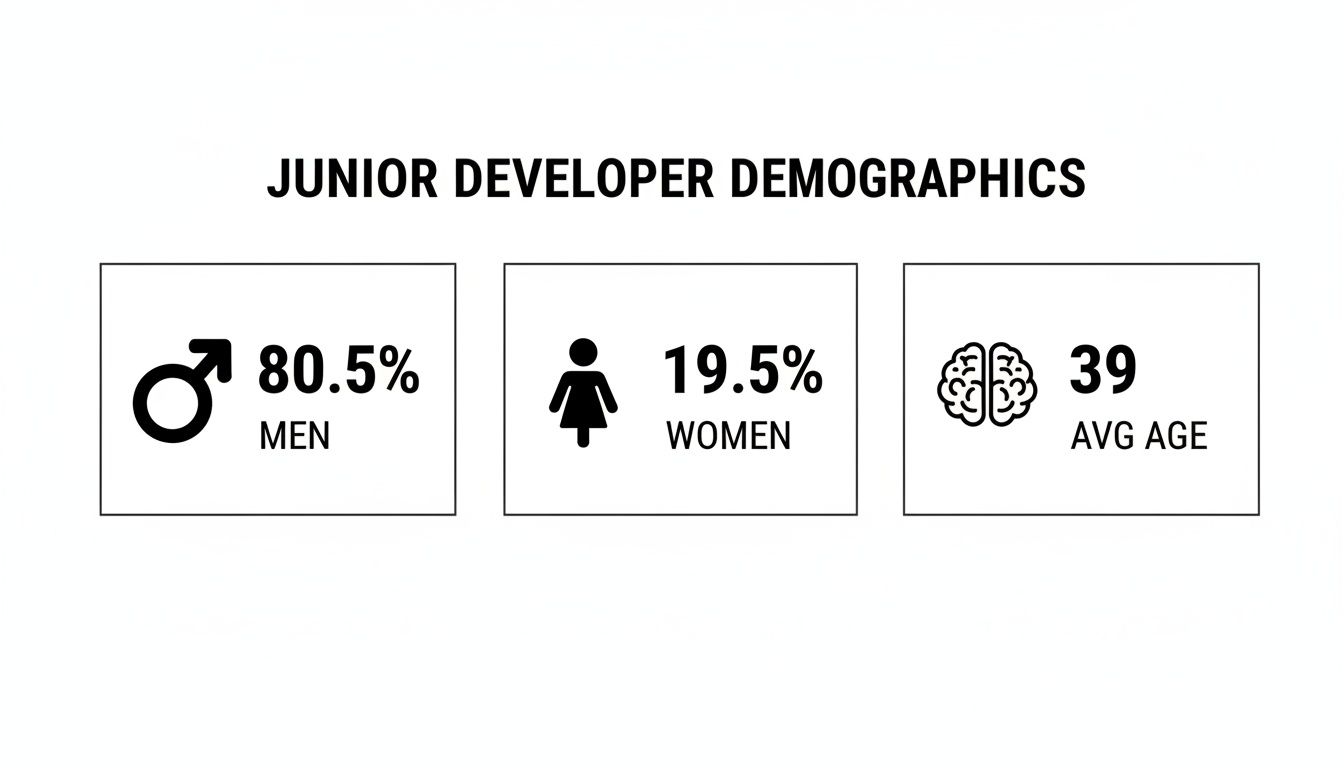
The takeaway for your job search is clear: frame your unique background as an asset. Your path to becoming a developer is a strength, not a weakness.
The Remote Web3 Job Market at a Glance
To build an effective strategy, you need to understand the landscape. These statistics reveal the competitive nature of the market and where you should focus your efforts.
| Metric | Key Statistic | Actionable Insight for Your Job Search |
|---|---|---|
| Global Talent Pool | 70%+ of Web3 jobs are remote-first | Your competition is global. Differentiate yourself with a niche portfolio and strong personal brand. |
| High Demand | 30,000+ open Web3 roles in 2023 | Opportunities are plentiful, but they are concentrated on specialized job boards. Focus your search there. |
| Junior-Friendly Roles | ~15% of roles are junior/entry-level | Entry points exist, but you must have a compelling portfolio to beat the high volume of applicants. |
| Specialized Skills | Solidity & Rust are top languages | Mastering one of these in-demand languages will make you a more attractive candidate and command a higher salary. |
These figures show that a "spray and pray" application strategy won't work. Success requires a targeted approach.
The core principle for your job search is simple: your portfolio and demonstrable skills are your strongest assets. Stop applying and start building. Create projects that solve real problems, because in a remote-first Web3 world, your code is your resume.
It's about crafting a strategy. Look for roles on specialized platforms, understand what Web3 companies actually need, and build a portfolio that directly addresses those needs. A great first step is to analyze current Web3 job openings to see which skills and project types are in demand right now.
Building a Portfolio That Gets You Hired in Web3
Let's get one thing straight: in the Web3 space, your GitHub profile is your resume. When you're targeting remote jobs for junior developers, a hiring manager will scrutinize your GitHub before they even read your application. Your ability to prove you can build things is non-negotiable.
Your portfolio is your single greatest hiring asset. Generic to-do list apps are a waste of time. Your projects must demonstrate that you understand the decentralized ecosystem. The goal is to give a hiring manager concrete proof that you can be productive from day one.
What Web3 Hiring Managers Actually Want to See
Forget spending months on an overly complex project. Hiring managers look for clear signals that you possess core Web3 skills. Focus on small, well-executed projects that showcase specific competencies.
- A Simple dApp: Build a basic decentralized application that interacts with a testnet like Sepolia. A voting dApp or an NFT minter is perfect. This proves you can connect a frontend to a smart contract—a fundamental requirement for most Web3 roles.
- On-Chain Data Scripts: Write a script using a library like Ethers.js or Web3.py to read data from the blockchain. For example, fetch a wallet's transaction history or check an ERC-20 token balance. This shows you can interact directly with the chain, a critical skill for backend and data-focused roles.
- A Basic Smart Contract: Author and deploy a simple contract in Solidity. It doesn't need to be revolutionary. A basic escrow contract or a time-locked wallet demonstrates that you understand the Ethereum Virtual Machine (EVM) and are thinking about security principles.
These projects are manageable for a junior but become powerful talking points in an interview. When asked about your experience, you can walk them through tangible code you've written.
Your portfolio should tell a strategic story. Each project should highlight a different skill—one for smart contracts, one for frontend integration, one for on-chain interaction. This demonstrates your breadth and genuine interest in the full Web3 stack, making you a more versatile candidate.
From Bootcamp Project to Hirable Portfolio
Positioning your background is half the battle. If you're self-taught or a bootcamp grad, frame it as a strength. You have proven you are a proactive, self-motivated learner—a highly desirable trait for any remote employee.
Use your GitHub READMEs to market yourself effectively. For each project, write a clear description: explain the problem it solves, the tech stack you used, and the key challenges you overcame.
This is also where you should implement keyword optimization. Recruiters use automated systems to scan for terms like Solidity, EVM, DeFi, Hardhat, and ERC-721. Weaving these naturally into your project descriptions will dramatically increase your visibility in recruiter searches.
Ultimately, your portfolio's job is to secure an interview. A hiring manager should look at your work and see a low-risk, high-potential candidate. A great way to validate your projects is to compare them against real job descriptions, like this early-career software developer position, and ensure your skills align. A focused portfolio makes it easy for them to say "yes."
Finding and Targeting the Right Remote Web3 Roles

To land a high-quality remote job as a junior developer in Web3, you must look in the right places. Stop wasting time on massive, generic job boards. Focus your efforts on specialized platforms where every listing is relevant. A targeted approach is the first step toward getting noticed by the right hiring managers.
The remote work landscape is incredibly competitive. Since 2020, remote job postings have tripled, jumping from 4% to over 15% of all US jobs. But while only 10% of total listings are fully remote, they attract 2.6 times more applications. This means you must be strategic to stand out. You can get a better feel for the developer job market and its recent shifts in this detailed statistical breakdown.
Decoding Web3 Job Titles
As you search, you'll encounter job titles that don't exist in traditional tech. Understanding them is crucial for targeting roles that match your skills and career goals.
- Junior Protocol Engineer: This role involves working on the core logic of a blockchain. You'll focus on low-level code, consensus mechanisms, and network performance. This is a great fit if you're fascinated by the fundamental architecture of decentralized systems and want a deeply technical career path.
- Web3 Frontend Developer: This is more than just building a UI. You will create interfaces that connect directly to smart contracts and wallets. Experience with libraries like Ethers.js or Web3.js is non-negotiable because your primary job is to bridge the gap between users and the blockchain.
- Smart Contract Developer: This is a specialized backend role focused on security and precision. You will write, test, and deploy smart contracts using languages like Solidity or Rust. Even as a junior, you'll need a strong understanding of common vulnerabilities and security best practices.
Understanding these titles allows you to filter opportunities effectively and, more importantly, tailor your portfolio and resume to mirror the language in the job descriptions. It shows you're an insider who understands the specific needs of the Web3 space.
Your ability to research a project beyond its careers page will set you apart. Look at their GitHub activity, read their documentation, and check their on-chain data using a block explorer. Mentioning a recent protocol upgrade or a specific transaction in your cover letter shows genuine, deep interest.
Researching Projects Like a Pro
Once you find a promising role, your next step is to perform deep due diligence. This isn't just to impress the hiring manager—it's to ensure the company is a stable and promising place to launch your career.
Start by analyzing their on-chain activity. Is their dApp actually being used? High transaction volume and a growing user base are strong positive signals. A protocol that looks like a ghost town could be a red flag about its long-term viability. This initiative demonstrates a practical, business-minded approach to the ecosystem.
This deep research directly fuels your application. Instead of a generic "I'm passionate about Web3," you can say, "I was impressed by the gas efficiency of your recent contract migration for X feature, and I believe my skills in Y could help further optimize that process." This level of specific, informed interest is rare and highly effective at capturing a recruiter's attention.
By applying these targeted strategies, you move from being just another applicant to a standout candidate. You might even find that a role like this Junior Risk Monitoring Analyst position is a perfect match for your analytical skills.
Mastering the Remote Interview and Technical Challenge

The interview process for remote jobs for junior developers has its own rules. Without in-person cues, your ability to communicate clearly and professionally over video is paramount.
Your setup is your first test. Good lighting, a clean background, and a stable internet connection are not minor details; they signal to the hiring manager that you are a professional who understands the requirements of effective remote work. Nailing these basics creates a strong first impression before you even answer a question.
Nailing the Live Coding Session
During a live coding session, silence is your enemy. The interviewer isn't just looking for the correct answer; they want to see your problem-solving process under pressure.
Therefore, you must think out loud. Narrate your actions as you type. "I'm choosing a hash map here for O(1) lookups, which will be more efficient." If you get stuck, don't panic. Articulate your thought process: "Okay, that approach isn't working as expected. I suspect the issue is X, so I'm going to try debugging it by Y." This turns a potential failure into a demonstration of your debugging and critical thinking skills.
The goal of a remote technical interview isn't just to prove you can code; it's to prove you can be a collaborative and communicative teammate from thousands of miles away. Think of the interviewer as your first pair programming partner.
Web3 companies will also test your foundational knowledge. Don't just grind LeetCode; be prepared for domain-specific questions.
- Decentralization Concepts: Be ready to articulate the trade-offs between PoW and PoS or discuss why immutability is both a core feature and a development challenge.
- Security Mindset: Expect questions on common smart contract vulnerabilities like reentrancy attacks or integer overflows.
- Gas Optimization: Demonstrate your understanding of blockchain economics by explaining how you would write code to minimize transaction costs for users.
Acing the Take-Home Assignment
The take-home assignment is your best opportunity to shine. It simulates a real work task and shows the hiring team exactly what it would be like to work with you.
Your submission must be more than just functional code; it must be professional. This means clean, commented code and, most importantly, a comprehensive README.md file. Your README should provide clear instructions on setup and execution, along with a brief explanation of your architectural decisions. This shows respect for the reviewer's time and proves you can produce work that is easy for a distributed team to understand and maintain.
Ultimately, functional code proves you're a developer. A clean, well-documented project proves you’ll be a great remote developer—someone who can integrate into a team and contribute effectively with minimal friction.
From Offer Letter to Your First 90 Days

You got the offer. This is a major career milestone, so take a moment to celebrate. But before you sign, the next steps are crucial for setting up your long-term success.
First, carefully review the entire offer. For global Web3 roles, compensation can be complex, often including salary, tokens, and other benefits. Understand the complete value of the package.
Even as a junior, don't be afraid to negotiate. It's an expected part of the hiring process. If the salary seems low based on your research, it is acceptable to make a counteroffer. Justify your request by tying it back to the specific value you demonstrated in your interviews and portfolio.
Your First Month: Building Trust
Once you've accepted, your primary goal is to build trust. Your first 30 days are not about shipping massive features; they are about listening, learning the team's processes, and establishing yourself as a reliable team member.
You must be proactive in your communication. Dive into the team’s Slack or Discord channels. Don't be a passive observer. Ask thoughtful questions, participate in relevant discussions, and make your presence known. Your goal is to become a familiar and dependable voice.
Early on, your most valuable skill isn't coding—it's communication. Over-communicating your progress, blockers, and questions is far better than staying silent. This visibility builds the trust that is essential for a successful remote career.
From Onboarding to Impact in 90 Days
As you settle in, focus on accumulating small, consistent wins. No one expects you to rewrite a core protocol in your first three months. Instead, make yourself invaluable by taking on tasks that provide clear value.
Here are actionable ways to make an impact:
- Improve the Documentation: As a newcomer, you have fresh eyes. If you struggle with a section of the documentation, it’s likely unclear. Volunteer to improve it. This is a low-risk, high-impact contribution.
- Tackle Small Bugs: Every project has a backlog of small, well-defined bugs. Claim one. Successfully fixing it demonstrates that you can navigate the codebase, follow the development workflow, and see a task through to completion.
- Shadow Senior Developers: Ask a senior engineer if you can join a pair programming session or a system design meeting. You will learn more by observing an expert solve a real problem than you would from any tutorial. This helps you understand the "why" behind technical decisions.
Focusing on these actions shows that you are a proactive team member, not just waiting for instructions. This is how you transition from "the new junior" to a vital part of the team, proving that in remote jobs for junior developers, tangible contributions matter more than physical location.
Got Questions About Junior Web3 Jobs? Let’s Clear Things Up.
Navigating the world of remote Web3 jobs as a junior developer raises many questions. Let's address the most common ones to help you build a clear and effective career strategy.
Is It Actually Harder for Juniors to Land Remote Jobs Right Now?
Yes, the market is competitive across all of tech. Major tech companies have reportedly cut graduate hiring by over 50% in recent years. However, this shift in big tech can create opportunities for those targeting Web3.
The Web3 industry operates on a different hiring philosophy. It has always prioritized practical skills over traditional credentials. Skills-first hiring has tripled for remote roles, with 18% of HR leaders now valuing certifications and portfolios more than a university degree for software engineers. This is a significant advantage for self-taught developers and bootcamp graduates who can demonstrate their abilities. For more data, review these entry-level developer job trends.
Do I Absolutely Need a Computer Science Degree?
No. While a CS degree is valuable, it is not a mandatory prerequisite for a successful career in Web3.
Hiring managers in this space are primarily focused on one question: can you build things? Your GitHub profile is the most critical component of your application. A repository with a working dApp, well-written smart contracts, or contributions to an open-source project provides more compelling evidence of your skills than a diploma. Web3 is fundamentally meritocratic; if your code is clean and you understand decentralized principles, you can secure a role.
Your portfolio is your proof-of-work. In a decentralized world, a well-documented GitHub repository that showcases your ability to solve real problems is the most respected credential you can have.
What’s a Realistic Salary for a Junior Web3 Developer?
Salaries are highly variable and depend on factors like your location, the company's funding, and your specific tech stack.
However, Web3 roles generally offer competitive compensation, even at the junior level. A reasonable salary range for a remote junior developer in this space is $70,000 to $110,000 USD per year. Many startups also offer compensation packages that include tokens. While these can have significant upside potential, they also carry risk and volatility. Be prepared to negotiate the entire compensation package, including salary, token vesting schedules, and benefits.
How Can I Grow Without In-Person Mentorship?
This is a critical challenge for remote junior developers. You cannot simply turn to a senior engineer at the next desk for help. Therefore, you must be intentional about seeking mentorship and growth opportunities.
Here is a practical framework for career progression:
- Be Proactive: Don't wait for your manager to check in. Schedule regular, brief syncs with your team lead or a senior engineer. Come prepared with specific, well-researched questions.
- Embrace Pair Programming: This is the most effective tool for remote learning. Actively ask to pair on tickets. It provides direct exposure to expert problem-solving and team best practices.
- Document Your Learnings: When you solve a difficult problem, write a short summary of the solution for the team's internal knowledge base. This demonstrates initiative, reinforces your own learning, and positions you as a helpful team member.
Thriving as a remote junior is less about knowing everything and more about being resourceful, communicative, and committed to your own professional development. Mastering these skills will not only ensure success in your first role but also accelerate your entire career trajectory.
Ready to find your first remote Web3 role? Blockchain Jobs is the leading job board dedicated to the decentralized world. Start exploring opportunities today!