Land Top Remote Web Dev Jobs in 2026
You refresh the job board, open another remote posting, and see the same pattern. Hundreds of applicants. A vague salary range. A tech stack you can handle. Then silence after you apply.
That silence is not always about your coding ability. In remote web dev jobs, companies screen for signal differently. They want proof that you can ship without hand-holding, communicate clearly without a hallway conversation, and leave behind work that another engineer can pick up fast.
That changes how you search, how you present your work, how you interview, and how you evaluate an offer. It also changes how a traditional web developer should think about Web3 roles, where distributed teams are common and the portfolio bar is often less about polish alone and more about showing how you reason through systems, product trade-offs, and async execution.
The New Reality of Landing Remote Developer Jobs
Remote work is not the perk anymore. It is part of the operating model.
As of 2023, 41% of developers worldwide work fully remote, with another 42% in hybrid arrangements, while remote roles make up under 15% of new LinkedIn listings but attract over 50% of applications according to Tapflare’s remote developer market analysis. That gap explains why good developers can still feel invisible.
The mistake is treating remote web dev jobs like local jobs with Zoom added on top. Hiring managers do not. They often read your application as a risk assessment.
Can this person work through ambiguity? Can they write updates that reduce management overhead? Can they handle a handoff across time zones without dropping context?
That is why generic applications fail. A resume that says “built frontend features in React” tells them almost nothing. A portfolio that shows how you broke down a feature, documented setup, handled edge cases, and communicated trade-offs tells them much more.
There is also a second market inside the first one. Traditional SaaS teams still hire remote web developers. So do decentralized teams building wallets, dashboards, protocol tooling, explorers, and internal ops platforms. If you are open to both, your search surface expands. Browsing dedicated remote listings can help you spot that overlap early, especially on pages that focus on remote roles across distributed teams.
Key takeaway: Remote hiring rewards developers who market execution, not just knowledge.
The practical shift is simple. Stop asking, “How do I find more jobs?” Start asking, “How do I make it easy for a remote team to trust me?”
Crafting Your Remote-Ready Resume and Portfolio
A remote-ready resume does one job. It reduces uncertainty.
Most resumes do the opposite. They list tools, duties, and buzzwords, but they hide how the person works. That is a problem in a crowded market, especially for junior and career-switching developers. Job board data shows very few entry-level remote web developer roles explicitly waive degree requirements, which is why a strong portfolio and proven skills matter more than hoping your resume title alone gets you through according to Indeed job board results for remote entry-level web developer roles.
Rewrite your resume around remote signals
If you have shipped features before, you already have material. You just need to frame it properly.
Instead of this:
- Built dashboard components in React
- Worked with backend team
- Participated in sprint planning
Write bullets that expose ownership:
- Built and shipped dashboard components in React, documented edge cases, and resolved review feedback asynchronously
- Coordinated API contract changes with backend engineers through GitHub issues and pull request discussion
- Broke feature work into sprint-sized tasks, posted delivery updates, and flagged blockers early
The difference is subtle but important. The second version tells a remote employer how you behave when nobody is sitting next to you.
Show outcomes, not just stacks
A hiring manager can infer your stack from a repo, package file, or project tags. What they cannot infer is whether you understand why the project exists.
Each portfolio project should answer four questions:
- What problem did you solve
- Why did you choose this approach
- What trade-offs did you make
- How would another engineer run, review, or extend it
That structure matters in both traditional web roles and Web3-adjacent roles. A clean CRUD app is fine. A cleaner portfolio entry explains why you chose server rendering, how you handled auth, what assumptions you made about API reliability, and where the architecture would break under heavier usage.
Treat GitHub like a work sample, not a code dump
For remote web dev jobs, your repository is often the first collaboration artifact anyone sees.
A solid project README should include:
- Context: What the app does and who it is for
- Architecture: Frontend, backend, database, services, and deployment choices
- Setup: How to run it locally without friction
- Decisions: Why you picked Next.js over plain React, or PostgreSQL over SQLite
- Known gaps: What you would improve with more time
This is useful for take-home tasks and for portfolio projects you want recruiters to skim quickly.
Tip: If a recruiter opens your repo and cannot understand the project in a minute or two, they will move on.
Build two portfolio layers
One layer is for scanning. The other is for technical depth.
Use this format:
| Layer | What it includes | Why it matters |
|---|---|---|
| Portfolio homepage | Short project summaries, tech stack, live demo, GitHub link | Helps recruiters and non-technical screeners move fast |
| Project case study | Problem, architecture, screenshots, trade-offs, implementation notes | Gives engineers evidence of judgment and execution |
This model works even if you do not have paid experience. Three thoughtful projects with strong write-ups beat ten unfinished clones.
Make your profile look intentional
Your LinkedIn, GitHub, and personal site should agree on what kind of work you want.
If you want remote frontend work, say that. If you want full-stack product roles, say that. If you are moving toward dApp interfaces or developer tooling, say that too.
Mixed signals hurt. A profile that says “open to anything in tech” usually reads as “I have no clear value proposition.”
For your public-facing materials, presentation matters. If you are debating whether to include a photo on your application assets, this guide on using a headshot on your resume is a useful framing resource because it focuses on context and professional fit rather than blanket advice.
Show the Web3 bridge directly
Many developers want to move from standard web work into crypto-native teams, but they hide the bridge. Avoid that.
If you know JavaScript, TypeScript, React, APIs, auth flows, and state management, you already have a base that matters. Add one or two projects that make the transition obvious:
- A wallet-connected dashboard
- A token-gated content app
- A block explorer UI
- A small dApp frontend with contract interaction
- A governance proposal interface
You do not need to claim protocol expertise if you do not have it. You do need to show that your existing web skills can operate in that environment.
A practical shortcut is using application flows that let employers review your GitHub, LinkedIn, and CV together, like this efficient profile submission path. It mirrors how many remote teams assess digital presence as a package rather than as isolated assets.
Where to Find High-Quality Remote Web Dev Jobs
Most developers waste time in the wrong places.
Not because LinkedIn or Indeed are useless. They are useful. But they are noisy. If you apply to remote web dev jobs only through high-volume platforms, you spend too much energy sorting weak-fit listings, stale posts, and roles that say “remote” but mean “remote in one metro area.”
The better approach is to split your search by signal quality.
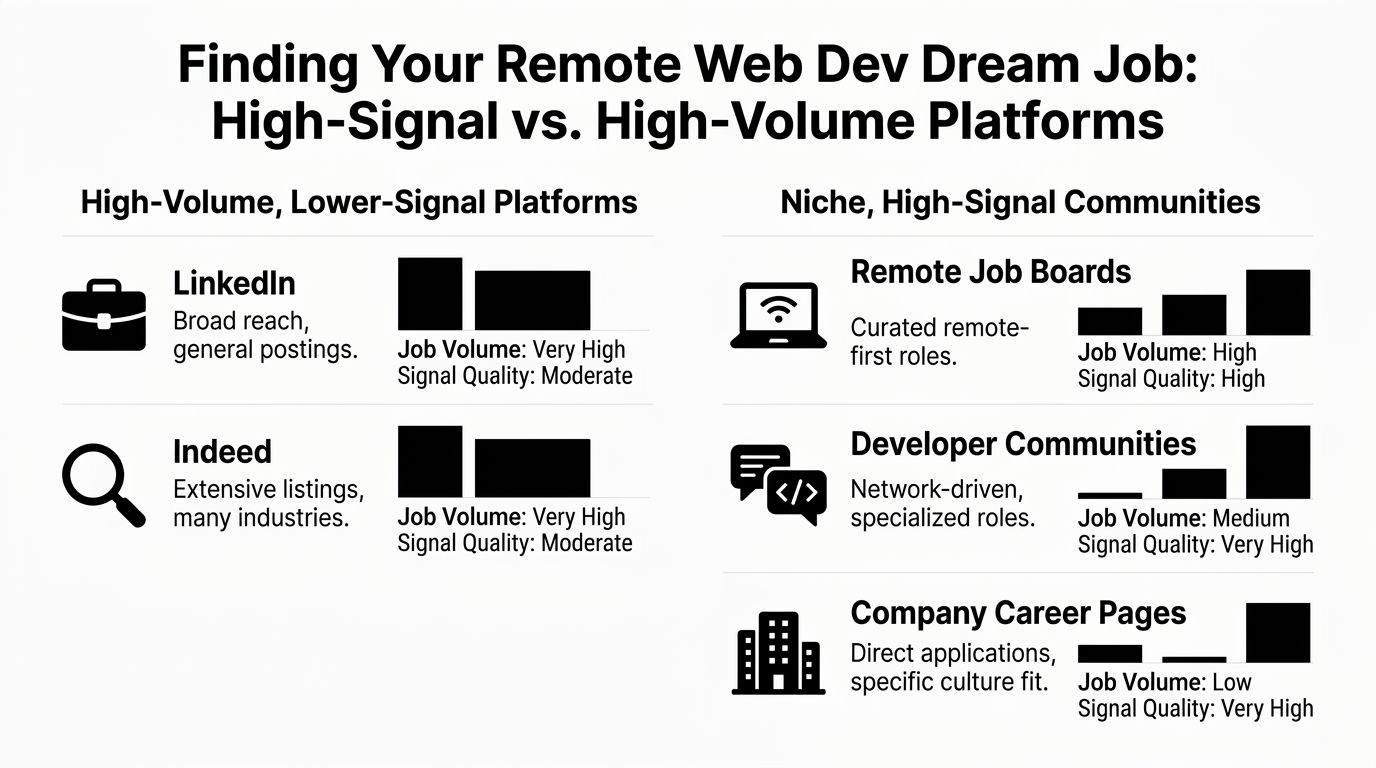
High-volume boards versus high-signal channels
Here is the practical difference.
| Channel | What it is good for | What it is bad for |
|---|---|---|
| LinkedIn and Indeed | Broad market visibility, trend spotting, recruiter activity | Heavy competition, inconsistent filters, duplicate listings |
| Remote-first job boards | Roles designed for distributed teams, clearer async expectations | Smaller pool than mass-market boards |
| Developer communities | Referrals, reputation, niche technical conversations | Requires participation before you need a job |
| Company career pages | Direct signal, less platform noise, clearer product context | Slower to monitor manually |
The smart play is not choosing one. It is assigning each one a job.
Use large boards to map demand. Use niche channels to find roles worth serious effort.
Search where the team structure matches the job
A common mistake is searching by title alone. Search by operating style.
Terms worth watching include:
- Remote-first
- Distributed team
- Async
- Global engineering
- Developer platform
- Protocol tooling
- Wallet
- Infrastructure
- Frontend engineer
- Full-stack engineer
- Product engineer
Those phrases often reveal more than the title itself.
A “frontend engineer” role at a small distributed team may give you broader ownership than a “senior web developer” title at a company that still behaves like an office-first organization.
General job boards miss the Web3 transition layer
If you want to move from traditional web development into blockchain-related work, broad platforms usually flatten the distinction. You end up seeing generic React roles and a few crypto postings with little context.
That misses the bridge itself. As noted by Remote Rocketship’s discussion of web developer roles and the transition into blockchain work, general boards often fail to capture the nuance of Web3 hiring, where teams value developers who can take existing JS and CSS skills and apply them to decentralized applications and DeFi-oriented products.
That means your search should include bridge roles, not only pure blockchain engineering titles.
Look for roles like:
- Frontend engineer for wallet or trading UI
- Full-stack engineer for analytics dashboards
- Product engineer for developer tools
- Platform engineer supporting protocol integrations
- Design engineer for Web3 onboarding flows
These are often the fastest entry points for strong web developers.
For broader curation beyond mass-market boards, resources like Web3 Developer Jobs Opportunities and Resources can help you identify the communities and role types that sit between standard web work and deeper protocol specialization.
Build a weekly system instead of doom-scrolling
The search gets easier when you stop browsing randomly.
A workable weekly rhythm looks like this:
- Monday: Review saved searches and fresh alerts
- Tuesday: Apply to the strongest-fit roles only
- Wednesday: Reach out to hiring managers or engineers where possible
- Thursday: Improve one portfolio artifact based on the roles you saw
- Friday: Follow up, track responses, and trim weak channels
This keeps your search tied to evidence. If many strong roles ask for TypeScript, auth, testing, or contract interaction, update your portfolio around those gaps.
What qualifies as a good remote listing
A high-quality listing usually answers practical questions early:
- What the team is building
- How engineering is organized
- Whether the company supports async work
- What kind of overlap hours exist
- What the interview process looks like
- What the first months of work involve
Low-quality listings are vague and overloaded. They ask for every framework, every cloud tool, and every soft skill but say almost nothing about how the team works.
When you see a strong signal, apply with care. When you see a weak signal, skip it.
For engineering-specific openings in crypto-native and adjacent teams, dedicated category pages like remote engineering roles in Web3-oriented companies can save time because they remove a lot of unrelated noise.
Mastering the Remote Interview and Technical Task
Remote interviews reward clarity more than charisma.
That catches some developers off guard. In person, you can recover from a rough answer through energy and presence. On video, every answer is judged harder on structure. In async tasks, your code and communication sit alone without your personality filling the gaps.

The useful framing is this. You are not only interviewing for competence. You are auditioning for remote trust.
According to Classic Informatics on remote hiring workflows, modern remote hiring managers often use output-driven evaluation, target a 95% pull request success rate, and aim for review times under 8 hours. They also avoid invasive monitoring because output-focused teams show 15% higher productivity. That makes your interview task a proxy for how you will work inside the team, not just whether you can solve a coding puzzle.
What hiring managers evaluate
In a remote interview, they are watching for a few specific things.
- Communication under uncertainty: Can you say what you know, what you assume, and what you need clarified?
- Decision quality: Do you understand trade-offs, or do you only know implementation details?
- Execution habits: Do you leave a clean trail through notes, commits, and documentation?
- Collaboration style: Can another engineer imagine reviewing your work without friction?
Many candidates focus too much on sounding smart. Strong candidates sound easy to work with.
Handle the live interview like a working session
Treat the video call as a professional environment, not a casual chat.
A few basics matter:
- Audio first: Clear sound beats a fancy camera
- Visible setup: Neutral background, stable light, screen ready
- Shared language: Use concise answers, then expand if asked
- Clarifying questions: Ask before coding if the prompt is underspecified
If they ask how you would build something, do not jump straight to syntax. Start with constraints. Ask about expected traffic, auth, latency tolerance, failure handling, or whether the feature is internal or customer-facing.
That answer tells them you think like someone who ships production software.
Your take-home task is a collaboration sample
Many good developers undersell themselves here.
A take-home should look like work a teammate could inherit. That means the repo matters. The README matters. The commit history matters. The issue notes matter if you use them.
A simple framework works well:
| Part | What to include |
|---|---|
| README | Setup, assumptions, architecture, trade-offs |
| Commits | Clean logical checkpoints, not “final fix 2” |
| Code | Readable structure, naming, error handling, tests if appropriate |
| Wrap-up note | What you would improve next and why |
Tip: If you run out of time, document what remains. Hiring teams usually prefer visible judgment over hidden unfinished work.
A concise written summary at the end can be stronger than one more hour of tweaking. Explain what you prioritized, what you intentionally left out, and where you would take it next.
Common mistakes in remote technical tasks
These show up often:
- Overbuilding the assignment: You add features nobody asked for and neglect the core path
- No instructions: The reviewer cannot run the project quickly
- No trade-off notes: It looks like you coded on autopilot
- Messy commits: Reviewers cannot tell how you think
- Silence on assumptions: You guessed, but never marked the guess
That last one matters a lot in remote web dev jobs. Good remote engineers surface assumptions because hidden assumptions become expensive later.
A practical demo of remote interview thinking can help if you want to compare your habits against a more structured approach:
A strong answer sounds like this
If they ask, “How would you approach this task?” a good answer is:
“I’d start by clarifying scope and success criteria. Then I’d implement the core path first, keep the structure simple, and leave a README that explains setup, assumptions, and trade-offs. If time allows, I’d add tests around the riskiest logic instead of polishing low-value details.”
That answer signals engineering judgment, remote communication, and prioritization in one pass.
Negotiating a Remote Offer That Works for You
A remote offer is not complete when the salary number looks good.
It is complete when the working conditions make the job sustainable.
Many developers negotiate compensation and forget everything that determines day-to-day quality. Then they discover the team expects constant daytime overlap across distant time zones, no hardware budget, and meeting-heavy calendars that wreck deep work.
What to clarify before you sign
Ask direct questions. Do not soften them into hints.
You need to know:
- Working hours: Is there fixed overlap, or mostly async communication?
- Equipment: Who provides the laptop, monitor, and accessories?
- Workspace support: Is there reimbursement for home office gear or coworking use?
- Review culture: How quickly do code reviews typically happen?
- Meeting load: How many recurring meetings are normal each week?
- Location policy: Does compensation change by geography?
These are not side issues. They shape whether the role is healthy.
Negotiate for effectiveness, not perks
The strongest negotiation framing is operational.
Instead of saying, “Can I get support for my home office?” say, “I do my best work with a stable setup. I’d like to understand what support exists for hardware and workspace so I can ramp quickly and contribute well.”
That language connects your request to output.
The same applies to overlap hours. If the team spans multiple regions, ask what response times are expected and when synchronous communication is necessary. A role can be “remote” and still feel rigid if expectations are not explicit.
Salary is only one part of the remote equation
Some companies pay by national benchmark. Others localize pay. Some have a clear policy. Others improvise.
Your goal is not winning every line item. Your goal is avoiding vague terms that become friction later.
A simple checklist helps:
| Offer item | What to confirm |
|---|---|
| Base compensation | Amount, currency, frequency |
| Equity or tokens | Vesting terms, grant details, liquidity context |
| Benefits | Health coverage, leave, contractor versus employee status |
| Remote support | Hardware, office stipend, internet support |
| Time expectations | Core hours, on-call, travel, retreat attendance |
Key takeaway: A remote offer should protect your ability to do focused work, not just increase your headline pay.
If the company is evasive on basic operating details, pay attention. Vague communication before you join seldom becomes clearer after you join.
Thriving in Your First 90 Days as a Remote Developer
Many new remote hires make the same mistake. They assume good work speaks for itself.
In an office, people can see that you are engaged. In a remote team, they mostly see artifacts. Messages. Pull requests. Notes. Comments. Decisions. If you do solid work but leave weak visibility, people will underestimate your progress.
The first ninety days are where that pattern gets set. Many remote hires disappear into their own task list during this period.

Days 1 to 30
In the first month, think like a systems reader.
You are learning code, tools, product language, review culture, and who knows what. The fastest way to build trust is not trying to impress everyone with speed. It is becoming easy to unblock.
A strong first month usually includes:
- Writing things down: Keep personal notes on services, conventions, and team terminology
- Asking bounded questions: “I checked A and B. I think the answer is C. Am I missing anything?”
- Shipping small fixes: Documentation, tests, UI cleanup, and low-risk bugs teach you the system
- Observing review habits: Learn how detailed the team expects comments, context, and test coverage to be
The developers who ramp well over-communicate early, then tighten later.
Days 31 to 60
During this period, many remote hires disappear into their own task list.
Do not do that. Start building collaboration intentionally.
Research on remote Scrum work found that distributed teams often struggle with reduced pair-programming and weaker feedback loops, and recommended practices include daily virtual stand-ups and async tools to preserve at least 80% of the feedback retention seen on-site according to the multi-method study on remote Scrum project success and pitfalls.
That finding matches what experienced engineers see in practice. Once hallway interactions vanish, you have to schedule the collaboration that used to happen by accident.
Try this in month two:
- Book a short pair session when entering an unfamiliar part of the codebase
- Post design notes before building medium-sized features
- Leave review context that explains intent, not just implementation
- Summarize blockers early instead of waiting for the next formal sync
Tip: Visibility is not posting more messages. Visibility is leaving useful context where the work happens.
Days 61 to 90
By the third month, people start forming a stable picture of you.
Not as a new hire, but as a teammate. This is when you want to shift from reactive execution to reliable ownership.
Good signals in this phase look like:
| Signal | What it looks like remotely |
|---|---|
| Ownership | You move a task from ambiguity to completion without drama |
| Judgment | You identify trade-offs and ask for input at the right time |
| Team contribution | You improve docs, onboarding notes, or shared tooling |
| Consistency | Your updates, code reviews, and delivery cadence become predictable |
A useful personal rhythm is sending concise status updates that cover three things: what moved, what is blocked, and what is next. Not every day needs a formal post, but your manager should not have to guess whether you are progressing.
One more point matters for remote web dev jobs, especially on distributed teams moving into Web3. Do not wait for permission to connect your work to the product. If you build a frontend flow for wallet connection, learn the underlying user journey. If you touch a dashboard tied to protocol data, learn what decisions that dashboard supports. Remote developers who understand product context gain trust much faster than those who stay inside implementation details only.
Frequently Asked Questions About Remote Web Dev Jobs
Do remote web dev jobs pay less if I live outside a major tech hub
Sometimes yes, sometimes no.
Some companies use location-based compensation. Others pay by role level regardless of where you live. The important move is to ask directly how compensation is determined before you accept. If the answer is vague, keep asking until it is concrete.
How do I handle large time zone differences on a remote team
Set working agreements early.
Ask what hours require overlap, what kinds of issues belong in async channels, and how urgent matters are flagged. Then build habits around written updates, well-scoped questions, and documented handoffs. Teams can handle time zone spread well if they define response expectations clearly.
I work in traditional web development. How do I move into Web3 without pretending to be a blockchain expert
Use your existing strengths as the bridge.
Frontend architecture, API integration, authentication flows, state management, testing, and performance work all transfer. Build one or two projects that show contract interaction, wallet connectivity, or data visualization for on-chain information. Then apply to roles that sit near the product surface, not only deep protocol roles.
Are take-home tasks worth doing
Sometimes.
They are worth doing when the company is specific about scope, respectful about time, and serious about review. They are less attractive when the prompt is vague, oversized, or disconnected from the actual role. A good take-home should reveal how you think and communicate, not extract unpaid production work.
Is it better to apply broadly or narrowly
Narrowly, then consistently.
A smaller number of high-fit applications with customized materials beats spraying resumes everywhere. Remote hiring teams look for alignment. If your background, portfolio, and application narrative all point in the same direction, you stand out faster.
Should I accept a hybrid role if I want to end up fully remote
It depends on the team and the trajectory.
A hybrid role can be a useful bridge if the company already supports distributed workflows and remote progression is realistic. It is less useful if “hybrid” really means office-first culture with occasional work from home. Look at how the team communicates, reviews code, and documents work. Those habits tell you more than the policy label.
If you want to turn this advice into a search, Blockchain Jobs is a strong place to look for remote-friendly roles across engineering, product, design, marketing, legal, and other Web3 functions. It is especially useful if you are bridging from traditional web development into decentralized products and want job listings that reflect how distributed teams hire.