Your Guide to Landing a Rust Programming Language Job in 2026
When surveying the tech job market, it's easy to get lost in the sheer volume of listings for languages like Python or JavaScript. But if you look closer, a different kind of opportunity shines through: Rust programming language jobs. They might not be the most numerous, but they often come with higher salaries, less competition, and fierce demand, making Rust a seriously strategic move for any developer looking to fast-track their career progression.
Why Rust Is Your Next Big Career Move

Here's the hiring insight most developers miss: they fixate on the total number of job openings. That’s a strategic mistake. The real power lies in the gap between the demand for a skill and the supply of qualified talent. For Rust, that gap is massive—and it’s a huge career advantage for you.
Think of it this way. Becoming a JavaScript pro is like entering a marathon with tens of thousands of other runners. It's crowded, and you have to fight to get noticed by hiring managers. Learning Rust, on the other hand, is like training for a specialized, high-stakes race where only a handful of elite athletes are qualified to compete. When a company needs a "Rust driver" for their critical systems, they can't just pick anyone. They need you.
The most important thing to remember is this: You only need one job. Focusing on a niche where talent is scarce gives you incredible leverage when it comes to negotiating your salary, choosing your projects, and shaping your long-term career path.
Scarcity Creates Hiring Leverage
The buzz around Rust isn't just hype; it's a straightforward case of supply and demand that you can use to your advantage. Everyone admires Rust for its blazing-fast performance and memory safety guarantees. But here’s the catch for hiring managers: its famous learning curve means that the pool of developers who have truly mastered it is still quite small. This creates a hiring bottleneck for companies building the next generation of essential software.
This dynamic is most pronounced in fields where a single bug can have catastrophic consequences, making skilled Rust developers invaluable:
- Blockchain & Web3: Building the secure and efficient protocols that power decentralized finance and other on-chain applications.
- Cloud Infrastructure: Writing the core services that support giants like AWS and Cloudflare.
- Embedded Systems: Developing software for physical devices where reliability and performance are absolutely critical.
The Market by the Numbers
Let's get one thing straight: Rust is still a niche language in the grand scheme of things. A recent analysis of over 12 million developer jobs found that Rust listings made up only about 1% of the total market. For perspective, JavaScript/TypeScript came in at 31%, and Python held a 20% share.
But that scarcity is exactly what makes it such a smart career move. While there are fewer Rust jobs overall, the competition for each one is a fraction of what you'd face elsewhere. This guide is all about showing you how to turn that scarcity into your greatest professional asset in interviews and negotiations. You can dig deeper into the data by reading the full DevJobsScanner analysis of programming languages.
To put it all into context, here’s a quick snapshot of how the job market looks for Rust compared to the industry giants, based on projected trends for 2026.
Rust Job Market At a Glance (2026)
This table provides a quick comparison of the Rust job market against other popular programming languages, focusing on key career metrics for job seekers.
| Metric | Rust | JavaScript | Python |
|---|---|---|---|
| Job Volume | Lower (Niche) | Highest | Very High |
| Competition Level | Low | Very High | High |
| Salary Potential | Very High | High | High |
| Growth in Demand | Highest | Moderate | Moderate |
| Required Specialization | High (Systems, Web3) | Varies (Web, Mobile) | Varies (AI, Data, Web) |
As you can see, while JavaScript and Python win on sheer volume, Rust offers a unique combination of low competition, high salary potential, and explosive growth in demand. It's a trade-off between chasing the crowd and becoming a highly sought-after specialist with significant career leverage.
Decoding Rust Job Titles and Career Paths
If you're serious about your career progression in Rust, you need to look past the generic "Software Engineer" title. Understanding the specific roles available is like having a map of the territory—it shows you what rust programming language jobs actually involve day-to-day. This is vital for targeting the right interviews and for hiring managers trying to write a job description that attracts top-tier talent.
The world of Rust jobs is surprisingly diverse. Each role requires a different mindset and a specialized set of skills. Simply having "Rust" on your resume won't impress a hiring manager; you have to prove you understand the specific challenges of the job you're targeting. For hiring managers, getting the job title right is the first step to attracting the right candidates.
Think of it like medicine. A general practitioner has broad knowledge, but you go to a neurosurgeon for their deep, specific expertise—and that expertise commands a premium salary. The same holds true in the Rust ecosystem.
Common Rust Engineer Roles
While job titles can be inconsistent between companies, most Rust positions fit into a few main categories. Each one is a distinct career path with its own unique projects and interview focus. Knowing the difference helps you zero in on the right opportunities and prepare for the right kind of technical questions.
Rust Engineer (Generalist): This is the title you'll see most often, especially at companies bringing Rust into an existing tech stack. You could find yourself building performance-critical microservices, creating command-line tools, or working on internal platforms. Your interview will likely focus on your ability to make existing systems faster and more reliable.
Systems Programmer: This role gets you much closer to the hardware. You’ll be working on operating systems, embedded devices, or low-level networking where peak performance and direct memory control are essential. Prepare for interview questions that test your grasp of computer architecture and low-level optimizations.
Web3 and Blockchain Specializations
The explosion of blockchain technology has created a huge demand for Rust developers, opening up some highly specialized and well-paid career paths. These roles are on the front lines, building the foundation of the decentralized internet.
Blockchain Protocol Developer: This is arguably one of the most advanced roles in the Rust world. You aren't just using a blockchain; you're building it. You'll design and implement core components like consensus mechanisms and peer-to-peer networking layers. Your interview will be a deep dive into cryptography, distributed systems, and consensus algorithms.
Web3 Backend Engineer: These engineers build the critical off-chain infrastructure that makes decentralized applications (dApps) work. You’ll be creating high-performance APIs, indexers, and data services that bridge the gap between users and the blockchain. Interviews will focus on API design, data management, and your expertise in interacting with smart contracts and navigating the challenges of a decentralized system. If that sounds interesting, check out what a Software Engineer in Core Engineering at Kraken does.
Understanding these distinctions is crucial for your career progression. An interview for a protocol developer will be worlds apart from one for a backend engineer. The key to a successful career in Rust is to identify the path that excites you and go all-in on preparing for its specific demands.
The Skills That Unlock Top-Tier Rust Jobs
If you’re ready to land a senior-level rust programming language job, knowing the syntax just isn't enough. The real difference between a junior and a senior developer—and the salary that comes with it—is a specific set of skills that hiring managers are actively hunting for.
Think of it like building a race car. The core principles of Rust are your engine block. It has to be perfect, solid, and reliable. But to win the race (and the job offer), you need the specialized parts: the turbocharger, the performance suspension, the custom aerodynamics. The best candidates have both the rock-solid foundation and the high-impact specializations.
The Foundational Must-Haves for Interviews
Before you even think about building complex applications, you need an ironclad grasp of Rust's core mechanics. These are the non-negotiable topics that will come up in every single technical interview because they are the heart and soul of writing safe, high-performance Rust. There's no faking it here.
- Ownership, Borrowing, and Lifetimes: This is Rust's defining feature. You must move past a purely academic knowledge and develop an intuition for how the borrow checker operates. Be ready to walk an interviewer through a tricky lifetime annotation problem on a whiteboard and explain why your solution is correct.
- Error Handling (Result & Option): A seasoned Rust developer doesn't think in
try-catchblocks. Your mind should naturally reach forResult<T, E>andOption<T>. You need to be fluent in using combinators likemap,and_then, and the?operator to write clean, idiomatic, and robust code. - Concurrency and Parallelism: "Fearless concurrency" is one of Rust’s biggest promises. You must be comfortable with primitives like
Arc,Mutex, andchannelsfor writing safe multi-threaded code. Be prepared to explain the difference between theSendandSynctraits and when to use each.
When a candidate can clearly articulate why a piece of code satisfies the borrow checker—or more importantly, why it doesn't—it's an immediate signal of senior-level thinking. It proves to the interviewer that you understand the deep guarantees Rust provides, not just how to make the compiler happy.
Specialized Skills for Senior Roles and Career Progression
Once the foundation is set, you can start adding the skills that make you stand out. This is how you differentiate yourself in a competitive market and justify a top-tier salary. These skills often align with high-growth sectors like Web3, cloud infrastructure, or embedded systems.
One of the biggest hurdles for companies in 2026 is the simple fact that there are way more junior Rust developers than seniors. This creates a massive bottleneck for businesses like Mozilla, AWS, and major blockchain protocols who are all fighting over a small pool of proven talent. This scarcity works in your favor if you have the right experience. You can get more perspective on this talent gap and how it affects hiring in the blockchain space.
In-Demand Libraries and Frameworks That Get You Hired
Nothing says "I've actually built things" to a hiring manager like being proficient with the ecosystem's most important libraries. Familiarity with these tools is often a prerequisite for specific roles and a great way to signal your expertise.
- Asynchronous I/O with Tokio: If your target job involves network programming—from web services to blockchain nodes—you're going to be using Tokio. A deep understanding of async/await, task management, and the danger of blocking in an async context is essential to pass the interview.
- Data Serialization with Serde: Serde is the standard for turning Rust data structures into bytes and back again. It’s everywhere. Demonstrating you can implement custom serialization logic or work with formats like JSON or Bincode shows practical, real-world experience.
- Blockchain Frameworks: For Web3 roles, you need to show you can apply your Rust skills to decentralized systems. This means having hands-on project experience with a framework like Substrate (used in the Polkadot ecosystem) or a solid grasp of the Solana program model.
At the end of the day, it's about developing a specific mindset that hiring managers look for: a relentless focus on performance, an obsession with memory safety, and the ability to think at a systems level. That combination of deep foundational knowledge and targeted, specialized expertise is what will make you a truly valuable hire.
What to Expect for Your Rust Developer Salary
Alright, let's get straight to the point: compensation. When you start looking at rust programming language jobs, you're stepping into a market where the basic rules of supply and demand work heavily in your favor. There’s a serious shortage of skilled Rust developers, and companies are willing to pay a premium to hire that talent.
This isn't just about hype. The high salaries reflect the critical nature of the work. We're talking about high-frequency trading systems, core blockchain infrastructure, and foundational cloud services. In these environments, a single bug or performance hiccup can be catastrophic. Companies need the safety and speed Rust offers, and they need engineers who can deliver on that promise—and will pay top dollar for them.
The reason for the high pay comes down to leverage. When a company's main product is built on Rust, the few developers who truly understand it become indispensable. That gives you serious negotiation power during the hiring process.
Global Salary Benchmarks (2026)
Rust developers consistently earn more than the average software engineer, a trend that holds true across every major tech hub. As of 2026, the data paints a very clear picture of the financial upside of specializing in Rust, making it an attractive path for career progression.
To give you a concrete idea, here’s a look at what you can expect across different regions and experience levels.
Global Rust Developer Salary Benchmarks (2026)
| Region | Junior Developer | Mid-Level Developer | Senior Developer |
|---|---|---|---|
| United States | $90,000 - $120,000 | $120,000 - $170,000 | $170,000 - $250,000+ |
| Europe (e.g., Germany, UK) | €60,000 - €80,000 | €80,000 - €110,000 | €110,000 - €150,000+ |
| India | ₹15 - ₹25 lakhs | ₹25 - ₹40 lakhs | ₹40 - ₹70 lakhs+ |
As you can see, the compensation is strong right from the start and grows significantly as you gain experience and take on more responsibility. These numbers reflect base salaries and can go much higher when you factor in bonuses and equity.
In the United States, for instance, it's common to see annual salaries between $110,000 and $160,000, easily placing Rustaceans among the highest-paid developers. The European market is just as hot, with typical ranges from €70,000 to €120,000. And in India's fast-growing tech scene, experienced Rust engineers can command salaries between ₹18 to ₹35 lakhs.
This chart helps visualize what skills drive these top-tier salaries.
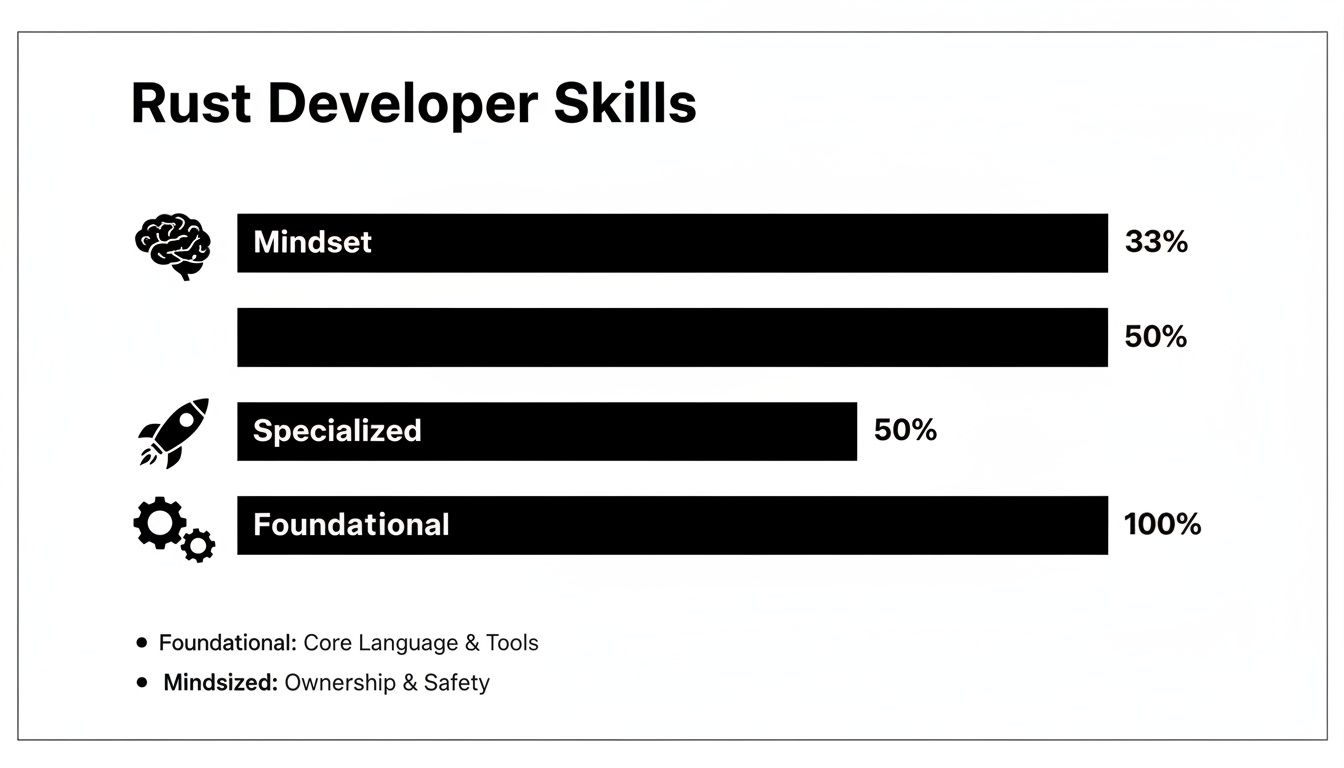
It’s not just about knowing the syntax. While foundational skills are a must to get through the door, it's the specialized knowledge and the systems-thinking mindset that really command the highest salaries and set top earners apart.
Factors That Shape Your Paycheck
Of course, your final offer will depend on a few key variables. Knowing these will help you gauge your market value and negotiate from a position of strength.
- Experience Level: This is the biggest driver. A senior developer who can architect a complex system from scratch, mentor other engineers, and lead a project is in a completely different ballpark from a negotiation standpoint. For top-tier senior roles, total compensation packages pushing $400,000 are not unusual, especially when equity is involved.
- Industry: The field you're in makes a big difference. A developer at a well-funded Web3 or FinTech company will almost always earn more than someone in a less specialized sector because your code has a direct, measurable impact on the company's high-value bottom line.
- Company Type: Big Tech firms (like FAANG) tend to offer high base salaries and amazing benefits. On the other hand, an early-stage startup, especially in the blockchain space, might offer a lower base but compensate with a much larger equity stake—which could be incredibly valuable for your long-term career growth if the company succeeds.
Looking Beyond the Base Salary: The Total Compensation Package
Remember, the base salary is just one part of the story. For mid-level and senior roles, you should always be thinking in terms of total compensation. When you get an offer, it's time to put on your analyst hat and break down the entire package to assess its true value.
Here’s what a competitive offer for a senior Rust engineer often includes:
- A strong base salary as the foundation.
- Equity or stock options, giving you a real stake in the company's future.
- Performance bonuses tied to your work and the company's success.
- Great benefits, including remote work flexibility, a home office stipend, and comprehensive health insurance. These are table stakes in a competitive hiring market.
When you're interviewing, don't hesitate to ask for the details on each of these components. A slightly lower base salary might be a great trade-off for a generous equity grant in a company you believe in. You can see many roles structured this way by checking out the latest Rust opportunities in the USA. Making an informed career decision means understanding every piece of what's on the table.
How to Pass Your Rust Job Interview
The technical interview is the moment of truth in landing a great Rust programming language job. It's where you must prove that your skills on paper translate into an ability to solve real problems and think like an experienced Rust developer, especially under pressure.
Getting ready for this stage starts long before you get an email from a recruiter. It begins with your resume and your online presence. Hiring managers are looking for concrete evidence of your skills, and simply listing "Rust" isn't enough to get noticed.
Think of your resume as a highlight reel designed to get you past the initial screen.
- Highlight Open-Source Contributions: Have you submitted a pull request to a popular Rust crate? Even a small bug fix or documentation improvement shows you can navigate a professional-grade codebase and collaborate effectively.
- Showcase Personal Projects: Nothing speaks louder than a well-documented project on GitHub. It's your best marketing tool, giving recruiters a direct look at your coding style, problem-solving skills, and ability to see a project through to completion.
Nailing the Technical Hurdles
Let's be clear: the Rust interview process is known for being tough. It’s intentionally designed to separate candidates who have a deep, practical understanding of the language from those who have only read the book. Expect a multi-stage gauntlet that will test your knowledge from every angle.
The key isn't just getting the right answer. It’s about clearly explaining your thought process as you go. You need to talk about the trade-offs you're considering and justify why your solution is the right one, balancing performance with Rust's strict safety guarantees. This is what separates junior-level candidates from senior-level hires.
The single most important thing a candidate can do is talk through their thought process. When a developer explains why they chose
Arc<Mutex<T>>over another concurrency primitive, or how a specific lifetime annotation prevents a use-after-free bug, it shows a depth of understanding that a silent, correct answer never could. This is what interviewers are listening for.
What to Expect in the Interview Process
Most companies will use a mix of live coding challenges, system design discussions, and behavioral questions. Each format is designed to test a different aspect of your skill set, so be prepared for all three.
- Live Coding Problems: This is the core of most technical screens. You’ll be in a shared editor, tasked with solving a problem while the interviewer watches and asks questions. Expect problems specifically tailored to test Rust's unique features, like ownership and the borrow checker.
- Systems Design Questions: Here, you'll zoom out. The interviewer might ask you to architect a larger system, like a high-throughput web service or a key part of a distributed database. They're looking for your architectural mindset and ability to think about scalability and trade-offs.
- Behavioral Questions: These are about your experience and how you work with others. Prepare to answer questions about past projects, how you've dealt with tough technical roadblocks, and your approach to team collaboration using the STAR (Situation, Task, Action, Result) method.
How to Approach the Coding Questions
When it comes to the live coding, you have to be fluent in Rust's core concepts. The interviewer is looking for confidence and competence with the language’s most powerful—and often most difficult—features.
Example Problem: "Write a function that takes a slice of strings, finds the longest string, and returns a reference to it. Explain your choice of lifetime annotations."
This might seem straightforward, but it's a classic test of your grasp on lifetimes. A senior-level answer requires using a lifetime parameter to tell the compiler that the returned reference is tied to the lifetime of the input slice, guaranteeing it will always point to valid data.
Your explanation should break down:
- Why the lifetime parameter (
'a) is absolutely necessary. - How it creates a link between the input (
&'a [String]) and the output (&'a String). - The compiler error you’d get if you left it out, and what that error really means about memory safety.
Beyond lifetimes, your approach to error handling will be under a microscope. If you feel the urge to use .unwrap() or .expect() in an interview, stop. That's a major red flag for any production-focused role. Top candidates demonstrate their commitment to writing robust code by gracefully handling Result and Option types with match expressions or combinators like map_err.
Finding the Best Rust and Web3 Job Opportunities

When you're hunting for top-tier rust programming language jobs, the big, mainstream job boards are rarely the place to look. Your ideal role in Web3 or high-performance systems isn't just sitting out in the open; it's tucked away in the niche communities where the real action is happening. A successful job search requires a targeted strategy.
Forget endless scrolling through irrelevant listings. Your job search should be as efficient as the code you write. The secret is to embed yourself directly into the Rust ecosystem and connect with the teams that are actually hiring.
Go Straight to the Source
The best roles are almost always found where developers gather. Instead of just reacting to job postings, you can get a serious advantage by becoming an active participant in the communities that companies rely on for talent. This approach gets you noticed by hiring managers long before a formal job description ever goes public.
These platforms offer a direct line to the people doing the hiring:
Dedicated Job Boards: Sites specializing in Rust or Web3 are your most valuable resource. They cut through the noise, curating listings specifically for your skills. You can get a great feel for the market by browsing the latest blockchain engineering jobs and seeing which companies are actively hiring.
Community Hubs: Don't underestimate the power of community forums as a job-seeking tool. They aren't just for asking technical questions; they're living, breathing job markets.
- Reddit: Subreddits like r/rust and its monthly "Who's Hiring?" thread are goldmines for connecting directly with hiring managers and engineering leads.
- Discord Servers: Many open-source projects and companies have active Discord communities. This is often the very first place new roles are announced, giving you a head start.
For a job seeker, being a known quantity in a technical community is a superpower. When a hiring manager sees a familiar name from a Discord channel or a helpful contributor from a GitHub repo, that candidate immediately moves to the top of the pile.
Target the Trailblazers
Another powerful strategy is to go directly to the source: the companies at the forefront of Rust adoption. These organizations are always scouting for talent and often have "Careers" pages filled with high-value roles you simply won't find anywhere else. They already believe in Rust and invest heavily in their engineering teams.
Keep a close watch on these types of companies:
Tech Giants: Big players like AWS, Microsoft, and Cloudflare use Rust for critical, performance-sensitive infrastructure. They are constantly looking for experts to join their ranks.
Blockchain Pioneers: The companies building the foundation of Web3 are your best bet for specialized, high-paying roles. Regularly check the career pages for the Solana Foundation, Parity Technologies (the team behind Polkadot), and other major layer-1 and layer-2 protocols. They are perpetually on the hunt for sharp protocol and systems developers.
Answering Your Top Questions About a Career in Rust
Whenever I talk to developers and hiring managers about Rust, the same handful of questions always come up. It's a field with a lot of excitement but also some uncertainty. Let's clear the air and tackle the big ones from the perspective of both job seekers and employers.
Can I Get a Rust Job Without Professional Experience?
This is a common concern, especially for developers transitioning from other languages. The short answer is: absolutely, yes. But you can't just send out a resume listing "Rust" as a skill and hope for the best, particularly when so many companies are hunting for senior-level talent.
Since you don't have a formal work history with Rust, you have to create your own evidence of experience. A strong portfolio is your key to getting an interview.
- Contribute to Open-Source: Find a crate you admire and jump in. Even fixing a typo in the documentation is a great start. It shows hiring managers you can navigate a real-world codebase, use Git, and collaborate with a team.
- Build Tangible Projects: Get a project up on GitHub that actually does something meaningful. Whether it’s a command-line tool, a simple web service, or a basic component for a blockchain, you're demonstrating that you can apply your knowledge to solve real-world problems. This is your proof of work.
How Does a Rust Career Compare to Go for Backend Development?
Both Rust and Go are powerhouses for modern backend development, but they represent two different philosophies. As a developer, your choice impacts your career path; as a hiring manager, it defines your team's capabilities.
Go is all about being pragmatic and simple, designed for large teams to build services quickly. Rust is a maximalist language that offers unparalleled performance and safety, but it demands more from the developer.
In terms of job hunting, you'll see more Go positions out there, but you'll also face a much larger pool of applicants. The competition for JavaScript roles is roughly 1.4x higher than for Go, and a similar dynamic exists between Go and Rust. A Rust job might take longer to find, but once you're in the interview process, you'll have far fewer people to compete against, which gives you significant leverage.
What Is the Long-Term Career Outlook for Rust?
The long-term career outlook for Rust specialists is incredibly strong. We're seeing its adoption explode in industries where mistakes are costly and performance is non-negotiable.
- Systems Programming: It’s quickly becoming the modern successor to C++ for low-level systems development.
- Web3 & Blockchain: It's the de facto language for building new layer-1 protocols and the core infrastructure that powers them.
- Cloud & Edge Computing: All major cloud providers are using Rust to build their most performance-sensitive services.
As these critical technologies become more foundational to our digital world, the demand for developers who can build and maintain them will only grow. This makes specializing in Rust a durable, high-value career move for the long haul.
How Can Companies Attract Top Rust Talent?
In a market this tight, just posting a job ad on LinkedIn isn't going to cut it. If you want to attract and hire the best Rust engineers, you have to create an environment where they genuinely want to work.
- Offer Compelling Work: Rust developers are passionate about the language itself. Give them tough, interesting problems to solve, such as deep performance optimizations or complex systems-level design challenges.
- Invest in the Community: Show that you're an active participant in the ecosystem. Sponsor Rust conferences, support open-source projects your team relies on, and give your engineers paid time to contribute back. This builds a powerful employer brand.
- Be Flexible and Competitive: A top-tier salary, meaningful equity, and remote-friendly policies are the baseline, not a perk. You must demonstrate to candidates that you understand and value the rarity and importance of their expertise.
Ready to find your next opportunity or attract top-tier talent in the blockchain space? Visit Blockchain Jobs to explore curated roles and connect with the best in the industry. Find your next role or hire on blockchain-jobs.com.