Land Smart Contract Developer Jobs
If you want to land one of the highest-paying roles in tech, you need to think like the people doing the hiring. Smart contract developer jobs are incredibly rewarding, but getting your foot in the door takes more than just knowing how to code. It's about proving you can build secure, efficient, and reliable decentralized applications that a hiring manager would be confident shipping to production.
Mastering The Tech Stack Hiring Managers Demand
Let's get straight to it: recruiters and engineering leads are looking for a specific set of skills that prove you can solve their problems. They want to see practical, hands-on mastery of the entire development lifecycle—not just a list of languages on a resume.
In an interview, they're looking for problem-solvers. Can you explain why you chose a certain design pattern or how you'd prevent a common vulnerability? That's what separates a hire from a pass. Your technical skills are a toolkit; the more battle-tested and specialized your tools are, the more valuable you become in the job market.
Core Languages and Blockchain Fundamentals
Everything starts with the programming languages that build on-chain logic. To get past the initial resume screen for almost any smart contract developer job, you need proficiency in one of these two languages.
- Solidity: This is the non-negotiable language of the Ethereum Virtual Machine (EVM), which powers Ethereum and a massive ecosystem of chains like Polygon, Avalanche, and BNB Chain. For the vast majority of smart contract jobs, knowing Solidity isn't optional—it's the price of entry.
- Rust: Quickly becoming a favorite for high-performance blockchains like Solana, Polkadot, and Near, Rust is celebrated for its safety and speed. Adding Rust to your skillset opens up a whole other segment of the job market, often with seriously competitive pay, and makes you a more versatile candidate.
But knowing the syntax is just the beginning. A deep understanding of blockchain fundamentals is what will get you through a technical interview. You need to be able to clearly articulate the inner workings of the EVM, gas optimization techniques, and the critical differences between storage, memory, and calldata.
For example, being able to walk an interviewer through how you'd minimize the gas costs of a particular function shows you're thinking about real-world application and efficiency—a key trait hiring managers look for.
I’ve seen candidates who can clearly articulate the trade-offs between different smart contract upgrade patterns—like Proxies versus the Diamond Standard—immediately jump to the top of the list. It proves they're thinking about long-term maintainability and security, which is exactly what a senior role requires.
Essential Frameworks and Security Principles
Writing the contract is just step one. To operate at a professional level—and to pass a coding challenge—you need a robust set of tools for testing, deploying, and securing your code. Being fluent in industry-standard frameworks is a hard requirement for almost any serious role.
The infographic below gives a great visual breakdown of the core skills you need, showing how languages, frameworks, and security all fit together.
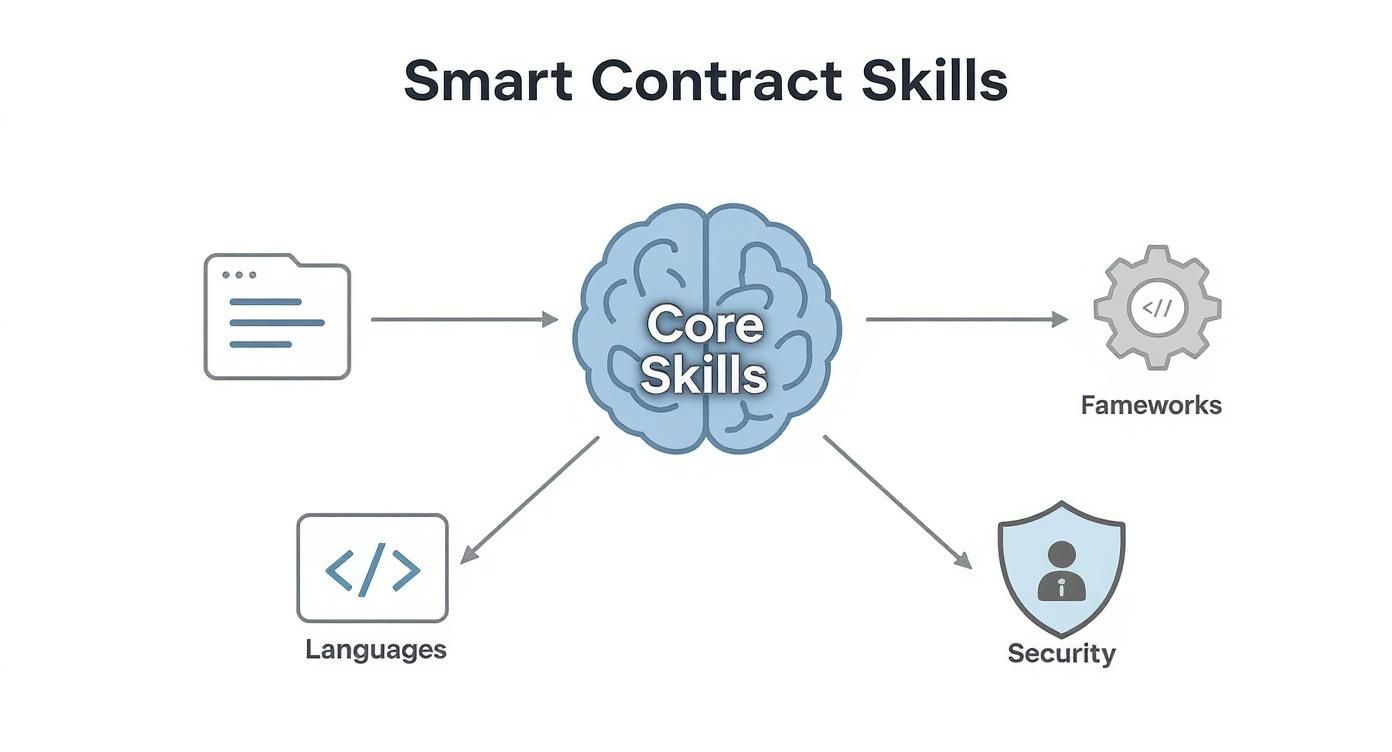
As you can see, these skills are deeply interconnected. Your mastery of a framework directly impacts your ability to implement strong security practices, which is the number one concern for employers.
To be competitive, you absolutely have to know at least one of the two biggest frameworks: Hardhat or Foundry. Hardhat is a powerful, flexible environment based in JavaScript, while Foundry is a blazing-fast toolkit built in Rust that lets you write your tests directly in Solidity. Being proficient in one is mandatory; knowing both shows you're adaptable and ready for any professional dev environment.
Finally, let's talk about the most critical piece of the puzzle: security. In this space, a single vulnerability can wipe out millions of dollars in an instant. You must have a solid grasp of how to identify and prevent common attacks, including:
- Reentrancy
- Integer overflow and underflow
- Front-running
- Price oracle manipulation
This combination of deep technical knowledge and a security-first mindset is precisely why compensation for these roles remains so high. The job requires you to handle security audits, performance optimization, and scalable architecture, especially in booming sectors like DeFi and gaming. A quick look at the market shows that roles like a smart contract engineer specializing in low-level EVM execution reflect this demand. Entry-level salaries start around $121,000 and can soar past $187,500 for experienced developers, a clear indicator of the high stakes and specialized expertise required.
Here's a quick cheat sheet of the technologies you need to focus on to build a compelling job application.
Essential Smart Contract Developer Tech Stack
If you want to build a resume that gets noticed, this is the stack you need to master. It covers the core technologies that hiring managers are actively looking for right now.
| Category | Core Technologies | Why It's Critical for Jobs |
|---|---|---|
| Languages | Solidity, Rust | The foundational languages for the two largest ecosystems (EVM and Solana/Rust-based chains). Non-negotiable for passing resume screens. |
| Frameworks | Hardhat, Foundry | The industry standards for professional smart contract development, testing, and deployment. You will be tested on these in interviews. |
| Libraries | OpenZeppelin, Ethers.js, Web3.js | Essential for building secure contracts with battle-tested components and interacting with the blockchain. Shows you build efficiently. |
| Wallets | MetaMask, WalletConnect | Understanding how users interact with dApps is crucial for building practical applications, a key aspect of any developer role. |
| Security Tools | Slither, Mythril, Echidna | Proves you take security seriously and know how to use static analysis and fuzzing tools. A huge plus for hiring managers. |
Focusing your learning on these specific areas will give you the most direct path to landing interviews and, ultimately, a top-tier job.
Your GitHub Portfolio Is Your Resume—Make It Count
When it comes to landing a job as a smart contract developer, your GitHub profile is everything. Forget what you think you know about resumes; in this space, your code is your credential. It’s the single most powerful asset you have, serving as tangible proof that you can ship secure, functional, and well-documented smart contracts.
A good portfolio is what separates someone who knows about Solidity from someone who can actually build with it. Hiring managers aren't looking for another to-do list dApp or a basic "Hello, World!" contract. They want to see projects that tackle real, on-chain problems. This shows them you have a solid grasp of blockchain logic and gives you fantastic talking points for your next technical interview.

Go Beyond Generic Tutorial Projects
Your goal is to show a potential employer that you have the skills they need to solve their problems. Following a tutorial is fine for learning, but putting those projects in your portfolio signals that you can only follow instructions. It doesn't prove you can think critically or solve unique challenges on your own.
Instead, build projects that demonstrate skills listed in job descriptions. Here are a few ideas that will immediately get a recruiter's attention:
- Decentralized Voting System: This is a great one because it forces you to manage state, handle permissions (who can vote and when?), and prevent common attacks like double-voting. It’s a perfect showcase of fundamental smart contract logic.
- Simple ERC-20 Token with Vesting: Anyone can create a standard token. The real test is adding a time-locked vesting schedule for founders or investors. This proves you can handle more complex financial logic and manage state over time.
- Multi-Signature Wallet: This is a classic for a reason. Building a contract that requires multiple owners to approve a transaction shows you understand crucial security patterns and on-chain authorization.
These projects aren't just lines of code; they're interview conversation starters. In an interview, you can walk through your design decisions, the security trade-offs you wrestled with, and how you tested for every possible edge case.
A candidate who can passionately explain why they chose a specific access control pattern in their multi-sig wallet project is infinitely more impressive than one who simply lists "Solidity" on their resume. It shows ownership and a deep level of engagement.
Structure Your GitHub for Recruiter Appeal
A messy GitHub profile is like a disorganized resume—it gets tossed aside. Recruiters and hiring managers spend seconds, not minutes, scanning profiles. You have to make it dead simple for them to see your value. Treat every repository in your portfolio like a professional product.
For each of your key projects, make sure you have:
- A Compelling README.md: This is your project's landing page. It needs to clearly explain what the project does, the problem it solves, and the tech you used. Don't forget to include setup instructions and how to run your tests.
- Comprehensive Test Suites: Nothing screams "professional" like a thorough test suite. Your tests are the ultimate proof that you value quality and security. Aim for high test coverage and use frameworks like Hardhat or Foundry to write clear, descriptive tests. This is a common requirement in take-home coding challenges.
- Well-Documented Code: Use NatSpec documentation and comments inside your Solidity contracts to explain why you wrote the code the way you did. This shows you can write code that other developers can actually understand and maintain—a non-negotiable skill for any team.
Think of each repository as a mini case study. A recruiter trying to fill a smart contract developer role at a major protocol like Uniswap Labs is going to be hunting for evidence of rigorous testing and crystal-clear documentation. Those aren't nice-to-haves; they're absolute requirements to get an interview.
Quality Over Quantity Is Key
Your portfolio should showcase your best work, not all of your work. It's far better to have 2-3 high-quality, well-documented projects that align with the jobs you're applying for than a dozen half-finished tutorials.
Each project should tell a story and highlight a specific skill. For instance, one project could demonstrate your deep understanding of token standards (like an ERC-721 with on-chain metadata), while another highlights your ability to write super gas-efficient code for a DeFi protocol. Curate your GitHub to build a narrative about who you are as a developer. When you do that, your profile will stand out and land you more interviews for the jobs you actually want.
Crafting Your Resume for Web3 Recruiters
Let's be clear: your resume is the first real test in landing a top-tier smart contract developer job. Sending in a generic Web2 resume is a guaranteed way to get overlooked. Recruiters in this space are scanning for a very specific combination of technical chops, on-chain evidence of your work, and a genuine passion for decentralization. Your resume needs to pass this initial screen to even get you a conversation.
This means leading with your most relevant skills, tailored to the specific job you're applying for. If a role is heavy on DeFi security, your summary shouldn't just list your skills—it should immediately point to your portfolio projects that demonstrate expertise with access control or security audits. Don't make them hunt for it. Put your most compelling evidence right at the top.
Translating Your Experience for Web3
Plenty of great developers make the jump from traditional software engineering. The trick is to reframe your past work through a Web3 lens, showing how your existing skills are directly relevant to blockchain development. Focus on hard numbers and achievements that prove you can handle complex, high-stakes environments.
For instance, "Developed backend services for a fintech app" is fine, but it doesn't pop. Try this instead: "Engineered and maintained high-availability APIs processing over $10M in daily transactions, demonstrating expertise in building secure and scalable financial systems." That small tweak directly connects your background to the non-negotiable requirements of DeFi: security and reliability.
Here’s how you can reframe other common experiences:
- Database Management: Talk about your work with data integrity, immutability concepts, and state management. These are the bedrock principles of blockchain architecture.
- API Development: This is really about building systems that communicate with external services—not all that different from how a dApp interacts with an oracle or calls another contract.
- Cybersecurity: If you have any security experience, you've struck gold. Go into detail about your work in vulnerability assessments, penetration testing, or secure coding practices. This is a massive selling point for any hiring manager.
Recruiters are actively looking for transferable skills. Someone who’s managed critical financial infrastructure in Web2 is a much lower-risk hire because they already have the security-first mindset. Your job is to make that connection impossible for them to miss.
Keywords, Links, and Getting Past the Filter
Your resume has to do two jobs: impress a human and get past the Applicant Tracking Systems (ATS). This is where keywords come in. You need to sprinkle the right terms from the job description throughout your skills and experience sections. Think Solidity, Hardhat, Foundry, DeFi, NFT, EVM, and ERC-20.
Even more importantly, your resume needs to point to your work. A Web3 resume without a link to a clean, active GitHub profile is an immediate red flag. Make your links section prominent and include these essentials:
- GitHub: This is your portfolio. It’s your proof-of-work. Make it shine.
- LinkedIn: Keep it updated and make sure the messaging matches your resume.
- Personal Website/Blog (Optional): This is a fantastic place for project deep-dives or articles on blockchain concepts. It’s a great way to show you’re not just a coder, but a thinker in the space.
It always helps to understand what the person on the other side is looking for. Job descriptions for a senior Web3 recruiter often spell out exactly what they're trained to find: technical fluency and real enthusiasm for the industry. Build your resume to speak their language. When you present a document that showcases real results, translates your past work, and is packed with the right keywords and links, you immediately position yourself as a serious candidate.
Winning the Technical Interview and Coding Challenge
Alright, let's talk about the part of the job hunt that really separates the contenders from the pretenders: the technical interview. For smart contract roles, this isn't your standard whiteboard algorithm session. It’s a high-stakes, multi-stage gauntlet built to see if you can actually write secure, efficient code when it counts.
The reason for the intensity is simple. A single bug in a smart contract can cost millions. Hiring managers need to know, without a doubt, that you have a defensive, security-first mindset baked into your development process. It's not just about getting the code to work; it’s about proving you can build something that won't get hacked.
Common Conceptual and Live Coding Questions
Your first real test is usually the technical screen. This is a mix of theory and practical, hands-on coding. The interviewer wants to see how you problem-solve and, just as importantly, how you communicate that process. They won't just ask for a definition; they'll want to know the implications of a concept in a real-world scenario.
You should be ready to field questions like:
- EVM Fundamentals: "Can you explain the difference between
storage,memory, andcalldatain Solidity? If you were processing a large array, how would your choice here affect gas costs?" - Security Scenarios: "Imagine you're auditing a contract with a token withdrawal function. Walk me through your process for spotting a reentrancy vulnerability. What's the very first thing you look for?"
- Gas Optimization: "Take a look at this function. It's updating several state variables and it's pretty expensive. How would you refactor it to save gas? What are the trade-offs with your approach?"
- Upgrade Patterns: "Let's compare the Transparent Proxy Pattern and UUPS. In what situation would a team pick one over the other?"
Pro-tip: Think out loud. Explain your assumptions as you go. Talk through the edge cases you're considering. This gives the interviewer a window into how you think and collaborate, which is often more valuable than just spitting out the perfect answer.
Navigating the Take-Home Coding Challenge
If you make it past the screen, you'll likely get a take-home assignment. This is your moment to prove your skills in a practical setting. You'll probably get a small, self-contained project—think a basic staking contract, a token vending machine, or a simple NFT minting dApp.
The biggest mistake I see candidates make on take-home challenges is only focusing on functionality. A contract that works but has no tests, poor documentation, and ignores security best practices is an instant no-go. We're looking for production-ready code.
To really knock it out of the park, treat the assignment like a professional, open-source project. Your submission needs to be more than just a .sol file.
- A Comprehensive Test Suite: Use a framework like Foundry or Hardhat to write exhaustive tests. Cover the happy path, sure, but really dig into the edge cases. Your goal should be 100% test coverage. This is a direct measure of your diligence.
- A Detailed README.md: This is your chance to explain your work. What does the project do? How do you set it up and run the tests? Most importantly, document your design decisions. Why did you structure the contracts that way? What trade-offs did you make?
- Clean, Documented Code: Use NatSpec comments generously. Another developer should be able to pick up your code and understand it without having to ask you a single question.
- A Security-First Approach: Don't just implement security patterns—call them out. Mention that you used the Checks-Effects-Interactions pattern or a Reentrancy Guard. It shows you're not just coding on autopilot; you're actively thinking about vulnerabilities.
The demand for skilled developers is booming. In the last year alone, the Web3 sector added about 100,000 professionals, pushing the global total to over 460,000. We've seen job postings for smart contract roles jump by around 45% year-over-year, with projections showing another 30% growth on the horizon. This fierce demand gives companies the luxury of being extremely selective. You can find more job market data and trends on ZipRecruiter.
Just look at the variety of openings on a platform like Blockchain Jobs.
The roles span from core engineering to product management, all pointing to a maturing industry where deep technical skill is the absolute baseline for getting hired.
Negotiating Your Salary and Compensation Package
You’ve made it. After grinding through portfolio projects and acing the technical interview, you’re at the final boss: the salary negotiation. This isn't just about throwing out a number—it’s about knowing your worth and confidently asking for a package that reflects your specialized skills in this high-stakes field.
Let’s be clear: understanding your market value is non-negotiable. The demand for sharp smart contract developers is still incredibly strong as blockchain continues to push into finance, gaming, and enterprise applications. This keeps salaries competitive, with the average in the US sitting somewhere between $120,000 to $180,000. Of course, this number swings wildly based on your experience, where you are, and what you specialize in. For a closer look at the numbers, you can check out some detailed smart contract salary statistics.

Come Prepared and Anchor the Conversation
Before an offer ever hits your inbox, you need to do your homework. Walking in with a clear, data-backed salary range keeps you from lowballing yourself or asking for something unrealistic. Scour job boards like Blockchain Jobs, check salary aggregators, and even browse developer communities on Discord or Telegram to get a real-world baseline.
But your research shouldn't stop at the general numbers. Your specific tech stack can make a huge difference in your negotiating power.
- Rust vs. Solidity: While Solidity is the big player, developers who know Rust for ecosystems like Solana are often in a position to ask for more. The talent pool is smaller, but the demand is fierce.
- DeFi vs. NFT Expertise: If you have a proven track record securing DeFi protocols—think lending platforms or DEXs—you're at the top of the food chain. That experience is worth a premium.
- Remote vs. In-Office: Most Web3 companies are remote-first, which has leveled the playing field a bit. Still, roles based in tech hubs like San Francisco or New York often come with higher base salaries to offset the insane cost of living.
When they ask for your salary expectations, don't give a single number. It boxes you in. Instead, offer a thoughtful range. Try something like: "Based on my research for a role that requires deep expertise in DeFi security and gas optimization, I'm targeting a range of $160,000 to $180,000." This immediately anchors the negotiation in your favor and shows you’re a pro.
Tie Your Ask to Your Performance
Your strongest negotiating chip is the value you’ve already proven. Think about it: your portfolio, your GitHub, and how you handled that technical challenge are all concrete evidence of what you bring to the table. Use it.
When you're discussing salary, connect your request directly to your achievements during the interview process. For example, you could say: "In the take-home project, I was able to reduce gas costs by 15% and delivered a test suite with 100% coverage. That's the kind of production-ready quality I plan to bring to the team, which I feel aligns with the upper end of my target range."
See what that does? It shifts the conversation from just asking for money to demonstrating a clear return on their investment.
To give you a clearer picture, here’s a breakdown of what you can generally expect at different stages of your career.
Smart Contract Developer Salary Ranges by Experience Level (US Market)
| Experience Level | Typical Annual Salary Range (USD) | Key Responsibilities & Skills |
|---|---|---|
| Junior (0-2 Years) | $80,000 – $125,000 | Writing and testing basic contracts, supporting dApp integrations, and learning security best practices under supervision. |
| Mid-Level (2-5 Years) | $125,000 – $180,000 | Independently deploying secure contracts, managing audits, optimizing for gas, and contributing to protocol architecture. |
| Senior (5+ Years) | $180,000 – $250,000+ | Leading protocol design, architecting complex systems (e.g., cross-chain bridges), conducting security research, and mentoring junior developers. |
This table provides a solid framework, but remember these are just starting points. Your unique skills and the company's specific needs can always shift the numbers.
Don’t Forget the Rest of the Package
Finally, remember that base salary is just one piece of the pie. A lot of smart contract developer jobs, especially at early-stage startups and protocols, get creative with their compensation. Don’t be shy about negotiating these other perks.
- Token Packages: This is a huge one in Web3. Get the details: the total token allocation, the vesting schedule (how long until they're all yours), and if there's a "cliff" (an initial waiting period before vesting kicks in).
- Equity: For more traditional setups, you might get stock options. Make sure you understand the strike price and vesting schedule.
- Signing Bonus: If a company can't quite meet your base salary expectation, a one-time signing bonus is a great way to close the gap.
Negotiating is a skill. The more you do it, the more comfortable you'll get. If you walk into that conversation armed with data, confident in your value, and ready to talk about the entire compensation package, you put yourself in the best possible position to land an offer that truly recognizes your worth.
Frequently Asked Questions About Landing a Smart Contract Job
Alright, let's get into the nitty-gritty. You've been grinding away, learning the tech, and building your skills. But now, as you get ready to hit the job market, a bunch of practical questions are probably swirling around in your head. Think of this as a tactical guide to navigating your job search and career path.
How Long Does It Really Take to Become a Smart Contract Developer?
This is the big one, and the honest-to-goodness answer is: it really depends on where you're starting from. This isn't just about learning a new programming language; it's a whole new way of thinking about security, decentralization, and how software works.
If you’re already a seasoned software engineer who knows their way around JavaScript or Python, you have a huge leg up. With some serious, dedicated effort, you could be job-ready in about 6 to 9 months. Your background in development fundamentals, Git, and testing gives you a massive head start.
For someone brand new to code, a 12 to 24-month timeline is far more realistic. The key here is not to rush it. The goal isn't just to memorize Solidity syntax—it's to prove you can ship secure, gas-efficient code that solves real problems. Trust me, hiring managers care way more about your ability to build something solid than how fast you finished a course.
Do I Need a Computer Science Degree to Get Hired?
Absolutely not. If there's one thing the Web3 space gets right, it's that it's a meritocracy. Your skills and what you can actually build matter infinitely more than traditional credentials.
In this world, your GitHub profile is your diploma. It’s the ultimate proof-of-work, showing what you can create, not just what you’ve studied. A killer portfolio will always trump a traditional resume that doesn’t have one.
So, instead of worrying about a degree, pour that energy into building interesting projects that showcase the skills employers are looking for. Contribute to some open-source protocols, get active in the developer community. Those actions are direct evidence of your capabilities and passion.
What Are the Biggest Mistakes People Make When Applying for Jobs?
I've seen so many talented developers trip up on a few critical—and completely avoidable—mistakes. Just knowing what these common pitfalls are can give you a major advantage in your job search.
- A Weak or Empty Portfolio: This is the #1 deal-breaker. You absolutely must have tangible proof of your skills. Applying with a GitHub that’s just a graveyard of forked tutorial repos signals that you haven't taken the initiative to solve your own problems.
- Ignoring Security: Submitting a technical challenge with obvious security flaws is an instant rejection. In Web3, security isn't some extra feature you bolt on at the end; it's the entire foundation. This is the fastest way to fail an interview.
- A Generic, "Web2" Resume: Your resume has to scream Web3. Talk about your understanding of decentralization, any contributions you've made to a DAO, or your passion for DeFi. Show them you’re a native to this ecosystem, not just a tourist.
Should I Specialize in a Niche like DeFi or NFTs Right Away?
When you’re just starting out, your main goal should be to build a rock-solid, general foundation. Get really good at the fundamentals—Solidity, how the EVM works, and common security patterns—before you try to pigeonhole yourself. This broad skillset makes you a more flexible and valuable candidate for a wider range of junior roles.
That being said, once you've got the basics down, picking a specialty can make you a much hotter commodity and accelerate your career. Companies building in specific areas like DeFi, blockchain gaming, or NFT infrastructure are desperate for developers who get the unique challenges of their domain. Choosing a niche shows you have a deep interest and helps position you as an expert. This focus can lead to more exciting work and, often, a bigger paycheck from top smart contract developer jobs.
Ready to find your place in the decentralized future? Blockchain Jobs is the premier platform for discovering roles in DeFi, NFTs, and core infrastructure. Start exploring curated opportunities and connect with the teams building tomorrow's technology today at https://blockchain-jobs.com.