How to Become a Smart Contract Programmer (And Get Hired)
A smart contract programmer is the architect behind self-executing contracts that live on a blockchain. But this isn't just about coding. This role demands an engineer who can translate complex business rules and logic into code that is secure, automated, and, most importantly, immutable. Their work forms the very foundation of decentralized finance (DeFi), NFTs, and decentralized autonomous organizations (DAOs), and hiring managers are looking for candidates who can protect billions of dollars in value.
What a Smart Contract Programmer Actually Does

Let’s ditch the jargon for a minute. Think of a smart contract programmer as the person who designs a very, very smart vending machine. You put your money in, press a button, and the machine is guaranteed to give you exactly what you paid for. No takebacks, no room for error. That’s the core of the job: writing code that is not just functional, but irreversible and completely reliable once deployed.
The day-to-day work is a fascinating mix of software engineering, security analysis, and airtight logical reasoning. It’s about building automated agreements that cut out the middleman, whether that’s a bank, a lawyer, or a marketplace. That’s why hiring managers are looking for more than just language proficiency; they need people with a security-first, almost paranoid, attention to detail. This is a critical mindset for anyone wanting to land a job in this field.
Core Responsibilities in Practice
The role is incredibly dynamic and goes way beyond just writing the initial code. From a hiring manager’s point of view, the best candidates are those who understand the entire lifecycle of a smart contract, from concept to post-deployment.
Here’s a look at what you’ll see in most job descriptions:
- Designing and Developing Contracts: This is the core of the job—writing clean, gas-efficient, and secure code. You’ll be using languages like Solidity or Rust to build the rules for a decentralized application.
- Rigorous Testing and Auditing: Before anything goes live, it needs to be bulletproof. This means creating extensive tests that simulate every imaginable scenario to catch bugs and potential exploits. This isn’t just a "nice-to-have"; it's a non-negotiable step that interviewers will grill you on.
- Deployment and Maintenance: You’ll manage the process of deploying the contract onto the blockchain and then oversee its performance. This can also include handling upgrades or making sure it integrates smoothly with other dApps and protocols.
- Security Analysis: You have to think like a hacker. A huge part of the job is proactively finding and fixing security flaws to prevent common attacks like reentrancy, integer overflows, or front-running.
The ultimate goal for a smart contract programmer is to build systems that are so robust and logical that they can operate autonomously and securely, handling potentially billions of dollars in value without human intervention.
At the end of the day, this career is about building the fundamental logic for Web3. Every contract you write is another brick in the foundation of new applications in finance, gaming, and supply chain management. It's a field where precision and a knack for creative problem-solving are your most valuable skills—and the key to career progression.
Mastering the Smart Contract Programmer Tech Stack
If you want to get hired as a smart contract programmer, you need to go beyond theory and build a practical, job-ready tech stack. Hiring managers aren't just looking for someone who understands blockchain concepts; they need developers who can write secure, efficient, and reliable code from day one.
Think of your tech stack as a specialized toolkit. A master mechanic wouldn't show up to work on a high-performance engine with a generic wrench. In the same way, you need the right programming languages and tools for the job, and in the world of Web3, that often comes down to two major players: Solidity and Rust.
The Core Programming Languages
Solidity is the undisputed king of the hill for the Ethereum Virtual Machine (EVM). This is the engine that powers not only Ethereum but also a whole ecosystem of compatible blockchains like Polygon and Avalanche. Because it was built specifically for writing smart contracts, its syntax will feel familiar if you've worked with languages like JavaScript. For almost any entry-level role, a solid grasp of Solidity is the baseline expectation.
Then there's Rust. This is the language of choice for newer, high-performance blockchains like Solana and Polkadot. It definitely has a steeper learning curve, but its intense focus on memory safety and raw performance makes it perfect for building complex systems where speed and security are everything. A developer with strong Rust skills really stands out and can often command a higher salary because the demand for this specialization is high.
A common interview question is to ask about the trade-offs between Solidity and Rust. Being able to explain when and why you'd choose one over the other shows you think like a system architect, not just a coder—a huge green flag for recruiters.
Essential Frameworks and Tools
Just writing the code is only half the battle. To be a productive and hirable developer, you need to be skilled with the tools that make testing, deployment, and security auditing possible. These aren't just nice-to-haves; they are non-negotiable skills for any professional.
- Hardhat & Foundry: These are your primary development environments. Hardhat is a super flexible framework for testing and deploying contracts, while Foundry is a newer, Rust-based toolkit praised for its incredible speed. You'll need to be proficient in at least one of them to pass a technical interview.
- Ethers.js & Web3.js: These are the essential JavaScript libraries that act as the bridge between your smart contracts and a user-facing website. You have to know how to connect your on-chain logic to an interface that real people can actually use.
The Security-First Mindset
Above all else, the single most important skill is a relentless focus on security. A tiny bug in a regular app might cause a crash. A tiny bug in a smart contract can lead to the permanent loss of millions of dollars. Recruiters will absolutely grill you on your knowledge of common vulnerabilities.
You must be able to spot and prevent threats like:
- Reentrancy Attacks: This is where a malicious contract calls back into your code over and over again to drain funds before the first transaction is even finished.
- Integer Overflows/Underflows: A classic programming error that becomes a financial catastrophe when you're dealing with digital assets.
- Front-Running: This happens when an attacker sees a profitable transaction waiting to be processed and slips their own transaction in first to exploit it.
Here’s a quick-glance table summarizing the core technologies you'll need to master. Think of this as your personal curriculum for becoming a job-ready smart contract programmer.
Essential Tech Stack for Smart Contract Programmers
| Category | Key Technologies | Why It's Critical for Your Career |
|---|---|---|
| Programming Languages | Solidity, Rust | These are the languages of the two largest blockchain ecosystems (EVM & Solana/Polkadot). Knowing at least one is mandatory to get hired. |
| Development Frameworks | Hardhat, Foundry | These toolkits are the industry standard for compiling, testing, and deploying your code. You can't be a professional without them. |
| Blockchain Interaction | Ethers.js, Web3.js | Your smart contracts are useless if a front-end can't communicate with them. These libraries are the critical link. |
| Security Tooling | Slither, Mythril | Automated security analysis tools help you find bugs before they get deployed and cost someone millions. Mentioning these in interviews shows professionalism. |
| Code Management | Git, GitHub | Version control is fundamental for collaboration, tracking changes, and maintaining a professional portfolio that recruiters will review. |
Getting comfortable with every item in this table is your most direct path to landing interviews and building a successful career in Web3. For more practical advice and career insights, feel free to explore other articles on the Blockchain Jobs blog.
How to Decode Job Descriptions and Career Paths
Trying to make sense of the smart contract job market can feel like deciphering a new language. Every job post is packed with specific keywords that give you clues about the seniority and true scope of the role. If you learn to speak this language, you can pinpoint the right opportunities and map out a clear path from entry-level coder to protocol architect.
One thing is for sure: the market is hungry for talent. There are only about 26,000 qualified blockchain developers in the world, yet the industry has around 440,000 open roles. That’s a staggering ratio of roughly 17 job openings for every single developer, giving anyone with the right skills a huge amount of leverage in their career.
From Junior to Senior: What Really Changes?
The career of a smart contract programmer isn't just about getting better at coding; it's about a fundamental shift in responsibility. As you climb the ladder, your attention moves from pure execution to high-level strategy—from writing a single function to designing an entire on-chain economic system.
Junior Smart Contract Programmer: At this stage, your world revolves around implementation and testing. You'll be tasked with writing clean, well-documented, and gas-efficient code for specific contracts that have already been designed. Your main goal is to bring a senior developer's vision to life, securely and efficiently.
Mid-Level Smart Contract Programmer: This is where you start taking on real ownership. You’re not just coding anymore; you’re designing and implementing systems of multiple, interconnected contracts. You'll be expected to weigh in on architectural decisions and have a solid understanding of security patterns to head off common exploits before they happen.
Senior/Lead Smart Contract Programmer: Welcome to the architect's chair. As a senior, you spend less time on the day-to-day coding and more time designing the entire protocol from the ground up. You’re making the big calls on tokenomics, upgradeability strategies, and how the system will interact with other chains. A big part of your job also becomes mentoring the junior and mid-level developers on your team.
This diagram breaks down the core pillars—languages, frameworks, and security principles—that form the foundation at every step of this journey.
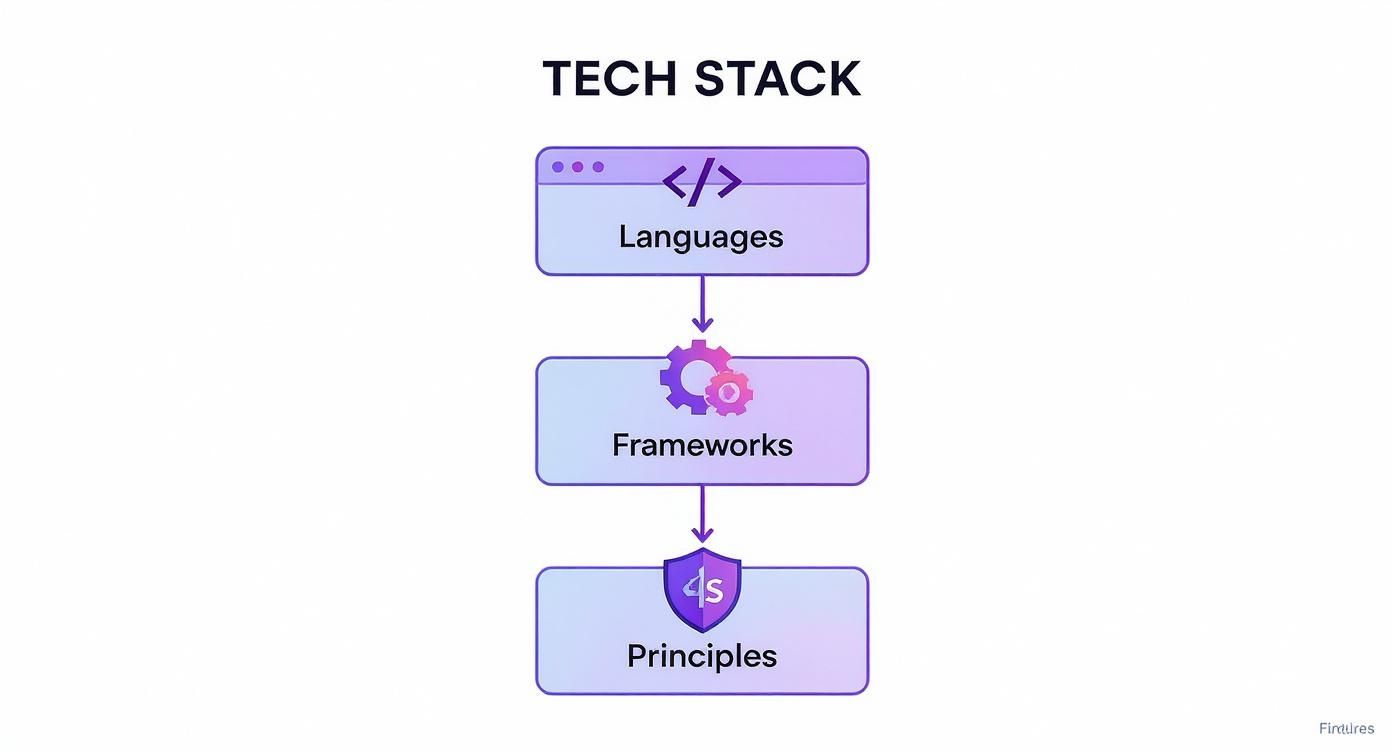
As you can see, while the core languages like Solidity and Rust stay the same, it's the deep mastery of advanced frameworks and complex security concepts that truly sets a senior programmer apart.
Mapping Your Career Trajectory
Once you understand these distinct levels, you can read between the lines of any job posting. If a description talks a lot about "maintaining existing contracts," you're likely looking at a junior role. But when it starts mentioning "protocol design" or "leading security audits," you know you're in senior territory.
The secret to moving up is to constantly seek out projects that push you just beyond your current comfort zone. If you're a junior, ask to shadow a security review. If you're a mid-level dev, take the initiative to propose a new architectural pattern for an upcoming feature.
This kind of proactive mindset is exactly what hiring managers are looking for. By figuring out where you are now and what the next level demands, you can start building the experience you need to land that next promotion.
Ready to see what's out there? You can start exploring roles at every level right now on Blockchain Jobs.
Building a Portfolio That Gets You Hired
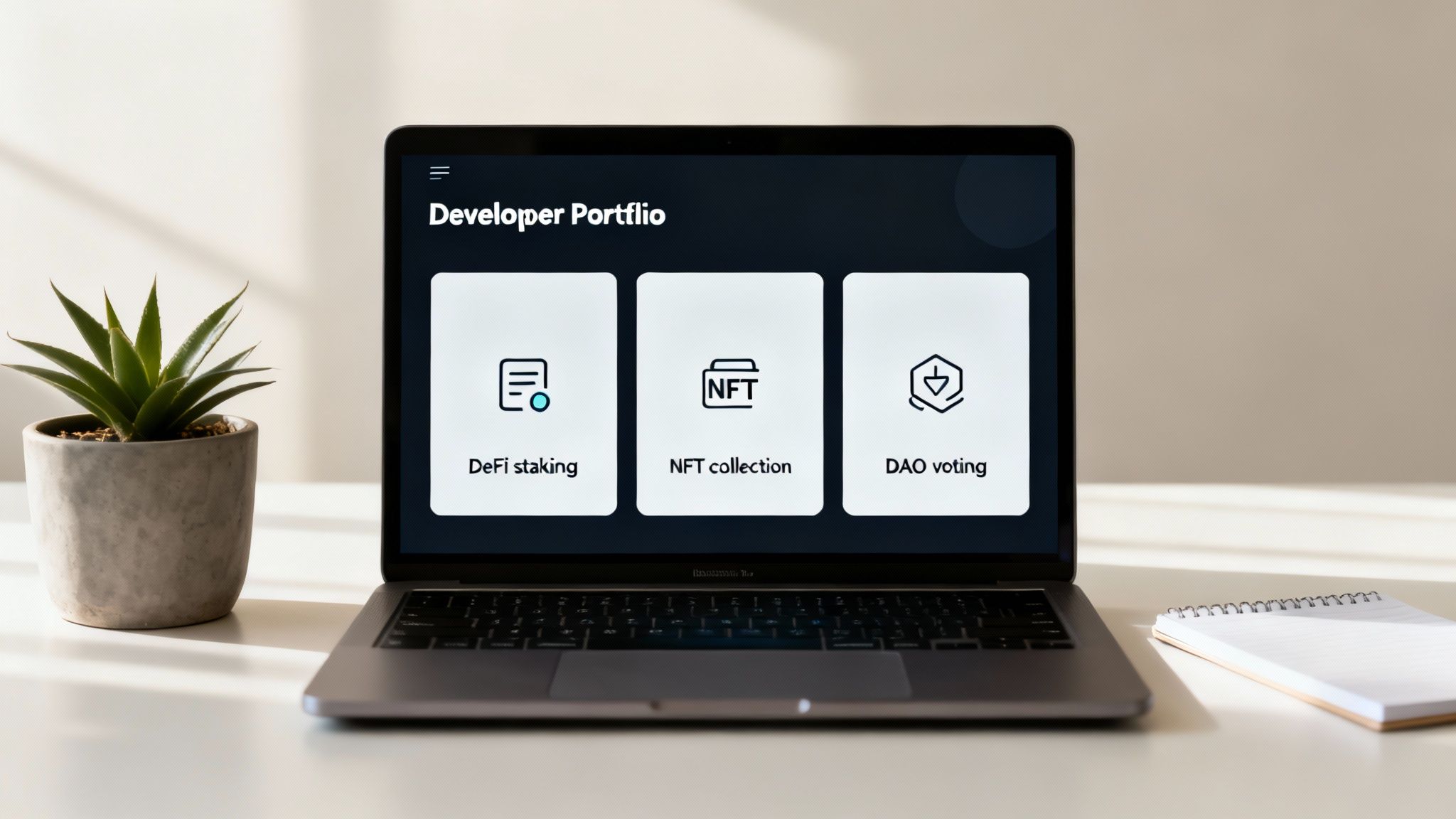
In the Web3 world, your GitHub profile isn’t just a code repository—it’s your resume. A portfolio packed with thoughtful projects does more than prove you can write code. It shows a hiring manager that you can think like a smart contract engineer and tackle real problems, which is exactly how you stand out from the crowd.
The blockchain space is booming. The number of active open-source developers has been jumping by an average of 39% every year since Ethereum took off. But here’s the catch: the pool of developers who have actually shipped production-ready code is tiny, estimated to be between 5,000 and 7,000 people globally. This gap is your opportunity, and a killer portfolio is the bridge. If you're curious about the numbers, you can find more insights about the developer ecosystem here.
Projects That Impress Hiring Managers
So, what should you build? Recruiters have seen a million generic clones. To really catch their eye, you need to build projects that show you get the fundamentals of Web3, especially security and gas optimization.
Here are three ideas for projects that mirror what companies are actually building and hiring for:
A DeFi Staking Contract: This is a fantastic starting point. Create a contract that lets users deposit an ERC20 token to earn rewards over time. This project is a perfect way to prove you can handle token transfers, securely manage balances, and nail time-based logic.
An NFT Collection with Dynamic Metadata: Don't just mint another static JPEG. Build an NFT where the art or its traits change based on external data or on-chain events. This shows you can integrate oracles, manage complex state, and have a deep understanding of the ERC721 standard.
A Simple DAO Voting System: This one shows you understand the big picture of decentralized governance. Build a system where token holders can create proposals and cast votes. You’ll be demonstrating your skills in token-gated access, on-chain voting mechanics, and structuring decision-making without a central authority.
When a technical recruiter opens your GitHub, they aren't just looking at your Solidity. The first things they check are your tests and documentation. Clean, well-commented code with near-100% test coverage screams professionalism and a security-first mindset—before they’ve even read a single line of your contract.
Demonstrating Job-Ready Skills
Remember, the project itself is only half the battle. How you build it is what actually lands you the job. Every project in your portfolio is a chance to show off the non-negotiable skills every professional smart contract programmer needs.
| Project Type | Key Features to Build | Skills You Demonstrate to Employers |
|---|---|---|
| DeFi Staking Contract | Functions for deposit, withdrawal, and reward calculation. | Security: Protecting user funds from reentrancy attacks. Gas Optimization: Efficiently managing storage and loops. |
| Dynamic NFT Collection | Metadata that updates based on an oracle or on-chain action. | Integration: Working with external data sources like Chainlink. Advanced Logic: Handling complex state changes. |
| DAO Voting System | Proposal submission, token-weighted voting, and execution. | Architecture: Designing systems with multiple user roles. Governance: Understanding on-chain decision-making. |
At the end of the day, your portfolio needs to tell a story about your journey as a developer. It should prove that you can do more than just write code—you can design secure, efficient, and useful solutions for a decentralized world. That’s what separates someone who "knows Solidity" from someone who is a hirable smart contract programmer.
Acing the Interview and Negotiating Your Salary

Walking into a smart contract programmer interview is different. It’s not just about proving you can write code. Hiring managers are looking for a rare blend of technical skill, a paranoid approach to security, and a genuine grasp of what decentralization actually means. You need to show them you’re more than a coder; you're a guardian of digital assets.
The technical part of the interview will almost always zero in on real-world security threats. Be ready to go deeper than textbook definitions. For instance, don't just explain what a reentrancy attack is. Be prepared to sketch out a vulnerable code snippet, walk them through patching it with the checks-effects-interactions pattern, and maybe even discuss the pros and cons of using a reentrancy guard.
The same hands-on approach is expected for gas optimization. An interviewer might present a function and ask, "How would you make this cheaper to run?" They're listening for specific, practical techniques—things like using calldata instead of memory for external function arguments or strategically packing variables to use fewer storage slots.
Beyond the Code: Behavioral and Conceptual Questions
While your technical chops are table stakes, your mindset is what sets you apart. The hiring team needs to trust your judgment and see that you understand the philosophical and practical weight of working on-chain.
Here are a few conceptual questions you should be ready for:
- Decentralization Trade-offs: "When would a more centralized solution actually be better than a fully decentralized one? Talk me through the security and usability implications."
- Protocol Design: "How would you approach designing an upgradeable contract? What are the biggest risks of using proxies, and how do you manage them?"
- Security Mindset: "Walk me through your personal process for auditing a smart contract before it goes live. What tools and methods do you rely on?"
How you answer these questions says a lot about your maturity as a developer. It shows if you think about code in isolation or if you see yourself as an architect responsible for a secure, living ecosystem. A strong answer demonstrates foresight and an instinct for managing risk.
Negotiating Your Worth, Backed by Data
Once you’ve impressed them with your skills, the conversation will turn to compensation. This is where you have some serious leverage. The demand for a sharp smart contract programmer is intense, so walk into this discussion armed with data.
Current salary trends show just how valued this role is. The global average salary for a smart contract developer hovers around $125,000, but that number can swing dramatically. A junior developer might start between $80,000 and $120,000, while a mid-level programmer can often command $120,000 to $160,000. For senior talent, salaries frequently start above $160,000 and can push well past $200,000, especially with specialized expertise. You can get a closer look and explore smart contract developer compensation trends on Web3.career.
Don't just throw these numbers out. Use them as the foundation for your conversation. Point to the specific skills you have—like experience with Rust, advanced security auditing, or a knack for gas optimization—that place you in a higher bracket. By connecting your value directly to market data, you can confidently make the case for the salary you’ve earned.
Your Smart Contract Career Questions Answered
If you're looking to become a smart contract programmer, you've probably got a ton of questions. The great thing about Web3 is that the answers aren't always what you'd expect. This space values what you can do far more than traditional credentials. Let's tackle some of the most common uncertainties to get you on the right track.
The biggest question I hear is about formal education: Do you really need a computer science degree? The short answer is no. While a CS degree gives you a great theoretical foundation in algorithms and data structures, hiring managers in Web3 are way more interested in your practical skills. A killer GitHub portfolio showcasing secure, optimized code will always speak louder than a diploma.
Navigating Key Career Decisions
Your journey will be full of choices about which technologies to learn and how to grow. Thinking about these things early on will give you a serious leg up and help you match your skills to the best jobs out there.
A classic dilemma for anyone starting out is whether to learn Solidity or Rust first. For most people, Solidity is the pragmatic starting point. It’s the language that powers the massive Ethereum ecosystem, which means the lion's share of job listings, tutorials, and open-source projects are built with it. Nail Solidity first, and you open up a world of opportunities. You can always pick up Rust later to work in high-performance ecosystems like Solana.
What about math? You don't need to be a math whiz, but a good handle on logic, the basics of cryptography, and algebra is non-negotiable. This job is less about complex calculus and more about building airtight logical structures to prevent exploits and design smart tokenomics.
The most critical skill isn't a specific language or a math formula. It's the commitment to stay current. The tech, security vulnerabilities, and best practices in this industry evolve at a breakneck speed. Your long-term success hinges on your ability to keep learning.
Staying Sharp in a Fast-Moving Field
Keeping your skills from going stale is a huge part of the job. You have to be proactive. Set aside time every week to read through audit reports from top security firms like Trail of Bits or OpenZeppelin. This practice directly prepares you for interview questions and demonstrates your commitment to security.
Follow core developers on social media, jump into hackathons, and contribute to open-source projects. This stuff isn't just for practice—it builds a public track record that proves your expertise and passion, making you a much more attractive candidate.
At the end of the day, how far you go is tied directly to the value you can prove you deliver. By focusing on practical skills, building an impressive portfolio, and getting involved in the community, you're building an undeniable case for yourself. To get a feel for the companies and teams driving the industry forward, you can learn more about the mission behind platforms like Blockchain Jobs.
Ready to find your place in the decentralized future? Blockchain Jobs is your dedicated portal to the best opportunities in the industry. Find your next role today!