Web3 Leadership: Become a Smart Project Manager
You're probably in one of two situations right now. You're a traditional PM trying to break into Web3 and finding that your usual playbook doesn't map cleanly. Or you're hiring for a Web3 project lead and getting flooded with candidates who can run Jira, but can't survive a token launch, governance fight, or protocol upgrade.
That gap is where the smart project manager matters.
In Web3, the title sounds familiar, but the job isn't. The best people in this seat don't just move tickets across a board. They align contributors who don't report to them, translate engineering trade-offs into business decisions, and keep a project moving when the loudest stakeholders all want different things.
What Is a Smart Project Manager in Web3
A smart project manager in Web3 is not the person with the neatest sprint board. It's the person who can create alignment when nobody has clean authority.
That's the first hard truth candidates need to understand. In many crypto teams, DAOs, and protocol ecosystems, the PM can't rely on hierarchy. A core challenge in Web3 is that PMs often have influence without formal authority, and effectiveness depends less on more tools than on negotiating priorities, managing trade-offs, and creating alignment across distributed teams, as discussed in this Web3 project management discussion.
A weak PM tries to compensate by adding meetings, dashboards, and process. A smart one reduces ambiguity, clarifies decision rights, and gets the right people to commit publicly.
What smart actually means in Web3
Traditional environments reward control. Web3 rewards coordination.
A smart Web3 PM usually operates across:
- Anonymous or pseudonymous contributors who may disappear mid-stream
- Community-driven feedback loops that can derail a roadmap if ignored
- Technical constraints tied to smart contracts, integrations, audits, and release sequencing
- Economic incentives where token design and governance mechanics affect user behavior
That means your real job isn't “manage the project.” Your real job is to make execution possible in an environment that resists command-and-control management.
Practical rule: If your main PM strength is enforcing deadlines through reporting lines, you're not ready for Web3 yet.
Why traditional PM advice falls short
A lot of mainstream advice still assumes a manager can escalate through org charts and settle conflicts with executive authority. That breaks fast in decentralized teams.
If you want a useful baseline for execution discipline, this guide to leading projects effectively is worth reading. Then adjust for the Web3 reality: visibility is public, contributors are distributed, and consensus is often slower than code.
For employers, the hiring implication is simple. Stop screening only for certifications, ceremonies, and template fluency. Screen for judgment under ambiguity.
For candidates, the message is even simpler. Don't present yourself as a process operator. Present yourself as a coordination specialist who can move engineers, community leads, and founders toward a decision when nobody fully agrees.
Traditional PM vs Web3 PM A Core Comparison
Most hiring mistakes happen because companies post a normal PM role and expect a crypto-native operator to appear. Most candidate mistakes happen because they answer Web3 interviews like they're applying to a SaaS delivery role.
Here's the clean comparison.
Traditional Project Manager vs Web3 Project Manager
| Aspect | Traditional PM | Web3 PM (Smart PM) |
|---|---|---|
| Authority | Usually backed by hierarchy, managers, and escalation paths | Often works through influence, public alignment, and negotiated trade-offs |
| Team structure | Internal employees with defined functions | Distributed contributors, core teams, agencies, communities, and external stakeholders |
| Primary success lens | On-time delivery, budget control, scope management | Adoption, trust, security, governance alignment, and execution quality |
| Stakeholders | Executives, internal teams, customers | Founders, engineers, token holders, community members, ecosystem partners |
| Risk profile | Scope creep, missed dependencies, resourcing issues | Governance conflict, security incidents, ecosystem backlash, integration failures |
| Communication style | Scheduled updates and internal reporting | Async updates, public transparency, rapid context switching across channels |
| Roadmap ownership | More centralized | More contested, often shaped by community pressure and protocol realities |
| Decision-making | Usually private and top-down | Frequently networked, visible, and politically sensitive |
What transfers and what doesn't
Some traditional PM skills still matter a lot.
Transferable skills
- Dependency management: You still need to know what blocks what.
- Stakeholder communication: Clear writing is even more valuable in async teams.
- Risk tracking: Good PMs still spot failure paths early.
- Execution discipline: Shipping still beats talking.
Other habits can hurt you.
Bad carryovers
- Escalation reflex: In Web3, there may be no boss who can force a decision.
- Process maximalism: More workflow doesn't fix unclear ownership.
- Corporate polish without technical depth: Engineers will tune you out fast if you can't follow the architecture discussion.
What hiring managers should look for
The strongest Web3 PM candidates usually show these signs:
- They talk in trade-offs. They don't pretend every stakeholder can win.
- They understand public coordination. They know a roadmap in Web3 is partly execution and partly legitimacy.
- They can bridge technical and business language. They don't need to write contracts, but they do need to understand system implications.
Good PMs keep things organized. Great Web3 PMs make messy groups commit to a path.
If you're a candidate, adjust your interview stories. Stop saying, “I kept the team on track.” Start saying, “I resolved a conflict between competing priorities, got explicit buy-in, and preserved delivery momentum.”
The Four Pillars of a Smart Web3 PM
The best smart project managers in Web3 are rarely the loudest people in the room. They're the ones who combine enough technical fluency, product judgment, community instinct, and market awareness to keep everyone else aligned.
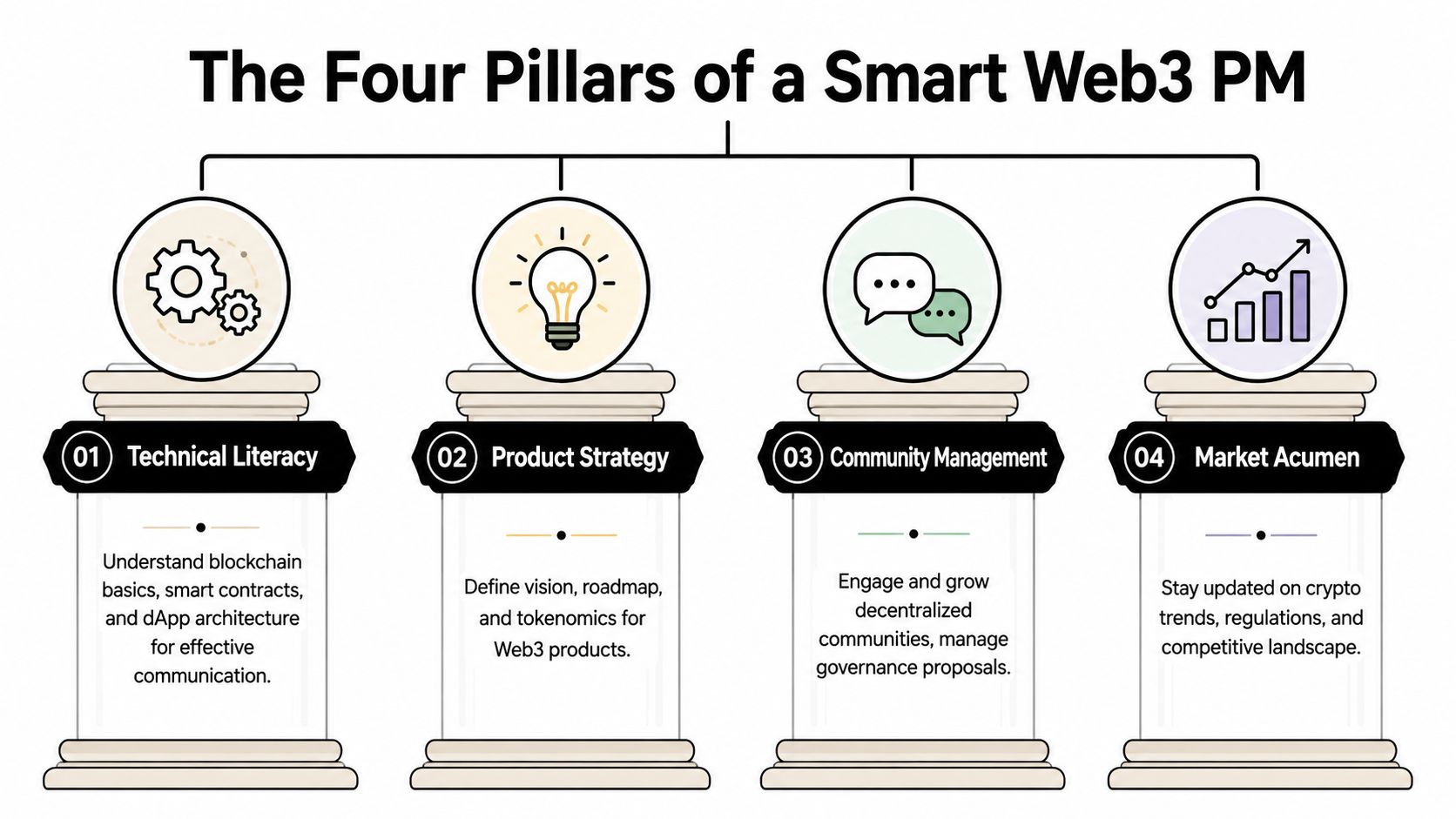
Technical literacy
You don't need to be the best Solidity engineer on the team. You do need to understand what the engineers are worried about, what the architecture allows, and where integrations can fail.
One technical job specification outside Web3 makes this point clearly. The role expects familiarity with protocols such as REST and JSON, system and application integration, and an understanding of how architecture affects delivery outcomes in this technical project specification. In Web3, the same principle applies. If you can't follow how wallet flows, indexers, APIs, contract interactions, and frontend dependencies fit together, you'll make bad roadmap calls.
A smart PM should be able to ask useful questions like:
- What breaks if we change this contract interaction?
- Is this dependency blocking audit readiness or just UI polish?
- Are we sequencing integrations correctly for testing and launch?
Product strategy
Web3 teams love activity. Smart PMs protect outcomes.
That means turning a noisy wishlist into a roadmap with a point of view. Not every community request deserves prioritization. Not every founder idea belongs in the next release. Not every partnership is worth the engineering cost.
Strong product strategy in Web3 usually comes down to three things:
- Clear user value: Why does this feature matter on-chain, in-app, or in governance?
- Release discipline: What must ship now, and what can wait?
- Incentive awareness: How does this change user behavior, contributor behavior, or governance pressure?
Community management
Many otherwise solid PMs fail in this area. In Web3, community isn't a marketing side function. It's part of execution.
You need to know when feedback is signal and when it's noise. You need to know how to handle vocal opposition without becoming defensive. You need to know how to keep a roadmap legible even when governance sentiment shifts.
If you can't explain a roadmap decision clearly to both engineers and token holders, you're not operating at a senior Web3 PM level.
Market acumen
Crypto changes fast. Your roadmap can become outdated because a competitor ships first, regulation shifts, or a new standard changes user expectations.
A smart PM keeps one eye on internal execution and one eye on the outside market. That doesn't mean chasing every trend. It means knowing when the environment has changed enough that your original plan no longer deserves loyalty.
For hiring managers, these four pillars are a sharper screen than generic PM criteria. For candidates, they're your checklist. If one pillar is weak, fix it before the interview, not during it.
Essential Tools and Workflows for Decentralized Teams
A Web3 PM's stack isn't just Jira plus Slack. The workflow is broader, messier, and closer to operations than many candidates expect.
A typical week might start with engineering coordination in Linear or Jira, shift into Discord and Telegram community threads, move into Snapshot governance planning, and end with treasury or approval conversations around Gnosis Safe. If you can't explain how work moves across those surfaces, you'll sound theoretical in an interview.
A protocol upgrade workflow
Say the team is preparing a protocol upgrade.
The PM's job starts before any public announcement. You align engineering on scope, identify dependencies across backend, contracts, frontend, and infra, and decide what must be reviewed before anything goes live. Then you prepare the communication path. Internal notes for contributors. Public language for community channels. Governance framing if the change needs broader legitimacy.
The tool stack often looks something like this:
- Linear or Jira: Track engineering tasks and blockers.
- Notion or GitHub: Keep specs, decisions, and release notes visible.
- Discord and Telegram: Surface community questions and sentiment quickly.
- Snapshot: Handle governance voting when a proposal needs formal support.
- Gnosis Safe: Coordinate treasury approvals or multi-sig actions tied to rollout.
Skill isn't naming the tools. It's knowing when a conversation belongs in a private planning channel, a public forum, or a governance vote.
A bug bounty or incident-response workflow
Weak PMs become obvious: they freeze, over-communicate, or hide.
A smart PM creates order fast:
- Lock the facts first. What's confirmed, what's suspected, what's noise.
- Separate workstreams. Engineering response, stakeholder comms, legal or ops review if needed.
- Control message timing. Don't let half-formed updates create more damage.
- Document decisions. Teams need a record, especially in distributed environments.
Fast communication isn't the goal. Accurate communication with clear ownership is the goal.
If you're job hunting, spend time studying real crypto operating environments instead of just reading PM advice. Browse active roles in Web3 operations teams and note how often execution, coordination, documentation, and ecosystem communication show up together. That's the actual shape of the work.
For employers, test workflow thinking in interviews. Ask candidates how they'd run a release, a governance proposal, or a security issue across tools and stakeholders. If they answer with generic Agile language, keep looking.
How to Get Hired A Sample Job Description
Most Web3 PM job descriptions are terrible. They're either too vague to attract the right people or so overloaded that nobody credible takes them seriously.
A good job description does two things. It defines the actual coordination burden of the role, and it makes the bar obvious.
A stronger sample job description
Role title
Web3 Project Manager
What you'll own
- Roadmap coordination: Drive execution across protocol, product, and partner-facing initiatives.
- Cross-functional alignment: Keep engineers, product leads, community managers, and external contributors working from the same priorities.
- Release management: Coordinate launches, upgrades, testing windows, and post-release follow-up.
- Stakeholder communication: Turn technical decisions into updates that founders, communities, and partners can understand.
- Risk management: Identify delivery, governance, and integration risks early and force explicit trade-off decisions.
What you've done
- Worked in technical environments: You've supported products where system dependencies and integrations mattered.
- Operated with low authority: You've led through influence, not title.
- Written clearly: Your updates reduce confusion instead of adding noise.
- Handled ambiguity well: You don't wait for perfect information to make progress.
- Built trust across functions: Engineers respect your questions. Non-technical stakeholders trust your judgment.
What stands out
- Crypto-native experience: DAO, protocol, wallet, infrastructure, DeFi, NFT, or exchange exposure.
- Governance familiarity: You understand how public stakeholder input affects execution.
- Operational calm: You can manage launch pressure without becoming chaotic.
Why this works
This job description screens for behavior, not buzzwords. It doesn't ask for a random list of frameworks. It asks whether the person can carry coordination load in a decentralized environment.
Candidates should use roles like this as a self-audit. If you can't point to examples for at least most of these responsibilities, you're not ready for a senior seat yet.
Employers should compare their own posting against live Web3 product management roles and tighten the brief. Better input creates a better candidate pool. Sloppy hiring language attracts sloppy matches.
Nailing the Interview Key Questions and Answers
Many promising candidates miss the mark. They prepare for a generic PM interview and get crushed by questions about coordination, technical empathy, and judgment under public pressure.
That's a costly mistake in a field this large and valuable. The U.S. market includes about 843,910 project management specialists, experienced project managers can earn around $100,000 per year on average, and the profession remains a meaningful career path according to this project management statistics roundup. If you want one of the better Web3 roles, your interview prep needs to be sharper than your résumé.
Start with the core themes below.
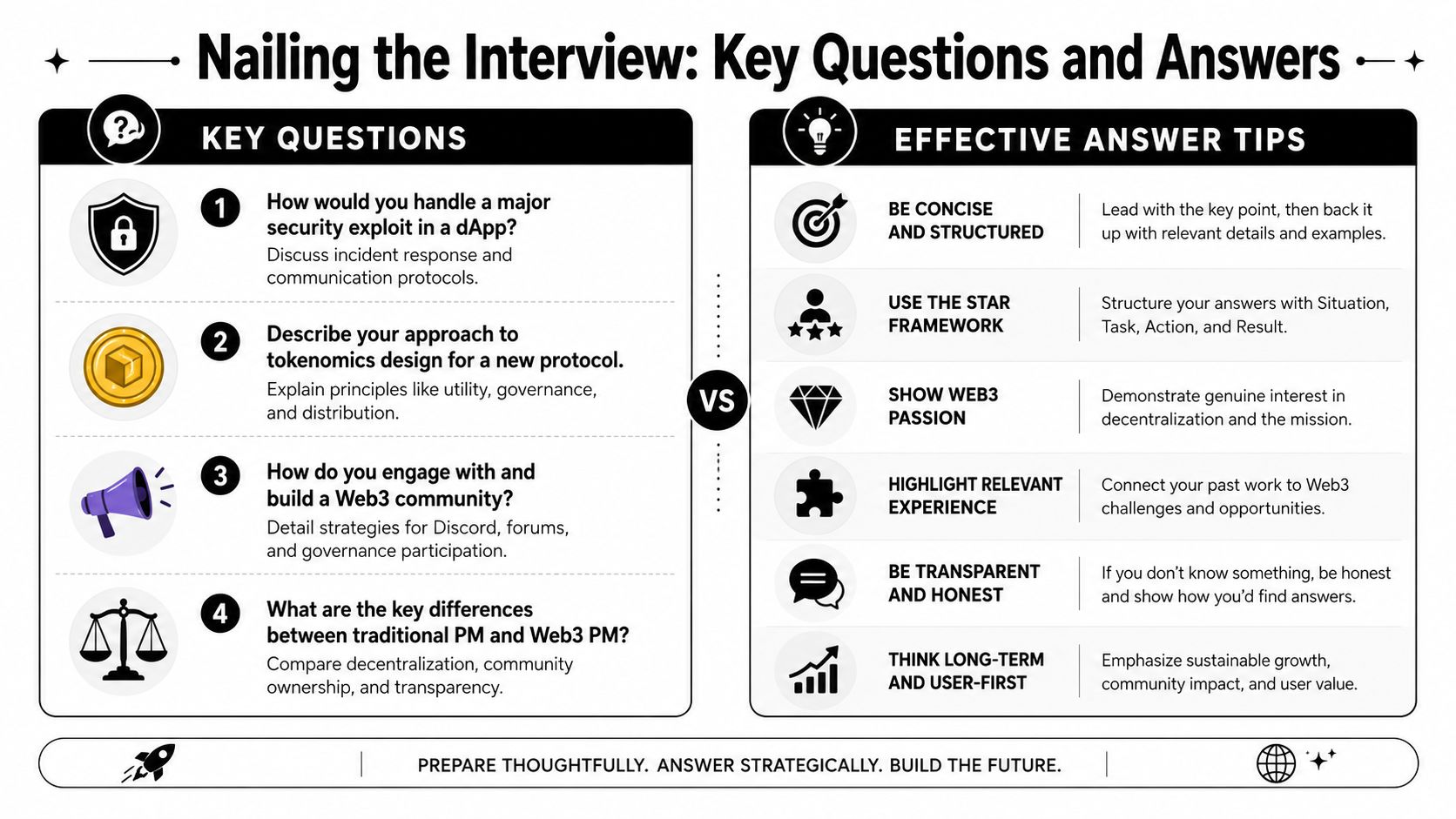
Four questions hiring managers should ask
How would you handle strong community disagreement with a roadmap item?
A strong answer shows you won't cave to noise or ignore legitimate concerns. You should talk about clarifying the decision owner, separating feedback from final authority, and communicating trade-offs in plain language.
Walk me through a technical launch with multiple dependencies.
This tests whether you can think beyond task lists. Good candidates explain sequencing, risk review, stakeholder communication, and what gets cut if timing slips.
What do you do when engineering, product, and community priorities conflict?
The right answer isn't “align everyone.” The right answer is to define the decision, expose the trade-off, identify who decides, and move.
How do you know if a Web3 project initiative is successful?
Weak candidates hide behind vague KPIs. Strong ones define success based on the initiative itself. Adoption, trust, upgrade stability, partner readiness, governance support, or user experience can all matter depending on the work.
How candidates should structure answers
Use a simple answer frame:
- Define the problem clearly
- Name the stakeholders
- Explain the trade-off
- State the decision path
- Show the outcome or lesson
Here's the difference.
Bad answer: “I'm very collaborative and would gather feedback from all sides.”
Better answer: “I'd separate opinion from authority first. If the roadmap item is strategically necessary, I'd document the rationale, collect community concerns in a structured way, and decide whether the issue is messaging, timing, or actual product risk. Then I'd publish the decision and next steps so the team doesn't stay in limbo.”
This short video is also useful if you want another perspective on interview delivery and PM framing.
A hiring manager shortcut
Ask for one detailed story about a messy launch, conflict, or decision. Then keep pushing.
- What was unclear at the start
- Who disagreed
- What trade-off did you make
- What did you cut
- What would you do differently
If the candidate stays high-level, they probably haven't carried real PM load. If you want to see how real openings frame this mix of execution and technical coordination, review a live technical project manager role at Galaxy. Then calibrate your interview around the actual work, not generic PM theory.
Your Roadmap from Traditional PM to Web3 Expert
The move from traditional PM to Web3 PM isn't a branding exercise. You won't get there by adding “blockchain” to your LinkedIn headline and memorizing a few protocol names.
You get there by building judgment in messy environments. That matters even more as tooling gets smarter. The future smart project manager still needs strategic judgment and emotional intelligence, and AI won't remove the coordination burden so much as shift it toward higher-order review and stakeholder trade-offs, as noted in this future of project management analysis.
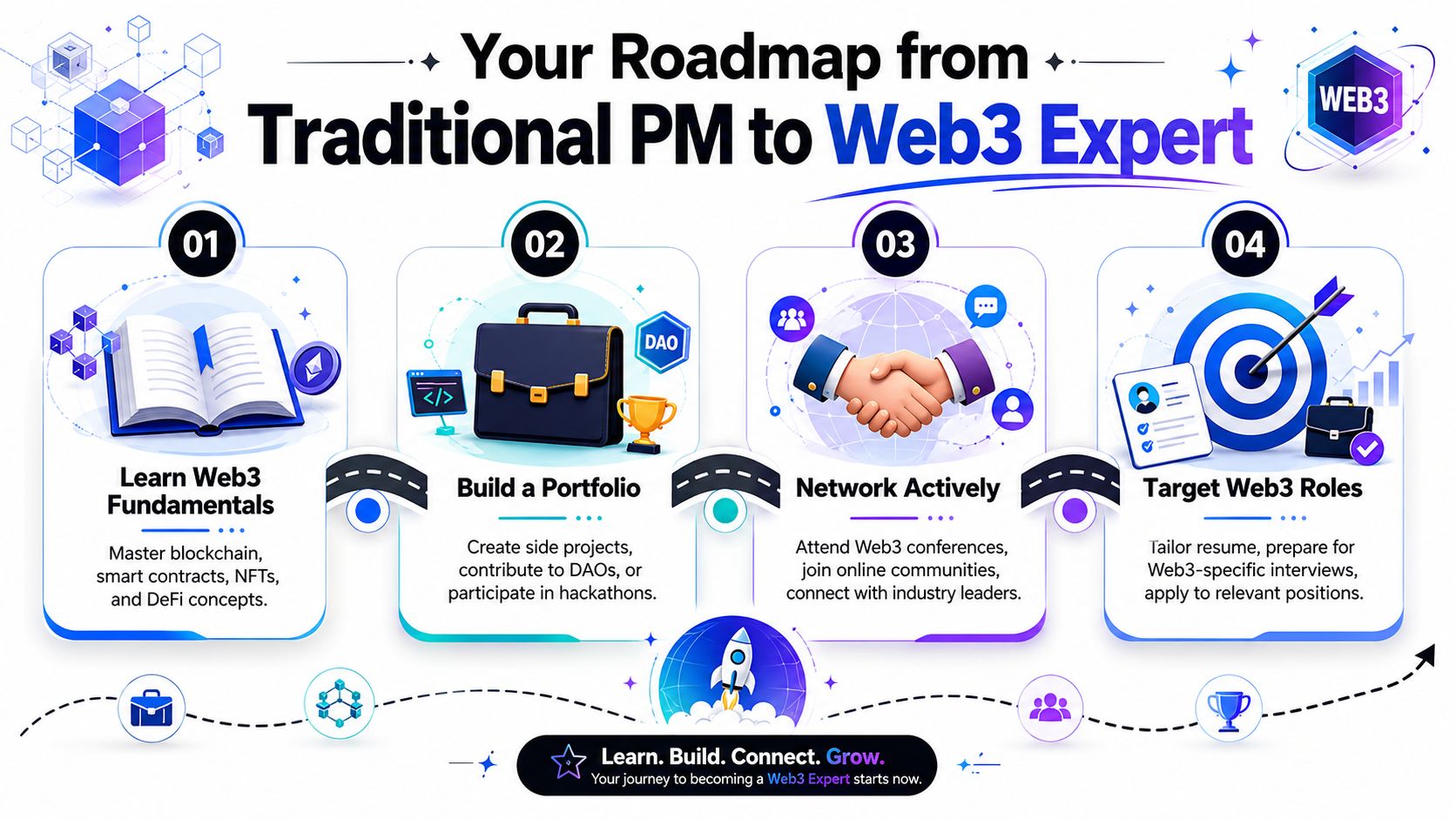
Step one: get on-chain
Stop learning Web3 only through podcasts and hot takes.
Use a wallet. Try a few dApps. Read token pages, governance forums, and protocol docs. Notice where users get confused, where trust breaks down, and where product decisions collide with technical constraints. That lived experience is what makes your interview answers stop sounding borrowed.
Step two: contribute before you're hired
You don't need a full-time role to start acting like a Web3 PM.
Useful entry points include:
- Join a DAO or community working group: Volunteer for coordination, notes, proposals, or contributor ops.
- Write teardown analyses: Review a protocol launch, governance flow, or product experience and publish your thinking.
- Support open-source efforts: Even lightweight coordination work teaches you how decentralized execution feels.
The fastest way to look credible in Web3 is to do visible work in public, even if the scope starts small.
Step three: build a portfolio around judgment
Most PM portfolios are weak because they're just screenshots and vague summaries.
A better portfolio for Web3 includes:
- Decision memos: Show how you framed a trade-off.
- Launch plans: Outline dependencies, stakeholders, and risks.
- Community or governance summaries: Prove you can synthesize noisy input.
- Technical walkthroughs: Demonstrate that you can follow architecture at a useful level.
Step four: prepare for the interview shift
Web3 interviews reward specificity. They also punish polished nonsense.
When you practice, focus on conflict, ambiguity, and sequencing. If you want a practical prep resource outside crypto-specific material, HypeScribe's interview strategies are a useful way to tighten your answers and reduce rambling. Then bring that discipline into Web3 scenarios where authority is weaker and trade-offs are sharper.
The candidates who break in fastest usually do one thing differently. They stop waiting for permission to gain relevant experience. They start acting like the role before anyone gives them the title.
If you're ready to turn that plan into a real move, explore open Web3 roles on Blockchain Jobs. It's one of the simplest ways to find teams hiring across protocol, product, operations, and technical project management without wasting time on generic job boards.