
Your Guide to Startup Remote Jobs in Web3 2026

You’re probably in one of two camps right now. You already work remotely and want a better role with more upside, or you’re in a traditional company staring at product roadmaps, release cycles, and committee-heavy decisions, wondering how people break into Web3 without looking reckless.
That instinct is valid. Startup remote jobs in Web3 can be excellent career moves, but they’re different from remote roles at a SaaS company with polished HR processes and predictable ladders. You’re not just applying for flexibility. You’re choosing a compensation model, a communication culture, and a risk profile that can shape the next few years of your career.
Navigating the New Frontier of Web3 Work
Web3 attracts people who are tired of building around the edges of old systems. Engineers want to work closer to protocol design. Product managers want faster feedback loops. Operators want ownership that feels real, not symbolic. The appeal isn’t only remote work. It’s proximity to infrastructure that could define how value, identity, and coordination work online.
That matters because the broader remote market is already substantial. The remote work sector grew from USD 25.88 billion in 2023 to USD 31.84 billion in 2024, a 23% CAGR, according to StartUs Insights' remote work market report. Remote work is no longer a fringe arrangement. It’s a serious business layer.

What makes Web3 startup remote jobs different
A remote startup in Web2 usually asks, “Can you do the work from anywhere?” A remote startup in Web3 often asks a harder question. “Can you operate with ambiguity, public accountability, and a compensation package that may include tokens, legal complexity, and uneven documentation?”
That changes how you should evaluate the opportunity.
A good Web3 role can give you:
- Closer ownership: You may work directly with founders, core contributors, or protocol leads.
- Faster learning: Teams are smaller, so scope expands quickly.
- Visible work: Your writing, code, governance input, or shipping cadence often has a public footprint.
A bad Web3 role can give you:
- Blurry accountability: No one really owns decisions.
- Weak documentation: You learn everything by chasing messages across Discord, Notion, Telegram, and GitHub.
- Mispriced upside: The offer sounds generous until you inspect vesting, liquidity, and token disclosure.
Practical rule: Treat startup remote jobs in Web3 like a business partnership with an employment wrapper. You’re evaluating mission, management, and mechanics at the same time.
Candidates often underestimate the culture shift. In a traditional firm, your title carries a lot of weight. In a crypto-native startup, your proof of work carries more. That could mean code, shipped product, a governance proposal, research threads, community moderation, or a sharp operations system nobody else had the discipline to build.
If you already have strong skills from fintech, SaaS, security, design, legal, growth, or operations, you’re not starting from zero. You’re translating your value into a market that rewards initiative, clarity, and domain curiosity far more than pedigree alone.
Mastering Your Search for Remote Web3 Roles
Most candidates lose time in the search phase, not the interview phase. They browse broad platforms, save too many listings, apply too late, and wonder why nothing sticks. That approach breaks down fast in Web3, where strong roles often move through niche channels before they feel visible.

Remote roles also attract more competition. Remote Rebellion’s remote startup hiring analysis notes that remote job advertisements receive approximately 2.5 times more applicants than in-person counterparts. If you search casually, you’ll be one more résumé in a crowded stack.
Use signal-rich channels, not general noise
General job boards still have value. LinkedIn can help with visibility, recruiter discovery, and public proof that you’re available. If your profile still looks passive, Postline.ai's Open to Work guide is useful for tightening that first signal without making your profile look generic.
But for actual discovery, specialized filters are better. You want listings organized by function and ecosystem relevance, not mixed into a giant feed of unrelated tech roles. For remote-first crypto opportunities, browse a dedicated remote Web3 jobs board and sort by areas that match your edge, such as protocol engineering, security, product, compliance, community, or growth.
Build a search system you can run weekly
A serious search should look more like pipeline management than hopeful browsing.
Use this structure:
Pick your lane Define the roles you can credibly win now. Good examples include smart contract engineering, backend infrastructure, DevRel, product management, community ops, content, token design support, or legal and compliance.
Map your ecosystem fit Don’t search “Web3 jobs” as one bucket. Break it into categories such as DeFi, wallets, infrastructure, L1/L2, data, custody, identity, gaming, or DAO tooling.
Track companies before openings appear Follow founders, hiring managers, and investors on X. Join project Discords. Read governance forums. Many teams telegraph hiring through product momentum, funding news, contributor activity, or public pain points before a role appears.
Watch contribution paths Some startups prefer contributors before full-time hires. If you’re technical, that may mean pull requests or documentation help. If you’re non-technical, it may mean community moderation, research, ecosystem support, or clear bug reporting.
Where strong candidates often find the best leads
Here’s a practical comparison:
| Channel | Best use | Weakness |
|---|---|---|
| Profile visibility and recruiter discovery | Too broad, high noise | |
| Specialized Web3 boards | Targeted search by role and ecosystem | Requires consistent monitoring |
| X lists | Early founder and VC signals | Information moves fast |
| Discord and Telegram | Real-time team activity and culture clues | Easy to get distracted |
| Governance forums | Protocol maturity and contributor pathways | More useful for some sectors than others |
Many candidates also benefit from seeing how others frame the market before they start applying. This breakdown is a helpful primer:
The best remote Web3 roles rarely go to the person who clicked first. They often go to the candidate who understood the project earliest.
A final search note. Don’t over-optimize for prestige. Smaller teams with clear product momentum and sane operating habits often beat famous names with vague scopes and chaotic leadership. In startup remote jobs, your day-to-day environment matters more than the logo in your headline.
Crafting a Web3-Native Professional Profile
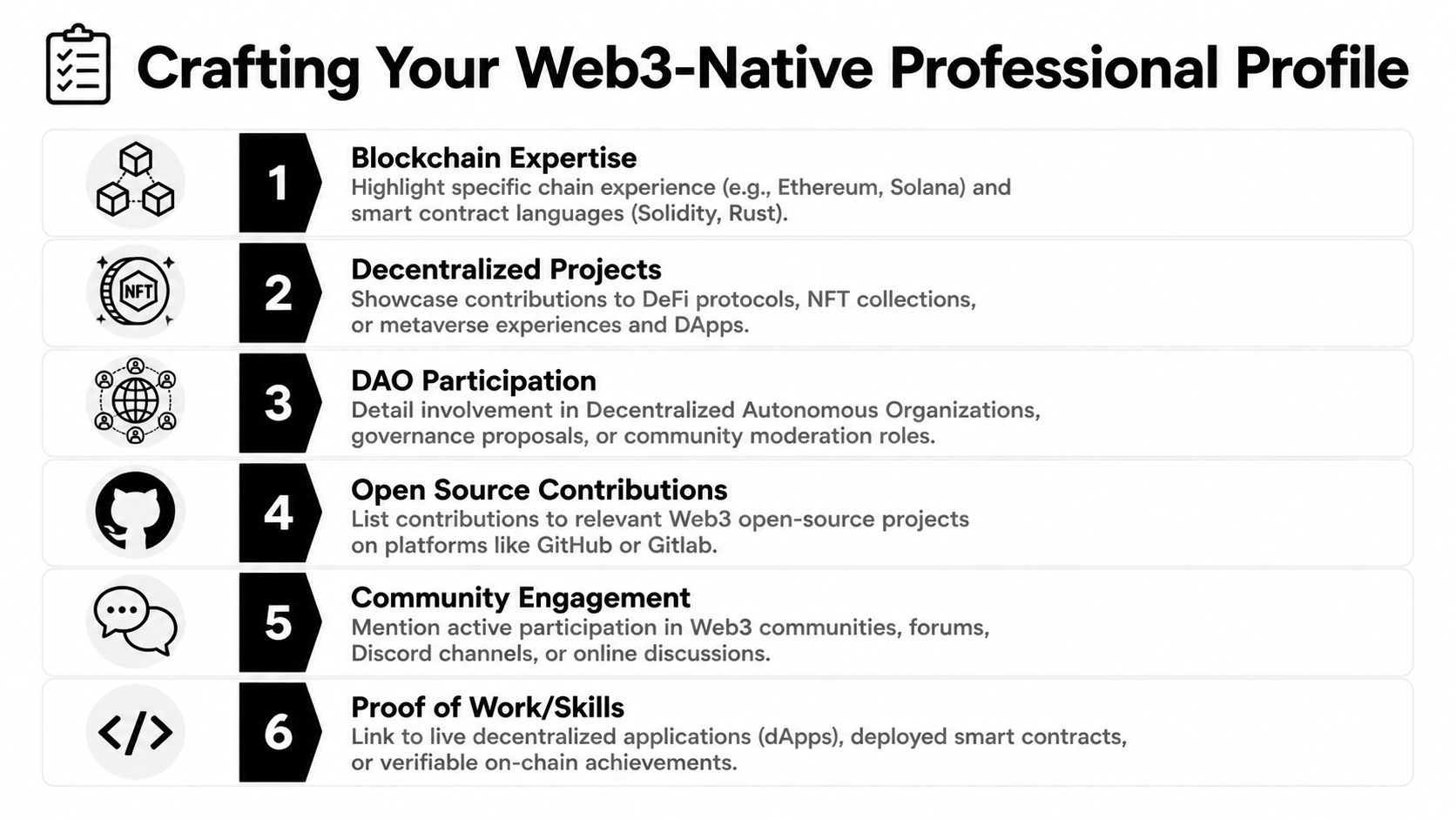
Most applications fail because they sound transferable but not specific. A founder doesn’t want to infer your relevance. They want to see it instantly. Your résumé, LinkedIn profile, and GitHub or work portfolio should answer one question without friction: why would this person ramp quickly in a crypto-native environment?
Reframe your résumé around proof and relevance
Titles matter less than operating context. “Senior Product Manager” means little by itself. “Led launch planning for API-heavy fintech product with compliance dependencies and cross-functional release ownership” is more useful. It shows constraints that resemble real Web3 environments.
A stronger Web3 résumé does three things well:
It translates adjacent experience If you worked in payments, distributed systems, security, marketplaces, or developer tooling, say so plainly and connect it to blockchain-relevant problems.
It highlights shipped work Name launches, migrations, audits supported, partnerships closed, communities built, or internal systems improved.
It cuts corporate filler Remove empty phrases like “results-oriented leader” and replace them with scope, tools, and outcomes.
Make LinkedIn searchable by Web3 recruiters
Recruiters search by terms. If your headline only says “Product Leader” or “Software Engineer,” you’re hiding your fit.
Try a format like this:
- Product manager focused on wallets, DeFi UX, and developer platforms
- Backend engineer with Go and Rust experience, building infra for high-trust systems
- Legal and compliance operator specializing in digital assets, cross-border risk, and policy workflows
Your About section should read like a short positioning memo, not a biography. Keep it tight. State your domain, the environments where you work best, and the kinds of Web3 teams you want to help.
For role discovery, it also helps to review focused categories instead of broad listings. If you’re technical, scan Web3 engineering roles and mirror the language that appears repeatedly in serious listings.
Show work, not just interest
For technical candidates, GitHub can move you from “possible fit” to “interview.” Recruiters look for signs that you can operate in public, document clearly, and work with existing code rather than only polished greenfield projects.
A strong profile often includes:
- Readable repositories: Clear README files, setup instructions, and sensible commit history.
- Relevant experiments: Smart contracts, bots, analytics tools, SDK examples, or small dApps.
- Open source evidence: Issues discussed well, pull requests handled professionally, and docs improved with care.
For non-technical candidates, the equivalent is a live portfolio of useful artifacts.
That might include:
- Research memos: Token model critiques, competitor breakdowns, governance analysis.
- Operational assets: Community workflows, support macros, onboarding docs, launch calendars.
- Content with judgment: Threads, essays, docs, or presentations that prove you can explain complex systems with clarity.
Hiring signal: In Web3, “I’m passionate about crypto” is weak. “Here’s the thing I built, analyzed, improved, or contributed” is strong.
If you’re moving from traditional tech, don’t pretend you’ve been in Web3 forever. That reads false. Position yourself as someone with durable skills who has already started doing the work in public. That combination is credible, and credibility gets interviews.
Engaging Startups with High-Impact Outreach
Passive applications aren’t useless. They have limited impact in a market where strong candidates can look interchangeable on paper. Outreach changes that because it lets you demonstrate two traits startups care about immediately: judgment and communication.
That second one matters more than many candidates realize. The University of Pennsylvania’s overview of remote work challenges notes that approximately 20% of remote professionals identify cooperation and communication as their primary challenge. In a remote startup, thoughtful outreach is more than networking. It’s an early sample of how you’ll operate on the team.

What bad outreach looks like
Most cold outreach fails for predictable reasons:
- It’s generic: “I’d love to learn more about your company.”
- It’s selfish: The message asks for time before showing relevance.
- It’s unresearched: The sender clearly didn’t read the docs, roadmap, or recent announcements.
That approach forces the founder or recruiter to do the thinking for you. They won’t.
What gets replies in Web3
Good outreach proves you paid attention and can contribute to the conversation. Keep the message short, specific, and grounded in something public.
Use one of these angles:
Product angle Reference a recent launch, docs update, governance proposal, or integration and offer a concrete observation.
Role angle Connect your background to a current pain point in the job description. Don’t restate your résumé. Translate it.
Community angle If you’re already active in the project’s ecosystem, mention the contribution naturally. Don’t inflate casual participation into deep involvement.
Here’s a simple structure that works:
Subject or opener: concise and specific
Line one: what you noticed
Line two: why it matters
Line three: why you’re relevant
Line four: low-friction next step
A message to a founder on X or email might sound like this in practice:
I saw your team’s update on wallet onboarding friction. I’ve worked on activation flows in regulated fintech products where trust and completion rates mattered as much as speed. One thing I’d look at first is where users stall between education and irreversible action. If helpful, I can send a short teardown and a few ideas relevant to the role you posted.
That works because it sounds like a peer, not a template.
If you want more tactical examples for email structure, subject lines, and follow-up tone, Draftery’s guide for job-seeking professionals is worth reviewing.
Target the company, not only the opening
Some of the best outreach starts before you apply. A useful way to source targets is to browse Web3 companies that are actively building, then shortlist the teams that fit your strengths, timezone preferences, and product interests.
Use a small account list. Ten researched companies beat fifty shallow applications.
- Founders: Best for small teams if your note is sharp and relevant.
- Hiring managers: Best when you can speak directly to role scope.
- Talent leads: Best when the company already has structured hiring.
Send fewer messages. Make each one easier to answer.
The strongest outreach usually leads to one of three outcomes. A direct response, a referral to the right person, or quiet name recognition when your application arrives later. All three help.
Acing the Remote Web3 Startup Interview
A Web3 interview process usually tests more than functional competence. Teams are trying to answer whether you can work with limited structure, communicate across time zones, and make good decisions when the documentation is incomplete.
That’s why the process often feels uneven if you come from mature companies. One round may be polished. The next may be a founder call from a hotel room between conference meetings. Don’t mistake informality for a lack of scrutiny. They’re still assessing you closely.
What each stage is really testing
The first conversation is often framed as a culture or intro call. In practice, it checks whether you understand the company’s space, can explain your background clearly, and sound comfortable in a remote-first environment.
Then comes the higher-signal work. For engineers, that may be a technical deep dive, code review, or take-home tied to a realistic problem. For product, design, ops, or growth, it may be a case discussion around user adoption, ecosystem trade-offs, incident handling, or prioritization under uncertainty.
The founder conversation usually tests range. Can you zoom out to mission and zoom in to execution? Can you disagree productively? Can you operate without waiting for permission on every decision?
Questions you should expect
Here are the themes that come up often in serious startup remote jobs:
| Interview stage | Likely focus | What they want to hear |
|---|---|---|
| Intro screen | Motivation and clarity | You know why this company, not just why crypto |
| Functional round | Craft and judgment | You can explain trade-offs, not only outputs |
| Protocol discussion | Domain understanding | You’ve studied the product, users, and constraints |
| Founder round | Ownership and maturity | You can move fast without creating chaos |
For behavioral prep, it helps to rehearse concise stories around conflict, ambiguity, prioritization, and failure. Eztrackr’s behavioral interview questions resource is a practical refresher if you want prompts to tighten your examples.
Ask questions that reveal management quality
A weak candidate asks about perks first. A strong candidate asks how work gets done.
This is especially important because a 2023 Atlassian study, summarized here, found that micromanaged remote teams ship code 40% slower than autonomous teams. You need to know whether the company trusts operators or supervises them into paralysis.
Ask questions like:
- How do you decide what needs synchronous discussion versus async documentation?
- What does a strong first 90 days look like in this role?
- Who owns final decisions when product, engineering, and community feedback conflict?
- How are roadmaps updated when priorities shift quickly?
- What does performance feedback look like on this team?
- When someone is blocked, what’s the expected escalation path?
If a team can’t explain how it communicates, prioritizes, and resolves disagreement, the problem isn’t your lack of clarity. It’s theirs.
Listen for specifics. Good teams mention tools, rituals, and examples. Weak teams answer with slogans like “we move fast” or “everyone just takes ownership.” Those phrases mean nothing without operating detail.
One more interview habit matters in Web3. Bring opinions, but keep them falsifiable. You don’t need to posture as the smartest person in the room. You need to show that you can reason through volatile conditions without becoming rigid.
Negotiating Offers and Onboarding Successfully
A Web3 offer can look attractive and still be poorly structured. Many candidates often become sloppy in this situation because they’re excited to land the role. Don’t be. Slow down and inspect the mechanics.
The biggest issue is disclosure. Purpose Jobs’ analysis of remote jobs and crypto-native hiring notes that over 60% of early-stage crypto-native companies under-disclose token terms and vesting schedules. If the team is vague at offer stage, assume you need to ask harder questions, not fewer.
How to evaluate token-heavy compensation
Cash is simple. Tokens are not. You need to understand what you’re receiving and when that value may become meaningful, if ever.
Ask for clarity on:
- Vesting schedule: When does vesting start, how often does it vest, and is there a cliff?
- Token type: Is this a live token, a future token promise, or a contractual right tied to a future event?
- Liquidity conditions: Can the token be sold at vest, or are there lockups and transfer restrictions?
- Utility and governance: What is the token used for inside the network, if anything?
- Jurisdictional constraints: Are there country-based limitations or legal risks tied to receiving it?
A practical way to compare offers is to separate them into two buckets. Guaranteed compensation and speculative upside. Don’t mentally blend them into one number. That’s how candidates overvalue risk.
Negotiate with precision
You don’t need an aggressive tone. You need a clean set of questions and a rationale.
Try language like:
- I’m excited about the role. I’d like to understand the token component in more detail before I finalize.
- Can you share the vesting terms, any cliff, and whether there are transfer or liquidity restrictions?
- If the token details aren’t finalized, can we adjust the cash component to reflect that uncertainty?
If the company responds defensively to reasonable questions, pay attention. Mature teams expect this diligence.
Start strong in a remote-first onboarding
Joining a remote Web3 startup can feel like landing mid-conversation. Docs may be partial. Decision-makers may be distributed. Some norms may exist only in people’s heads.
Your first month should focus on visibility, reliability, and map-making.
Week one Read everything. Product docs, onboarding notes, GitHub, governance threads, old launch posts, and team rituals. Start a personal glossary of terms, people, and systems.
Week two Identify where work happens. Not where the handbook says it happens. Watch which channels matter, who resolves blockers, and how priorities get updated.
Week three Ship one useful thing. A fix, a memo, a cleaned-up workflow, a dashboard, a clearer spec, a support improvement. Small but unmistakably helpful.
Week four Fill one documentation gap you encountered yourself. That’s one of the fastest ways to build trust on a remote team.
Your first win doesn’t need to be dramatic. It needs to reduce friction for other people.
Onboarding well in startup remote jobs is less about waiting for a perfect process and more about becoming someone others can depend on quickly.
Building Your Career in the Decentralized Future
The candidates who land the best startup remote jobs in Web3 usually make three mindset shifts early. They stop relying on generic applications, they stop presenting themselves as broad tech talent, and they stop treating offers as if all upside is equal.
This market rewards people who do their homework in public. That can mean code, writing, research, community work, thoughtful outreach, or sharp interview questions. It also rewards people who can handle ambiguity without becoming vague themselves. That’s a real distinction. Strong candidates bring clarity into messy environments.
Career progression in Web3 won’t always look linear. You may move from contributor to operator, from product to ecosystem, or from legal and compliance into policy-facing leadership. That’s normal. The ecosystem is still young enough that reputation compounds quickly when your work is visible and useful.
Keep building domain fluency. Keep joining the conversations where projects reveal how they think. Keep testing whether a team has real operating discipline behind the hype.
You don’t need to know everything before you start. You do need to search with intent, present proof, communicate like a remote teammate already, and negotiate like someone protecting their future.
If you’re ready to move from browsing to targeted action, start with Blockchain Jobs. It’s a focused place to explore startup remote jobs across the Web3 ecosystem, from engineering and product to compliance, operations, marketing, and security.