Your Guide to Landing High-Paying Web3 Developer Jobs

If you're a developer wondering if it's the right time to jump into Web3, the short answer is a resounding yes. The market for skilled web3 developer jobs isn't just hot; it's a full-blown talent gold rush, and those with the right skills are in a prime position to advance their careers.
This isn't just hype. It's a simple, powerful imbalance of supply and demand that creates incredible career leverage for developers like you.
Why Web3 Developers Are So In-Demand
Every week, it seems another major industry—from finance and supply chain to gaming and digital art—announces a new Web3 initiative. They're all scrambling to build on the blockchain, but they're hitting a wall: there simply aren't enough developers who know how to do it.
This bottleneck is the single biggest factor driving the incredible demand and creating a unique opportunity for your career. The pool of developers who are truly proficient with smart contracts, decentralized applications (dApps), and blockchain architecture is tiny compared to the number of companies desperate to hire them.
The Numbers Don't Lie
Just how big is this gap? Let's look at the data from a hiring perspective.
Analysis from March 2026 shows a stark reality: for certain specialized roles, there are only about 500 qualified developers on the market globally. Meanwhile, over 5,000 companies are fighting to hire from that same small pool. It’s an almost unbelievable ratio.
This visual from CryptoRecruit paints the picture perfectly.
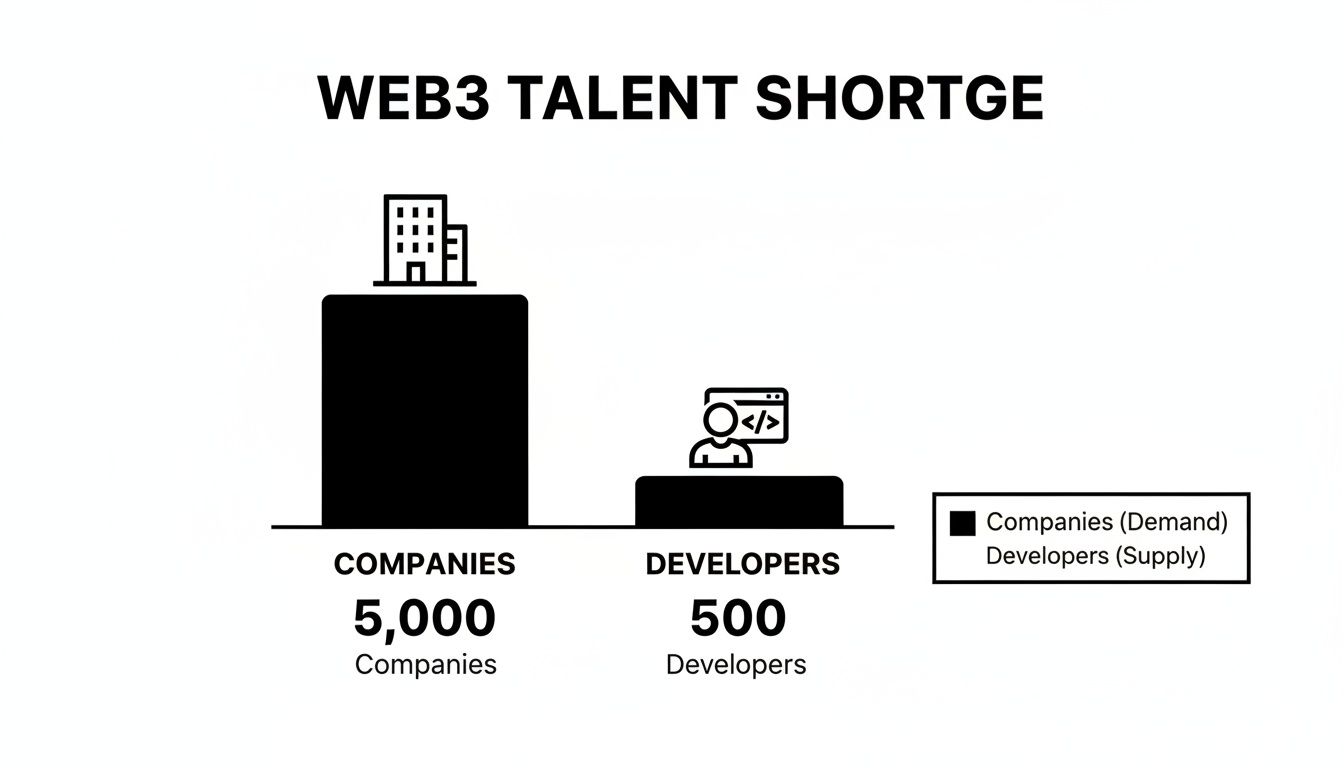
When you see a market this lopsided, it tells you one thing: the power is in the hands of the talent. Companies are being forced to offer premium salaries, flexible work, and compelling projects just to get a foot in the door with a qualified candidate.
My Take: The current market gives you incredible leverage in job interviews and negotiations. Your skills are a scarce asset. This means you can be more selective, negotiate for better compensation, and choose roles that offer the best path for your long-term career progression.
High Demand Means High Salaries
This talent shortage directly translates to impressive earning potential. To give you a concrete idea for your next salary negotiation, here's a snapshot of typical salary ranges for in-demand Web3 roles in 2026.
| Role | Junior Salary | Senior Salary |
|---|---|---|
| Smart Contract Developer | $120,000 - $150,000 | $180,000 - $250,000+ |
| Blockchain Core Developer | $130,000 - $160,000 | $190,000 - $275,000+ |
| Full-Stack Web3 Developer | $110,000 - $140,000 | $170,000 - $240,000+ |
| DeFi Protocol Engineer | $140,000 - $170,000 | $200,000 - $300,000+ |
Note: These are baseline figures. Top-tier talent at leading protocols can command even higher salaries, plus equity or token allocations.
These numbers show that specializing in areas like DeFi or core protocol development can significantly boost your earning potential right from the start of your Web3 career.
What This All Means For You
For anyone looking to break into the space, this talent gap is your open door to an interview.
Companies are hungry for potential. They are more willing to interview developers with a solid Web2 background, a good portfolio of personal Web3 projects, and a genuine passion for the technology. You don't necessarily need five years of professional Solidity experience to get noticed.
This is your moment to build a specialized skill set that hiring managers are looking for.
- Get obsessed with smart contract security and auditing.
- Build your own DeFi protocols on a testnet to discuss in interviews.
- Experiment with novel NFT mechanics to showcase your creativity.
Developing a specific, sought-after skill makes you a magnet for recruiters. You can get a feel for what's hot right now by browsing current Web3 engineering jobs and seeing which roles and skills pop up most often. This is your blueprint for what to learn next.
Building Your Job-Ready Web3 Tech Stack

If you're coming from a traditional dev background, getting hired in Web3 isn't just about learning a new programming language—it's about adopting a new engineering mindset. To land one of the countless web3 developer jobs out there, your tech stack needs to prove you grasp the decentralized paradigm.
Hiring managers need to see that you understand the shift from centralized databases to immutable public ledgers. This means showing you've got a solid handle on concepts like decentralization, tokenomics, and consensus mechanisms. Your tech stack is your proof.
Solidity or Rust: The First Big Choice
Right out of the gate, you have a major decision to make that will shape your career path: Solidity or Rust? These are the two giants in the smart contract world, and your choice determines the ecosystem—and the types of jobs—you’ll be applying for.
Solidity: This is the language of Ethereum and all the EVM-compatible chains like Polygon and Avalanche. Because its syntax feels a bit like JavaScript, it's a common entry point for web developers. The massive ecosystem means more learning resources and a larger number of job openings, making it an excellent choice for landing your first role.
Rust: This is what powers high-performance blockchains like Solana and Polkadot. Rust is all about memory safety and speed. It has a notoriously steep learning curve, but mastering it pays dividends. Skilled Rust developers are rare and in high demand, which means more negotiating power and often a higher salary.
For most people breaking into the space, the smartest career move is to master Solidity first. It opens the door to the largest segment of the job market. Once you're established, adding Rust to your skillset makes you a more versatile—and valuable—candidate for senior roles.
Beyond the Language: Core Competencies
Knowing how to write a basic smart contract is just table stakes. To impress a hiring manager in a technical interview, you need to show you understand the tooling and concepts that surround the code. This is what separates a tutorial-follower from a job-ready engineer.
A good hiring manager won't just ask you to code; they'll test your architectural thinking. They might ask how you'd keep transaction costs low for a dApp expected to have high traffic. This is a direct test of your practical knowledge of gas optimization—a key skill for real-world projects.
In an interview, I often ask candidates, "How do you ensure your smart contracts are secure?" A weak answer is, "I write tests." A strong answer names specific tools like Slither, talks about following the checks-effects-interactions pattern, and explains how to prevent a reentrancy attack. This demonstrates the security-first mindset we hire for.
Essential Tools and Concepts
Once you're comfortable with Solidity or Rust, integrate these tools and concepts into your projects. For any mid-level or senior web3 developer jobs, these are non-negotiable and will be discussed in interviews.
Development Frameworks: You absolutely must master either Hardhat or Foundry. These are the industry-standard toolchains for compiling, testing, and deploying smart contracts. Being able to discuss the pros and cons of each in an interview proves you've done real-world development.
Gas Optimization: Bad code costs users real money on-chain. Learning to write gas-efficient code is a critical skill that immediately makes you a more attractive candidate. This means understanding opcode costs, knowing when to use memory versus storage, and writing efficient loops.
Layer 1 vs. Layer 2: You have to be able to clearly explain why Layer 2 solutions like Optimism or Arbitrum exist. What problems do they solve for Layer 1s like Ethereum? Answering this well shows you grasp the scalability challenge—a major focus for most Web3 companies.
Oracles: Blockchains are isolated; they can't access outside data on their own. Explaining how an oracle, like the widely used Chainlink, securely feeds real-world data onto the blockchain is a common interview question. It proves you know how to build dApps that interact with the real world, a requirement for many jobs.
How to Build a Portfolio That Gets You Hired

In Web3, your GitHub is your resume. A traditional CV lists your experience, but your portfolio is where you prove your skills. For anyone serious about landing one of the many web3 developer jobs, a solid, well-documented portfolio is the single best tool for getting past recruiters and into a technical interview.
So, what should you build? To stand out, your projects need to solve the kinds of problems that real Web3 companies are tackling. This shows you're not just a coder—you're a potential colleague who understands the market.
Build Projects That Signal In-Demand Skills
Your portfolio's purpose is to show a potential employer you can solve their problems from day one. Instead of building generic tutorials, create applications that highlight the skills they’re hiring for. This sends a clear message that you can hit the ground running.
Here are project ideas that get a recruiter's attention and give you talking points for an interview:
- A Simple DeFi Lending dApp: Build a protocol where users can deposit one asset as collateral to borrow another. This immediately demonstrates your grasp of smart contract logic, state management, and the core financial mechanics of DeFi.
- A DAO Voting Mechanism: Create a system allowing token holders to create and vote on proposals. This proves you can handle on-chain governance, a critical function for countless Web3 organizations.
- An Upgradable NFT Contract: Code an NFT project using a proxy pattern (like UUPS) so the contract logic can be updated post-deployment. This shows forward-thinking about long-term maintenance and security—a huge plus for any hiring manager.
To see what companies are looking for, reverse-engineer a job description. This Senior Fullstack Blockchain Developer role is a perfect blueprint. Build projects that let you claim the skills it lists.
The Underestimated Power of Open-Source Contributions
A personal project is good. But a pull request merged into a well-known open-source protocol? That's even better. It proves you can navigate a large, existing codebase, collaborate with other engineers, and write code that meets high standards. For many hiring managers, it's the ultimate validation of your abilities.
Get started by searching GitHub for repositories with tags like "good first issue" or "help wanted." Pick a project you're interested in and contribute.
A single, well-documented PR to a protocol like Aave, Uniswap, or even a smaller respected project can be more valuable than three personal projects. It signals that you can operate in a real-world, collaborative engineering environment, which is exactly what we look for when hiring.
Document Everything (For Your Future Interview)
Building the project is only half the job. You have to be able to explain what you built, the problems you ran into, and the architectural decisions you made. Every project in your portfolio needs a detailed README.md file.
Your documentation should be an interview cheat sheet:
- The Problem: What business or user problem does your project solve?
- The Tech Stack: List the tools, languages, and frameworks you used, and why.
- The Challenges: Did you wrestle with gas optimization? A tricky security flaw? Write it down. This is prime material for answering "Tell me about a time you faced a technical challenge."
- The Outcome: What did you learn, and what would you do differently next time? This shows you're reflective and always improving.
This documentation isn't just for others; it’s your prep sheet for the interview. When a hiring manager asks you to walk them through a project, you'll have a clear, compelling story ready to go that showcases both your technical chops and your communication skills.
How to Win the Web3 Job Interview

The Web3 job interview process is a unique test of your thinking around decentralization, security, and protocol design. To stand out and land the offer, you need a strategy that goes beyond the standard tech interview playbook.
First, your hunt for web3 developer jobs needs to happen in the right places. The best opportunities are on niche platforms, through networking on Twitter and Discord, and by getting involved in project communities.
The market moves at a breakneck pace. Data from early 2026 shows top companies like Tastylive and Improbable expanding their teams quickly. Some engineering roles pull in over 450 applications, with hiring managers often making a decision in less than 14 days.
Get a better sense of the competitive landscape by checking out the top-growing companies from Q1 2026.
Breaking Down the Interview Gauntlet
Knowing what's coming is half the battle. While every company has its own process, most interviews follow a predictable pattern. Here’s a game plan for each stage of your career progression.
The Recruiter Screen
This is your first impression. Be ready to articulate your projects clearly. Most importantly, you need a genuine and specific answer to, "Why Web3?" A generic response like "it's the future" won't fly. Talk about a specific protocol that fascinates you or a problem you believe decentralization can solve.
The Technical Deep-Dive
This is where you prove your skills. Expect live coding challenges focused on smart contracts. A huge part of this is knowing how to prepare for coding interviews, which in Web3 often involve writing, debugging, and optimizing Solidity or Rust code on the spot. Be ready to explain your thought process out loud.
The Systems Design Round
Here, the focus zooms out from code to architecture. An interviewer might ask you to design a DeFi protocol or a staking mechanism from scratch. They are testing how you think about security, scalability, and gas efficiency at a high level. Use a whiteboard and talk through the trade-offs of your decisions.
The "Vibe Check" or Culture Fit
In the tight-knit world of Web3, this stage is critical. Hiring managers want to see if you’re passionate, adaptable, and aligned with the space's collaborative ethos. Be prepared to talk about your favorite projects, your thoughts on the industry's direction, and how you keep your skills sharp.
Making Your Resume Scream "Web3"
Your resume needs to be tailored to pass recruiter scans. Don't just list keywords; show impact and application.
For example, instead of listing "Solidity" as a skill, frame it as an achievement:
"Developed and tested gas-efficient, secure smart contracts using Solidity and Foundry, including a proxy contract for upgradability on an NFT marketplace project."
This small tweak makes a huge difference. It shifts the narrative from simply knowing a language to applying it to solve real-world problems—exactly what a hiring manager is looking for.
Ultimately, acing the interview means showing you're more than just a coder. You're a builder who is genuinely invested in the ecosystem. When your proven skills are backed by real enthusiasm, you become the candidate they can't afford to pass up.
Negotiating Your Web3 Compensation Package
Getting an offer for a web3 developer job is a huge win, but your work isn't done. The negotiation is where you can significantly influence your financial future. Web3 compensation is a unique blend of cash and token-based incentives that you need to understand thoroughly to maximize your long-term career value.
Before you can advocate for your worth, you have to know what you’re looking at. An offer in this space is rarely just a single number. It’s a package deal with both stable income and high-upside potential.
Deconstructing the Web3 Offer
Most Web3 compensation packages consist of three key pieces. Each serves a different purpose, and importantly, each is a potential point of negotiation.
- Base Salary: This is the guaranteed cash portion of your compensation. It's your most stable income and should be competitive with market rates.
- Performance Bonus: A cash reward, usually paid out annually, tied to your individual performance and the company's success.
- Token Grants: This is your equity in the project, paid in its native tokens. It carries the highest potential for returns but also the most risk and complexity.
The token grant requires the most scrutiny. You have to dig deeper than the dollar value presented on day one and understand the terms that govern it.
Web3 compensation often feels like a blend of a startup package and a public company RSU grant. You get the high-risk, high-reward feel of early-stage equity, but with the added complexity of tokenomics and market volatility. Your job is to understand these complexities before you sign.
Tokens Unlocked vs Locked and Vesting Schedules
The phrase "token grant" is vague. When you get an offer, you need to ask specific questions about the vesting schedule to understand when the tokens become yours.
A vesting schedule dictates the timeline over which you earn full ownership of your tokens. A common structure is a four-year vest with a one-year cliff.
Here's how that works for your career: if you leave before your first anniversary (the "cliff"), you get 0% of your granted tokens. The day you hit the one-year mark, 25% of your tokens are yours. The rest typically unlock monthly or quarterly over the next three years.
You must also ask: are the tokens unlocked (liquid) or locked (illiquid) once they vest? Unlocked tokens can be sold on the open market immediately. Locked tokens may have restrictions that prevent you from selling them for a set period, even after they've vested. This is a critical detail for your financial planning.
Building Your Negotiation Strategy
To negotiate from a position of strength, you need leverage. In this industry, market data is your best leverage.
In 2026, blockchain developers in the United States are earning premium salaries, with the average hitting $146,250 per year. For senior-level roles, that number climbs to between $187,000 and $200,000 in base pay alone. Generally, Web3 roles command a 20-40% premium over their Web2 equivalents, a figure that can rocket to 30-60% for highly sought-after Solidity specialists. You can discover more insights about these 2026 salary trends to arm yourself with data.
Use your portfolio, any competing offers, and this market data to build a compelling case for your value. Knowing how to prepare for a video interview and win the job is about more than just acing technical questions; it’s also about being ready to discuss compensation with confidence.
Since many top Web3 projects are remote, you can check out our guide on companies offering remote Web3 roles to find your next opportunity. Enter every negotiation prepared to clearly articulate your value and ask for what you're worth.
Answering the Big Questions About a Web3 Developer Career
If you’re planning your career in Web3, you probably have a few big questions. I get asked these all the time by developers looking to make the switch, so let's tackle them head-on with actionable career advice.
Do I Really Need a Computer Science Degree?
Honestly, no. While a formal CS degree doesn't hurt, the Web3 world values demonstrable skill above all else. Here, what you can build is infinitely more important than your academic credentials.
A strong GitHub profile showing dApps you've built, open-source contributions, or smart contract experiments is the most effective way to prove your abilities. It’s tangible evidence that you have the skills a company needs.
Hiring managers are looking for evidence. A portfolio that proves you can write a secure smart contract, optimize for gas fees, and understand core blockchain mechanics is far more compelling than a diploma. It shows you can do the job, which is all that matters.
Should I Learn Solidity or Rust First?
This is a key career strategy question. The path you choose will shape your first year in the industry and the types of jobs you'll be qualified for.
- Solidity is your ticket to the largest part of the market (Ethereum, Polygon, Avalanche). The vast ecosystem means more learning resources, a bigger community, and a much larger pool of junior-friendly jobs to get your career started.
- Rust is for targeting high-performance ecosystems like Solana or Polkadot. The learning curve is steep, but the career payoff can be huge. Skilled Rust developers are in short supply, which translates to significant negotiating power and higher starting salaries.
My advice for career progression: start with Solidity to land that first job and gain real-world experience. Once you're established, learning Rust will make you a highly versatile candidate for more specialized, senior-level opportunities.
How Do I Get Experience Without a Job?
This is the classic career paradox, but the open nature of Web3 provides a clear solution. You can build a legitimate track record that employers will respect without ever having a formal job title.
Here are actionable steps to build your resume today:
- Become a Builder: Don't wait for permission. Build a simple NFT marketplace, a DAO voting tool, or a basic DeFi app on a testnet. This is practical experience you can put on your resume and discuss in an interview.
- Contribute to Open Source: This is your secret weapon. Find projects on GitHub and look for issues labeled “good first issue.” Even a small bug fix or documentation improvement gets your name on the contributor list and shows you can work within a professional codebase.
- Jump into a Hackathon: Events by groups like ETHGlobal are career accelerators. You’ll build a project from scratch, learn at an incredible pace, and network directly with founders and senior engineers—your future employers.
- Join a DAO: Many Decentralized Autonomous Organizations need technical contributors. Join their Discord, find a task, and start delivering value. This is real, collaborative work that looks fantastic on a resume.
Is It Too Late to Start a Career in Web3?
Not even close. The industry has moved beyond speculation and is now in a crucial building phase. Companies are focused on creating the long-term infrastructure for a decentralized internet, and that requires a massive influx of talented engineers.
Right now, the demand for developers who can build secure, scalable, and efficient systems is growing much faster than the supply. Getting in now means you’re still an early mover with a massive opportunity for rapid career growth and the chance to make a real impact on the future of the web.
Ready to find your place in the decentralized world? Blockchain Jobs is the leading job board connecting top-tier talent with the best companies in Web3. Explore thousands of open roles and start your search today.