The 12 Best Web3 Development Courses to Land a Job in 2026

The Web3 space is expanding rapidly, creating a massive demand for skilled developers. Yet, finding the right starting point can feel like searching for a needle in a haystack. This guide is designed to cut through that noise. We are not just listing courses; we are providing a strategic roadmap built around a single goal: getting you hired.
This resource analyzes the best web3 development courses from a career-focused perspective. We highlight the specific skills, portfolio-worthy projects, and credentials that hiring managers actually look for on a resume. If you are just starting your journey, understanding the foundational concepts is key. The journey into Web3 often begins with understanding its core principles. To get started, you might want to read our comprehensive guide on What Is Web3? A Guide to the Next Internet Evolution.
Whether you are a seasoned Web2 developer transitioning your skills or a complete newcomer to code, this list is your blueprint. We will dissect each platform, offering honest assessments of their strengths, weaknesses, and ideal student profiles. You will find screenshots and direct links for every entry, alongside analysis of time commitment, cost, and the real-world value of their certificates.
Our goal is to help you select the most effective learning path for your career ambitions, whether you aim to be a smart contract specialist, a full-stack dApp engineer, or a Web3 security expert. Consider this your guide to moving from learning theory to landing job interviews, equipped with the practical skills the industry demands. Let’s explore the options that will build your expertise and your career.
1. Alchemy University
Alchemy University has quickly become a foundational resource for aspiring blockchain developers, particularly those coming from a Web2 background. It offers a structured, completely free learning path that removes the financial barrier to entry, making it one of the best starting points for anyone serious about building a career in the Ethereum ecosystem. From a hiring perspective, completing this program demonstrates initiative and a solid grasp of core EVM concepts.
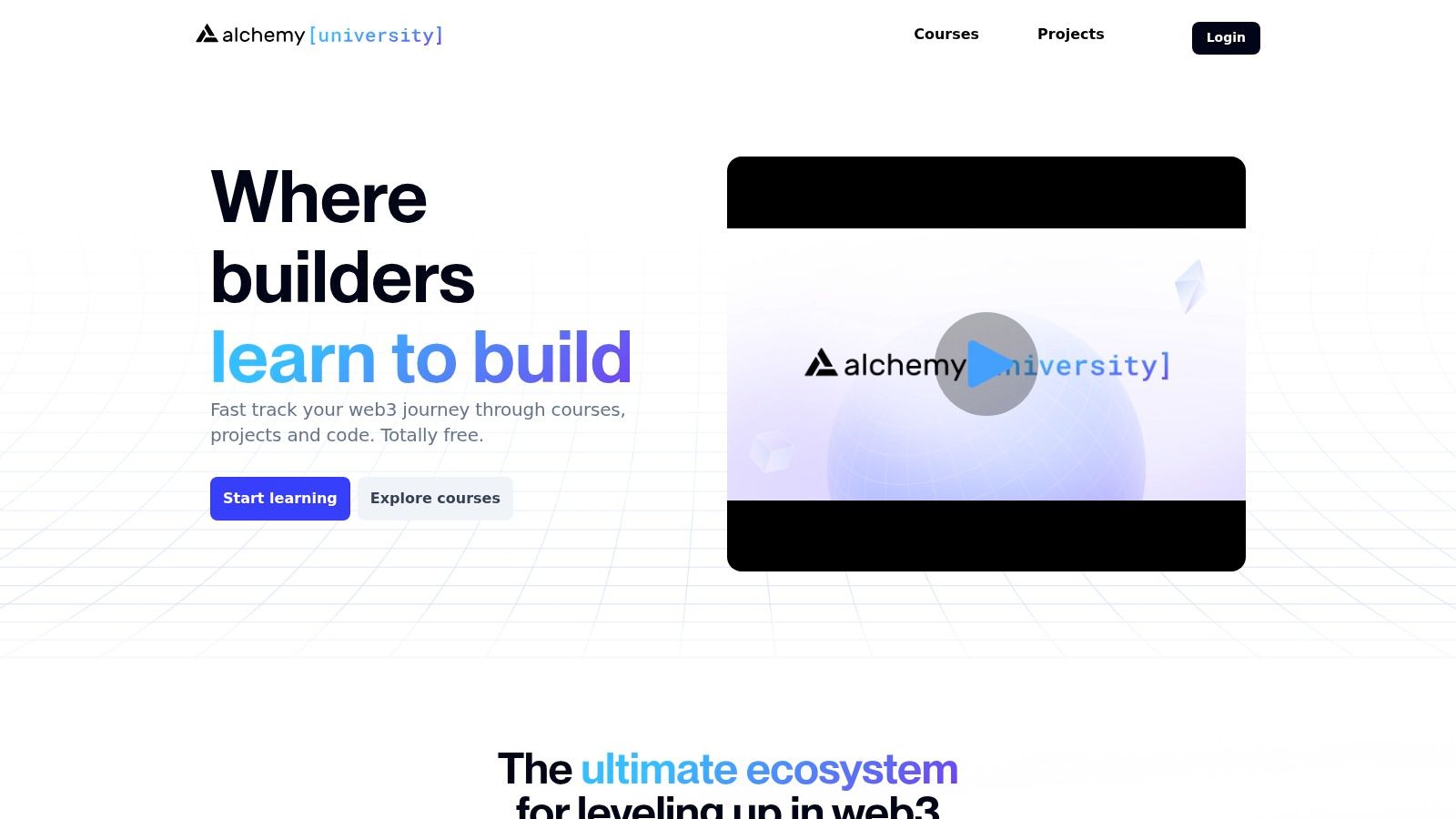
The core offering is a two-part track: a three-week JavaScript for Blockchain course followed by a seven-week Ethereum Developer Bootcamp. This sequence is perfect for solidifying fundamentals before diving into complex topics like smart contract development and decentralized application architecture. Its hands-on approach, filled with interactive coding challenges and capstone projects, ensures you are building a portfolio that can be discussed in job interviews.
Key Details & Learning Path
| Feature | Details |
|---|---|
| Target Audience | Web2 developers transitioning to Web3; beginners with some JavaScript knowledge. |
| Prerequisites | Intermediate JavaScript proficiency is highly recommended to get the most out of the bootcamp. |
| Cost & Time | Free. The full track is designed to take 10 weeks, but it's self-paced. |
| Hands-on Projects | Includes building a full-stack dapp, creating an NFT collection, and writing a smart contract escrow—all great portfolio pieces. |
| Certificate Value | Well-recognized by hiring managers as proof of foundational EVM knowledge and a commitment to learning. |
| Primary Focus | Ethereum Virtual Machine (EVM), Solidity, JavaScript (Ethers.js), Layer-2 scaling (Arbitrum, Optimism). |
| Job Market Impact | Completing the bootcamp is a significant portfolio booster, demonstrating the exact skills needed for many entry-level blockchain jobs. |
| Website | alchemy.com/university |
A major advantage from a career standpoint is its direct connection to Alchemy's suite of developer tools, providing immediate exposure to industry-standard infrastructure you'll use on the job. However, its main limitation is the singular focus on EVM-compatible chains. Developers aiming for careers in the Solana or Cosmos ecosystems will need to supplement this course with other resources to broaden their hiring prospects.
2. ConsenSys Academy – Blockchain Developer Program
ConsenSys Academy offers an end-to-end Ethereum developer program backed by one of the most established names in the blockchain space. As the company behind core infrastructure like MetaMask and Infura, a certificate from ConsenSys carries significant weight with employers. This self-paced program is ideal for developers who want a structured but flexible learning environment with a direct line to industry-standard practices that hiring managers value.

The program distinguishes itself with open, year-round enrollment and a 12-month access window, accommodating professionals with busy schedules. It covers the full development lifecycle from fundamentals to advanced dApp creation and security. While direct mentorship is limited, a forum-based Q&A system provides community support. The optional final assessment allows students to earn a formal certificate, a valuable credential to highlight on a resume and LinkedIn profile.
Key Details & Learning Path
| Feature | Details |
|---|---|
| Target Audience | Developers seeking a comprehensive, self-paced Ethereum education from an authoritative source. |
| Prerequisites | Solid understanding of web development fundamentals (HTML, CSS, JavaScript) is expected. |
| Cost & Time | Paid. A one-time fee (currently listed at $295) grants 12 months of access. The optional certificate exam has an additional fee. |
| Hands-on Projects | Focuses on building, testing, and deploying Ethereum dApps, with a strong emphasis on security best practices needed for real-world jobs. |
| Certificate Value | Highly credible. The optional, paid certificate is a strong signal to employers of proficiency, given ConsenSys's reputation. |
| Primary Focus | Ethereum, Solidity, Truffle Suite, dApp development, smart contract security, and Web3.js. |
| Job Market Impact | Completion provides the skills and a credential that are directly applicable to many blockchain engineering jobs. |
| Website | consensys.io/academy/ondemand |
The primary strength of ConsenSys Academy is its credibility and deep-rooted connection to the Ethereum ecosystem, making its certificate a powerful asset in job applications. The curriculum is thorough and directly relevant to what companies are looking for. However, the self-paced, forum-supported model may not suit learners who need live instruction or one-on-one mentorship to stay on track for their career goals.
3. Udacity – Blockchain Developer Nanodegree
Udacity’s Blockchain Developer Nanodegree is a structured, project-based program explicitly designed to bridge the gap between learning and landing a job. It stands out by combining fundamental blockchain theory with practical, hands-on application and career-focused services. This makes it an excellent option for learners who want direct support in preparing their professional materials for the job market.
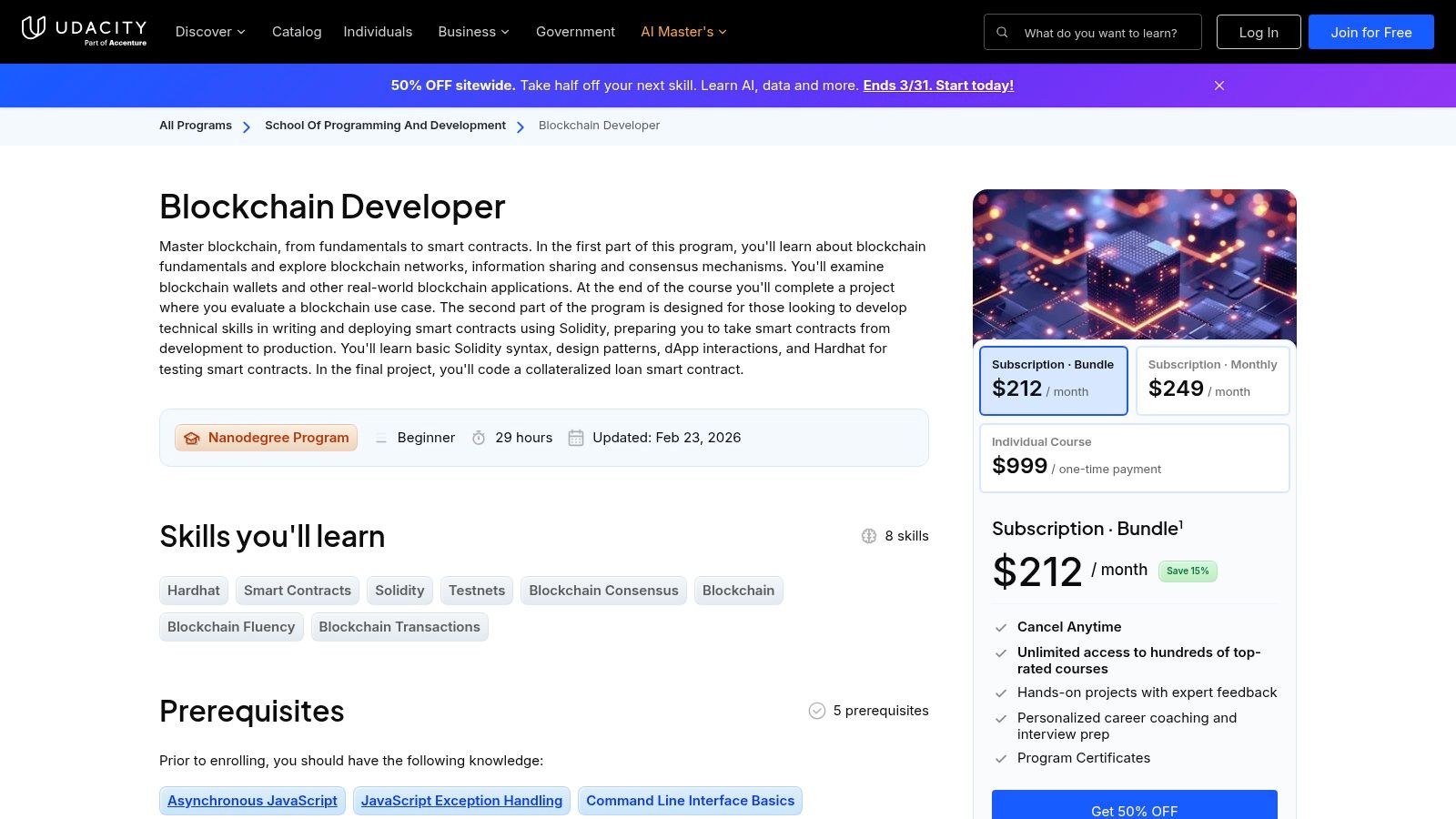
The curriculum is built around completing a series of real-world projects, such as building your own blockchain and creating a decentralized application (dApp). A key benefit is the structured feedback provided on your projects, which helps you build a high-quality portfolio. The integrated career services, offering resume and portfolio reviews, are a significant advantage for those aiming to make a direct transition into a full-time role and prepare for interviews.
Key Details & Learning Path
| Feature | Details |
|---|---|
| Target Audience | Developers seeking a structured, project-driven curriculum with career support; bootcamp-style learners. |
| Prerequisites | Intermediate object-oriented programming skills (Python, Go, or C++) and familiarity with JavaScript (Node.js). |
| Cost & Time | Subscription-based. The cost depends on completion speed. It's estimated to take 4 months at 10 hours/week. |
| Hands-on Projects | Includes building a private blockchain, a Star Notary Service dApp, and a decentralized housing marketplace—all strong portfolio pieces. |
| Certificate Value | The Nanodegree certificate is from a reputable brand and adds weight to a resume, especially when paired with the project portfolio. |
| Primary Focus | Blockchain fundamentals (cryptography, P2P networks), Ethereum, Solidity, dApp architecture, and smart contract security. |
| Job Market Impact | The career services and project-based portfolio are designed to directly prepare you for interviews with top blockchain companies. |
| Website | udacity.com/course/blockchain-developer |
The primary strength of this program is its explicit focus on job-readiness, from building a strong portfolio to interview preparation. However, its subscription pricing model can be confusing, as the total cost is tied to how quickly you finish. Additionally, while it provides a solid foundation, developers targeting highly specialized Ethereum roles may need supplementary, EVM-specific resources to stand out in a competitive hiring landscape.
4. University at Buffalo (SUNY) – Coursera Blockchain Specialization
For those seeking an academic foundation to anchor their resume, the University at Buffalo's Blockchain Specialization on Coursera offers a credible, university-authored curriculum. This program stands out by blending academic rigor with practical application, making it an excellent choice for learners who want a formal credential to enhance their job prospects. Its four-course sequence methodically builds from blockchain basics to advanced smart contract development.
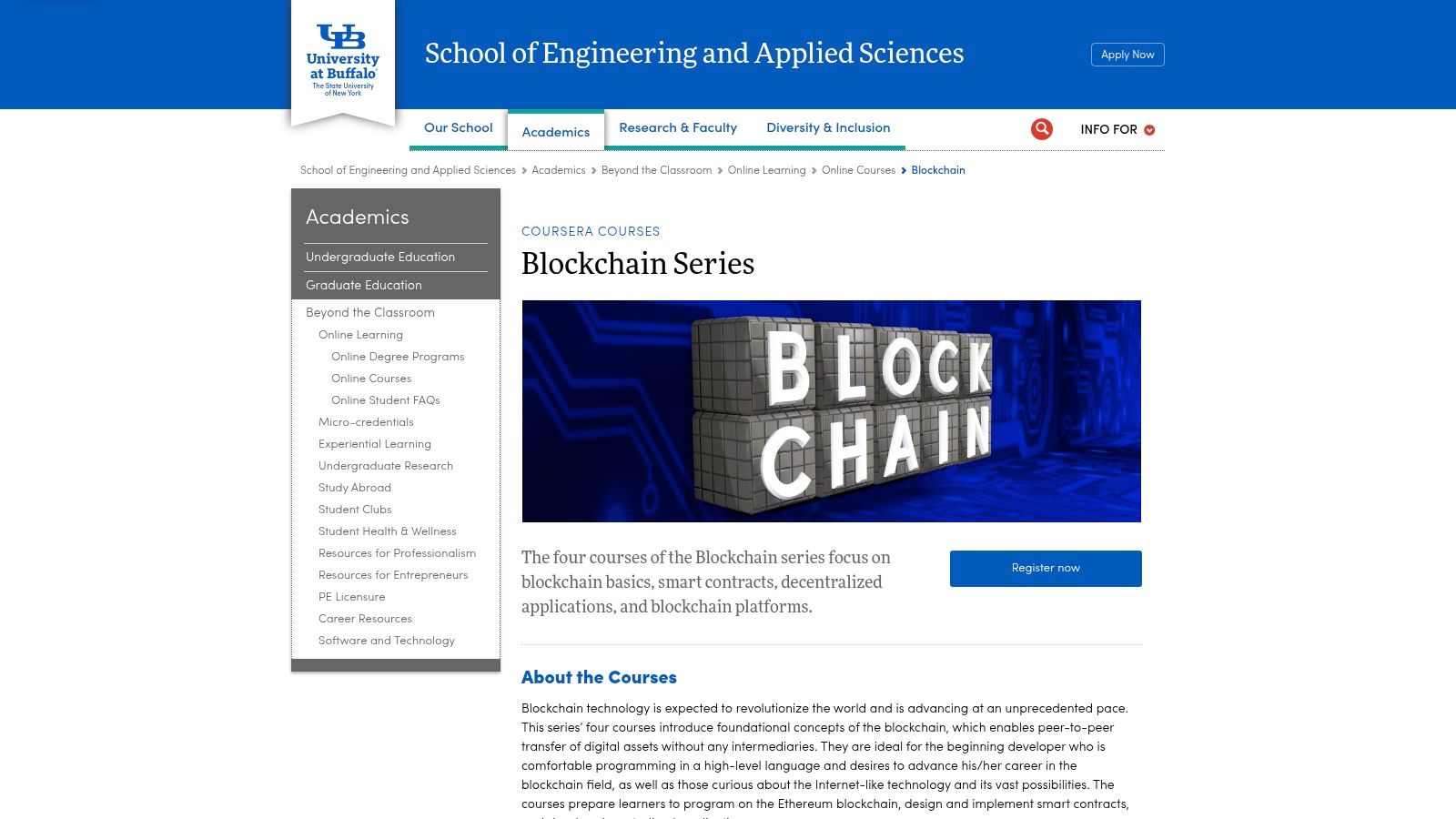
The specialization's main strength is its applied learning approach within a formal framework. You'll move from theoretical concepts to hands-on labs using the Remix IDE, a standard tool for Solidity developers. This structure helps cement core programming logic before moving on to designing and implementing full decentralized applications—skills you can directly showcase in a technical interview. While it doesn’t offer the same cohort-based support as a bootcamp, its flexibility and free audit option make it highly accessible.
Key Details & Learning Path
| Feature | Details |
|---|---|
| Target Audience | Beginners with a computer science background; individuals seeking an academic certificate to bolster their resume. |
| Prerequisites | Basic understanding of at least one object-oriented programming language and data structures. |
| Cost & Time | Free to Audit. Paid Coursera subscription required for graded assignments and certificate (~$49/month). Self-paced, est. 4 months at 4 hrs/wk. |
| Hands-on Projects | Includes building smart contracts in Solidity and designing a decentralized application—key projects for any entry-level portfolio. |
| Certificate Value | The Coursera/SUNY certificate adds academic credibility to a resume, especially for those without a traditional CS degree. |
| Primary Focus | Blockchain fundamentals, Smart Contract Development, Solidity, Ethereum, Decentralized Application (dApp) design. |
| Job Market Impact | Demonstrates a strong theoretical and practical grasp of Ethereum, which is valuable for roles requiring deep protocol understanding. |
| Website | engineering.buffalo.edu/home/academics/beyond/online/courses/blockchain.html |
The primary advantage is gaining a university-backed credential that can strengthen a portfolio for job applications, particularly in more corporate or enterprise blockchain settings. Its key limitation from a career progression standpoint is the lack of dedicated community or direct mentorship, which is a trade-off for the self-paced, low-cost structure. Job seekers must be self-motivated to complete the material and seek external communities for support and networking.
5. LearnWeb3 – Degrees and Courses
LearnWeb3 takes a unique, gamified approach to blockchain education by structuring its content into "Degrees" that guide learners from freshman to senior-level topics. It’s an excellent, completely free platform for developers who want a structured yet self-paced path with a strong sense of progression. For hiring, its on-chain credentials provide a public, verifiable record of your skills and dedication—a modern alternative to a traditional certificate.
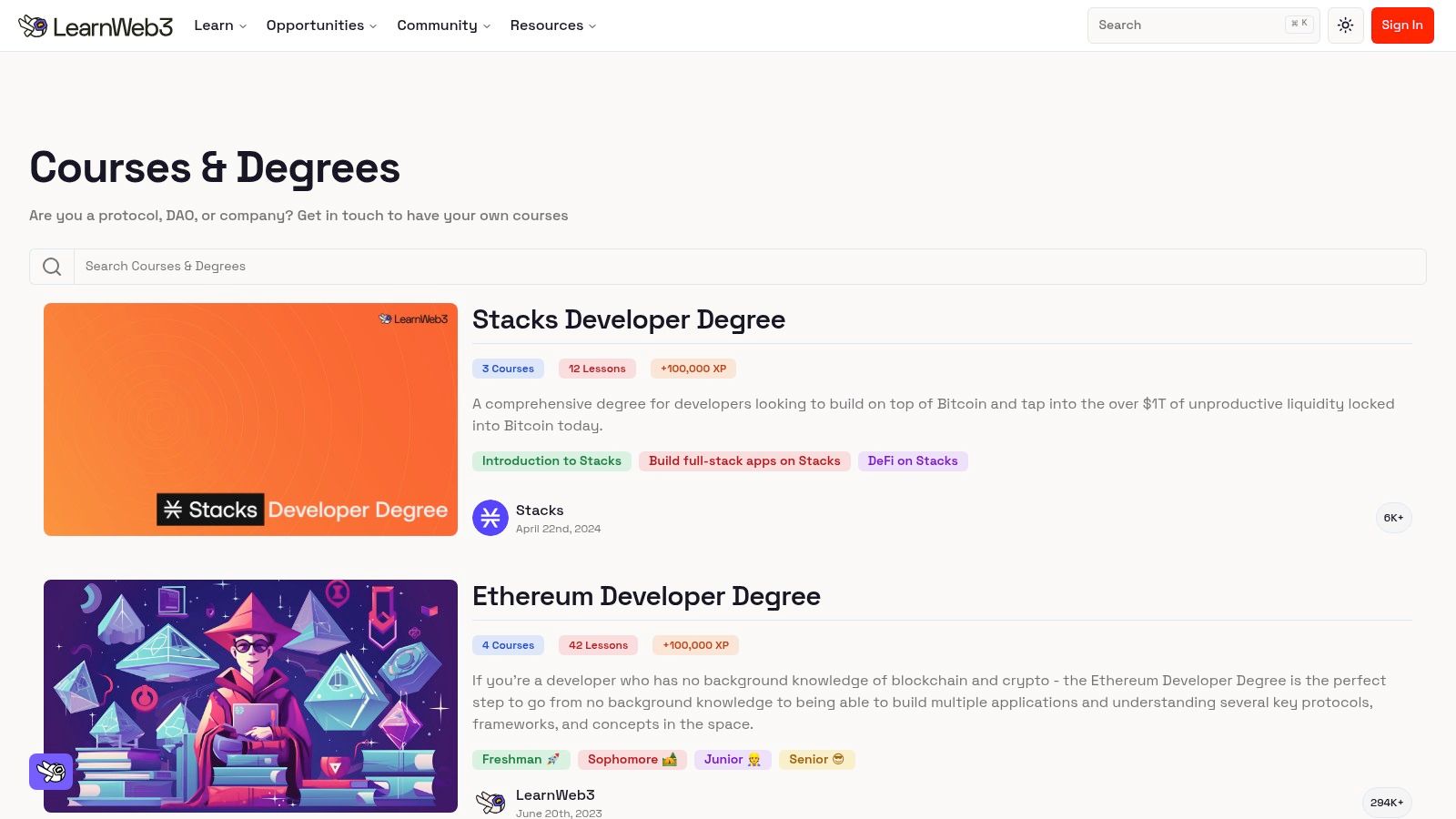
The core Ethereum Developer Degree is a fantastic starting point, but the platform also offers dedicated tracks for Stacks, Flow, and Fuel. This makes it a valuable resource for developers aiming for flexibility and a wider understanding of the Web3 space. The project-based lessons ensure you are building a portfolio as you learn, which is a key consideration for demonstrating skills to potential employers.
Key Details & Learning Path
| Feature | Details |
|---|---|
| Target Audience | Beginners and intermediate developers looking for a gamified, multi-chain learning experience. |
| Prerequisites | Basic programming knowledge (JavaScript, Python, or Rust depending on the track) is beneficial. |
| Cost & Time | Free. The platform is self-paced, with degrees broken into manageable course modules. |
| Hands-on Projects | Includes building NFT collections, creating DAOs, and developing dapps on various chains, creating a diverse portfolio. |
| Certificate Value | The on-chain credentials and XP serve as a public record of your learning journey, acting as a great signal of commitment on a resume or portfolio. |
| Primary Focus | Ethereum, Solidity, but also extends to other ecosystems like Stacks, Flow, and Fuel. |
| Job Market Impact | Completing multiple tracks demonstrates versatility and a proactive learning attitude, making you a more adaptable candidate for various Web3 roles. |
| Website | learnweb3.io/degrees/ |
The multi-chain exposure is a significant career advantage, preparing developers for a future where interoperability is key and making them attractive to a wider range of companies. A potential downside is that the self-paced, community-reliant format may offer less direct mentorship compared to structured, paid bootcamps. However, for self-motivated learners, it offers one of the most diverse and career-relevant free web3 development courses available.
6. RareSkills – Solidity Bootcamp
RareSkills offers an advanced Solidity Bootcamp designed for engineers who want to achieve production-grade proficiency and target senior-level roles. Unlike self-paced platforms, it creates an intense, high-accountability environment through small cohorts and weekly one-on-one code reviews. This rigorous approach makes it a top choice for developers aiming for senior smart contract or protocol engineering jobs where deep security and DeFi knowledge are non-negotiable hiring criteria.
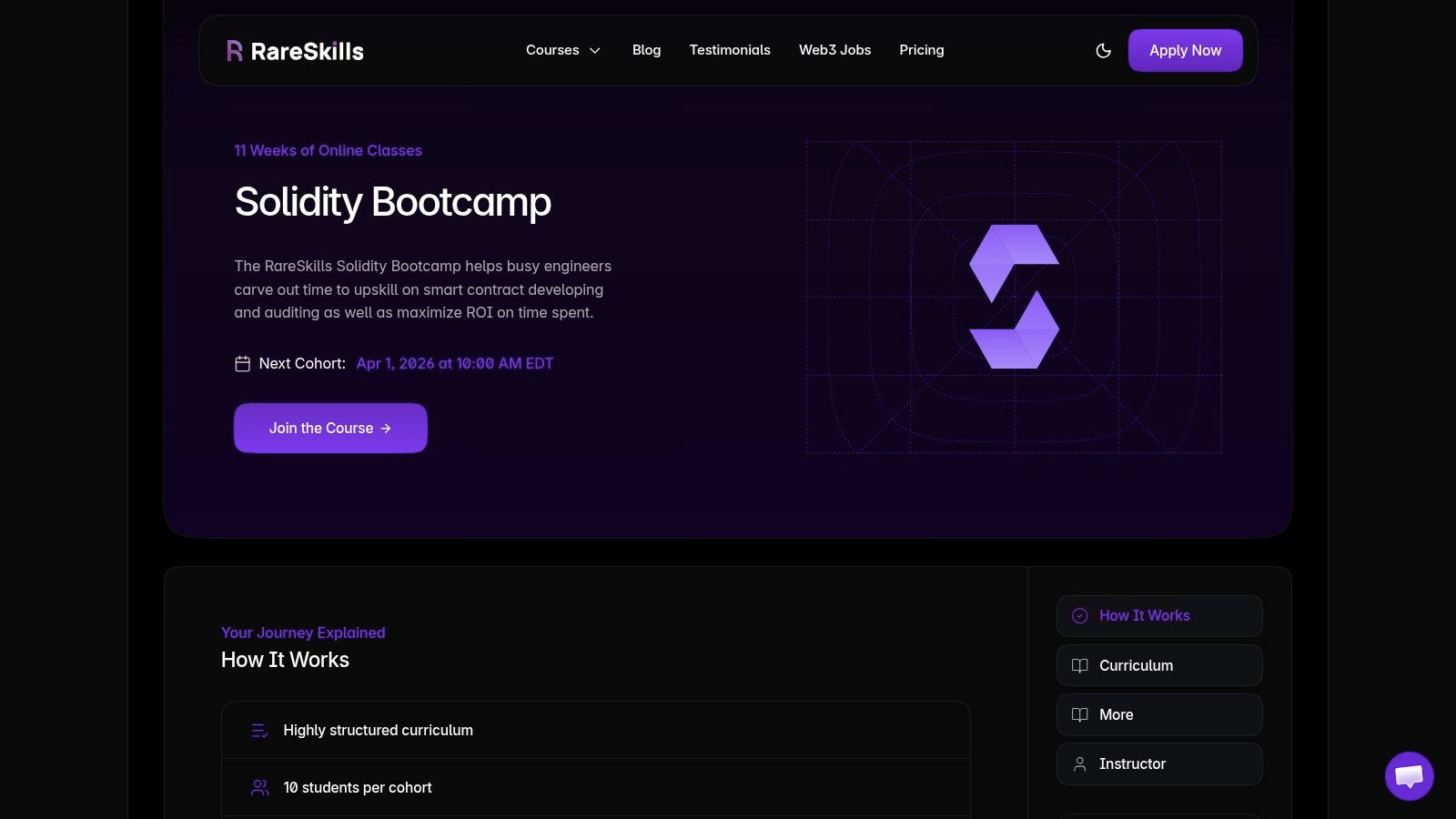
The curriculum dives straight into complex topics that are often glossed over in introductory web3 development courses, such as DeFi primitives, flash loans, and yield-bearing vaults. The strong emphasis on security, gas optimization, and advanced assembly is tailored to build the skills that hiring managers for top-tier protocol teams look for and test heavily during interviews.
Key Details & Learning Path
| Feature | Details |
|---|---|
| Target Audience | Experienced engineers (Web2 or Web3) aiming for senior smart contract or protocol security roles. |
| Prerequisites | Strong programming background required; not suitable for beginners. Comfort with technical concepts is essential. |
| Cost & Time | Premium. The bootcamp is an 11-week, part-time commitment with live sessions. |
| Hands-on Projects | Involves deep-dive security drills and building DeFi mechanisms—projects that directly map to high-value engineering tasks. |
| Certificate Value | Highly respected. Completion signals a deep, practical understanding of advanced Solidity and security principles to employers. |
| Primary Focus | Advanced Solidity, Smart Contract Security, Gas Optimization, Yul/Assembly, DeFi protocols (Uniswap, Vaults). |
| Job Market Impact | Graduates are well-positioned for high-paying roles in protocol development and security auditing, where this level of rigor is expected. |
| Website | rareskills.io/courses/solidity-bootcamp |
The key career advantage is its depth and the personalized feedback from one-on-one code reviews, which rapidly prepares you for senior-level technical interviews. However, the demanding workload and premium price point make it a significant investment. This program is not for casual learners but for committed engineers seeking to operate at the highest level of the EVM ecosystem and command a top-tier salary.
7. Cyfrin Updraft – Web3 Dev and Security Courses
Cyfrin Updraft provides a security-first approach to blockchain education, making it an essential resource for any developer aiming for a long-term, successful career in Web3. Founded by smart contract auditing experts, its free courses emphasize the "why" behind secure coding practices, instilling a deep understanding of vulnerabilities—a skill that is critically important and highly valued by hiring managers.
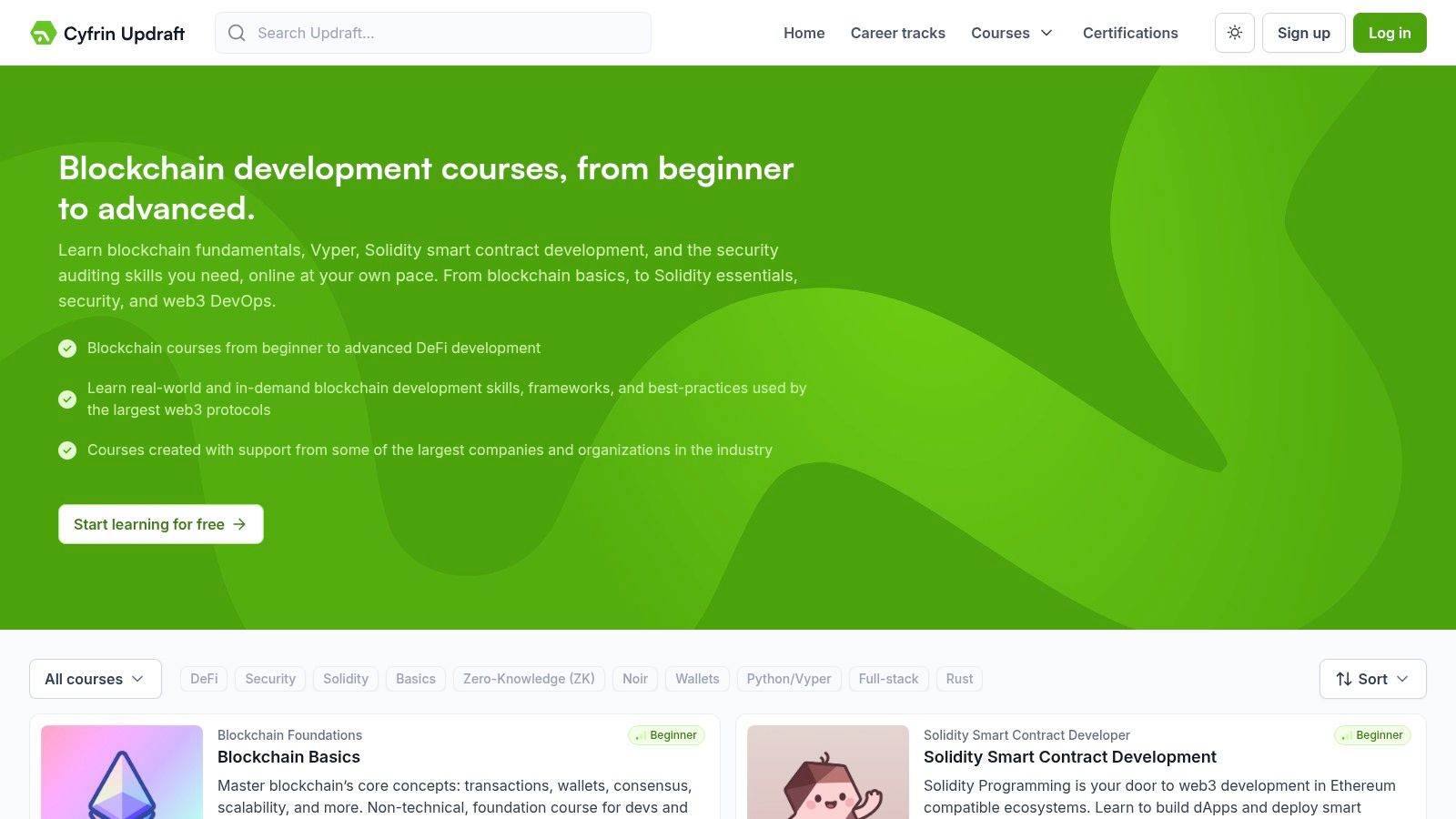
The platform stands out by offering deep dives into complex DeFi protocols like Aave and Uniswap, alongside foundational courses in Solidity and Rust. This creates a clear learning path from a beginner developer to a security-aware protocol expert. For job seekers, completing Cyfrin's advanced modules demonstrates a rare and highly valued skill set, signaling to employers that you are not just a builder but a defender of on-chain value.
Key Details & Learning Path
| Feature | Details |
|---|---|
| Target Audience | Developers aiming for security roles; engineers wanting to build DeFi protocols; auditors in training. |
| Prerequisites | Varies by course. Beginner modules have few, while advanced protocol courses require strong Solidity and Web3 knowledge. |
| Cost & Time | Mostly free. Contains 60+ hours of self-paced content. Time commitment depends on the chosen learning path. |
| Hands-on Projects | Includes building secure smart contracts and analyzing real-world exploits, providing excellent talking points for technical interviews. |
| Certificate Value | Highly respected in security circles. Signals a serious commitment to smart contract security best practices to any hiring manager. |
| Primary Focus | Smart Contract Security, Auditing, DeFi Protocols (Aave, Uniswap), Solidity, Foundry, Rust, Solana, Zero-Knowledge Proofs. |
| Job Market Impact | A massive differentiator for security auditor and senior smart contract developer roles. Demonstrates skills that directly prevent financial loss. |
| Website | updraft.cyfrin.io/courses |
A key strength for career progression is the high-quality, expert-led content available at no cost, allowing you to gain in-demand security skills without a financial barrier. However, the platform is largely self-guided, which requires self-discipline. Job seekers should actively participate in the community Discord to network and demonstrate their progress.
8. OpenZeppelin – Ethernaut
While many web3 development courses focus on building, OpenZeppelin's Ethernaut teaches you how to break things—a critical skill for any top-tier developer. It is a free, EVM-based wargame where developers learn to identify and exploit common smart contract vulnerabilities. Completing it is a powerful signal to hiring managers that you take security seriously and can think adversarially.
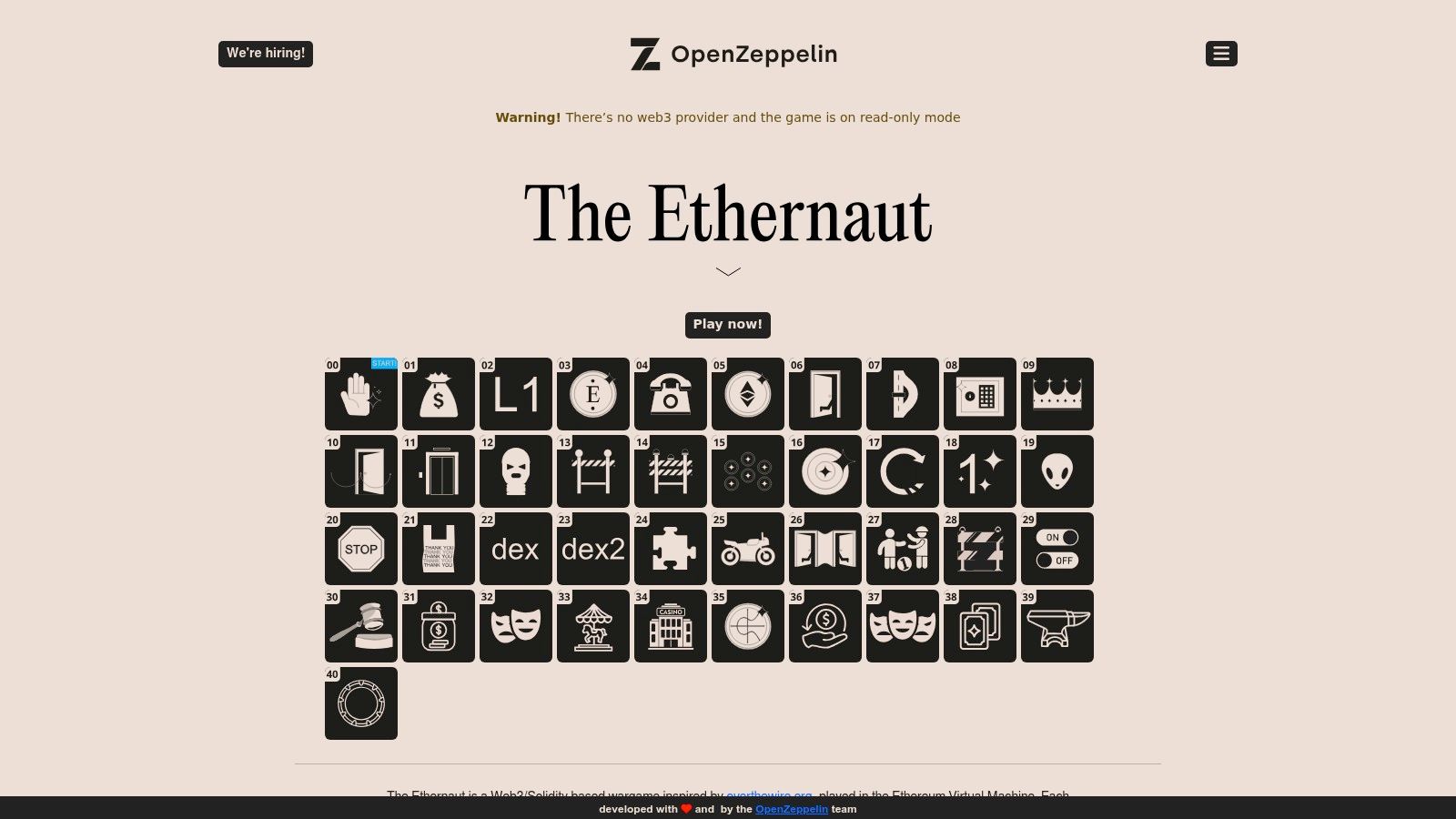
Ethernaut presents a series of challenges, each a smart contract with a hidden flaw. Your task is to hack it. This approach moves beyond theory, forcing you to think like an attacker. Completing these challenges is a strong signal to hiring managers that you understand contract security at a practical level, a skill that is in extremely high demand and can set you apart in technical interviews. It's less a formal course and more a rite of passage for serious Solidity developers.
Key Details & Learning Path
| Feature | Details |
|---|---|
| Target Audience | Solidity developers, smart contract auditors, security researchers, and anyone looking to deepen their EVM security knowledge. |
| Prerequisites | Solid understanding of Solidity and how the Ethereum blockchain works. Not suitable for absolute beginners. |
| Cost & Time | Free. Self-paced, with completion time varying widely based on skill. |
| Hands-on Projects | The entire platform consists of hands-on hacking challenges, covering reentrancy, integer overflows, access control flaws, and more. |
| Certificate Value | No formal certificate, but completion is highly respected in the security community and is a major portfolio and resume achievement. |
| Primary Focus | Smart contract security, common attack vectors, defensive programming patterns, and understanding EVM-level behavior. |
| Job Market Impact | Demonstrates advanced, practical security skills that are critical for smart contract auditor and senior developer roles. |
| Website | ethernaut.openzeppelin.com |
The main career strength of Ethernaut is its practical, puzzle-based learning model that builds lasting intuition around security—something you can't fake in an interview. However, it's not a comprehensive course. It provides minimal hand-holding and entirely skips frontend and dApp architecture topics, so it should be used to supplement, not replace, a broader development education.
9. buildspace – Nights & Weekends
While many platforms offer structured lessons, buildspace operates on a different principle: shipping a real project. Its "Nights & Weekends" program is a 6-week sprint designed to push builders from idea to a tangible, portfolio-ready product. For job seekers, this is an invaluable opportunity to create a standout project that demonstrates initiative, execution, and the ability to deliver—qualities every hiring manager seeks.

The program's core is its "build in public" ethos, supported by live sessions and a vibrant community. This isn't a typical web3 development course focused on theory; it's a practical accelerator for your portfolio. The end-of-season showcases provide direct visibility to founders and investors, making it a powerful networking tool for career advancement and potentially landing a job directly.
Key Details & Learning Path
| Feature | Details |
|---|---|
| Target Audience | Developers with an idea who need structure and accountability to ship a project. |
| Prerequisites | Existing programming knowledge is required. It's not a beginner's course for learning to code. |
| Cost & Time | Free. The program is a 6-week sprint with a commitment of several hours per week. |
| Hands-on Projects | The entire program is centered on building one significant project of your own design—the ultimate portfolio piece. |
| Certificate Value | No formal certificate; the value lies in the finished project, the network built, and the public proof-of-work. |
| Primary Focus | Project execution, rapid prototyping, community feedback, and building in public. Tech stack is self-determined. |
| Job Market Impact | Creates a standout portfolio piece that hiring managers love to see. Demonstrates initiative, execution skills, and an ability to ship. |
| Website | buildspace.so |
The main strength of buildspace from a hiring perspective is its relentless focus on output. A finished, publicly-demoed project is more valuable than a dozen course certificates. However, it's not a substitute for deep protocol or smart contract education. Aspiring developers should use it to apply what they've learned elsewhere, not as their primary source for learning core Web3 concepts.
10. Solana – Official Developer Courses
For developers looking to build a career outside the EVM ecosystem, the official Solana developer courses are the most direct path to acquiring in-demand skills. Offered for free by the Solana Foundation, this collection of tutorials provides the most accurate and up-to-date information for getting started with Rust-based smart contracts. Mastering this content makes you a prime candidate for roles in the fast-growing Solana ecosystem.
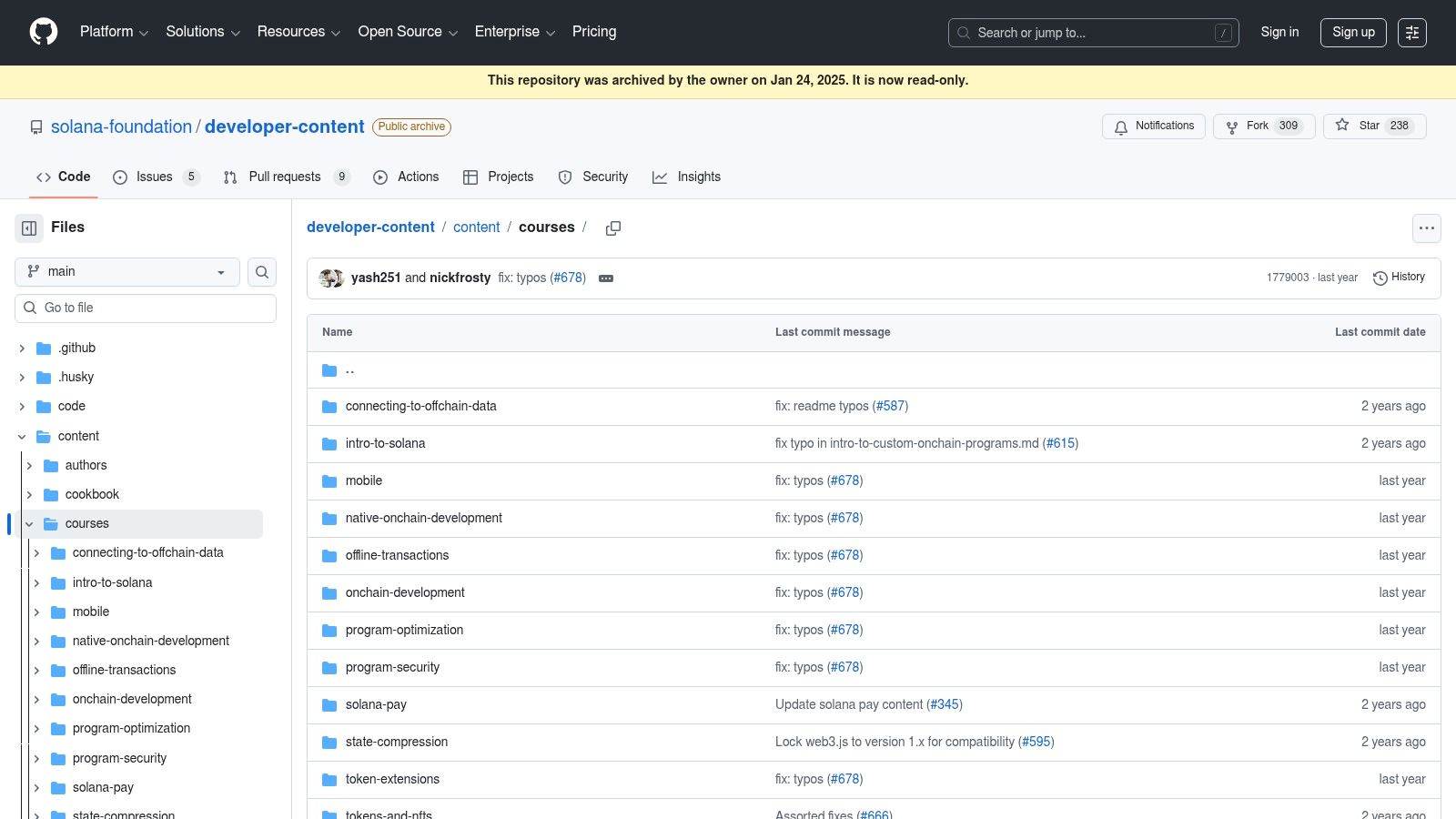
The curriculum is modular, allowing developers to target specific skills needed for job applications. It covers everything from creating tokens and NFTs to advanced program design using both native Rust and the popular Anchor framework. This hands-on, code-first approach ensures you are building a practical portfolio and understanding Solana's unique architecture, which will be tested in technical interviews.
Key Details & Learning Path
| Feature | Details |
|---|---|
| Target Audience | Developers with some Rust experience; EVM developers looking to transition to a non-EVM chain. |
| Prerequisites | Basic understanding of Rust is assumed. The learning curve can be steep without it. |
| Cost & Time | Free. Completely self-paced, allowing developers to learn around their own schedules. |
| Hands-on Projects | Includes building DeFi programs with Anchor and creating custom SPL tokens, all of which are excellent for a Solana-focused portfolio. |
| Certificate Value | No formal certificate is offered, but mastering this content is direct proof of Solana development competency for hiring managers. |
| Primary Focus | Solana program development, Rust, Anchor framework, SPL tokens, program security and optimization. |
| Job Market Impact | Demonstrates the exact skills needed for Solana-specific roles. A portfolio with projects from these courses is a strong hiring signal. |
| Website | solana.com/developers/courses |
The main career strength of these web3 development courses is their authenticity; the material comes directly from Solana's core contributors. This ensures you are learning the best practices that employers expect. However, its primary limitation is the assumption of prior Rust knowledge. The self-paced, doc-heavy nature also requires strong self-discipline to build a portfolio that stands out to recruiters.
11. Metaschool – Web3 Courses & Tracks
Metaschool offers a unique, project-based approach to learning that emphasizes portfolio building from day one—a crucial element for any job search. Instead of traditional theory-heavy lectures, the platform guides learners through building complete decentralized applications across a variety of blockchain ecosystems. This hands-on method is excellent for beginners who need tangible proof of their skills to show potential employers.
The platform stands out by offering many free courses and providing exposure to multiple chains, including emerging ecosystems like Sui and Fuel. Learning is gamified with community challenges on Discord and NFT-based certificates for course completion. This community-driven environment helps with networking and keeps motivation high for aspiring developers building their resumes.
Key Details & Learning Path
| Feature | Details |
|---|---|
| Target Audience | Beginners looking for project-based learning; developers exploring non-EVM ecosystems. |
| Prerequisites | Varies by course, but most are beginner-friendly with basic coding knowledge assumed. |
| Cost & Time | Mostly Free. Courses are self-paced and project-focused, typically taking a few hours to a few days to complete. |
| Hands-on Projects | Includes building a decentralized Kickstarter, creating a token on Sui, and deploying a smart wallet—all creating a diverse portfolio. |
| Certificate Value | NFT certificates are great for community recognition and showing project completion, but carry less weight with formal hiring managers. |
| Primary Focus | Multi-chain development (EVM, Sui, Fuel, Solana), project-driven portfolio building. |
| Job Market Impact | Strong for building a diverse project portfolio, which is essential for job applications. It shows initiative and a breadth of knowledge. |
| Website | metaschool.so/courses |
The key advantage of Metaschool for job seekers is its breadth, allowing you to quickly build a varied portfolio and discover a niche. However, the trade-off is that the depth can vary between courses. While the NFT certificates are a fun credential, they are more for community signaling and should not be the primary focus on a resume for formal job interviews. The finished projects are the real prize.
12. Metana – Web3 Solidity Bootcamp
Metana offers a high-intensity, cohort-based bootcamp for developers who are serious about becoming production-ready Solidity engineers and are looking for a direct path to employment. Unlike self-paced courses, its structure is designed for deep mastery and explicitly includes a job guarantee, making it a powerful option for those willing to invest in their career transition.
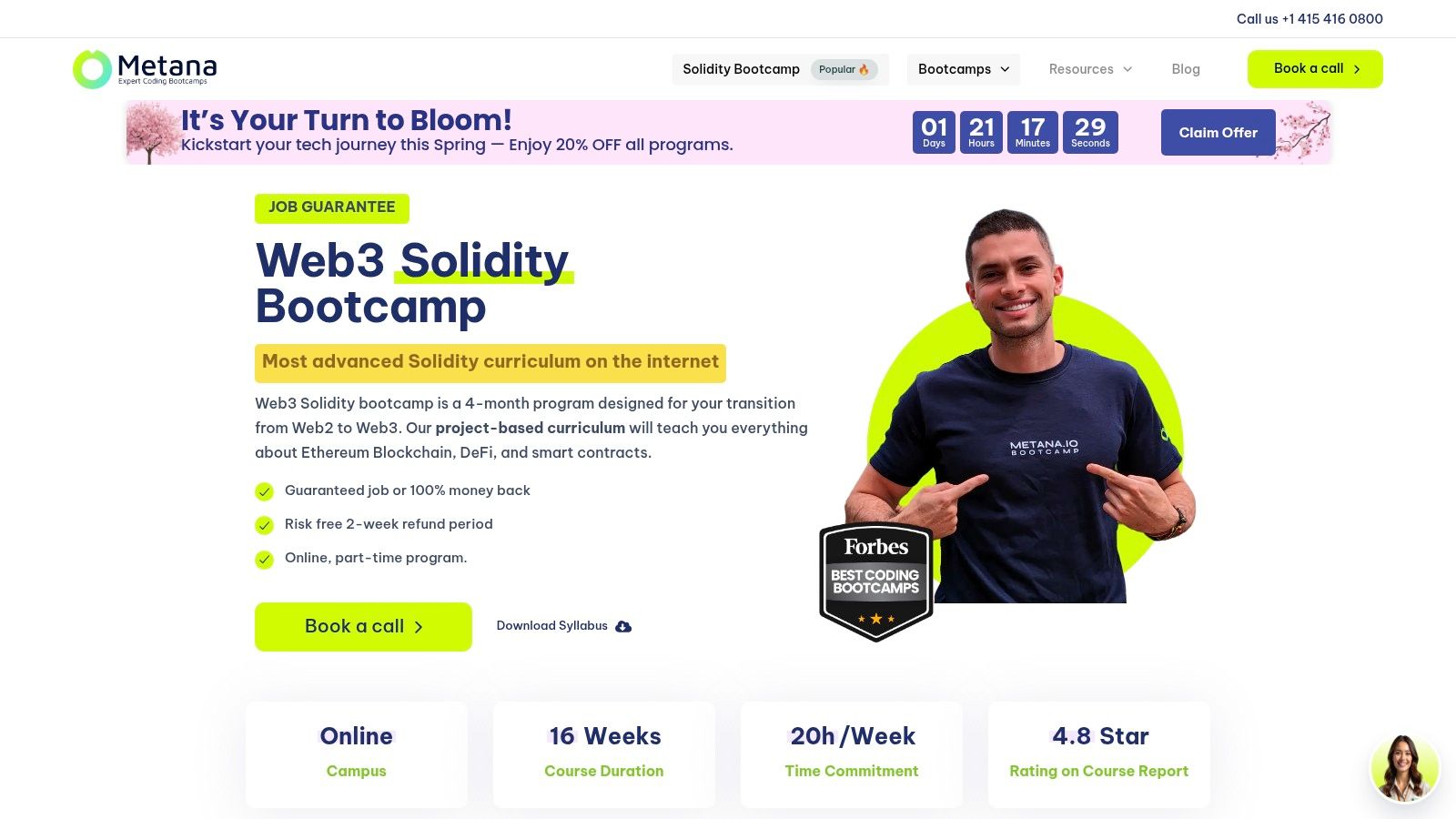
The bootcamp's key differentiator is its high-touch instructional model combined with career support. With small cohorts, 1:1 code reviews, and office hours, students receive personalized feedback that prepares them for rigorous technical interviews. The curriculum includes advanced topics like Yul and assembly, preparing graduates for complex security audits and optimization tasks that are highly valued by employers.
Key Details & Learning Path
| Feature | Details |
|---|---|
| Target Audience | Developers seeking to specialize in high-security smart contract engineering; those aiming for senior roles. |
| Prerequisites | Requires a coding assessment and existing proficiency in JavaScript and general web development. |
| Cost & Time | Premium. 16-22 weeks part-time. Financing is available, and it has a public job-guarantee policy. |
| Hands-on Projects | Focuses on security-heavy assignments and building production-grade contracts that mimic real-world job responsibilities. |
| Certificate Value | The depth of training and focus on security make graduates strong candidates for specialized engineering roles. |
| Primary Focus | Advanced Solidity, EVM internals, smart contract security, gas optimization, Yul/assembly, and production-ready development practices. |
| Job Market Impact | The explicit job guarantee and focus on security-first development directly align with what top protocols and DeFi projects look for. |
| Website | metana.io/web3-solidity-bootcamp-ethereum-blockchain/ |
The primary strength of Metana is its direct focus on getting you hired, backed by a job guarantee. The program is designed to produce elite-level talent with demonstrable, security-oriented skills that are in high demand. However, the high cost, demanding weekly time commitment, and selective admissions process mean this is a serious commitment for those ready to accelerate their career, not for casual learners.
Top 12 Web3 Development Courses Comparison
| Program | Core Focus ✨ | Quality & Support ★ | Price / Value 💰 | Target 👥 | Top Strength 🏆 |
|---|---|---|---|---|---|
| Alchemy University | Free EVM-focused tracks (JS & Ethereum bootcamp) ✨ | 4★ — interactive labs + instructor vids; community help | Free — best low-cost on-ramp 💰 | Web2 devs → EVM engineers 👥 | Zero-cost, structured EVM path 🏆 |
| ConsenSys Academy | End-to-end Ethereum dev curriculum; optional cert ✨ | 4★ — well-structured; forum Q&A | Paid ($295–$695 reported) — verify 💰 | Aspiring Ethereum devs & tooling learners 👥 | Ethereum-native credibility & tooling focus 🏆 |
| Udacity – Nanodegree | Project-based blockchain fundamentals & dApps ✨ | 4★ — mentor feedback, project reviews | Subscription/premium — cost varies with pace 💰 | Career switchers building portfolio 👥 | Career services + hands-on projects 🏆 |
| Univ. at Buffalo (Coursera) | 4-course Solidity/Remix sequence; academic labs ✨ | 3.5★ — university rigor; lighter mentoring | Audit free; paid certs via Coursera 💰 | Learners seeking academic credential 👥 | University-authored Solidity curriculum 🏆 |
| LearnWeb3 | Gamified multi-chain Degrees & XP system ✨ | 3.5★ — engaging gamified UX; self-paced | Free — broad ecosystem coverage 💰 | Self-paced explorers & multi-chain learners 👥 | Multi-chain gamification and credentialing ✨🏆 |
| RareSkills – Solidity Bootcamp | Advanced 11-week Solidity + DeFi/security drills ✨ | 5★ — small cohorts, weekly 1:1 code reviews | Premium tuition (transparent pricing) 💰 | Experienced engineers targeting DeFi roles 👥 | Intensive security training & 1:1 reviews 🏆 |
| Cyfrin Updraft | Large catalog: dev + security + ZK + Rust/Solana ✨ | 4★ — high-signal courses; self-guided | Mostly free; some paid modules 💰 | Security-minded devs & auditors 👥 | Security-first depth and ZK modules 🏆 |
| OpenZeppelin – Ethernaut | EVM security wargame (hands-on challenges) ✨ | 4★ — practical, memorable vuln practice | Free — open access 💰 | Auditors and smart contract devs learning exploits 👥 | Real-world vulnerability challenges 🏆 |
| buildspace – Nights & Weekends | 6-week project sprints; shipping & showcases ✨ | 4★ — live + async, strong community accountability | Free/seasonal; microgrants available 💰 | Builders who want fast portfolio projects 👥 | Ship projects quickly; investor/founder visibility 🏆 |
| Solana – Official Courses | Official Solana + Anchor/Rust tracks ✨ | 4★ — authoritative, practical examples | Free — maintained by core team 💰 | Rust devs and Solana-native builders 👥 | Official, up-to-date Solana material 🏆 |
| Metaschool | Project-driven multi-ecosystem courses; NFT certs ✨ | 3.5★ — community Discord support; variable depth | Many free courses; some guided options 💰 | Beginners exploring newer ecosystems 👥 | Hands-on projects + NFT-based certificates ✨🏆 |
| Metana – Web3 Solidity Bootcamp | Part-time 16–22 week cohort; security + job support ✨ | 5★ — high-touch, weekly 1:1, office hours | Premium with financing + published job-guarantee 💰 | Serious engineers aiming for production roles 👥 | Job-guarantee + production-ready security focus 🏆 |
Putting Your Skills to Work: Your Next Steps to a Web3 Career
You have now explored a detailed map of the best Web3 development courses available today. From the structured curriculum of Alchemy University to the security-first approach of Cyfrin Updraft and the project-based sprints at buildspace, the path from novice to proficient Web3 developer is clearer than ever. Each course offers a distinct set of tools, community access, and project opportunities designed to equip you with marketable skills.
The most critical insight is that completing one of these programs isn't the finish line; it’s the starting gun. The Web3 space values demonstrable skill and active participation far more than simple certificates of completion. Your goal now is to convert your newfound knowledge into a compelling portfolio and professional network that catches the eye of hiring managers.
From Course Completion to Career Commencement
Merely listing a course on your resume is not enough. The next phase is about application and visibility. This is where you separate yourself from other candidates who have completed the same Web3 development courses.
Build a Standout Portfolio: Your GitHub profile is your most important asset. Don't just upload the final projects from your courses. Instead, fork them, add unique features, fix bugs, and write clean, well-documented code. For instance, if you built a simple NFT marketplace, consider adding auction functionality or a new mechanism for royalty splits. This shows initiative and a deeper understanding of the concepts.
Engage with the Ecosystem: True learning happens when you apply your skills in a live environment. Participate in hackathons like those hosted by ETHGlobal or DoraHacks. Contribute to open-source projects, even if it's just by improving documentation. Join a developer-focused DAO to collaborate with peers. These activities provide irrefutable proof of your passion and ability to work within a team, a key signal for recruiters.
Document Your Learning in Public: Start a blog, a Twitter thread, or a series of LinkedIn posts detailing what you’re building. Explain the technical challenges you faced and how you solved them. This not only reinforces your own understanding but also builds a personal brand and demonstrates your communication skills, which are vital in remote-first Web3 companies.
Choosing Your Path and Starting to Build
The courses we’ve covered cater to different career aspirations. If your goal is to become a high-demand smart contract auditor, a program like RareSkills or the advanced modules from Cyfrin Updraft should be your focus. If you're aiming for a full-stack Web3 role, combining a foundational course like LearnWeb3 with a project-focused program like buildspace provides a powerful combination.
Once you feel confident in your foundational knowledge, the real work begins. You'll be ready to start building web3 applications that solve real problems. Whether it's a DeFi protocol, a DAO tooling platform, or a decentralized identity system, having tangible projects you conceived and executed yourself is the ultimate differentiator. When you can walk an interviewer through the architecture of your own dApp, explain the security considerations you implemented, and discuss the trade-offs you made, you are no longer just a candidate; you are a builder.
Your journey into a Web3 career is a marathon, not a sprint. The courses listed are your training ground, but the race is won through persistent building, networking, and a proactive job search. By strategically applying your skills and making yourself visible within the community, you transform your educational investment into a real, rewarding career in decentralized technology.
Ready to take the next step and find your first or next Web3 role? Blockchain Jobs is a dedicated job board that connects talented developers like you with top companies in the blockchain industry. Explore curated opportunities that match the skills you’ve just worked so hard to acquire. Start your search on Blockchain Jobs today.