Your Guide to Landing High-Paying Web 3 Jobs

Welcome to the new frontier of careers in Web3, where opportunities are popping up faster than ever. This isn't just another tech buzzword; Web3 is a ground-up reinvention of the internet, and it's creating a massive need for talented people in both technical and non-technical roles. From a career perspective, landing one of the many available Web3 jobs means you're not just getting a paycheck—you're joining a movement built on decentralization, transparency, and user control, positioning you at the forefront of the next technological wave.
Your Roadmap to a Career in Web3

Think of the Web3 job market right now as the internet in the early 90s—a wide-open field waiting for pioneers to build the future. This guide is designed to be your career playbook, cutting through the noise to show you what hiring managers are looking for and providing a clear path to your first or next Web3 role.
This growth isn't just speculation; it's fueled by real products finding users and serious money from big-time investors. That investment has sparked a red-hot job market that needs more than just coders. Whether you're a veteran developer, a sharp marketer, or fresh out of college, there's a spot for you to build a long-term career.
Understanding the Explosive Market Growth
The demand for talent is backed by some pretty staggering numbers. The Web3 job market is on a tear, adding an incredible 66,494 new roles over the past year. Around the world, more than 3,700 new Web3 positions are listed every single month—that's a 300% jump in job openings since 2023. For job seekers, this isn't a temporary blip; it points to a healthy, long-term need for skilled professionals. For a deeper dive, check out the recent Web3 jobs report.
This boom means companies are desperately searching for people who can help build and grow decentralized applications (dApps), engage and manage vibrant online communities, and tackle the unique legal and financial challenges that come with blockchain technology.
The secret to breaking into Web3? It's all about showing initiative. Hiring managers value verifiable proof of your passion and skills over a perfectly polished resume. They are looking for genuine interest, a willingness to learn on the fly, and a real belief in the core ideas of Web3.
On top of that, the work culture in Web3 is a world away from your typical 9-to-5. To succeed, you need to adapt to a new way of working:
- Remote-First Environments: The vast majority of jobs are fully remote, opening up global opportunities but requiring strong self-discipline and communication skills.
- Outcome-Based Performance: Your impact and what you deliver are what matter, not the hours you spend at a desk. Career progression is tied to tangible results.
- Continuous Learning: Things change fast. You have to stay curious and be ready to adapt to new ideas and technologies to remain relevant.
Understanding these cultural shifts is as crucial for your job search as learning technical skills. It's about demonstrating that your work style fits with the core principles of autonomy and decentralization. That's exactly what this guide will prepare you for.
What Are the Most In-Demand Web3 Jobs?

When people hear "Web3 jobs," their minds often jump straight to coding. But the reality is much bigger. This industry needs a whole spectrum of talent, from the deep-tech architects building the infrastructure to the storytellers and strategists who drive user adoption.
To get your foot in the door, you first need to understand the landscape—what roles are out there and what do they actually do? Hiring managers aren't just looking for someone who can write code; they need people who bring precision and a sense of ownership to their work, whether that’s securing a protocol or building a loyal user base.
Let's break down the key roles you'll find in the wild.
The Technical Backbone
These are the builders—the engineers and security experts who construct and safeguard the decentralized world. These roles are often the most sought-after and highest-paid, and interview processes will rigorously test your specialized skills.
- Blockchain Engineer: Think of these folks as the master architects of a new digital city. They design and build the foundational blockchain protocols, obsessing over things like speed, security, and scalability. In an interview, you'll be grilled on systems design and core concepts in languages like Rust or Go.
- Smart Contract Developer: This is where the magic happens for most applications. Using languages like Solidity or Vyper, these developers write the self-executing contracts that are the engine behind dApps. Job interviews will involve live coding challenges and deep dives into your past on-chain projects.
- Smart Contract Auditor: In a world where a single bug can lead to millions in losses, this role is non-negotiable. Auditors are like digital detectives, poring over smart contract code to find and fix vulnerabilities. To get hired, you'll need to demonstrate an almost paranoid attention to detail and a portfolio of identified exploits.
The Non-Technical Growth Engine
Flawless code is only half the battle. A project is doomed to fail without a clear vision, a great user experience, and a passionate community. These roles are essential for career progression into leadership as Web3 pushes for mainstream adoption.
Web3 isn't just a technological shift; it's a cultural one. Hiring managers for non-technical roles look for candidates who can bridge the gap between complex technology and everyday users. A project can have flawless code, but without a clear product vision and an engaged community, it will fail.
The good news is that your traditional experience is highly transferable. The key is showing you can apply it to the unique challenges of a decentralized ecosystem during your job interviews.
- Web3 Product Manager: This person is the captain of the ship, setting the product's vision and strategy. A great PM in this space needs to be fluent in user needs, tokenomics, and the competitive market. In an interview, be prepared to present a full product teardown of a competitor. To see what they look for, check out this Senior Web3 Product Manager job listing from Binance.
- dApp UX/UI Designer: Designing for Web3 is its own special kind of puzzle. How do you make connecting a wallet or paying for gas fees feel simple and intuitive? To land this job, your portfolio must showcase solutions to Web3-specific user friction points.
- Community Manager: Here, "community" isn't just a marketing buzzword—it's everything. A community manager is the lifeblood of a project, engaging with users on platforms like Discord and Telegram. Hiring managers will look for evidence of how you've grown and managed a community before.
- DeFi Analyst: Part financial expert, part crypto-native. These analysts dive deep into the world of decentralized finance, analyzing protocols, modeling risk, and identifying new opportunities. Your interview will involve complex modeling tasks and deep questioning about market mechanics.
To help you visualize where you might fit and what's expected for career progression, here’s a breakdown of the most prominent job categories.
Key Web3 Job Categories and Core Responsibilities
| Job Category | Example Roles | Core Mission and Responsibilities |
|---|---|---|
| Core Engineering | Blockchain Engineer, Protocol Developer | Build, maintain, and scale the foundational blockchain infrastructure. Focus on security, performance, and decentralization. |
| Application Development | Smart Contract Developer, dApp Developer | Write and deploy the self-executing code that powers applications. Build the on-chain logic for everything from DeFi to gaming. |
| Security & Auditing | Smart Contract Auditor, Security Researcher | Identify and mitigate vulnerabilities in smart contracts and protocols. The "white hat hackers" protecting user funds. |
| Product & Design | Web3 Product Manager, UX/UI Designer | Define the "what" and "why" behind a product. Create intuitive, user-friendly experiences that onboard new users to Web3. |
| Community & Marketing | Community Manager, Marketing Lead, DevRel | Build and engage a project's user base. Tell the story, foster a sense of ownership, and drive adoption. |
| Data & Finance | DeFi Analyst, On-Chain Data Analyst | Analyze blockchain data and financial protocols to inform strategy, identify trends, and assess risk. |
As you can see, the opportunities are incredibly diverse. Whether you're a coder, a creative, a strategist, or a people person, there's likely a role where you can build a long-term career.
What Skills Do You Actually Need to Get Hired?
Forget just stuffing your resume with Web3 buzzwords. To land a job and advance your career, you need to show you can actually do something. Hiring managers are looking for people with a genuine passion for decentralization and concrete proof that you can add value from day one.
One of the most powerful aspects of Web3 for job seekers is that your work often lives out in the open. Your on-chain activity and public contributions effectively become your resume. Unlike a traditional tech job where projects are locked behind NDAs, here, your skills are publicly verifiable. This is a massive advantage if you take the time to learn, build, and participate where everyone can see it.
Getting the Technical Chops
For anyone targeting a developer role, knowing the right tech stack is table stakes. But just listing a programming language on your LinkedIn won't get you an interview. You have to prove you can use that knowledge to build real, functional things in a decentralized environment.
To prepare for technical interviews, start by mastering the essentials:
- Smart Contract Languages: You need to get comfortable with Solidity, which is the language behind Ethereum and most other EVM-compatible chains. Alternatively, Rust is the go-to for ecosystems like Solana and Polkadot.
- Blockchain Fundamentals: You can't build on a foundation you don't understand. Get a solid grasp of how blockchains work—things like consensus mechanisms (think Proof-of-Work vs. Proof-of-Stake), how a transaction goes from pending to confirmed, and the basics of cryptography. Expect questions on these in any engineering interview.
- The Developer's Toolkit: Get your hands dirty with the tools of the trade. That means using frameworks like Hardhat or Foundry for testing and deploying code, libraries like Ethers.js or Web3.js to talk to smart contracts, and node services like Infura or Alchemy to connect to the blockchain.
Building Real-World Industry Knowledge
If you're coming from a non-technical background, deep domain expertise is your golden ticket to getting hired. You have to understand the why behind Web3 and speak the language of the community you want to join. A product manager who can't explain gas fees or a marketer who doesn't know what a DAO is will not pass the interview screen.
Pick a niche and go deep. Immerse yourself in the specifics:
- Decentralized Finance (DeFi): Really learn the mechanics. How do lending protocols work? What’s the difference between a DEX and a centralized exchange? What is yield farming, really?
- Non-Fungible Tokens (NFTs): Move past the hype. Dig into smart contract standards like ERC-721 and ERC-1155, understand how a minting process works, and explore the dynamics of different marketplaces.
- Decentralized Autonomous Organizations (DAOs): The best way to learn is by doing. Join a DAO and see how it operates. Watch how governance proposals are made, participate in token-based voting, and see how the treasury is managed. This is direct experience you can talk about in interviews.
The single best way to prove you have what it takes is to build something—anything. A simple dApp, a thoughtful governance proposal, or a deep-dive analysis of a DeFi protocol speaks volumes more than a course certificate ever will. This is your portfolio.
The goal is to shift from just reading and watching to actually doing. This is how you build a verifiable track record. Competing in a hackathon or contributing to an open-source project on GitHub is hard evidence that you can ship code and work with a team. It's this kind of hands-on experience that will make you stand out and put you on the fast track in your Web3 career.
Getting Paid in Web3: A Look at Salaries and Compensation
Let's talk money. Understanding compensation is key to your career progression in Web3. You see the crazy headlines about massive salaries, but the reality is more nuanced—it's a blend of cash and unique, crypto-native incentives. Mastering both is critical for evaluating offers and negotiating effectively.
The market for Web3 talent is hot, and that competition is reflected in the pay. It's also a remote-first world; recent data shows that a whopping 70% of all placements are fully remote. Blockchain developers are in high demand, often pulling in between $130,000 to $270,000 a year, and that’s before you even factor in token equity. It's not just the tech roles, either. Demand for Web3 marketing pros, for example, is up 35% year-over-year. You can dig deeper into the 2025 hiring trends for Web3 to see how different roles are shaking out.
When companies decide what to offer, they're looking at a mix of your hard skills, industry smarts, and what you've actually built.
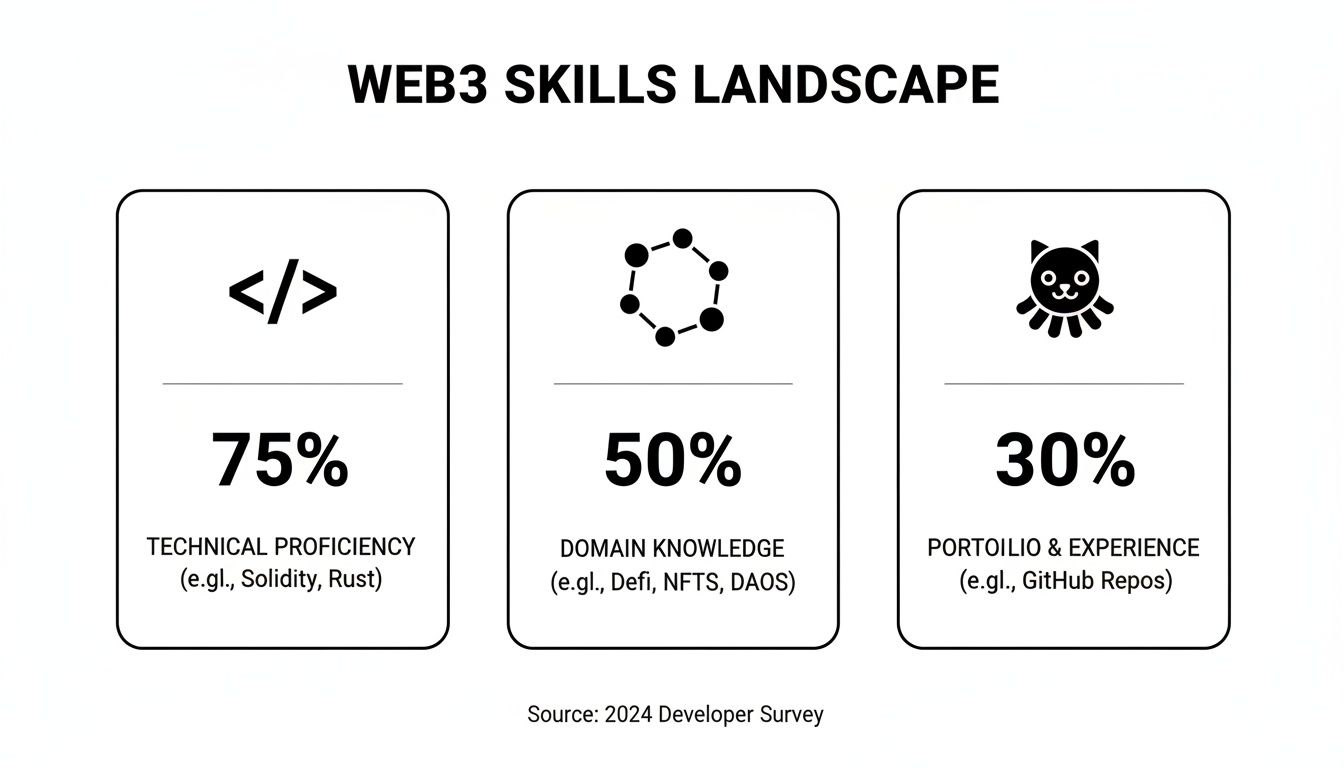
This really drives home the point that while being a great coder is crucial, having that deep domain knowledge and a portfolio to prove it is what really moves the needle on your earning potential and career growth.
Typical Salary Ranges for Popular Web3 Roles
While every offer is different, it helps to have a baseline for negotiation. The table below gives you a ballpark idea of what you can expect for a base salary in some of the most common Web3 roles. Remember, this doesn't include the token or equity portion, which can significantly increase the total package.
| Role | Experience Level | Typical Annual Salary (USD) |
|---|---|---|
| Smart Contract Engineer | Mid-Level | $120,000 - $180,000 |
| Blockchain Developer | Senior | $150,000 - $270,000+ |
| Product Manager | Mid to Senior | $130,000 - $220,000 |
| Community Manager | Junior to Mid | $70,000 - $120,000 |
| Protocol Researcher | All Levels | $100,000 - $250,000+ |
| Web3 Marketing Manager | Mid-Level | $90,000 - $160,000 |
These numbers are a great starting point for negotiations, but always consider the full scope of the role, the project's funding, and the overall compensation structure.
It's Not Just About the Base Salary
In Web3, your base salary is just one piece of the puzzle. The real long-term career potential often lies in the equity, which usually means project tokens. This is a huge departure from traditional stock options. Tokens can offer a faster path to liquidity and let you share directly in the success of the protocol you're building.
When you receive a token grant in an offer, don't just get mesmerized by the dollar value. You have to put on your investor hat and perform due diligence.
- Vesting Schedules: How long until those tokens are actually yours? Most projects use a vesting schedule. A common one is a one-year "cliff" (you get nothing if you leave before a year) followed by monthly or quarterly payouts over the next three or four years.
- Tokenomics: This is the economic blueprint of the token. What’s the total supply? Is the supply inflationary or deflationary? Understanding these mechanics is absolutely critical to evaluating its future value and your potential upside.
- Liquidity: Can you actually sell the token? Is it already trading on major exchanges, or is it an illiquid asset from a project that hasn't launched yet? This makes a massive difference in your ability to turn that equity into cash.
A job offer with a lower base salary but a generous, well-structured token package from a promising project can often be far more lucrative in the long run than a high-salary offer with no equity. It’s a bet on your ability to contribute to the project's growth.
The New Normal: Remote and Contract Gigs
The decentralized ethos of Web3 has made remote work the default setting. This incredible flexibility is a major magnet for talent, but it also changes the career calculus.
Working as a remote contractor gives you freedom and the ability to contribute to multiple projects. The trade-off? You're responsible for your own benefits like health insurance, taxes, and retirement savings. Full-time roles often come with more stability and traditional benefits. It's all about weighing these pros and cons to figure out which path aligns with your long-term career goals.
How to Ace Your Web3 Job Application and Interview

Getting a job in Web3 isn't like applying for a traditional corporate role. A standard resume just won't cut it here. This space is built on transparency and verifiable proof, and hiring managers want to see that you're genuinely part of the culture, not just chasing a trend.
Your application needs to tell the story of your journey into the decentralized world. It's less about listing past duties and more about showing tangible evidence of your skills, passion, and commitment.
Tailoring Your Web3 Application
Think of your application less as a document and more as your decentralized identity. It's a collection of public, verifiable contributions that do the talking for you. Before you even think about hitting "apply," you need to have this presence built out.
- Make Your GitHub Shine: For developers, your GitHub profile is your resume. It should be packed with contributions to open-source Web3 projects, personal dApps you've built, or even sharp code reviews you’ve offered. This is the first place a technical recruiter will look.
- Show Off Your On-Chain Activity: Don't be shy about including your public wallet address (an ENS name is a professional touch). This lets recruiters see your real-world interactions—whether it's swapping tokens on a DEX, collecting NFTs, or voting in a DAO. It’s the ultimate proof that you’re an active participant.
- Highlight Community Engagement: Are you a helpful voice in a project's Discord? Do you share thoughtful analysis on Twitter or governance forums? Documenting this involvement shows a level of understanding and passion that a resume simply can't convey.
The mantra here is "show, don't tell." A traditional resume claims you have skills; a Web3 portfolio provides cryptographic proof. Your on-chain history and public contributions are your strongest calling cards in an interview process.
Nailing the Web3 Job Interview
Get ready for an interview that's part technical deep-dive, part culture check, and part philosophical debate. Web3 teams want to know you don't just get the tech—you also believe in the ethos behind it.
If you're coming from a Web2 background, the key is to reframe your experience. Instead of just talking about managing a software team, explain how you’d use those skills to coordinate a globally distributed, anonymous team within a DAO. It's all about bridging your expertise with the unique problems of a decentralized environment. A role like a Smart Contract Backend Engineer, for example, demands both serious technical chops and a native understanding of decentralized systems.
Answering Common Interview Questions
You'll definitely face questions that test your foundational knowledge and your vision for the industry. It pays to have thoughtful answers ready for prompts like these:
- "Explain Proof-of-Stake to someone who isn't technical." This is a test of your communication skills. Can you make complex ideas accessible to non-technical stakeholders?
- "What's your take on the future of decentralization?" They want to hear your genuine conviction. Is this just another job for you, or are you truly invested in the mission? Your passion here can be a deciding factor.
- "Tell us about a time you secured a smart contract or found a vulnerability." For any technical role, this is where you prove you can handle high-stakes responsibility. Use the STAR method (Situation, Task, Action, Result).
- "Which Web3 project do you admire most, and why?" This is a great way to show where your interests lie and how closely you're following the space. A well-reasoned answer shows you're a student of the industry.
In the end, interview success comes down to two things: showing genuine enthusiasm and providing undeniable proof of your abilities. So, build in public, get involved in the community, and be ready to explain not just what you do, but why you believe in building a more open, decentralized web.
Where to Find the Best Web3 Job Opportunities
Knowing where to look is half the battle when you're hunting for a great role in Web3. You might see a few listings pop up on massive sites like LinkedIn or Indeed, but the highest quality opportunities are on specialized Web3 job boards.
These niche sites are where serious, crypto-native companies go to find talent that "gets it." They cut through the corporate noise and connect you directly with teams building the future. A fantastic place to start your search is a dedicated platform; for instance, you can find Web3 jobs across dozens of categories on Blockchain Jobs. This ensures you're looking at roles from teams who are truly part of the ecosystem.
Beyond Job Boards: The Community Advantage
But here's a tip that seasoned Web3 pros know well: the best opportunities often never even make it to a job board. The real secret weapon for advancing your career in this space is getting involved in the community. It’s less about applying and more about participating.
Jumping into the right circles gets you noticed by the founders, hiring managers, and project leads who are constantly on the lookout for passionate talent. This isn't about just lurking in the background; it’s about making a real contribution.
- Dive into Discord and Telegram: Find the projects that genuinely excite you and join their communities. Don't just sit there—answer questions, share your thoughts on a new proposal, and become a familiar face that adds value. This is networking 2.0.
- Connect on Social Media: Platforms like X (formerly Twitter) are the industry's town square. Follow the builders, investors, and developers you respect. Engage with their posts thoughtfully, and you'll start building real connections that lead to job opportunities.
- Show Up at Events: Whether it's a virtual summit or an in-person hackathon, these gatherings are goldmines for networking. One good conversation can lead to an interview you'd never find by sending out a hundred resumes.
When you take this approach, you stop being just another applicant in a long list. You become an active participant in the industry. Building your reputation and showing your passion publicly is how you tap into the hidden job market and find those perfect-fit roles before anyone else does.
Got Questions About Web3 Jobs? We’ve Got Answers.
Jumping into a Web3 career can feel like learning a new language, especially if you're coming from a more traditional background. It's natural to have a few questions about how things work in this space. Let's tackle some of the most common ones from a job-seeker's perspective.
How Do I Even Begin to Translate My Web2 Experience for a Web3 Role?
This is the big one, and the answer is simpler than you might think. It’s not about throwing away your old skills; it's about re-angling them for a decentralized world.
Think about it this way: a sharp project manager from a SaaS company already has the chops to be a great Web3 product manager. The key is showing a hiring manager you understand how to apply that experience to the unique puzzles of Web3—things like tokenomics, decentralized governance, or building products that live on-chain.
Your passion for the space has to shine through on your application. You need to prove you’re not just a tourist. Add a line on your resume about contributing to a DAO, mention how you're active in a project's Discord community, or link to a thoughtful analysis you wrote about a DeFi protocol. That’s what gets a hiring manager’s attention.
Is It Really Safe to Give a Potential Employer My Crypto Wallet Address?
Yes, it's not only safe but often a great move in an application process. Think of your public wallet address as your on-chain resume or portfolio. It’s a transparent, verifiable record of your activity in the ecosystem.
Hiring managers can see the NFTs you hold, the DAOs you've voted in, or the protocols you've used. This kind of on-chain proof speaks volumes and can back up the experience you claim to have, building trust instantly before an interview even begins.
Crucially, never, ever share your private keys or seed phrase. A legitimate employer will never ask for them. If they do, it's a massive red flag—it's a scam, 100% of the time. Guard your seed phrase like it’s your bank password, because that's essentially what it is.
Sharing your public address gives you an edge. It’s a way to validate your skills and engagement that a traditional PDF resume just can't match, making you a more compelling candidate.