
Master Web Development Contracts: Essential 2026 Guide

You're probably in one of two situations right now. A client sent over a thin, vague agreement for a “simple” build, and your gut says it's missing half the project. Or you're the one sending proposals, trying to look more senior, charge more confidently, and stop getting dragged into endless revisions, delayed payments, and ownership fights.
I've seen both sides. The developers who treat contracts like admin work stay stuck in low-trust, low-margin jobs. The ones who learn to write and negotiate solid terms get better clients, cleaner projects, stronger portfolios, and more repeat work.
Why Your Contract Is Your Most Important Career Tool
The fastest way to look junior is to accept a vague one-pager and hope the relationship works itself out.
That one page usually says almost nothing useful. It doesn't define deliverables. It doesn't say what “done” means. It doesn't cap revisions. It doesn't separate custom work from your reusable code. It definitely doesn't protect you when the client changes direction halfway through.
That's not a legal nuisance. That's a career problem.

The market is too big, and too competitive, to freeload on handshake logic. The global web development services market is projected to grow from USD 80.6 billion in 2025 to USD 134.17 billion by 2031, and web applications make up more than 57% of that market according to Mordor Intelligence's web development market analysis. Bigger budgets attract better clients, but they also attract heavier expectations. If your contract is weak, your advantage disappears the moment the project gets complicated.
Contracts signal seniority
Clients don't just buy code. They buy certainty.
When you send a contract that defines scope, review flow, approvals, ownership, and change handling, you immediately sound like someone who has shipped real work before. That matters in hiring, too. Teams looking at contractor profiles want proof that you can manage delivery, not just write React, Next.js, Solidity, or Node.
A serious contract says you understand operations, risk, and accountability. That's what separates a coder from a consultant.
A bad contract doesn't just expose one project. It trains clients to see you as replaceable labor.
If you need a practical business-side companion to your own templates, RNC Group contract guidance is worth reviewing because it focuses on process discipline, not legal theater.
Better contracts lead to better opportunities
A strong contract also helps you qualify clients. Good clients respect clear terms. Bad clients resist them.
That alone can save months of frustration.
If your goal is to move into stronger contract roles, pay attention to how mature teams hire for them. A posting like this Senior Web Developer Contractor role at OpenZeppelin reflects the kind of environment where delivery discipline matters as much as code quality. The people who win those jobs don't act surprised by contract structure. They expect it, and they use it well.
Anatomy of a Rock-Solid Web Development Contract
A contract is a build spec for the relationship. If the blueprint is sloppy, the project collapses later.
Most web development contracts fail in the same place. The scope sounds specific until real work starts. Then “responsive website” turns into design support, CMS migration, analytics setup, copy cleanup, QA across old devices, post-launch bug fixes, and three rounds of stakeholder opinions from people you never met.
Scope must be concrete
Start with the statement of work. If it isn't measurable, it isn't scope.
Bad scope: “Build a modern, user-friendly website for our brand.”
Good scope: a marketing site built in Webflow or Next.js, a defined page list, named integrations, stated browser support, responsive breakpoints, content responsibilities, launch tasks, and exclusions.
Expert guidance recommends specifying 2 to 3 revision rounds, objective acceptance criteria, and a documented change-order process because ambiguous scope drives most disputes, as explained in HDWEBSOFT's guidance on writing a web development contract.
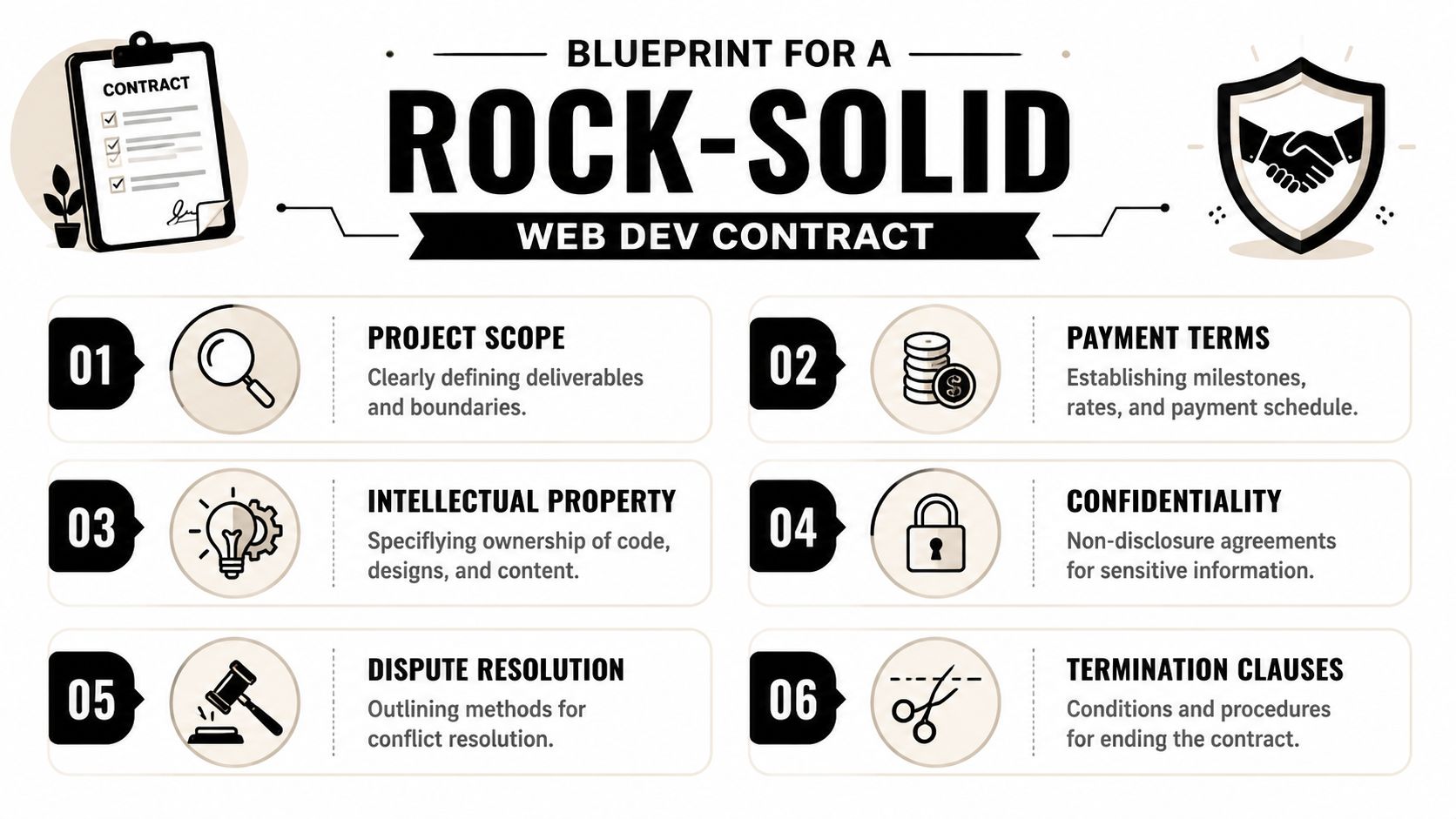
What your scope section should include
- Deliverables by name: List every output. Homepage design, dashboard UI, admin panel, API integration, smart contract front end, QA pass, deployment support.
- Acceptance criteria: Replace “client satisfaction” with observable conditions. Forms submit, wallet connection works, pages render on agreed breakpoints, analytics fires, content is populated where assigned.
- Explicit exclusions: Say what is not included. Copywriting, custom illustrations, SEO strategy, hosting costs, third-party subscriptions, audit fees, legal review.
- Client dependencies: If they must provide copy, API keys, branding, legal text, or wallet access, write it down.
- Approval mechanics: State who approves work, how approvals happen, and what happens if feedback is delayed.
If you want a useful reference for turning vague projects into proper work packages, Umbrella Company SOW resources do a good job of showing what a real statement of work should accomplish.
Milestones prevent chaos
Don't let “project timeline” sit as one line near the bottom of the agreement. Break the work into milestones with clear review points.
A simple structure works:
Discovery and specification
Finalize sitemap, user flows, technical assumptions, dependencies.Design or prototype approval
Wireframes, mockups, component direction, style references.Build phase
Front-end implementation, CMS setup, API work, wallet flow, contract integration.QA and revision window
Bug fixes tied to agreed scope, not new feature requests.Launch and handoff
Deployment, repo access, documentation, credentials transfer.
This protects both sides. The client gets visibility. You get checkpoints. If they stall approvals, the timeline moves accordingly.
Practical rule: Never start coding until the contract defines what the client is actually buying.
Revisions need limits
Unlimited revisions don't make you look flexible. They make you look inexperienced.
If a project includes design work, define the number of revision rounds. If it includes functional revisions, separate bug fixes from change requests. A broken button is your responsibility. A new checkout flow is not.
Use language a client can understand:
- Included revisions: Changes within approved scope during the review window
- Out-of-scope revisions: New features, changed requirements, redesign requests after approval
- How extras are billed: Change order, hourly add-on, or new milestone
Response times and communication rules matter
A lot of project pain comes from silence, not code.
Write down expected response windows, communication channels, and who the point of contact is. If the client has five stakeholders, demand one approver. If they want Slack access, state whether that counts as project communication or informal discussion only.
Attachments do real work
The appendix is where professional contracts get stronger.
Include:
- Wireframes or page lists
- Mockups or design references
- Style guide or component rules
- Technical notes
- Accessibility expectations
- Hosting and deployment assumptions
If accessibility matters, define it directly in the acceptance criteria. If performance matters, define what you'll optimize and what you won't guarantee. If agile delivery is part of the engagement, define what “done” means for each sprint.
That level of clarity isn't overkill. It's what gets projects finished without resentment on either side.
Pricing Models and Financial Terms That Build Your Business
Your pricing model isn't just billing mechanics. It shapes your workload, your risk, and the kind of clients you attract.
A lot of developers pick a model out of habit. That's lazy. You should pick it based on scope clarity, client maturity, and what you want your career to look like six months from now.
According to GoodFirms website cost survey data, 50% of web development companies price projects between USD 1,000 and USD 15,000, while the U.S. Bureau of Labor Statistics reports a USD 90,930 median annual wage for web developers in May 2024. If you ignore labor economics and price structure, you end up subsidizing your client's uncertainty with your own time.
Choose the model that matches the work
| Model | Best For | Freelancer Pro | Client Pro |
|---|---|---|---|
| Fixed-Price | Clearly defined builds with stable requirements | Better margin if you scope tightly | Predictable budget |
| Time and Materials | Agile projects, evolving product work, unclear scope | You get paid for actual effort | Flexibility to adapt priorities |
| Retainer | Ongoing support, growth work, maintenance, embedded collaboration | More stable income and stronger client relationships | Reserved capacity and faster turnaround |
Fixed-price works only when scope is hard-edged
Fixed-price can be great. It rewards efficiency and makes sales easier.
It also punishes sloppy scoping.
Use fixed-price when the page count, integrations, acceptance criteria, and approval path are clear. Don't use it when a founder says, “We'll figure out details as we go.” That's not a fixed-price project. That's a time-and-materials project pretending to be one.
Time and materials is often the honest option
A lot of clients resist hourly or day-rate work because they think it creates uncertainty. In reality, unclear projects are already uncertain.
Time and materials is the cleanest model for product work, experimental UX, API-heavy projects, and Web3 builds where requirements move with protocol changes, security feedback, or stakeholder input. It also makes hiring managers more comfortable when they need execution without pretending they already know every detail.
If the scope is moving, the price should move too.
Retainers build a healthier business
Retainers don't just smooth income. They improve the relationship.
A retainer positions you as ongoing infrastructure, not a disposable pair of hands. That's where better referrals, deeper product context, and career progression usually happen. The client stops hiring you for tickets and starts trusting you with decisions.
Retainers work especially well for:
- Maintenance and support: bug fixes, dependency updates, uptime monitoring, content changes
- Growth work: landing pages, A/B implementation, analytics cleanup, conversion-focused changes
- Embedded product help: ongoing front-end delivery, design system work, feature rollout support
Financial terms you should stop apologizing for
These aren't aggressive. They're standard.
- Deposit or upfront milestone: You're reserving time. That has value.
- Invoice schedule: Tie payment to milestones or calendar dates, not vague completion language.
- Late fees: If you use late-payment terms, make them explicit in the contract.
- Pause rights: If invoices go unpaid, you should be able to stop work.
- Kill fee or termination payment: If the client cancels, you should still get paid for work performed and reserved capacity.
The cleanest money conversations happen before the work starts. After that, every missing clause becomes an argument.
Defining Ownership Liability and Termination
Contracts determine whether careers are protected or subtly harmed.
Most developers obsess over scope and pricing, then sign away code rights, accept ugly liability language, and ignore termination mechanics. That's backwards. If you plan to stay in this field, the clauses around ownership and risk matter just as much as the money.

Separate deliverables from background technology
The most important ownership distinction in web development contracts is simple. The client can own the final project deliverables without owning every tool, component, script, pattern, and reusable block you brought into the job.
That distinction matters more now because modern projects often mix custom code with frameworks, boilerplate, open-source dependencies, reusable UI systems, and AI-assisted drafting. MyIntervals' discussion of contract red flags highlights why developers should separate client-owned deliverables from developer-owned background technology, then grant a perpetual, nonexclusive license to what the delivered project needs.
That's the right approach. It protects the client's ability to use the product while protecting your ability to reuse your own assets.
Don't give away your engine
If you build with a starter stack, internal component library, deployment scripts, wallet connection module, or custom CMS helpers, those are business assets. Don't hand them over by accident under broad “work for hire” language.
Use a cleaner split:
- Client-owned items: final approved designs, project-specific code, content prepared for the client, custom configurations
- Developer-owned items: pre-existing code, templates, frameworks, utilities, libraries, generalized know-how
- License grant: the client gets a broad license to use the embedded background technology as part of the final deliverable
That keeps the project maintainable without gutting your future earning power.
Your reusable codebase is not leftover clutter. It's part of your leverage.
Liability needs a ceiling
Never accept unlimited liability unless you enjoy insuring risks you can't control.
A reasonable contract limits your exposure and narrows your warranties. You can promise that you have the right to enter the agreement, that your work won't knowingly infringe third-party rights to the best of your knowledge, and that you'll fix defects discovered within the agreed support window. That's fine.
You should not accept responsibility for every downstream business loss, security event, lost revenue claim, or third-party misuse. If you want a non-legal-business perspective on how to think through exposure, this guide to risk management for SMEs is a practical reminder that unmanaged risk compounds fast.
A basic rule set works well:
- Limit warranties: define what you stand behind
- Cap liability: keep exposure tied to the contract value or fees paid
- Exclude indirect losses: no responsibility for speculative business damages
- Clarify third-party risk: you don't control hosting vendors, plugins, wallets, or client-side misuse
For broader platform rules around terminology and expectations in crypto work, it's also smart to read Blockchain Jobs terms before you enter platform-mediated engagements.
A short explainer helps if you need to visualize how ownership and risk language often gets framed in practice.
Termination should be boring and clean
If termination feels dramatic, the clause is badly written.
Your contract should say who can terminate, for what reasons, with what notice, and what happens next. Keep it operational:
- Immediate termination for breach: nonpayment, illegal use, repeated failure to cooperate
- Convenience termination: either party can exit with written notice
- Payment on exit: client pays for completed work and committed time
- Handover rules: deliver completed materials after payment clears
- Access changes: revoke staging or admin access when the engagement ends
A clean exit clause protects reputations. You want a path out that doesn't turn a failing project into a month-long fight.
The Web3 Frontier Navigating Crypto and Smart Contracts
Web3 projects don't remove the need for contracts. They increase it.
A lot of blockchain-native teams talk like code is the contract and the chain is the enforcement layer. That's fine until someone disputes scope, token compensation, audit responsibility, governance authority, or who owns off-chain assets. Smart contracts can automate transfers. They don't magically define the business relationship around the work.
Payment terms need reality, not ideology
If you're getting paid in crypto, define exactly how value is measured.
Spell out the payment currency, wallet requirements, timing, and what happens if the parties agree to price work in one unit but pay in another. Stablecoins often reduce friction because they simplify milestone accounting. If a client wants to pay partly in tokens, treat that as a separate compensation component with its own terms, not a hand-wave and a Telegram promise.
The same goes for delays. If on-chain transfer timing, multisig approvals, or DAO votes affect payment release, put that process in the agreement.
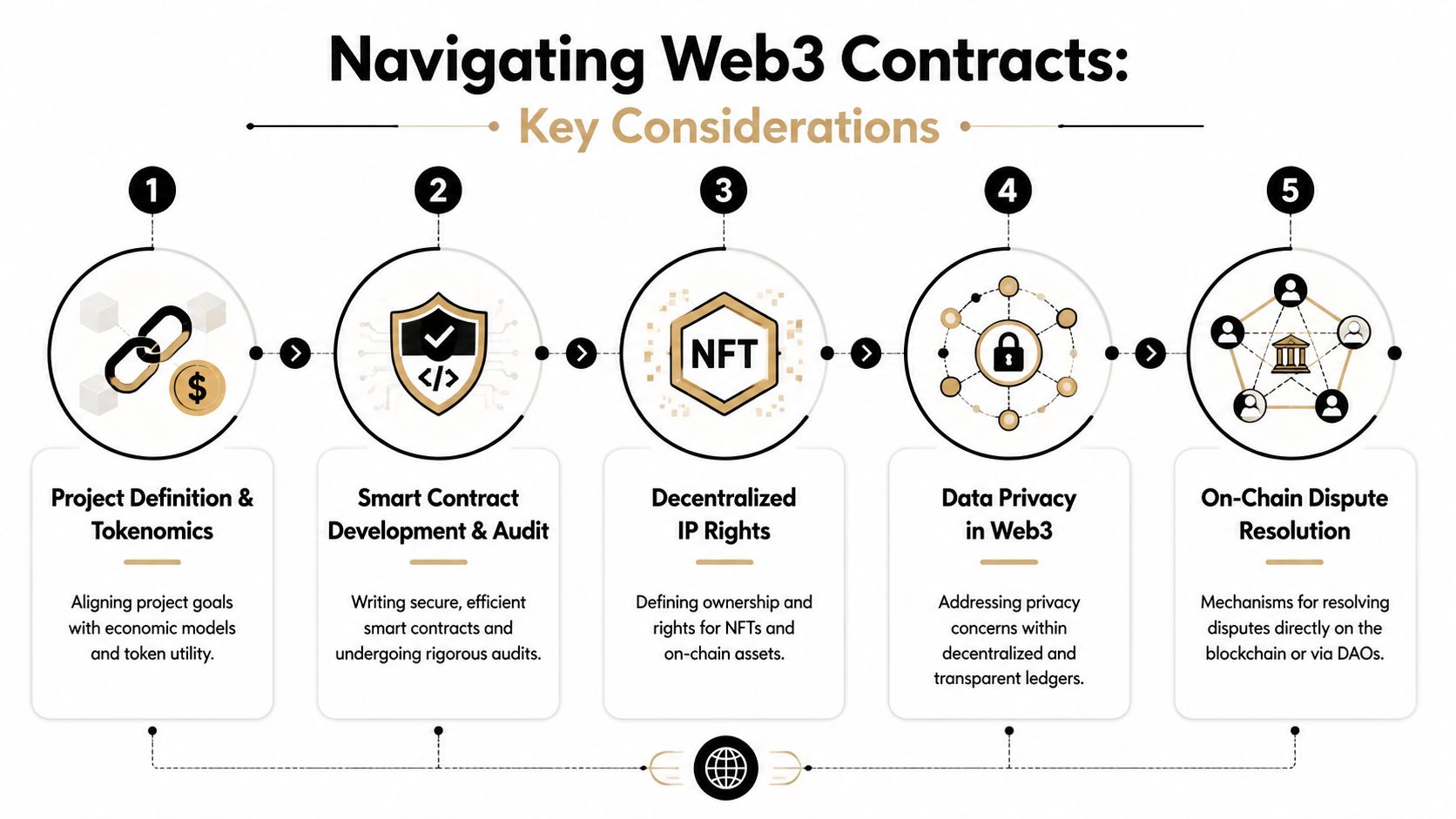
Smart contract scope must define more than code delivery
A vague Web3 scope is worse than a vague marketing-site scope because failure can be irreversible.
When the work includes Solidity, Rust, Cairo, wallet flows, bridge integrations, indexers, or token launch infrastructure, define the deliverable stack clearly:
- On-chain deliverables: contract modules, deployment scripts, tests, upgrade patterns
- Off-chain deliverables: front end, admin tooling, indexing, monitoring, docs
- Security obligations: whether audits are required, who pays, and whether remediation support is included
- Deployment authority: who controls deployer wallets, multisig signers, and production access
- Definition of done: passing tests, documentation delivered, specified features deployed, agreed remediation complete
If you're trying to break into security-heavy blockchain work, reviewing a role like this smart contract auditor opening at Nethermind is useful because it shows how mature teams think about accountability and rigor.
In Web3, “ship fast” is not a substitute for writing down who approves, who audits, and who carries the risk.
Token compensation needs written rules
Token upside sounds exciting until nobody wrote down vesting, cliffs, transfer restrictions, or what happens if the relationship ends early.
If any part of your compensation is token-based, define:
- Grant mechanics: what you're receiving and under what event it's granted
- Vesting schedule: when rights accrue
- Cliff conditions: if any minimum service period applies
- Termination effect: what you keep, what you forfeit, and when
- Liquidity constraints: lockups, transfer restrictions, or governance limits
Don't let anyone frame this as distrust. It's the opposite. Clear token terms stop future resentment.
DAO work needs an authority map
DAOs create a special kind of confusion. Everyone talks about decentralization, but contracts still need a real counterparty and a real approval path.
If you're working with a DAO, identify:
- Who can sign
- Who can approve milestones
- Which wallet or entity pays
- How governance decisions affect scope changes
- What forum or vote counts as binding instruction
Without that, you'll spend half the project trying to figure out whether a Discord mod, a multisig signer, or a governance proposal has authority to direct the work.
For blockchain-native developers, this is the edge. Traditional contract discipline is still the foundation. You just apply it to token economics, audits, governance, and irreversible deployment risk.
Negotiation Tactics and Red Flag Spotting
A lot of developers treat negotiation like a test of likability. That's the wrong frame.
Negotiation is where both sides decide whether the project deserves to exist. If the client can't handle clear terms before kickoff, they won't become easier once deadlines slip, stakeholders pile on, or invoices hit their inbox.
Send your paper first
Whenever possible, use your own contract or master service agreement.
The party that drafts first controls the default assumptions. If you wait for the client's template, you spend your time defending yourself clause by clause. If you send yours first, the conversation starts from your operating model.
That alone improves outcomes.
Push back like a professional
You don't need to sound combative. You need to sound experienced.
Try responses like these:
- On unlimited revisions: “I include a defined review window and revision rounds so we can keep momentum and avoid open-ended drift.”
- On vague scope: “I'm happy to price this once the deliverables and approval path are specific.”
- On broad IP transfer: “The client should own the project deliverables. I retain pre-existing tools and reusable components, with a license for project use.”
- On payment delay language: “I tie invoices to milestones so both sides have clear checkpoints.”
That's not friction. That's project management.
Red flag checklist
Walk away faster when you see these:
- They resist written scope: They want flexibility for themselves and accountability for you.
- They want everything included: That usually means they haven't prioritized the work.
- They refuse milestone approvals: They want to judge the whole project at the end, when your bargaining power is minimal.
- They demand full ownership of all code, tools, and processes: They don't understand how development businesses work, or they do and they're trying to extract extra value.
- They won't discuss termination: They expect commitment from you but won't commit to a fair exit.
- They delay legal or procurement answers before kickoff: You'll feel that same delay when invoices are due.
Bad clients don't hate contracts. They hate limits.
Use change orders without guilt
If the request is outside scope, issue a change order. Every time.
Don't absorb “small” extras just to seem helpful. Repeated unpaid extras train the client to see your boundaries as optional. A good change-order habit protects margin, preserves trust, and makes you easier to rehire because the client always knows where they stand.
The strongest web development contracts don't make relationships colder. They make them clearer. That clarity is a hiring advantage, a pricing advantage, and a long-term career advantage.
If you want contract roles, freelance gigs, or full-time opportunities with teams that respect delivery discipline, browse Blockchain Jobs. It's one of the better places to find Web3 companies hiring across engineering, security, product, design, marketing, legal, and operations, especially if you want work that values both technical depth and professional rigor.