
How to Find Contract Work in the Web3 and Blockchain Space

If you're looking to land contract work in Web3, you need to understand one crucial thing: it’s not just about who you know, it’s about what you’ve done. And more importantly, what you can prove on-chain. Approaching this like a traditional tech job hunt is a mistake; succeeding here requires a different strategy focused on verifiable skill and strategic career positioning.
Why Web3 Contract Work Is Booming
The demand for skilled talent in Web3 is exploding. We’re seeing a massive shift as developers, marketers, and designers realize their skills are highly valuable in this new corner of the internet. Unlike traditional tech where a polished resume is your primary tool, Web3 values verifiable contributions. This is a significant advantage for contractors who can demonstrate their abilities and impact directly.
The data confirms this trend. In January 2026 alone, over 460 full-time Web3 roles were posted on major job boards. When full-time hiring accelerates, it's a clear indicator that the contract market is also heating up. Projects need specialists for specific builds, short-term sprints, or to fill immediate skill gaps. To understand the hiring landscape, you can dig into these crypto job market trends and see how fast the industry is evolving.
For your career progression in Web3, you must shift from telling hiring managers what you can do to showing them what you've already accomplished. Your GitHub, your on-chain activity, and your DAO proposals become your career narrative and your most powerful interview tools.
This guide is your playbook for navigating the hiring process. We're going to cover the actionable steps for:
- Getting noticed by hiring managers at DeFi protocols, DAOs, and infrastructure projects.
- Identifying the channels where the best contract roles are posted.
- Building a portfolio that directly answers the questions interviewers will ask.
- Negotiating your contract to secure fair compensation and set yourself up for long-term career success.
Think of this as the career roadmap for securing high-value contract work. By focusing on the right platforms and building a reputation backed by tangible results, you can position yourself as the ideal candidate for the most exciting projects available. Let's begin.
Where the Best Web3 Contract Opportunities Are Hiding
To find the best contract gigs in Web3, you must look beyond mainstream job sites. The most valuable opportunities are found within specific ecosystems, and knowing where to search is your greatest competitive advantage in the job market.
Think of your job search strategically: using traditional job boards is like casting a wide, inefficient net. Tapping into niche Web3 platforms is like targeted fishing; you know exactly what roles you're qualified for and can connect directly with hiring managers looking for your specific skills. This makes your search far more effective.
Specialized Job Boards and Bounty Platforms
The most direct path to finding contract work is through platforms built for the industry. Unlike generic sites, Web3-specific job boards allow you to filter for precise roles like "Smart Contract Auditing" or "DeFi Protocol Marketing," connecting you directly with relevant opportunities. A great starting point for any job seeker is exploring a platform like Blockchain Jobs, which curates roles from companies actively seeking specialized contract talent.
Beyond job boards, bounty platforms are a strategic tool for career progression. Completing small, paid tasks on platforms like Gitcoin offers several key benefits for your job search:
- Build Your Interview Talking Points: Every completed bounty is a public, verifiable piece of work that adds a concrete project to your portfolio, giving you a powerful example to discuss during interviews.
- Create Warm Leads: A well-executed bounty often leads directly to larger contract offers from the same project, turning a small task into a significant career opportunity.
- Get Paid to Upskill: You earn money while learning new codebases and engaging with different protocols, enhancing your skills and making you a more attractive candidate.
This process—from networking to building an on-chain resume—is a virtuous cycle. Each step strengthens your position and brings you closer to securing high-quality contract work.
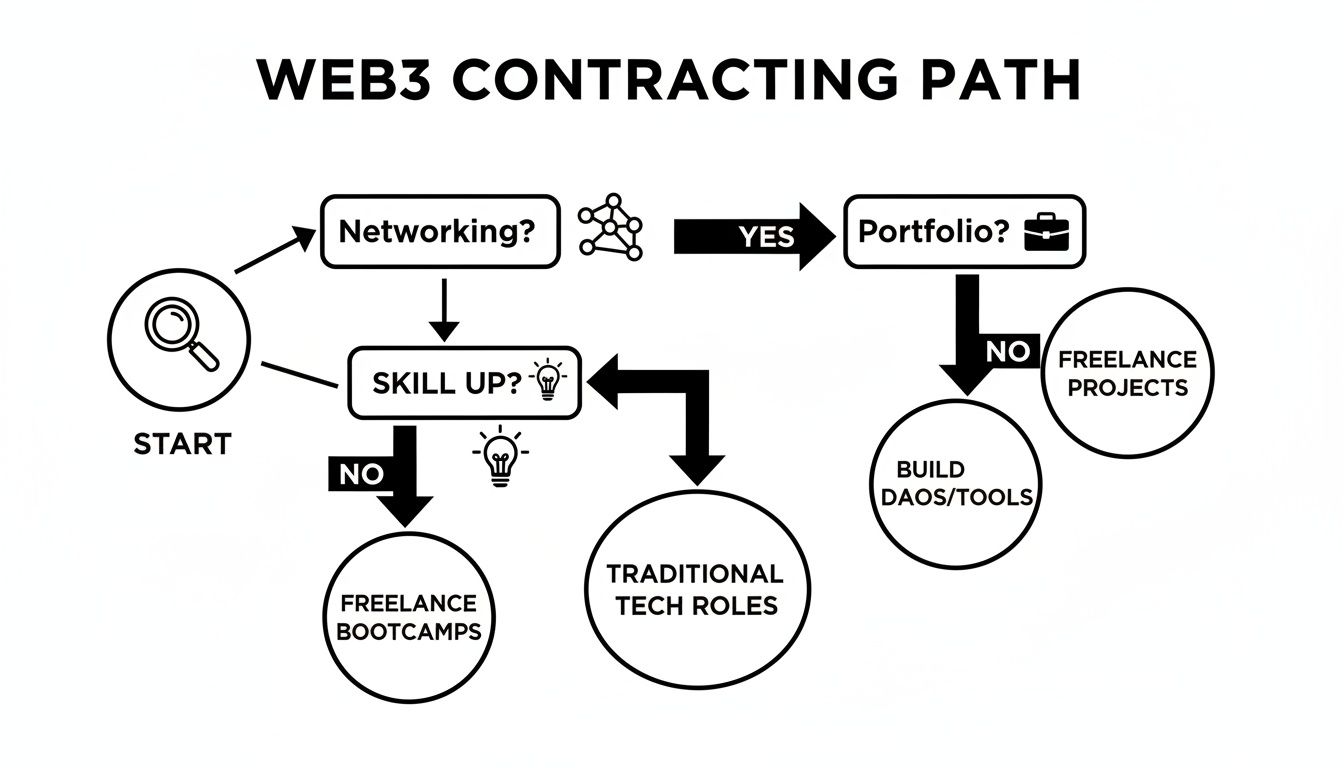
The key takeaway for your career is that every action—networking, contributing to a DAO, or completing a bounty—should be a deliberate step toward strengthening your professional profile and on-chain resume.
Dive into DAOs and Ecosystem Hubs
Decentralized Autonomous Organizations (DAOs) are more than just online communities; they are active organizations constantly seeking talent. Engaging with a DAO is one of the most effective ways to organically find contract work and advance your career.
The path is straightforward: join a DAO's Discord, participate in governance discussions, and provide thoughtful contributions. Many DAOs have dedicated channels for contributors or grant programs for new initiatives. For example, a marketing professional could propose a small, paid project to improve a DAO's onboarding documentation. Nailing this initial project puts you on the radar for larger, more strategic marketing contracts, effectively turning a contribution into an interview.
In Web3, your reputation is your most valuable career asset. Unlike a traditional job interview where you talk about your skills, in a DAO, you demonstrate them publicly. Every contribution builds the professional credibility that leads to paid opportunities.
Networking on X, Discord, and Telegram
The most valuable contracts often originate from professional connections. The heart of the Web3 professional world is on platforms like X (formerly Twitter), Discord, and Telegram. Effective networking isn't about spamming your portfolio; it's about strategic engagement.
Join the right conversations. Follow core developers, project founders, and VCs in your niche. Engage with their content thoughtfully. Join private developer groups on Telegram or protocol-specific channels on Discord. When you consistently add value and showcase your expertise, you begin to attract inbound interest from hiring managers.
Founders and team leads are always active in these circles, scouting for talent. An insightful, well-timed comment can be more effective than a hundred cold applications, creating a pipeline of opportunities that come directly to you.
A Comparison of Top Web3 Contract Channels
To land the right gig, you need a multi-channel job search strategy. Each platform offers different types of opportunities and requires a different approach. This table breaks down the most common places to find Web3 contract work.
| Channel | Best For | Typical Gig Type | Effort Level |
|---|---|---|---|
| Specialized Job Boards | Direct applications for well-defined roles | Smart contract development, community management, marketing campaigns | Low |
| Bounty Platforms | Building a public portfolio and gaining initial experience | Bug fixes, feature development, documentation, content creation | Medium |
| DAO Contributions | Establishing a long-term reputation and securing strategic roles | Governance proposals, project grants, core contributor roles | High |
| Direct Networking | Accessing high-value, unlisted opportunities via referrals | Advisory roles, protocol architecture, strategic consulting | High |
Ultimately, a diversified approach is most effective. Use job boards for immediate opportunities, complete bounties to build your portfolio, and immerse yourself in DAOs and social platforms to cultivate the long-term relationships that lead to the best career-defining contracts.
Building a Portfolio That Actually Gets You Hired

Let’s be direct: in Web3, your GitHub is your resume. A traditional PDF listing past job titles lacks the impact of tangible, on-chain proof of your abilities. Hiring managers and project founders want to see your work before they schedule an interview.
If you are serious about figuring out how to find contract work, your portfolio must speak the language of results. It isn't about listing responsibilities; it's about showcasing verifiable outcomes. A project lead doesn’t just want to hear that you're a capable developer—they want to see your pull requests on a reputable protocol or interact with a dApp you shipped.
Your portfolio's primary function is to proactively answer a hiring manager's biggest question: "Can this person solve my specific problem?" Every project you feature should provide a clear and compelling "yes."
Tailor Your Showcase to Your Role
A generic portfolio will be overlooked. To capture a hiring manager's attention, you must present work that is directly relevant to the contracts you are pursuing. Your goal is to make it effortless for them to see the connection between your past successes and their current needs.
Here's how to tailor your portfolio for maximum impact:
- For Developers: Your portfolio must be an on-chain C.V. Feature links to audited smart contracts, highlight your GitHub contributions (especially to well-known protocols), and provide access to live dApps. This is essential to pass technical screening.
- For Designers: Move beyond static mockups. Create detailed UX/UI case studies for relevant products like DeFi dashboards, NFT marketplaces, or crypto wallets. Clearly explain your design process and how your decisions led to improved user outcomes.
- For Marketers: Focus on quantifiable results. Present data-driven case studies from token launches or community-building campaigns. Showcase key metrics—the percentage increase in Discord engagement, the growth in wallet connections, or the ROI on an influencer campaign.
Curating your portfolio this way demonstrates more than just technical skill; it proves you understand the ecosystem and the specific challenges that Web3 projects face, making you a much stronger candidate.
Frame Your Work with a Personal Website
While your on-chain activity provides the proof, a professional website tells the story. It’s the strategic narrative that contextualizes your technical work. This is your opportunity to frame your projects and explain the "why" behind your code, designs, or marketing campaigns.
Your personal site connects your skills to business outcomes. For each project, don't just provide a link. Briefly explain the problem you were hired to solve, the specific actions you took, and the measurable results you achieved. This narrative is crucial—it bridges the gap between your technical ability and the tangible value you deliver, giving you powerful talking points for any job interview.
When you present your experience this way, you position yourself not just as a contractor, but as a problem-solver. That’s what opens doors to opportunities with top-tier Web3 companies looking for high-impact contributors.
How to Pitch, Price, and Negotiate Your Web3 Contracts
Landing an interview confirms they're interested in your skills. Now, you must demonstrate your professionalism. How you handle the initial pitch, your pricing strategy, and the negotiation process often determines the quality of the contract and your long-term career trajectory. This is where you transition from a service provider to a strategic partner.
Your initial proposal must be compelling. Don't just list your skills; show that you understand their specific problem and are the solution. A hiring manager at a DeFi protocol isn't just looking for a "Solidity developer"; they need someone who can reduce gas fees on their new lending contract or protect their protocol from flash loan attacks.
A powerful pitch is direct and results-oriented. For example: "I saw you're looking to enhance your protocol's security. In my last contract, I implemented a time-weighted average price oracle for a similar DEX, which reduced price manipulation risk by over 90%. I'm confident I can bring that same expertise to your team." This immediately connects your past success to their present need, making you a standout candidate.
Setting Your Rates with Confidence
Determining your rate is a critical step. The two most common models are hourly and per-project.
- Hourly Rates: Ideal for projects with an undefined scope or for ongoing support roles. This model ensures you are compensated for all your time, but some clients may be wary of unpredictable costs.
- Per-Project Rates: Best for work with clear deliverables, such as auditing a single smart contract or designing a dApp's UI. This provides cost certainty for the client and rewards you for efficiency.
To determine your rate, research market data. A Solidity developer specializing in security audits will command a higher rate than a generalist. Similarly, expertise in a high-demand niche like Rust for Solana justifies a premium rate. Know your market value before entering a negotiation.
Pro Tip for salary negotiation: Whenever possible, avoid being the first to state a number. When asked for your rate, politely turn the question around: "What budget have you allocated for this role?" This provides a baseline and instantly improves your negotiating position.
Mastering the Art of Negotiation
Negotiation is about more than just money. It’s about establishing clear expectations for the entire engagement, including scope, deliverables, timelines, and payment terms. Be prepared to discuss real-world scenarios.
For instance, what if a client requests a major new feature mid-project? Don't just agree. A professional response would be: "That's an excellent idea. Since this falls outside the original scope, let's create a small addendum to the contract to account for the additional 15 hours of work. I can begin as soon as we've aligned on the new terms." This protects you from scope creep while positioning you as a flexible and proactive partner.
For more insights on professional growth, the Blockchain Jobs blog is an excellent resource.
When discussing payment, especially in crypto, clarity is essential. Document everything in writing: the specific currency (USDC, DAI, ETH), the payment schedule (a common structure is 50% upfront and 50% on completion), and the exact wallet address. Finalizing these details at the outset prevents future complications and builds a professional relationship that encourages repeat business.
Finalizing Your Contract and Getting Paid Securely
Receiving a verbal "yes" is a milestone, but the work isn't done. In contracting, nothing is official until it's documented. This stage is crucial for finalizing the legal and financial details that protect both you and the client, setting the foundation for a successful professional engagement.
A well-drafted contract is your primary defense against misunderstandings, scope creep, and payment issues. It is the definitive document that clarifies expectations for both parties. Every contract must outline the terms of work with absolute clarity to prevent future disputes.
Think of your contract as the smart contract governing your working relationship. It should be unambiguous, auditable, and comprehensive, defining the rules that ensure the project proceeds smoothly.
Must-Have Clauses in Your Contract
Before signing, ensure the agreement includes these critical, non-negotiable clauses. Omitting any of them can expose you to significant professional and financial risk.
Always look for:
- A Detailed Scope of Work: What are the exact deliverables? Vague descriptions like "community management" are a red flag. The scope must specify tasks, outputs, and explicitly state what is out of scope.
- Clear Payment Milestones: How and when will you be paid? A standard structure is 50% upfront, 25% at a key midpoint, and the final 25% upon completion. For hourly work, the contract must define the invoicing frequency.
- Intellectual Property (IP) Rights: Who owns the work you create? This must be explicitly stated. Typically, the client owns the final work product upon full payment, but the contract must formalize this.
- Termination Conditions: This clause outlines the process for ending the contract prematurely. It should cover notice periods and the payment process for work completed. Priorities can change quickly; in fiscal year 2024, federal agencies terminated nearly 40,000 contracts for convenience, illustrating the importance of having a clear exit plan.
Getting Paid Securely in Crypto
Receiving payment in crypto is common in Web3, but it requires careful handling. First, use a hardware wallet. Never leave significant earnings on an exchange; transfer them to your secure wallet immediately.
When invoicing, use a crypto-native tool to generate a professional invoice that includes your wallet address. Always double-check the address before sending and confirm the payment currency with the client (USDC, USDT, ETH, SOL). The growth of the blockchain-based remittance market, projected to reach $156 billion by 2026, is leading to better payment tools for contractors. You can explore more blockchain statistics and facts to understand the scale of this trend.
Finally, manage your taxes diligently. Every crypto payment is taxable income. You must maintain detailed records of each transaction, including the fair market value of the crypto on the date of receipt. Proper financial management is what transforms contracting from a gig into a sustainable business.
From a Single Gig to a Sustainable Contracting Career
Landing your first contract is a major achievement, but the long-term goal is to build a sustainable career with a consistent flow of high-quality projects. This requires shifting your mindset from that of a job seeker to a business owner, focusing on building long-term partnerships rather than just securing the next gig.
The most effective way to generate future work is to excel in your current contract. Exceed expectations. Deliver work ahead of schedule. Provide proactive weekly updates without being asked. Constantly look for opportunities to add value beyond the scope of work. This transforms you from a temporary contractor into an indispensable team member.
Turning One Project into Many
Excellent performance is often enough to secure repeat business, but you can also be strategic about extending your engagement. During project meetings, listen for discussions about future plans. When a topic aligns with your skillset, proactively position yourself for the opportunity.
For example, you might say: "I noticed the Q3 roadmap includes a token-gated community feature. I built a similar system for a DeFi protocol last year and could draft a brief proposal on how we could approach that." This initiative demonstrates foresight and makes it easy for the client to extend your contract.
Your best marketing tool is exceptional work. A satisfied client is far more likely to re-hire you or refer you to their network than any cold outreach could ever achieve.
Building Your Pipeline Through Referrals
After successfully completing a project, the work continues. This is the ideal time to request a testimonial for your portfolio or a review on a platform like Upwork or LinkedIn. A strong collection of positive feedback serves as powerful social proof, helping you close future deals more quickly.
Don't hesitate to politely ask for referrals. A simple, direct message can be highly effective.
Try this approach: "I truly enjoyed collaborating on the new smart contract audit. If you know of anyone else in your network who might need similar support, I would greatly appreciate an introduction."
This simple step is how you leverage one successful engagement to build a robust pipeline, turning a single client into a powerful engine for growing your contracting career.
Common Questions About Web3 Contract Work
If you're transitioning into Web3 contracting, you likely have questions. Here are answers to some of the most common queries from professionals looking to enter or advance in this space.
Do I Really Need a Computer Science Degree?
For most roles, no. While a deep technical background is non-negotiable for core protocol development positions, the Web3 ecosystem urgently needs talent in marketing, community management, design, and operations.
Hiring managers consistently prioritize candidates with a strong portfolio and a proven track record of shipping projects over those with a prestigious degree but little practical experience. Your GitHub, case studies, and on-chain resume are far more persuasive than a diploma in an interview.
Should I Get Paid in Crypto or Fiat?
This is a personal financial decision with no single correct answer. It depends on your financial situation and risk tolerance.
Receiving payment in ETH or another token can be an excellent way to increase your holdings and align yourself with the ecosystem, but you must be prepared for volatility. Fiat, on the other hand, offers stability and predictability.
Pro Tip: Many experienced contractors mitigate risk by requesting a split payment—for example, 50% in a stablecoin like USDC and 50% in fiat. This provides stability for living expenses while allowing you to maintain exposure to the market.
How Do I Spot the Scams and Find Legit Gigs?
The decentralized nature of the space requires vigilance. To protect your career, stick to reputable channels. Use dedicated Web3 job boards, platforms for DAO contributions, and established freelance marketplaces with crypto categories.
Be highly skeptical of unsolicited DMs on Discord or Telegram offering jobs that seem too good to be true. Before applying for any role, conduct due diligence. Research the project, examine their social media presence, verify on-chain activity, and check if the team is public. A major red flag is any request to pay for an interview or "training materials." Legitimacy is key to long-term career progression.
Ready to find a role that’s actually legit? Blockchain Jobs is a dedicated job board built for people who want to build the future of the internet. Start your search for top Web3 contract work today.