Top Job Opportunities for C Programmers in 2026
Even with all the newer, shinier languages out there, job opportunities for C programmers are everywhere. You just have to know where to look. C isn't just another language; it's the foundation much of modern technology is built on. Mastering it means you're qualified to build and maintain the invisible infrastructure that powers everything from your car to the cloud, giving you a distinct advantage in your career.
Why C Programming Skills Remain In High Demand
I get this question all the time: "Is it still worth learning C to get a job?" The answer is an absolute yes. While you won't be building the next hot social media app with it, C's command over performance-critical systems is unmatched. It’s the go-to language when every single microsecond and byte of memory matters, and hiring managers know this.
Think of it this way. A general-purpose language like Python is like a versatile adjustable wrench—great for a wide range of everyday jobs. C, on the other hand, is the perfectly-sized, high-torque wrench you need for critical tasks where there's zero room for error. C programmers are the specialists brought in for the jobs that simply cannot fail, and they are compensated accordingly.
The Enduring Value of C in Modern Tech
This need for precision and performance creates a constant demand for skilled C developers. When hiring managers in certain industries see C on a resume, they see someone who understands how computers actually work, right down to the metal. This immediately signals a level of technical depth that sets you apart.
Your skills are indispensable in fields like:
- Embedded Systems: C is the lifeblood of microcontrollers with tight memory and power constraints. It's in everything from the anti-lock brakes in your car to the firmware on a smart home device. These are stable, long-term career paths.
- Operating Systems: The very core of Windows, macOS, and Linux is built with C. These roles require developers who can manage system resources at the lowest possible level, a skill that is always in demand.
- High-Performance Computing (HPC): Whether it's for scientific research, financial modeling, or weather prediction, C is used to build applications that chew through massive datasets at incredible speeds. Excelling here can lead to highly specialized and lucrative career progression.
These traditional paths are well-established, but they're not the only option. Your C expertise is also a perfect springboard into some of the most innovative areas of tech today, including Web3 and blockchain.
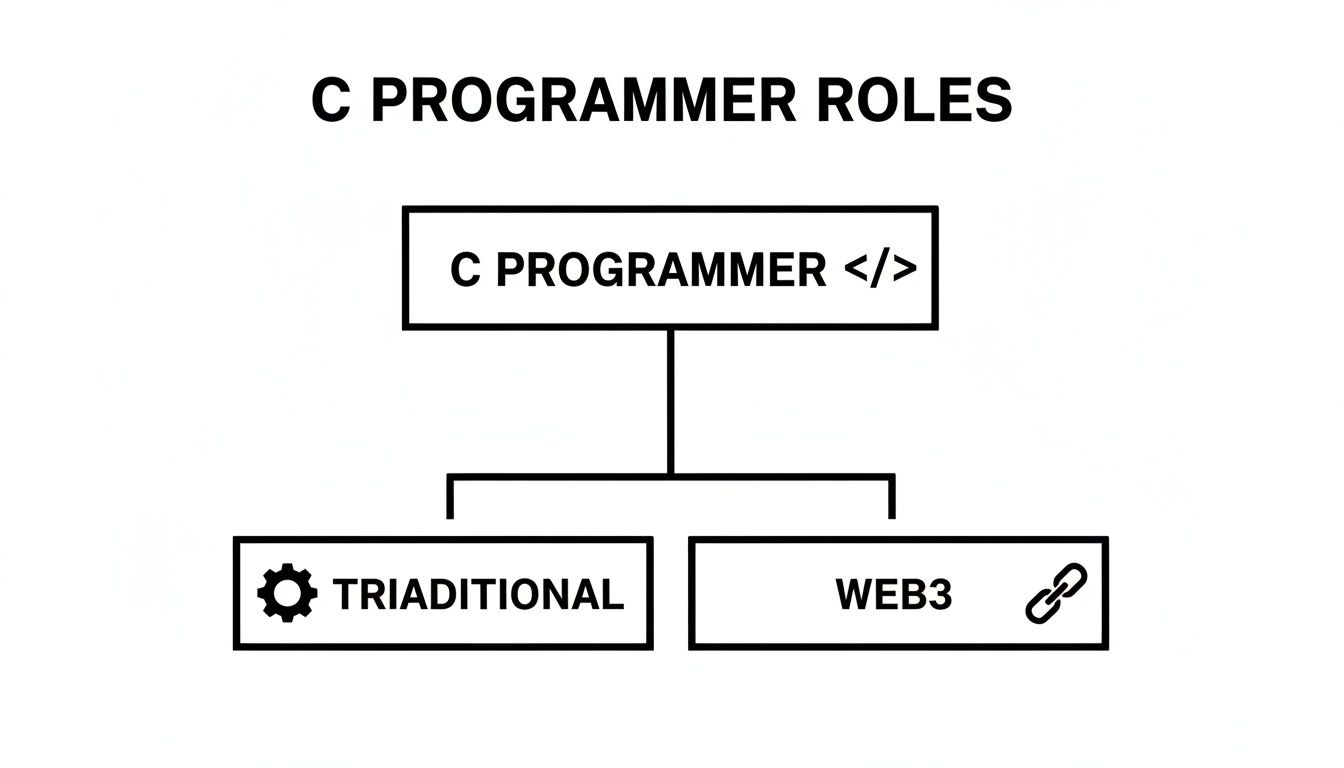
As you can see, your skills can take you down two very different, yet equally rewarding, paths. To make this clearer, let's compare these career tracks from a hiring perspective.
C Programmer Career Paths At A Glance Traditional vs Web3
| Aspect | Traditional C Programming Roles | Web3 & Blockchain C Programming Roles |
|---|---|---|
| Primary Focus | Hardware interaction, performance optimization, system-level control. | Decentralization, security, protocol development, smart contract logic. |
| Typical Projects | Operating systems, device drivers, firmware, embedded systems, game engines. | Core blockchain clients, decentralized applications (dApps), crypto wallets, layer-2 solutions. |
| Key Environments | Bare-metal, real-time operating systems (RTOS), Linux/Windows kernel. | Decentralized networks, consensus mechanisms (e.g., Proof-of-Work), peer-to-peer systems. |
| Core Challenge | Maximizing performance and efficiency with limited hardware resources. | Ensuring cryptographic security, immutability, and trustless operation. |
This table shows how the same fundamental C skills are applied to solve very different problems. In traditional roles, you're fighting for every clock cycle; in Web3, you're building the very architecture of a new, decentralized internet. Both require a level of precision that makes skilled C programmers highly valuable.
Career Outlook and Salary Potential
While you might see headlines about a decline in general "computer programmer" roles, that data doesn't tell the whole story for specialists. The U.S. Bureau of Labor Statistics projects that even with a slight decline, there will still be around 5,500 new job openings annually between 2026 and 2036.
The median salary is a solid $98,670 per year, but that's just a baseline. C specialists in high-demand niches like embedded systems security or blockchain development often command significantly higher salaries due to their rare and critical expertise.
Actionable Insight: The key to a long and successful career in C isn't just knowing the syntax. It's about strategically applying your skills in performance-critical niches. By focusing on these areas, you transform yourself from a general programmer into an indispensable asset that top companies actively compete to hire.
Digging into Foundational C Programming Jobs
You hear a lot about the hot new languages for web and mobile apps, but don't let that fool you. The world still runs on C. The job opportunities for C programmers are not just plentiful; they're the very foundation of our modern tech infrastructure. These are the roles responsible for the invisible, high-performance code that makes everything from your car to your cloud storage actually work.
If you're fascinated by what happens "under the hood," this is your world. Think of C programmers in these roles as the civil engineers of technology. They aren't designing the flashy user interface, but they’re building the rock-solid foundations, power grids, and data highways that the entire digital city depends on. It's a career built on efficiency, reliability, and having direct command over the hardware itself—qualities that are highly sought after by hiring managers.

The World of Embedded Systems Engineering
One of the biggest fields for C experts is embedded systems. An Embedded Systems Engineer writes the software that lives inside devices that aren't general-purpose computers. We're talking about everything from the tiny chip in your smart coffee maker to the intricate systems managing sensors in a drone. It's easily one of the most common and stable job opportunities for C programmers.
Your day-to-day work could involve squeezing a complex function into just a few kilobytes of memory or hunting down a bug where a millisecond of lag could cause a total system failure. This means getting a job requires more than just knowing C syntax.
Interview Insight: When you interview for an embedded role, get ready for a deep dive. They'll press you on memory management, pointer arithmetic, and bit manipulation. A hiring manager needs absolute confidence that you can work in tight spaces where every single byte and clock cycle is precious. Be prepared to whiteboard solutions.
Want your portfolio to catch their eye? Build something that touches real hardware. Even a simple project with an Arduino or Raspberry Pi that reads sensors and controls a motor shows you have the practical, hands-on skills they’re desperate to find. This is a direct, tangible way to prove your value.
Core Skills for Embedded Roles
For embedded positions, recruiters are looking for that perfect mix of C mastery and a genuine understanding of hardware. To get your resume to the top of the pile, highlight these skills:
- Microcontroller Experience: Show that you've worked with common architectures like ARM, AVR, or PIC. If you can name the specific chips you've programmed, even better. This shows direct, relevant experience.
- Real-Time Operating Systems (RTOS): Having experience with FreeRTOS or Zephyr is a huge advantage. It shows you get the complexities of task scheduling and handling interrupts in applications where timing is everything.
- Communication Protocols: You need to be fluent in the languages devices use to communicate. Demonstrate your knowledge of I2C, SPI, UART, and CAN bus.
- Debugging Tools: You can't fix what you can't see. Proficiency with oscilloscopes, logic analyzers, and in-circuit debuggers like JTAG is non-negotiable for any serious embedded developer. List these tools on your resume.
Take a look at current job descriptions to see what companies need right now. For example, this Software Engineer position for an Embedded role gives you a clear picture of the specific tech stack you’d be working with and can help you tailor your resume.
Systems and Firmware Programming
Systems and firmware programming are close cousins to embedded work. The titles are sometimes used interchangeably, but understanding the distinctions can help you focus your career and job search.
Systems Programmers tend to operate one level up from the bare metal, usually inside the operating system itself. Their work might involve writing device drivers, tinkering with the OS kernel, or creating powerful system utilities. A systems programmer at a major cloud company, for instance, might be tasked with optimizing the hypervisor to squeeze more performance out of their servers.
Firmware Developers, on the other hand, work at the absolute lowest level. They write the code that first breathes life into a piece of hardware—the stuff that runs before the operating system even loads. The BIOS/UEFI on your computer is a classic example of firmware. Here, your C code is directly manipulating hardware registers to get everything ready for the main OS.
For either path, a profound grasp of computer architecture is a must. Your interviews will almost certainly include questions on memory hierarchies, caching, and the system boot process. The key to landing these foundational roles is proving you can write low-level code that is secure, stable, and incredibly fast.
Breaking Into High-Performance C Programming Careers
Once you’ve mastered the fundamentals, your C skills open the door to some of the most challenging and rewarding careers in tech. We're talking about fields where performance isn't just a nice-to-have; it's the entire game. In these high-stakes roles, every microsecond counts, and direct control over hardware is an absolute must. That's why C and its powerful successor, C++, are the go-to languages.
If you love the challenge of pushing hardware to its absolute limits, a career in High-Performance Computing (HPC) could be a perfect fit. This isn't a single job title but a collection of elite specializations where speed is the ultimate metric of success, and the career progression is steep.
The Intense World of High-Frequency Trading
In High-Frequency Trading (HFT), financial firms live and die by the speed of their code. They use incredibly complex algorithms to execute millions of orders in the blink of an eye. A delay of just a few microseconds can be the difference between a multi-million dollar profit and a catastrophic loss. Only C and C++ provide the raw speed and low-level control needed to shave every possible nanosecond off latency.
As a Quantitative Developer (or "Quant"), you're not just coding—you're an architect of speed. To get hired for these roles, you need to prove you are a master of your craft.
- Complex Algorithms: You’ll need a deep, intuitive grasp of data structures and algorithms to design trading strategies that are faster than anyone else's.
- Network Programming: Forget high-level libraries. You’ll be working with low-level sockets, TCP/IP, and even kernel bypass technologies to make data fly.
- Hardware Proximity: A solid understanding of CPU architecture, cache lines, and memory layouts is critical. You'll write code that works with the hardware, not against it.
Be warned: interviews for these roles are notoriously difficult. You'll face intense algorithmic challenges on a whiteboard and get grilled on how you'd optimize a system for a very specific, time-sensitive task. It's a tough path, but the intellectual and financial rewards are huge.
Engineering Blockbuster Game Engines
Another thrilling frontier for C experts is Game Engine Development. The gorgeous, immersive worlds in today's biggest games are brought to life by massive engines like Unreal Engine and Unity. At their core, these powerful tools rely on C++ (and by extension, C's core principles) for raw performance.
Working in this field puts you right behind the curtain. You could be building the rendering pipeline that creates stunning visuals, tweaking the physics system to make every interaction feel real, or optimizing the engine's core architecture so the game runs smoothly on millions of different PCs and consoles. It’s a career that demands a unique mix of raw technical talent and creative problem-solving. A portfolio that shows off your passion for gaming and your ability to hunt down performance bottlenecks is a must for getting hired.
Interview Insight: A typical interview question for a game engine developer might sound like this: "How would you design a memory allocator for a game that needs to stream massive open-world assets without causing the player to experience stutter or lag?" Your answer needs to demonstrate a real-world understanding of C's memory management and the unique demands of real-time entertainment. Explaining the trade-offs of your approach is key.
Powering Scientific Discovery
Scientific Computing is where C and C++ are used to tackle some of humanity's biggest questions. These languages power the massive simulations that model black hole collisions, forecast climate change, and help discover new medicines. The sheer scale of these computations is mind-boggling, and C's ability to be finely tuned for performance makes it the perfect tool for the job.
While the general software market is growing at a healthy clip—projected to expand by 17 percent between 2023 and 2033, with full-stack developers earning around $117,880—these high-performance niches are in a league of their own. Specialists in scientific computing and parallel programming often command much higher salaries because the required skill set is so advanced. Don't be surprised to see job postings that require a Master's degree or even a PhD in a related scientific field.
A key tool here is CUDA, the parallel computing platform from NVIDIA. It lets developers tap into the massive processing power of GPUs for general-purpose computing, delivering incredible performance boosts. If that sounds exciting, a role like a CUDA Kernel Engineer could be a fantastic career move. These jobs are at the absolute cutting edge of high-performance programming, placing you at the forefront of scientific and technological progress.
Moving Your C Skills into Blockchain and Web3
While the traditional career path for a C programmer is stable and rewarding, some of the most fascinating new job opportunities for C programmers are popping up at the very edge of technology: blockchain and Web3. This isn't just about the latest crypto craze; it’s about building the core infrastructure for a decentralized new version of the internet.
If you're a C programmer, this career shift might feel more natural than you think. Your deep understanding of performance, security, and low-level memory management isn't just a "nice-to-have" in this world—it's absolutely essential.
Think of it like building the foundation for a skyscraper. You wouldn't use wood; you'd use reinforced steel and concrete designed to handle immense stress. C is that reinforced steel for a blockchain. Its raw speed and direct memory control make it the perfect tool for forging the secure, high-performance engines that power these networks. The companies building this future aren't looking for another web dev; they need engineers who get how machines really work.

Translating Your Experience for Web3
The key to making the jump is to reframe what you already know in the language of blockchain. You don't just have experience in "systems programming"; you have experience "building secure, high-throughput protocol architecture." A hiring manager at a Web3 company will instantly understand the value you bring.
Here’s a look at the key C-centric roles in Web3 and how your background gives you a direct advantage:
- Blockchain Core Engineer: These are the people who build the blockchain itself. They work on the client software, implement consensus algorithms, handle peer-to-peer networking, and process transactions. If you've done any network programming or multithreading in C, you're already halfway there.
- Protocol Developer: This is about designing and improving the fundamental rules of the network. It demands a solid grasp of computer science theory, cryptography, and distributed systems—all common strengths for veteran C developers.
- Virtual Machine (VM) Developer: Many blockchains run their own VMs to execute smart contracts (think the Ethereum Virtual Machine). Building and optimizing these VMs requires expert-level C or C++ knowledge to make them both fast and watertight from a security perspective.
Interview Insight: A core developer interview might hit you with a question like, "How would you design a memory-safe data structure for transaction data to prevent buffer overflows?" This isn't a trick question. It’s a direct test of your fundamental C security skills and your ability to apply them to a real-world blockchain problem. A strong answer here proves you're ready for the role.
Key Concepts to Master for the Transition
Your C expertise gives you a massive head start, but you'll still need to pick up some Web3-specific knowledge to be credible in an interview and effective on day one. Focus on the foundational concepts that everything else is built on to make your career transition smoother.
Get started by digging into these three areas:
- Cryptography Fundamentals: You don’t need a Ph.D. in cryptography, but you absolutely must understand public-key crypto, hash functions, and digital signatures. They are the bedrock of blockchain security, and you will be asked about them.
- Consensus Algorithms: You need to know how blockchains agree on what's true. Study the mechanics behind Proof-of-Work (PoW), the engine of Bitcoin, and Proof-of-Stake (PoS), which is used by Ethereum and most modern chains.
- Distributed Systems Concepts: Blockchains are, at their heart, massive distributed systems. It's a good idea to refresh your memory on P2P networking, fault tolerance, and the classic challenges of keeping everything in sync in a decentralized environment.
Looking at actual job listings is one of the best ways to see what employers are after. For example, a role like this Senior Software Engineer in C++/Rust at Ripple clearly shows the blend of traditional C++ expertise and specific blockchain knowledge they expect.
Building Your Web3 Portfolio
Reading is one thing, but doing is what gets you hired. To prove you have what it takes, you need to get your hands dirty with code. The single best way to do this is to contribute to open-source blockchain projects.
Many of the biggest protocols, including Bitcoin Core, are open source and actively welcome contributors. Find a project written in C or C++, and just start. Fix a small bug. Improve some documentation. Add a simple test.
These small contributions build a public track record on your GitHub profile that speaks volumes to recruiters. It shows you're not just interested—you're proactive and capable. This is how you bridge the gap from a traditional C background to a high-impact career in the blockchain space.
Building A Job-Winning C Programmer Portfolio
A sharp resume might get you in the door, but for a C programmer, your portfolio is what seals the deal. This is where you prove you can do more than just talk about concepts. It's your chance to show hiring managers you have the low-level problem-solving chops they’re desperately looking for—the ability to manage memory, wring out every drop of performance, and build solid systems from the ground up.
Think of it this way: you can either tell someone you're a great mechanic, or you can pop the hood on a flawlessly restored engine you built yourself. Which is more convincing? To really demonstrate your programming skills, you'll need to master how to create a digital portfolio that catches an employer's eye. This isn't just a gallery of your work; it's a carefully crafted argument for why you should be interviewed.
From Tasks To Impact-Driven Achievements
The single biggest mistake C programmers make on resumes is simply listing duties. A hiring manager doesn't just care what you did; they need to know why it mattered. This is especially true in fields built on C, where every byte of memory and every clock cycle can have a real impact on the bottom line.
You have to translate your experience from a list of tasks into a story of results. Here’s a quick before-and-after to show you what I mean.
Before (Task-Focused):
- "Wrote a data logging module for an embedded device."
After (Impact-Focused):
- "Engineered a high-performance data logging module in C for a resource-constrained embedded system, reducing memory usage by 30% by implementing a custom ring buffer and improving data write speeds by 15%."
See the difference? The second version screams value. It shows you understand memory management and performance optimization, and you have the numbers to prove it. This is the language that gets a hiring manager’s attention and leads to more interviews.
Portfolio Projects That Get You Hired
Your best projects are the ones that tackle the exact problems listed in the job opportunities for C programmers you're targeting. They need to shout, "I get the challenges you face every day." Focus on projects that showcase C's unique power.
Here’s a short list of projects that will make any technical recruiter or hiring manager sit up and take notice:
- A Simple Custom Kernel: Even a minimal one that handles basic task scheduling and interrupts shows you have a serious grasp of operating systems and hardware. It proves you aren't afraid to get your hands dirty at the lowest level.
- A Custom Memory Allocator: Try building your own versions of
malloc()andfree(). This project is a classic for a reason—it forces you to wrestle with memory fragmentation, performance trade-offs, and tricky pointer management. This is a fantastic interview talking point. - A Network Protocol Implementation: Code a simple TCP or HTTP server from scratch using low-level sockets. This is a fantastic way to prove you can manage network connections, handle concurrent requests, and build reliable communication systems.
- Contributions to Open-Source C Projects: Find a well-known project like the Linux kernel, Git, or a library like libcurl and make a contribution. Even fixing a small bug gives you a public, peer-reviewed code sample that speaks volumes about your skills and proactivity.
Actionable Insight: Your GitHub profile is your modern-day portfolio. Keep it clean, well-documented, and active. A hiring manager will almost certainly look at it, and seeing a history of thoughtful commits and interesting projects can be more persuasive than any resume.
In the end, your portfolio should tell a story about a programmer who is passionate about efficiency, security, and the core mechanics of how computers work. By focusing on your impact and building projects that solve real problems, you create a powerful narrative that makes you the obvious choice for the best C programming jobs out there.
How To Succeed In Your C Programming Job Interview
Walking into a C programming interview is a different ballgame. It’s not about the latest frameworks; it’s a deep dive into the very fundamentals of computing. The person across the table needs to know they can trust you with raw memory access and code where every nanosecond counts. So, brace yourself for a rigorous technical evaluation.
The process might kick off with a basic phone screen, but it ramps up quickly. The real test is the technical deep dive, where you’ll need to show not just what you know, but how you approach complex, low-level problems. To get a real edge, it’s worth brushing up on some general job interview preparation tips to complement your technical skills.
Mastering The Technical Deep Dive
The heart of any C interview is the technical grilling. You need a rock-solid command of the concepts that make C both incredibly powerful and notoriously tricky. How fluently you discuss these topics is a direct signal of your experience and fitness for the role.
Be ready to grab a marker or share your screen to code solutions for problems involving:
- Pointers and Memory Management: This is absolutely non-negotiable. Expect to be quizzed on pointer arithmetic, double pointers, function pointers, and how to hunt down memory leaks. A classic challenge is implementing
strcpy()while correctly handling potential buffer overflows. - Bit Manipulation: Can you efficiently set, clear, or flip a single bit within an integer? This is a core skill in embedded systems and firmware, where you’re talking directly to hardware registers.
- Data Structures in C: You’ll almost certainly be asked to build a fundamental data structure from scratch—think linked lists, hash tables, or binary trees. The goal is to see your raw implementation skills, manual memory allocation, and pointer logic in action.
Interview Tip: When you're working through a problem, always think out loud. Explain the trade-offs of your solution. For example, if you opt for a hash table, talk about your collision resolution strategy and why you chose it. This gives the interviewer a window into your thought process, which is often more valuable than the final lines of code.
Tackling C-Specific System Design Questions
For senior roles, the interview will move beyond pure coding into system design. These questions are tailored to C's domain: the world of resource constraints. You won't be asked to design a scalable web service; you'll be tasked with architecting something efficient, fast, and robust.
An interviewer might pose a question like, "How would you design a memory-efficient logging system for an embedded device?"
A great answer would go beyond just code. You'd discuss using a circular buffer (or ring buffer) to manage memory, strategies for log rotation to prevent storage from filling up, and maybe even using bitfields to pack status information into a smaller space. This shows you understand the practical, real-world engineering challenges that C programmers face and proves you're ready for a senior position.
Web3 Interview Considerations
If you’re aiming for one of the growing job opportunities for C programmers in the Web3 space, expect an extra layer to the interview process. All the core C expertise is still essential, but you’ll also need to prove you understand blockchain concepts.
Get ready for questions on:
- Basic Cryptography: You might be asked to explain how public-key cryptography works or the purpose of a cryptographic hash function.
- Consensus Mechanisms: You should be able to clearly articulate the difference between major models like Proof-of-Work and Proof-of-Stake.
These questions test whether you’ve made the leap from traditional low-level programming into the decentralized world. Proving you've done your homework here can be the very thing that sets you apart and lands you the job.
Your C Programming Career Questions, Answered
As you map out your career, a few questions always seem to pop up. Let's tackle some of the most common ones I hear from C programmers trying to find their footing in 2026.
Is C Still a Good Language to Learn for a Career in 2026?
Don't let the headlines about flashy new languages fool you. Absolutely. While you might not see C jobs advertised on billboards, the specialized job opportunities for C programmers are stronger than ever in fields where performance is non-negotiable.
Think about it: operating systems, embedded devices, and the very core of blockchain protocols can't afford to be slow. C gives you that raw power. Learning it doesn't just teach you a language; it teaches you how computers really work, making you a fundamentally better engineer and opening doors that are closed to most other developers. This foundational knowledge accelerates your entire career progression, no matter where it leads.
How Do I Move From a Traditional C Job to a Blockchain Role?
The key is to bridge the gap between your existing skills and the needs of Web3. Start by digging into core blockchain concepts—get familiar with cryptography and how different consensus mechanisms work.
Then, build a portfolio that proves you get it. Contribute to open-source blockchain projects written in C or C++. When it's time to apply, rework your resume. Don't just list "C programming." Emphasize your deep experience with security, performance tuning, and low-level systems. These are the exact skills that blockchain companies are desperate for.
Career Tip: In a blockchain interview, showing how your C memory management skills prevent critical vulnerabilities is a thousand times more impressive than just listing the cryptocurrencies you know. It proves you understand their biggest challenges and are ready to contribute from day one.
As a Junior C Programmer, How Can I Stand Out?
You have to show, not just tell. Go way beyond your coursework. Your GitHub profile should be your best asset.
Build projects that scream "I know C inside and out." Create your own simple command-line shell, write a custom memory allocator, or find an open-source library and submit a meaningful pull request. This kind of initiative shows hiring managers you're passionate and have the practical skills to solve real-world problems from day one, which is exactly what they want to see in a junior hire.
Ready to build the future on-chain? Blockchain Jobs is your direct connection to the top companies in the Web3 space. Find your next role and start making an impact. Check out the curated listings at https://blockchain-jobs.com.