
Your Guide to Web3 Smart Contract Development: A Career-First Approach

At its heart, a Web3 smart contract is like a super-powered digital vending machine built on a a blockchain. You put in a specific crypto coin (an input), and it automatically spits out exactly what you paid for (the output)—whether that's a digital collectible, access to a service, or another token. The rules are baked right into the code, and there's no need for a cashier or a bank to approve the transaction. Understanding this is your first step toward a high-demand career in Web3.
The Big Idea: Code as Law for Your Career

If you're looking to build a career in Web3, the first and most important idea to really get your head around is that a smart contract isn't just a piece of software. It’s a binding agreement where the code is the enforcer. This is what people mean when they say "code is law." It’s a fundamental shift from traditional legal documents or the backend logic we see in Web2.
Once a smart contract is deployed to the blockchain, its rules are set in stone. They can't be changed, and they will run exactly as written, every single time. This has massive implications for developers and the companies hiring them.
If you're interviewing for a smart contract developer role, your grasp of this concept isn't just a bonus—it's the whole game. You'll need to be able to clearly explain how this enables "trustless" systems, where two strangers can make a deal with absolute certainty that it will be honored, all without a lawyer or bank in sight. The blockchain itself is the guarantor.
Smart Contracts vs Traditional Contracts: An Interview Cheat Sheet
To really see the difference, it helps to put them side-by-side. This table isn't just for learning; it's a framework for answering interview questions about the value of decentralization.
| Attribute | Web3 Smart Contract | Traditional Contract |
|---|---|---|
| Execution | Automatic and self-executing when conditions are met | Requires manual enforcement by parties or legal system |
| Trust | Trust in the code and the blockchain network | Trust in the other party and the legal framework |
| Enforcement | Guaranteed by the decentralized network; unstoppable | Enforced through courts, which can be slow and costly |
| Modification | Immutable; cannot be changed after deployment | Can be amended or renegotiated with mutual consent |
| Transparency | Publicly viewable and verifiable on the blockchain | Private and only accessible to the involved parties |
Knowing these distinctions helps you articulate why Web3 companies exist and what problems they're trying to solve—a key insight that hiring managers look for.
Core Principles You Need to Master for Interviews
To impress in a technical interview, you can't just talk theory. You need to nail down the core properties that make all of this possible. These aren't just buzzwords; they're the pillars of every decentralized application you'll be hired to build.
- Self-Executing: The contract automatically performs actions—like transferring funds or minting an NFT—the moment its conditions are met. No human intervention required.
- Immutable: This is a big one. Once on the blockchain, the contract's code can't be altered. This permanence is what makes it so secure and predictable, but it also means bugs are forever.
- Transparent: Anyone can look at the contract's code and its transaction history on the public blockchain. This creates an open environment where everything is out in the open for verification.
A deep understanding of immutability and its consequences—both good and bad—is what separates a junior developer from a senior one. In an interview, be ready to talk about how you'd handle the challenge of fixing a bug in code that literally can't be changed. This shows you're thinking about real-world engineering problems.
Smart contracts are now the engine of Web3. Recent figures show they power over 85% of all deals on blockchain platforms, automating agreements on networks like Ethereum and Solana. This is why getting these fundamentals right is your first real step toward a career in this space. To see just how fast this area is growing, you can discover more insights about Web3 statistics.
The Nuts and Bolts: Your Professional Toolkit
To build a career in Web3, you have to know your toolkit. A smart contract doesn't just appear out of thin air; it runs on a specific blockchain, is written in a particular language, and lives by a unique set of economic rules. Getting a handle on these core technologies is the key to acing technical interviews and actually being good at the job.
The first big decision is the blockchain itself. This choice sets the stage for everything else, defining the entire development environment, and ultimately, your career path. Two of the biggest players you'll be hired to work on are Ethereum and Solana, and they couldn't be more different in their approach.
EVM vs. Non-EVM: The Great Career Divide
For a developer, the most important fork in the road is understanding the difference between EVM and non-EVM chains. This one distinction dictates the programming languages you'll learn, the tools you'll use, and ultimately, where your skills can take you.
The Ethereum Virtual Machine (EVM) is the engine that runs all of Ethereum's smart contracts and transactions. Think of it as a single, massive, decentralized computer that's kept running by thousands of machines all over the world. Its popularity exploded, leading countless other blockchains—like Polygon, Avalanche, and Binance Smart Chain—to become EVM-compatible.
This compatibility is a huge plus for your career. If you learn to build for the EVM, your skills are instantly useful across a massive ecosystem of chains. That means a whole lot more job opportunities.
On the other side, you have non-EVM chains like Solana, which operate on completely different technology. Solana's virtual machine is called the Sealevel runtime, and it was built from the ground up for one thing: speed. It processes transactions in parallel, making it incredibly fast and cheap, but it requires a totally different skillset. Developers who master Solana are often in high demand for projects where performance is everything, like in roles for a Solana Program Engineer at the Solana Foundation.
Choosing Your Language: Solidity vs. Rust
Picking an EVM or non-EVM path directly leads to your next big choice: which programming language to master. Hiring managers love to ask about this in interviews because they want to see that you've thought strategically about your career.
Solidity: This is the native tongue of the EVM. It’s an object-oriented language with a syntax that feels a bit like JavaScript, which makes it a smoother transition for many web developers. If you want to work on the widest variety of DeFi, NFT, and DAO projects, you simply have to learn Solidity.
Rust: Known for its raw performance and memory safety, Rust is the go-to language for high-speed blockchains like Solana. It definitely has a steeper learning curve, but developers who are proficient in Rust are highly sought after for building secure, scalable systems where every millisecond counts.
In an interview, explaining why you chose to learn Solidity or Rust demonstrates strategic thinking. Frame your answer around your career interests: "I chose Solidity to build applications across the diverse EVM ecosystem," or "I focused on Rust to specialize in high-throughput applications where performance is critical."
Gas Fees and Transaction Finality: The Business Realities
Beyond the platform and language, you have to understand the practical stuff, like gas fees and transaction finality. These aren't just abstract concepts; they have a direct impact on the user experience and whether your smart contract is even economically viable.
Gas fees are what users pay to get their transactions processed and validated on the blockchain. It's the compensation for the computing power required. On Ethereum, gas fees can swing wildly depending on how busy the network is. A good developer knows how to write gas-efficient code to keep costs low for users—a skill that interviewers love to test in coding challenges.
Transaction finality is the point of no return—the moment a transaction is officially irreversible. For Ethereum, this can take a few minutes. For Solana, it's often just a couple of seconds. Understanding this trade-off between decentralization and speed is critical for picking the right platform for a project, and it's a common topic in product-focused technical interviews.
From Idea to Deployment: A Roadmap for Getting Hired
This is where the rubber meets the road. Moving from theory to practice is how you build a real career as a Web3 smart contract developer. In this world, your GitHub portfolio isn't just a nice-to-have; it's your resume, and every single project is a direct reflection of your skills. The roadmap I’m about to lay out isn’t just about slinging code—it's about adopting the professional workflows that hiring managers are actively looking for.
Getting Started: Your Professional Development Environment
Your journey begins with a choice of tools, and this decision often signals what kind of developer you are. The two main players in the space are Hardhat (JavaScript-based) and Foundry (Rust/Solidity-based). They're both industry standards, but they cater to different preferences.
Hardhat is often the go-to for developers coming from a Web2 background because of its familiar JavaScript environment and massive plugin ecosystem. Foundry, on the other hand, is celebrated for its sheer speed and its unique approach to testing—you write your tests directly in Solidity, which many seasoned developers find more intuitive and powerful.
Your first chance to impress a potential employer happens before you even write a single line of Solidity. A clean, professional development environment, a well-organized GitHub repo, and a clear README show you have discipline and understand fundamental software engineering practices. It’s a huge green flag.
The Smart Contract Development Lifecycle for Professionals
The path from a smart contract idea to a live application on the blockchain isn't a chaotic sprint. It's a structured, methodical process. This flow breaks down the core stages, starting from the foundational blockchain, moving through the programming language, and ending with its execution.
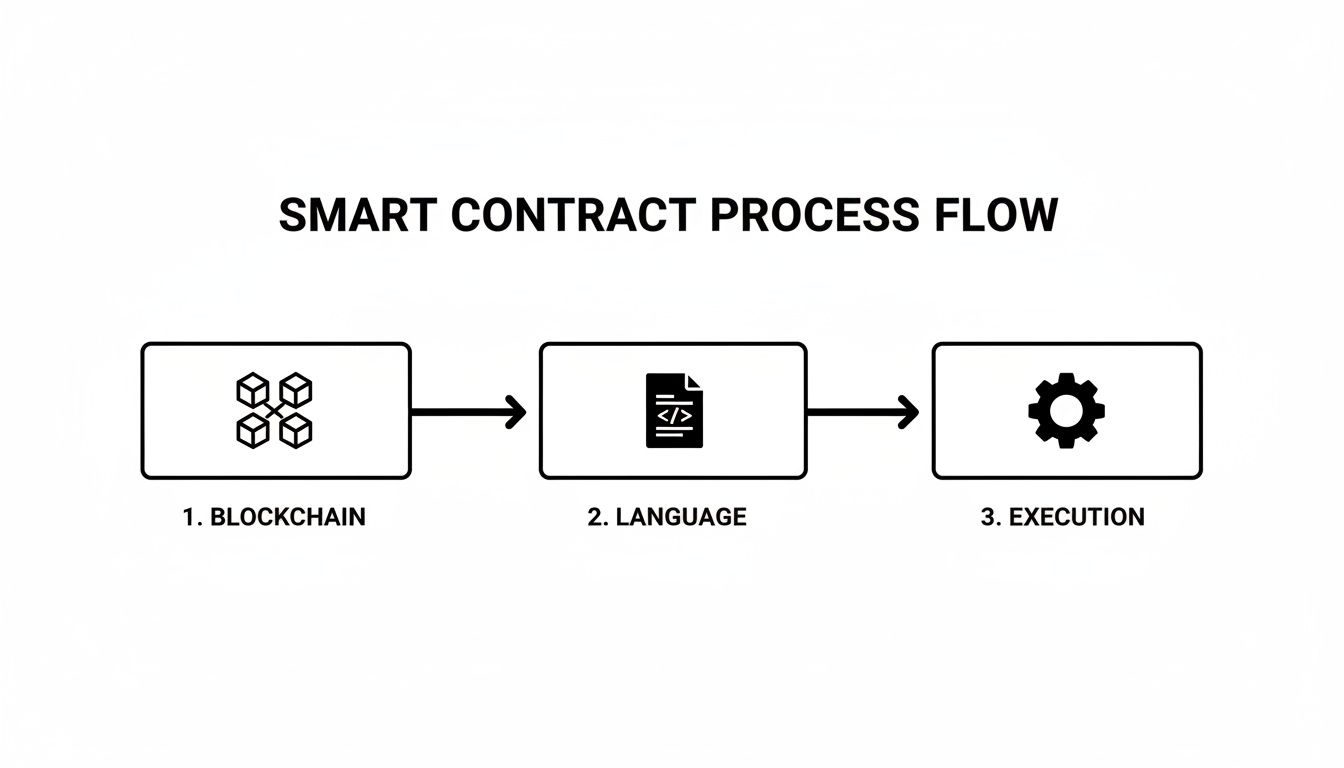
As the diagram shows, each step builds on the last. This layered approach is why a disciplined, step-by-step mindset is so highly valued in professional Web3 roles.
Once your environment is set up, the real work begins. This is where you separate yourself from the crowd of tutorial-followers.
Writing Clean Code: Your first job is to write code that’s not just functional, but also readable, modular, and secure. Use descriptive variable names and follow established security patterns like the Checks-Effects-Interactions pattern to head off common exploits. Remember, code that’s easy for others to review is the hallmark of a collaborative, professional developer.
Compiling the Contract: Next, your code needs to be compiled. This is where your human-readable Solidity or Rust gets translated into bytecode—the low-level language that the Ethereum Virtual Machine (EVM) or a similar runtime actually executes. Your chosen framework handles the heavy lifting, but understanding what’s happening under the hood is crucial for effective debugging.
Rigorous Testing: This is, without a doubt, the most critical phase. It's what separates the amateurs from the pros. Because blockchains are immutable, a bug that makes it to mainnet is there forever. Your test suite needs to be absolutely exhaustive, covering every function, every possible input, and every weird edge case you can think of.
A portfolio project that boasts test coverage of 95% or higher tells a hiring manager everything they need to know. It shows a deep respect for the high-stakes nature of smart contract development and a serious commitment to quality.
Testing Methodologies You Need to Master for Interviews
If you want to ace a technical interview, you need to be able to talk intelligently about your testing strategies. Don't just write tests—understand the why behind each type.
- Unit Tests: These are the bedrock of your testing pyramid. Each unit test isolates and validates a single, specific function in your contract. For instance, you’d write one test to confirm a
transfer()function correctly subtracts from the sender's balance and another to ensure it correctly adds to the receiver's. - Integration Tests: This is where you zoom out a bit. Integration tests verify that different contracts or multiple functions work together as a cohesive system. If your token contract needs to interact with a separate staking contract, an integration test makes sure that communication happens flawlessly.
- Forking Mainnet: This is an advanced (but incredibly powerful) technique. You essentially create a local, private copy of the entire main blockchain. This lets you test how your brand-new contract interacts with massive, battle-tested protocols like Uniswap or Aave in a completely safe and controlled environment. It’s like a full dress rehearsal before opening night.
After your contract has passed this gauntlet of tests, you'll deploy it to a testnet like Sepolia for one final round of real-world checks before going live. To build a full-stack dApp, you'll use libraries like Ethers.js or Web3.js to create a frontend that can call your contract’s functions.
Putting it all together—from a clean setup to a deployed contract with an interactive UI—creates an incredibly powerful portfolio piece. And the timing couldn't be better. The number of active Web3 developers has jumped 50% over the past three years, and Smart Contract Engineers are among the most sought-after roles, with a projected 32% YoY hiring spike. To get a better sense of the market, you can read the full Web3 hiring trends report. Mastering this full development lifecycle shows you’re not just a coder; you’re a professional engineer ready to build the future of the web.
Mastering Smart Contract Security: Your Most Valuable Skill

In Web3, security isn't just another item on a checklist; it's the bedrock everything is built on. A single flaw in a Web3 smart contract can trigger catastrophic losses, turning a groundbreaking project into a cautionary tale almost instantly.
This is exactly why security expertise is the most sought-after and highly-paid skill for any developer in this space. It’s how you stand out. Hiring managers aren’t just looking for someone who can write code—they’re looking for someone who can write safe code. They need engineers who can think like an attacker, spot exploits before they happen, and build bulletproof systems from day one.
Common Vulnerabilities and Real-World Exploits
Web3 history is littered with expensive lessons. The notorious DAO hack in 2016, which exploited a reentrancy bug, drained $60 million worth of ETH and literally split the Ethereum network. Since then, countless DeFi protocols have lost hundreds of millions to similar, and often preventable, attacks.
To prove you're ready for a serious role, you need to know these common attack vectors like the back of your hand. In an interview, talking about these shows more than just technical knowledge—it shows you understand the immense responsibility of the job.
- Reentrancy Attacks: The classic heist. A malicious contract repeatedly calls back into the victim’s contract before the first transaction finishes, draining funds layer by layer. The DAO hack is the textbook example.
- Integer Overflow/Underflow: Computers store numbers in fixed-size chunks. Pushing a number past its maximum value (overflow) or below zero (underflow) can cause it to "wrap around," creating massive loopholes in financial logic.
- Improper Access Control: This is when functions that should be private are left wide open. A simple mistake, like forgetting an
onlyOwnermodifier, can hand an attacker the keys to the entire contract.
Actionable Defense Strategies for Developers
Knowing the threats is one thing; stopping them is another. A top-tier developer has a proactive, defense-in-depth mindset. This means writing code that is secure by design, not just patched up later.
The Checks-Effects-Interactions pattern is a non-negotiable principle you absolutely must master. It’s a simple but rigid order for your functions: first, run all your checks (like require statements); second, change the contract's state (the effects); and only then do you interact with other contracts. This one pattern single-handedly shuts down reentrancy attacks.
In a technical interview, when asked how you would secure a contract, your first answer should be: "I follow the Checks-Effects-Interactions pattern." This immediately tells the interviewer you know your stuff.
Another critical practice is to use battle-tested, community-audited libraries. Don't reinvent the wheel for something as standard as an ERC-20 token; it’s just asking for trouble. Instead, build on the work of trusted sources like OpenZeppelin. Their libraries are rigorously audited and used across the industry, which dramatically shrinks your project's attack surface.
The Critical Role of Audits and Tooling
Even the best engineers are human and make mistakes. That's where automated tooling and professional audits come in as your final layers of defense.
Integrating static analysis tools into your workflow is a must for any serious project. Slither is an industry-standard tool that automatically scans your Solidity code for known vulnerabilities, acting like a security spellchecker. Running Slither before every commit is a simple habit that can catch devastating bugs early.
Finally, a formal security audit from a reputable firm is the ultimate stamp of approval. While they can be expensive, these audits provide a fresh, adversarial perspective on your code. You can learn a ton just by reading public audit reports from firms like Trail of Bits or ConsenSys Diligence.
For those looking to specialize, roles as a blockchain security engineer in smart contract auditing are among the most lucrative in the entire Web3 industry, which just goes to show how much this skill set is valued.
With so many potential pitfalls, understanding the most common ones is crucial for any developer building on the blockchain.
Common Smart Contract Vulnerabilities and Preventions
| Vulnerability | Description | Prevention Method |
|---|---|---|
| Reentrancy | An attacker's contract repeatedly calls a function before the initial call completes, allowing it to drain funds. | Use the Checks-Effects-Interactions pattern. Utilize reentrancy guard modifiers (e.g., from OpenZeppelin). |
| Integer Overflow/Underflow | A numerical value is pushed beyond its data type's storage capacity, causing it to "wrap around" to an unexpected value. | Use a safe math library (e.g., OpenZeppelin's SafeMath) that checks for overflows/underflows before performing arithmetic. |
| Unchecked External Calls | A contract calls an external contract but fails to handle cases where the call fails, potentially leading to a locked state. | Always check the return value of external calls. Use established patterns for sending funds, like the transfer method for ETH. |
| Access Control Flaws | Critical functions lack proper authorization checks, allowing any user to execute them. | Use function modifiers like onlyOwner or role-based access control. Ensure public and external visibility is used deliberately. |
| Transaction Order Dependence | The contract's logic can be manipulated by the order in which a miner includes transactions in a block (front-running). | Avoid logic that depends on block.timestamp or transaction order for critical outcomes. Use commit-reveal schemes for sensitive actions. |
By keeping these risks in mind and applying these prevention methods, you can build far more resilient and secure smart contracts.
Real-World Use Cases and Career Paths
Understanding the theory behind a Web3 smart contract is one thing. Knowing where to actually apply that knowledge is how you build a real career. Smart contracts aren't just abstract code; they are the engines driving some of the most dynamic sectors in technology today.
If you can zero in on a specific industry, you can focus your learning, build a portfolio that stands out, and catch the eye of hiring managers looking for more than just a generalist coder.
These aren't just niche experiments anymore. The numbers tell a powerful story. Smart contracts now execute over 85% of blockchain deals, support 50 million active Web3 users, and power a market already valued at $27.5 billion. The momentum is undeniable—by 2025, 46.7% of finance apps are expected to integrate Web3 smart contracts for better security. For a closer look at the data behind this growth, you can review the annual consumer report on cryptocurrency adoption.
Decentralized Finance (DeFi): The New Financial Frontier
DeFi is easily the biggest and most mature playground for smart contracts. The goal here is ambitious: to rebuild the entire traditional financial system—lending, borrowing, trading, insurance—on the blockchain, completely cutting out intermediaries like banks. Every single action, from taking out a loan to swapping one token for another, is handled by a smart contract.
This sector is a magnet for developers with razor-sharp logic and a security-first mindset. It’s a high-stakes world where a single bug can lead to catastrophic financial losses, which is exactly why top-tier talent is so valuable here.
In-Demand Career Paths in DeFi:
- DeFi Protocol Engineer: You're the one in the trenches, building and maintaining the core logic for lending platforms like Aave, decentralized exchanges like Uniswap, or complex yield farming protocols. This role demands deep expertise in Solidity, gas optimization, and advanced security patterns.
- Smart Contract Auditor (DeFi Specialization): In DeFi, security isn't just a feature; it's everything. Auditors are hired to hunt for vulnerabilities in protocol code before it goes live. You need an adversarial mindset and an almost encyclopedic knowledge of common attack vectors.
The Creator Economy and Non-Fungible Tokens (NFTs)
NFTs are so much more than digital art. They represent a fundamental change in how we prove ownership of digital goods. Under the hood, standards like ERC-721 and ERC-1155 use smart contracts to manage the creation (minting), sale, and transfer of unique assets. This has opened up entirely new ways for artists, musicians, and gamers to monetize their work.
Working in the NFT space is a fascinating blend of hard-core smart contract development and a genuine understanding of creative communities and market trends.
Think of smart contracts in the NFT world as digital certificates of authenticity and provenance, all baked directly into code. If you can show you can build contracts that handle royalties, metadata, and collection management, you have a direct path to a job in the creator economy.
In-Demand Career Paths in the NFT Space:
- NFT Marketplace Developer: You’ll build the smart contract infrastructure for platforms where NFTs are bought, sold, and auctioned. This means writing everything from the minting logic to the systems that handle bids and final settlements.
- Web3 Gaming Engineer: In blockchain-powered games, every in-game item—a sword, a shield, a plot of virtual land—can be an NFT. These engineers write the contracts that dictate how these items are earned, traded, and used within the game’s ecosystem.
Decentralized Autonomous Organizations (DAOs)
DAOs are a truly new way to organize people and money. Imagine an internet-native company with no CEO or central management. Instead, all the rules are written into smart contracts, and every decision—from how to spend treasury funds to what projects to greenlight—is made by members voting on the blockchain.
This field is perfect for developers fascinated by governance, community dynamics, and organizational design. The key skill is the ability to write voting mechanisms that are clear, secure, and fair.
In-Demand Career Paths in DAOs:
- DAO Tooling Specialist: These developers build the essential infrastructure that DAOs run on. That could mean creating better voting modules, more secure treasury management systems, or streamlined onboarding tools for new members.
- Governance Protocol Engineer: This is a more specialized role where you work on the complex smart contract systems that form a DAO’s constitution. Your job is to ensure the decision-making framework is both attack-resistant and truly aligned with the community's long-term goals.
Building Your Web3 Developer Career
Breaking into a Web3 role is about more than just knowing how to code a web3 smart contract. It's about proving you can think like an on-chain developer. Your GitHub is your new resume, and it needs to tell a compelling story.
Forget about cloning a dozen tutorials. Hiring managers want to see one or two unique projects you built from the ground up. Show your work. Document your thought process in the README, explain the security trade-offs you considered, and write a robust test suite. This is what separates a serious engineer from a hobbyist.
Preparing for the Technical Interview
Web3 interviews are designed to test how you think under pressure, not just what you know. Expect a mix of core concepts and practical, on-the-fly problem-solving.
You might get questions like:
- Foundational: "Walk me through the Checks-Effects-Interactions pattern. Why is it so critical for preventing reentrancy?"
- Practical: "Imagine a critical bug is found in an immutable contract already live on mainnet. What are our options? Talk me through different upgradeability patterns we could have used."
- Design: "Let's whiteboard a simple staking contract. What are the essential functions and state variables you'd start with?"
Your ability to clearly explain why you're making a certain design choice is often more impressive than just writing perfect code. Articulating the security and gas optimization trade-offs is a huge part of the job.
Advancing from Junior to Senior
Getting ahead in this space means you never stop learning. The ground is constantly shifting under our feet with new EIPs (Ethereum Improvement Proposals) and security vulnerabilities discovered weekly. Staying current isn't optional.
The best way to grow is to get involved. Contribute to an open-source project or find a DAO that interests you. This isn't just about building your network; it’s about getting your hands dirty with real-world code that has real stakes. If you want a preview of what senior-level expectations look like, check out roles like this Senior Smart Contract Engineer for tokenization projects to see exactly what skills top companies are looking for.
Frequently Asked Questions
When you're first getting your hands dirty with Web3 development, a few key questions almost always pop up. Let's tackle some of the most common ones you'll encounter, especially when you're gearing up for technical interviews.
What's the Difference Between a Smart Contract Developer and a Blockchain Developer?
It's a great question, and the roles are definitely related but distinct. Think of it like this: a Blockchain Developer is the architect of the highway system itself. They're deep in the weeds, working on the core protocol—things like consensus mechanisms, network infrastructure, and the peer-to-peer communication that makes the whole thing run.
A Smart Contract Developer, on the other hand, is the one building the businesses and attractions alongside that highway. They're application developers, creating the decentralized apps (dApps) that people actually use on an existing blockchain like Ethereum.
For most folks breaking into the space, the "Smart Contract Developer" path is far more common. You'll be using languages like Solidity or Rust to build products that end users can interact with every day.
How Much Hardcore Math and Crypto Do I Really Need to Know?
Good news: you don't need a Ph.D. in cryptography to get started. The heavy lifting—all the complex hashing and digital signatures—is handled by the underlying blockchain protocol. The tools do that work for you.
What you do need is a rock-solid grasp of computer science fundamentals, logic, and basic arithmetic. This is especially true when you're dealing with financial logic where a single misplaced decimal can be disastrous.
It's incredibly helpful to have a conceptual understanding of how public-key cryptography works, specifically how it powers wallets and secures transactions. If you can explain that clearly in an interview, you'll stand out from other candidates who only know the application layer. It shows you see the whole picture.
Wait, Can You Update a Smart Contract After It's Deployed?
This is a classic "gotcha" question. By their very nature, web3 smart contracts are immutable. Once a contract is on the blockchain, its code is set in stone. That immutability is the foundation of trust in a decentralized system—everyone knows the rules can't suddenly change.
But let's be realistic. Software has bugs, and products need new features. So, how do we square that circle? The answer lies in using "upgradeability patterns," with the Proxy Pattern being the most common.
This is a clever technique where you separate a contract's logic (the code) from its state (the data). A proxy contract holds all the user data and simply points to an implementation contract that contains the actual logic. To "upgrade," you just deploy a new logic contract and tell the proxy to point to the new address.
- State Contract (Proxy): This one holds all the user data and never changes.
- Logic Contract (Implementation): This contains the code that gets executed. It can be swapped out for a new version.
Being able to discuss upgradeability patterns is a huge signal of an experienced Web3 developer. It proves you're thinking about building robust, maintainable systems that can adapt over time, and that's exactly what employers are looking for.
Ready to find your place in the future of the web? At Blockchain Jobs, we connect top talent with leading companies in the Web3 space. Start exploring your next career move today!